


Chatbot Development – A Full Guide to Build Your First Chatbot

Jayanti Katariya
Last Updated: Jun 23, 2026 Total Views: 5027
Table of Content


Blog Summary:
This blog explores the world of chatbot development. It provides a detailed exploration of different types of chatbots, the technologies that power them, and the development process itself. You will also learn about the key business benefits of chatbots, Their development process, and the best practices to implement in chatbot development.
Table of Content
This blog explores the world of chatbot development. It provides a detailed exploration of the different types of chatbots, the technologies that power them, and the development process. You will also learn about the key business benefits of chatbots, their development process, and the best practices to implement in chatbot development.
Chatbots have completely transformed the way businesses engage with clients. These intelligent software programs simulate human conversation through text or voice.
This guide delves into chatbot development. It explores chatbot types, their powerful technologies, and their business advantages. You’ll also learn how to develop your AI chatbot and be guided through the development process, best practices, and cost considerations.
So, whether you’re a business owner or a tech enthusiast curious about this fascinating technology, this guide covers it all.
What is a Chatbot?
A chatbot is a software program that models a conversation with humans in text or voice. It can be rule-based, follow predefined scripts to deliver quick responses, or leverage AI to learn and adapt over time.
What Can Chatbots Do?
Chatbots can perform many tasks, such as answering questions, providing customer service, or scheduling appointments. Let’s examine their different potentials:
- They can serve as virtual assistants, such as Siri, Alexa, or the Google Assistant.
- Can provide 24/7 customer support, answering FAQs and troubleshooting issues.
- Chatbots can guide users through tasks and personalize interactions.
- Chatbots can automate repetitive tasks and streamline interactions.
- Provides quick access to information and data.
How Do Chatbots Work?
Chatbots use a combination of ML and NLP to understand and respond to user queries. Here’s a breakdown of the process:
- Input: Users send queries to the chatbot through text or voice.
- Processing: NLP analyzes the input, identifies keywords, and extracts key information.
- Response Generation: The chatbot generates a response based on the user’s query. This response can be pre-programmed or derived from ML models trained on past interactions.
- Engaging Interaction: The chatbot dynamically responds to user queries, fostering a conversational experience.
Which are The Best Chatbot Development Technologies?
Chatbots rely on a powerful trio of technologies to function: Natural Language Processing (NLP), Machine Learning (ML), and various user interaction mechanisms.
Natural Language Processing (NLP)
This technology empowers chatbots to interpret and respond in human-like conversations. NLP combines linguistics and algorithms, enabling chatbots to process and respond to user input in text or speech. It employs techniques like tokenization, entity recognition, sentiment analysis, and context management.
Machine Learning (ML)
It transforms chatbots from simple, scripted interactions into intelligent and adaptable entities. A cutting-edge machine learning development companyempowers chatbots to learn and improve from past interactions, unlocking a new level of sophistication in human-computer interaction.
Artificial Intelligence (AI)
AI encompasses both natural language processing and machine learning, enabling chatbots to simulate natural conversation. AI-powered chatbots allow users to engage in back-and-forth dialogue, answer questions, and even adapt their responses to behavioral changes.
Types of Chatbots
The world of chatbots is diverse. It offers a variety of options for businesses to achieve specific goals. Each type has unique capabilities and functionalities, adapting to industry-specific requirements. Here’s a breakdown of some popular chatbot types:
Rule-Based Chatbots
These chatbots are simple & efficient, relying on predefined rules and conditional statements. They provide exceptional support by handling appointment scheduling, answering common questions, and readily locating information. Their straightforward approach makes them ideal for predictable interactions.
AI-Powered Chatbots (Smart Chatbots)
These chatbots use AI and Machine Learning to understand natural language and engage in more dynamic conversations. An AI chatbot trains them to interpret user intent and provide personalized assistance. Chatbots in health care, e-commerce, and finance are well-suited to handling complex interactions.
Virtual Assistants
Popular chatbots like Siri, Alexa, and Google Assistant assist users with tasks such as responding to queries, setting reminders, and controlling smart home devices. Their integration with devices such as smartphones and smart speakers makes them a seamless part of our connected world.
Social Media Chatbots
Designed to engage users on popular platforms like Facebook, Twitter, and Instagram, these chatbots address customer queries, recommend personalized content, and facilitate online shopping. They enable real-time customer interaction, boosting engagement and satisfaction. Businesses can leverage them to form a consistent social media presence.
Customer Support Chatbots
These chatbots are a customer service powerhouse. They handle a wide range of customer queries, provide product information, troubleshoot issues, and guide users towards solutions. Their 24/7 availability eases the burden on customer support teams, improves response times, and enhances customer satisfaction.
Transactional Chatbots
Efficiency is key for transactional chatbots, particularly in the finance and banking sectors. These chatbots streamline transactions by enabling users to transfer funds, check balances, and make secure payments. They prioritize security and ensure safe interactions with accounts.
Informational Chatbots
Informational chatbots act as knowledge repositories, providing users with access to factual data and in-depth explanations. They serve as valuable resources on various topics, making them popular among educational institutions, news organizations, and content platforms.
These chatbots ensure accurate, timely information delivery, whether for news updates, user guidance, or educational resources.
Entertainment Chatbots
Designed to entertain users, these chatbots offer fun activities such as quizzes, games, and riddles. They can even engage users in humorous conversations.
Commonly found on social media platforms and gaming apps, these chatbots enhance user engagement and can be incorporated into marketing campaigns for a more interactive experience.
IoT (Internet of Things) Chatbots
Bridging the gap between users and IoT devices, these chatbots enable remote control and monitoring capabilities. Perfect for smart homes, they allow users to manage temperature, lighting, fans, and air conditioners. As the concept of smart homes continues to grow, so does the demand for these chatbots, keeping users updated and in control.
Hybrid Chatbots
These chatbots are a powerful blend of AI and rule-based systems, offering a flexible solution. They handle simple interactions with rule-based responses and seamlessly switch to AI-powered mode for complex user queries, ensuring an appropriate response is always delivered.
Benefits of Chatbot Development
Chatbots are revolutionizing the way businesses interact with customers. Let’s check the advantages.
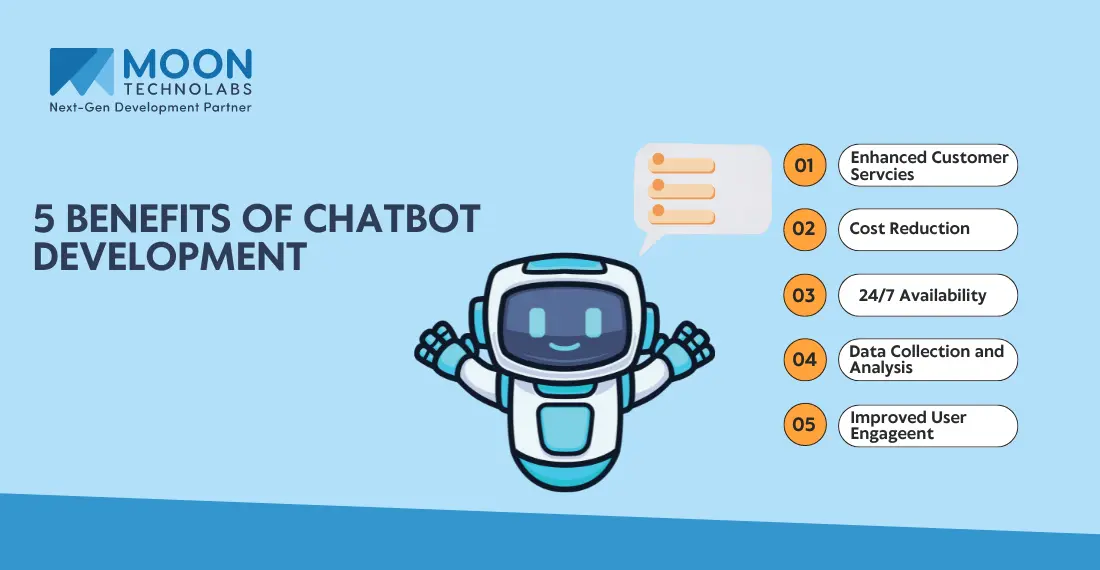
Enhanced Customer Service
Chatbots provide fast, consistent customer support, minimizing operational costs and ensuring a 24/7 presence. Customers receive prompt responses to their inquiries, leading to higher satisfaction rates.
Cost Reduction
Chatbots can provide faster and easier customer support by automating interactions and reducing wait times for assistance. This approach can save businesses significant money.
24/7 Availability
In today’s digital landscape, customers expect constant brand availability. Global customers get instant support anytime, thanks to chatbots available 24/7, with no breaks for holidays or time zones.
Data Collection and Analysis
Chatbots go beyond mere conversation; they can gather valuable user data during interactions. Data analysis equips businesses with a deep understanding of their customers’ wants, frustrations, and habits by analyzing massive datasets. Armed with these insights, companies can craft laser-focused marketing campaigns and optimize their products or services.
Improved User Engagement
Chatbots are powerful tools for driving user engagement and fostering stronger customer relationships. Discover personalized suggestions, upgrade your experience with relevant products and services, and enjoy a more interactive shopping experience. This, in turn, encourages users to explore what businesses offer and fosters brand loyalty.
Chatbot Development Platforms
- Microsoft Bot Framework: A versatile platform offering tools for chatbot creation, deployment, and management across multiple channels.
- IBM Watson Assistant: Offers powerful NLP capabilities and pre-built templates to streamline development and training.
- Dialogflow (by Google): A popular choice for building AI-powered chatbots with Google Assistant integration.
- ManyChat: A user-friendly platform specifically designed for building Facebook Messenger chatbots.
- Chatfuel: Another user-friendly option for building chatbots for Facebook Messenger, Telegram, and other popular platforms.
Chatbot Development Process
Creating your chatbot requires a thorough process. Here’s the breakdown:
Planning and Analysis
This stage involves defining your goals, target audience, and chatbot functionalities. You’ll also need to consider budget, resources, and platform selection.
Design and Development
Developers build the chatbot using the chosen platform and technologies. This includes integrating NLP capabilities, designing conversation flows, and creating a user interface.
Content Creation
This involves writing the chatbot’s dialogue, including greetings, responses to user queries, and branching conversation paths.
Testing and Training
Rigorous testing is essential to ensure the chatbot functions correctly and delivers a positive user experience. You may also need to train the chatbot with additional data to improve its accuracy and understanding.
Deployment and Maintenance
Once testing is complete, your chatbot is ready to be deployed on your chosen platform(s). Ongoing monitoring and maintenance are crucial to maintaining performance and addressing user feedback.
If you don’t want to perform the process yourself, you can get help from astrong>chatbot application development company. They can help you design, develop, and implement a chatbot solution tailored to your specific needs and goals.
Use Cases for Chatbot Development
Chatbots have become an integral part of many businesses and services due to their ability to automate and enhance customer interactions. Here are some common use cases for chatbot development:
Customer Service and Support
24/7 Availability:
Chatbots can provide round-the-clock customer support, handling common inquiries and issues without human intervention.
Issue Resolution:
They can help troubleshoot problems, guide users through processes, and escalate complex issues to human agents when necessary.
Sales and Marketing
Lead Generation:
Chatbots can engage website visitors, qualify leads through interactive conversations, and collect contact information for follow-up.
Personalized Recommendations:
By analyzing user data and preferences, chatbots can suggest products or services tailored to individual needs, enhancing the shopping experience.
E-commerce and Retail
Order Management:
They can assist customers with placing orders, tracking shipments, and handling returns or exchanges.
Product Discovery:
Chatbots can help users find products based on their descriptions, preferences, or past purchase history.
Healthcare
Symptom Checking:
Healthcare chatbots can provide a preliminary diagnosis based on user-input symptoms and recommend whether to seek professional medical advice.
Appointment Scheduling:
They can help patients schedule, reschedule, or cancel appointments with healthcare providers.
Banking and Finance
Account Management:
Chatbots can assist users in checking account balances, transferring funds, and paying bills.
Financial Advice:
They can provide information on financial products, investment options, and budgeting tips.
Human Resources
Employee Onboarding:
Chatbots can guide new hires through the onboarding process, answering questions about company policies, benefits, and procedures.
Internal Support:
They can assist employees with IT issues, HR inquiries, and other internal service requests.
Education
Student Support:
Educational chatbots can answer questions about courses, schedules, and campus facilities.
Learning Assistance:
They can provide tutoring, quizzes, and other interactive learning activities.
Best Practices for Chatbot Development
Here are some key best practices to keep in mind when developing your chatbot:
- Define Your Goals: Clearly define what you want your chatbot to achieve. This will guide the development process and ensure your chatbot meets your business needs.
- Focus on User Experience: Prioritize a user-friendly and engaging experience. The chatbot should be easy to understand and navigate and provide helpful and accurate responses.
- Personalize When Possible: Personalizing interactions can make the user experience feel more natural and engaging. This could involve using customer data to tailor responses or recommendations.
- Maintain Conversation Flow: Design a logical conversation flow that guides users toward achieving their goals with the chatbot.
- Gather and Implement User Feedback: Actively collect user feedback and use it to improve your chatbot’s performance and responses over time.
Tools Used for Chatbot Development
Several tools are available for chatbot development, each offering features tailored to different needs. Here are some popular ones:
Python:
Python is a versatile programming language known for its simplicity and readability, widely used in chatbot development due to its robust libraries for natural language processing and machine learning.
spaCy
spaCy is an advanced open-source library for Natural Language Processing (NLP) in Python, offering fast and efficient tools for text processing, tokenization, and named entity recognition, ideal for chatbots.
NLTK (Natural Language Toolkit):
LTK is a comprehensive Python library for building programs to work with human language data, providing easy-to-use interfaces and lexical resources for text analysis, essential for chatbot NLP tasks.
TensorFlow
TensorFlow is an open-source machine learning framework from Google, designed for implementing and deploying neural networks and other ML models, which are crucial for developing intelligent and adaptive chatbots.
PyTorch
PyTorch is an open-source machine learning library based on Torch, developed by Facebook’s AI Research lab, known for its flexibility and dynamic computation graph, widely used for chatbot AI models.
Zapier
Zapier is an automation tool that connects chatbots to various apps and services, enabling seamless data flow and task automation without coding, thereby enhancing chatbot functionality.
Google Analytics
Google Analytics is a web analytics service that tracks and reports website traffic, providing detailed insights into user interactions and engagement, essential for optimizing chatbot performance and user experience.
By leveraging these tools, developers can create sophisticated chatbots tailored to specific use cases, enhancing user experience and operational efficiency.
How Much Does it Cost to Develop a Chatbot?
The general cost breakdown of developing a chatbot:
- Simple Rule-Based Chatbot: $5,000 – $25,000
- Intermediate Chatbot with AI: $20,000 – $50,000
- Advanced Chatbot with Complex Features: $50,000+
However, it can vary significantly depending on several factors:
- Complexity: Simple rule-based chatbots are less expensive than complex AI-powered chatbots requiring advanced NLP capabilities.
- Development Platform: Some platforms have free tiers or subscription models, while others charge per user interaction.
- Customization: The level of customization, including unique features or integrations, will affect development costs.
When determining the cost of your AI chatbot development project, it’s important to consider your specific needs and budget.
Partner with us to create smart, scalable chatbot solutions designed to engage users and automate conversations. Let’s build and launch your chatbot solution faster.
Bottom Line
Chatbots are here to stay, and their capabilities are constantly evolving.As artificial intelligence and natural language processing continue to advance, chatbots will become even more sophisticated and versatile.
Businesses can unlock a multitude of benefits using chatbot technology, from enhanced customer service and cost reduction to improved user engagement and data-driven insights.
If you want to stay ahead of the curve and deliver an exceptional customer experience, incorporating chatbots into your strategy is a must. With the knowledge you’ve gained from this guide, you’re well on your way to developing a chatbot that will revolutionize your business interactions!
Similarly, you can also get in touch with a AI Chatbot Development Company that can seamlessly build your first bot.
FAQs
01
How do I start chatbot development?
1. Define your goals and target audience. 2. Choose a chatbot development platform. 3. Plan the conversation flow and content. 4. Develop and test your chatbot. 5. Deploy and monitor your chatbot.02
What language is used in chatbot development?
While the platform you choose may have its scripting language, popular languages for chatbot development include Python, Java, and JavaScript.03
Is coding a chatbot hard?
The difficulty depends on the complexity of your chatbot. Simple rule-based chatbots require less coding, while AI-powered chatbots involve more advanced programming.04
How much time does it take to develop a custom chatbot?
Development time varies depending on complexity. Simple chatbots can take weeks, while advanced AI chatbots may take months or even longer.




Jayanti Katariya is the CEO of Moon Technolabs, a fast-growing IT solutions provider, with 18+ years of experience in the industry. Passionate about developing creative apps from a young age, he pursued an engineering degree to further this interest. Under his leadership, Moon Technolabs has helped numerous brands establish their online presence and he has also launched an invoicing software that assists businesses to streamline their financial operations.
Submitting the form below will ensure a prompt response from us.
We refine our expertise to deliver innovative business solutions.





205 N Michigan Avenue, #810, Chicago, 60601, Illinois, United States
13500 Long Is Dr, Pflugerville, TX 78660, USA

C/105 Ganesh Meridian, S.G. Highway, Ahmedabad, GJ 380060


Ayse D.
Co-Founder France
“ I highly recommend Moon Technolabs as the quality of service is wonderful. We have hired this company to develop the product based on some complex & technical issues. We get the best quality services as compared with others in the market. Huge Thanks to Moon Technolabs as the team is always ready to give the solution all time.”

Justin G.
Founder & CEO USA
USA“ Moon Technolabs is a pioneer in the WebRTC based project as they have fixed complicated segments of the module by fulfilling different product lines by providing 24X7 customer support. We really recommended Moon Technolabs as they are able to develop products as per the module deadline and project timeline.”

Flavio S.
Founder & Managing Director Germany
“I am happy to recommend Moon Technolabs for their app development services. They successfully developed apps for me, and I am highly satisfied with the overall outcomes. The development team has swiftly addressed the issues with responsive and effective communication to understand the requirement quickly and actively resolve the back-and-forth problems that arose...”

Jay M.
Founder & CEOUSA“Moon Technolabs is the best company that provides advanced apps and websites development services in the USA and Europe. I am a newbie to develop my app with an external team. I am really happy to work with them as I am not that much mobile apps user. Here, the team and specially the CEO of Moon Technolabs helps me to let me know about the benefits of my app to generate revenue....”


Our Offices
India
C/105 Ganesh Meridian,S.G. Highway, Ahmedabad, GJ 380060USA
205 N Michigan Avenue, #810, Chicago, 60601, Illinois, United StatesContact Information


