
Jayanti Katariya
Last Updated: March 30, 2026 Total Views: 95
Table of Content


Blog Summary:
RPA in human resources is transforming how organizations manage routine tasks by automating processes like recruitment, onboarding, payroll, and employee data management. It reduces manual effort, improves accuracy, and speeds up workflows, enabling HR teams to focus on strategic initiatives and employee engagement. By adopting RPA in HR processes, companies can enhance efficiency, ensure consistency, and build more agile and scalable HR operations.
Table of Content
Human resources is undergoing a rapid digital transformation, driven by the need for greater efficiency, accuracy, and employee-centric experiences. One of the most impactful technologies leading this shift is RPA in human resources. By automating repetitive, rule-based tasks, RPA in HR is enabling teams to move beyond administrative burdens and focus on strategic initiatives like talent development, employee engagement, and organizational growth.
The momentum behind RPA adoption is reflected in its remarkable market growth. According to Precedence Research, the global robotic process automation market size reached USD 28.31 billion in 2025 and is projected to grow from USD 35.27 billion in 2026 to approximately USD 247.34 billion by 2035, expanding at a CAGR of 24.20% during this period.
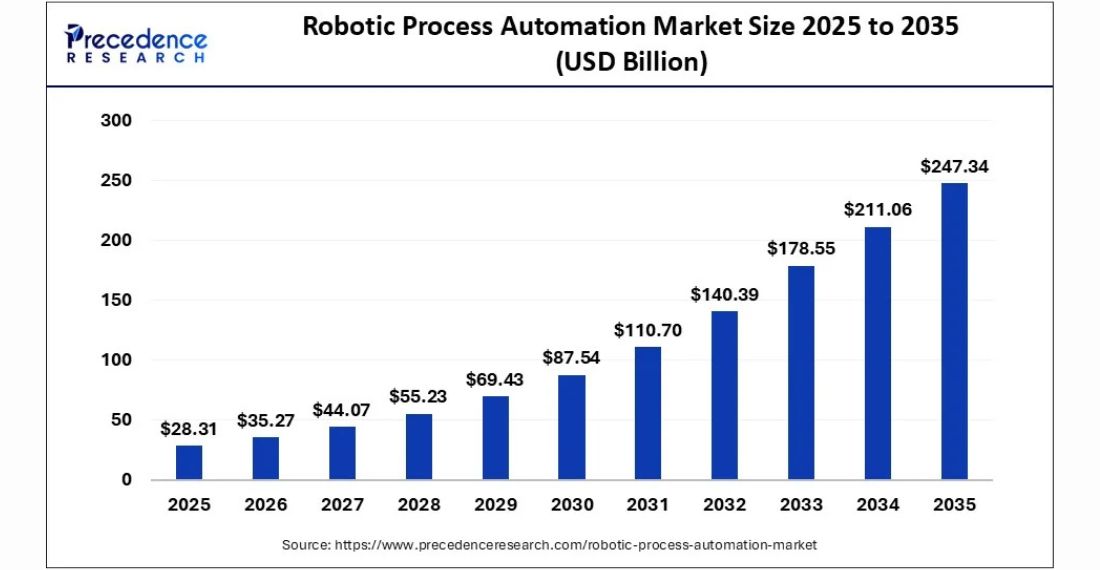
This surge highlights how organizations across industries are increasingly recognizing the value of RPA in human resources for streamlining operations and improving productivity.
This blog explores the key benefits of RPA in human resources, practical use cases, and a step-by-step implementation guide to help organizations successfully embrace this powerful technology. Whether you are just exploring robotic process automation in HR or ready to implement it, this guide covers everything you need to know.
RPA in human resources refers to the use of software “robots” or bots to automate repetitive, rule-based HR tasks. These bots can handle a wide range of activities, including employee data entry, payroll processing, attendance tracking, recruitment screening, and onboarding processes, enabling HR teams to focus on more strategic and people-centric initiatives.
As part of a broader business process automation strategy, RPA not only improves task-level efficiency but also helps streamline end-to-end HR workflows.
By mimicking human interactions with digital systems, RPA reduces manual effort, minimizes errors, and speeds up administrative processes. It integrates easily with existing human resources systems without requiring major infrastructure changes, making it a cost-effective solution for organizations looking to improve efficiency.
In HR, RPA allows professionals to shift their focus from routine operational work to more strategic functions like talent acquisition, employee engagement, and decision-making.
For example, bots can automatically extract candidate information from resumes, schedule interviews, or generate compliance reports, freeing up valuable time for HR teams. As a result, organizations benefit from improved accuracy, faster service delivery, and a better overall employee experience, while HR departments become more agile and data-driven.
RPA in human resources is becoming increasingly important because it streamlines repetitive, rule-based tasks, allowing HR professionals to focus on more strategic and people-centric activities. By automating routine workflows, organizations can enhance employee experiences, ensure consistency in HR operations, and make better use of data for decision-making.
Here’s why RPA is important in HR:
HR departments are under constant pressure to optimize processes, reduce costs, and enhance employee experience. RPA in human resources is transforming HR management by automating repetitive, time-consuming tasks and allowing HR professionals to focus on strategic initiatives.
Here’s how RPA can revolutionize HR operations:
Robotic process automation significantly reduces operational costs by automating repetitive HR tasks such as payroll processing, employee onboarding, and data entry. By reducing dependency on human intervention for routine processes, organizations can save time and money, allowing them to redirect resources to more value-driven initiatives.
Manual HR processes are prone to errors, from incorrect payroll calculations to data inconsistencies. RPA ensures accuracy by performing routine tasks with precision and consistency, minimizing errors, and ensuring data integrity. This leads to fewer compliance issues and higher trust in HR operations.
RPA bots can complete repetitive HR tasks in a fraction of the time it would take a human. Processes such as candidate screening, payroll processing, and leave approvals are executed swiftly, improving overall efficiency and reducing bottlenecks in the HR workflow.
Unlike humans, RPA bots can operate around the clock without fatigue. This scalability allows the HR department to manage high workloads during peak periods, such as recruitment drives or performance review cycles, without delays or overtime costs.
The HR department must adhere to numerous regulations and labor laws. RPA helps ensure compliance by consistently following predefined rules and maintaining accurate records for audits. This reduces the risk of legal penalties and enhances regulatory reporting.
By automating administrative tasks, HR professionals can focus more on employee engagement, training, and development. Employees experience faster service for leave requests, payroll inquiries, and onboarding, enhancing overall satisfaction and retention.
With repetitive tasks automated, HR teams can dedicate more time to strategic functions such as talent acquisition, performance management, and employee development. Robotic process automation empowers HR professionals to work smarter, not harder, leading to higher productivity and business impact.
Our experienced RPA developers combine deep automation expertise with HR knowledge to reduce errors, ensure compliance, and maintain flawless records across all your HR processes.
Manual HR processes are often time-consuming and error-prone, whereas RPA-driven automation improves speed, accuracy, and scalability. The table below highlights the key differences between the two approaches:
| HR Function | Manual HR Processes | RPA-Driven HR Automation |
|---|---|---|
| Employee Onboarding | Paperwork-heavy, time-consuming, prone to errors and delays. | Automated document collection, fast onboarding, error-free data entry. |
| Payroll Processing | Manual calculations, high risk of errors, and time-sensitive. | Accurate, automated salary calculations, tax deductions, and timely processing. |
| Resume Screening | HR manually reviews resumes, a process that is slow and inconsistent. | Bots scan and filter resumes using predefined criteria, faster and more unbiased. |
| Leave Management | Requests handled via email or forms are difficult to track. | Automated leave request, approvals, and real-time tracking. |
| Performance Evaluation | Subjective reviews and manual tracking of employee performance. | Data-driven insights, automated tracking, standardized evaluations. |
| Compliance Reporting | Manual data collection, risk of non-compliance, and penalties. | Automated report generation ensures adherence to legal and regulatory requirements. |
| Employee Query Handling | HR handles queries individually, which is time-consuming. | Chatbots and automated responses provide instant support and reduce HR workload. |
As organizations seek greater efficiency, RPA in human resources is becoming a key enabler across HR departments. It automates routine tasks, reduces errors, and speeds up processes across areas like hiring, onboarding, payroll, and compliance. This allows HR teams to focus on more strategic and employee-focused initiatives.
Here are the top RPA HR use cases you need to know:
RPA can automatically collect, filter, and shortlist resumes based on predefined job criteria. It reduces the time spent on manual screening, minimizes human bias, and ensures that only the most relevant candidates are passed on to recruiters for further evaluation.
RPA streamlines onboarding by automating document collection, account creation, system access provisioning, and welcome communications. Similarly, during offboarding, it ensures the timely deactivation of accounts, the recovery of assets, and the completion of exit formalities, thereby improving security and compliance.
Payroll involves multiple data points and calculations. RPA helps automate salary computations, tax deductions, payslip generation, and report creation. This reduces errors, ensures timely payments, and improves overall payroll accuracy and compliance.
RPA can track employee attendance, update leave balances, and process leave requests automatically. It integrates with HR systems to maintain real-time records, reducing manual tracking efforts and ensuring transparency in attendance management.
Managing employee records across systems can be complex. RPA automates data entry, updates, and synchronization across platforms, ensuring data consistency and accuracy. It also helps maintain secure and up-to-date employee information for reporting and decision-making.
RPA automates compliance tracking, policy updates, and reporting. It ensures employees acknowledge company policies, reduces legal risks, and helps organizations efficiently stay aligned with regulatory requirements.
RPA streamlines HR help desk operations by automating responses to common employee queries about payroll, leave, and policies, reducing response times and allowing HR teams to focus on complex issues.
RPA automates performance review processes by sending reminders, collecting feedback, and consolidating appraisal data, ensuring timely evaluations and providing accurate insights for promotions, rewards, and employee development decisions.
RPA tracks employee training, certifications, and learning progress by automating scheduling, reminders, and record updates, ensuring compliance with training requirements and supporting continuous skill development across the organization.
RPA accelerates background verification by automating candidate data checks, interacting with verification sources, and generating reports quickly, reducing hiring delays while improving the accuracy and reliability of candidate screening processes.
RPA automates benefits enrollment, updates, and claims processing, ensuring accurate records and timely communication with providers, while enhancing employee experience and reducing administrative workload for HR teams
RPA streamlines employee exit processes by automating resignation workflows, final settlements, and compliance checks, ensuring the timely completion of formalities, secure revocation of access, and a smooth transition for both employees and the organization.
Trust our proven RPA solutions to streamline operations, reduce errors, and elevate your HR performance.
RPA in human resources offers a powerful solution for streamlining repetitive and time-consuming tasks. By automating routine processes, organizations can reduce manual effort, improve accuracy, and enable HR teams to focus on more strategic, value-added activities.
Below is a practical guide to help implement RPA in human resources:
Start by pinpointing which HR tasks are ideal candidates for automation. Focus on processes that are rule-based, repetitive, and involve large volumes of data. Common examples include:
Selecting the right tasks for automation sets the foundation for a successful RPA implementation.
Once you’ve identified the processes to automate, create a strategic automation roadmap. This plan should outline:
A solid roadmap ensures alignment with business objectives and prepares your HR department for the transition to automation.
The success of your RPA initiative depends largely on selecting the right tools. Consider these factors when evaluating RPA software:
Popular RPA platforms for HR automation solutions include Microsoft Power, Automate, UiPath, and Automation Anywhere.
To ensure smooth automation, map out workflows and define the rules for each process. This includes:
By visualizing these workflows, you ensure that the RPA bots can perform tasks accurately and efficiently.
Before launching RPA across the entire HR department, conduct pilot projects. This allows you to:
Pilot projects provide valuable insights and help refine your RPA implementation before full-scale deployment.
After successful pilots, proceed with full-scale deployment. However, RPA implementation is an ongoing process:
Ongoing monitoring and adjustments will keep your RPA system running smoothly and improve its efficiency over time.
RPA in human resources is transforming HR operations by streamlining repetitive tasks, eliminating errors, and improving efficiency. To ensure a successful implementation of RPA in human resources, organizations should follow a structured approach:
The initial step is to identify HR processes that are repetitive, rule-based, and time-consuming. Common examples include payroll processing, employee onboarding, attendance tracking, and data entry. Prioritizing the right processes ensures maximum ROI and quick wins.
Selecting an appropriate RPA tool is critical. Factors such as ease of use, scalability, integration capabilities, and cost should be considered. The platform should align with the organization’s technical environment and HR system requirements.
Once processes and tools are selected, the next step is to design automation workflows. This involves mapping out each step of the process, defining rules, and ensuring that exceptions are handled properly. Well-designed workflows improve data accuracy and efficiency.
Before full-scale implementation, it is important to run a pilot project. Testing the automation on a smaller scale helps identify potential bottlenecks, validate performance, and make necessary adjustments without disrupting core HR operations.
After successful pilot testing, organizations can gradually scale RPA across other HR functions. Continuous monitoring, feedback, and optimization are important to ensure long-term success and adaptability.
By combining automation expertise with HR insight, we streamline repetitive tasks, improve data accuracy, and free your team to focus on high-value strategic work.
RPA in human resources is enhancing HR management by handling mundane tasks, improving accuracy, and enabling HR professionals to focus on more strategic responsibilities. With ongoing digital transformation, emerging trends are set to make HR processes smarter and more efficient:
The integration of AI with RPA is enabling more intelligent automation. While RPA handles structured tasks, AI brings capabilities such as natural language processing and machine learning. Together, they empower HR systems to process unstructured data, screen resumes, and make data-driven hiring decisions.
Hyperautomation refers to the use of advanced technologies like RPA, AI, and analytics to automate end-to-end business processes. In HR, this means the seamless automation of recruitment, onboarding, payroll, and performance management, resulting in faster, more efficient workflows.
Cognitive RPA goes beyond basic automation by mimicking human decision-making. It can interpret context, learn from data, and handle complex tasks such as employee sentiment analysis and personalized HR services, improving overall employee experience.
Chatbots and virtual assistants are becoming an integral part of HR operations. These conversational bots can handle employee queries, assist in onboarding, provide policy information, and offer 24/7 support, reducing the workload on HR teams.
With constantly evolving labor laws and regulations, compliance is a critical HR function. RPA helps ensure adherence by automating compliance checks, maintaining accurate records, and generating reports, thereby reducing risks and errors.
Cloud technology is enhancing the scalability and accessibility of HR automation. Cloud-based RPA solutions allow organizations to manage HR processes remotely, ensure data security, and integrate easily with other enterprise systems.
RPA combined with analytics tools enables predictive insights in HR. Organizations can forecast employee turnover, identify skill gaps, and proactively plan workforce strategies, leading to better decision-making and improved organizational performance.
Implementing RPA in human resources can significantly streamline repetitive tasks, reduce human error, and improve overall efficiency. With our expertise in automation solutions, organizations can automate processes such as employee onboarding, payroll management, attendance tracking, and recruitment workflows.
By leveraging intelligent workflow automation, HR teams can shift their focus from administrative duties to more strategic initiatives like talent development and employee engagement. We provide tailored RPA solutions that integrate seamlessly with existing HR systems, ensuring minimal disruption and maximum ROI.
Our automation strategies are designed to enhance regulatory compliance, maintain data accuracy, and accelerate decision-making through real-time insights. As businesses continue to evolve, adopting RPA in human resources not only boosts productivity but also creates a more agile and responsive workforce environment.
RPA in human resources is reshaping HR by automating repetitive, time-consuming tasks and allowing teams to focus on what truly matters: people, strategy, and employee engagement. It not only improves efficiency and accuracy but also helps create faster, more consistent HR processes across functions like hiring, onboarding, and payroll.
When implemented with clear goals and the right processes in mind, RPA can deliver significant value without disrupting existing systems. As organizations continue to evolve in a digital-first world, adopting RPA is a practical step toward building more agile, scalable, and future-ready HR operations.
01
02
03
04
05

Jayanti Katariya is the CEO of Moon Technolabs, a fast-growing IT solutions provider, with 18+ years of experience in the industry. Passionate about developing creative apps from a young age, he pursued an engineering degree to further this interest. Under his leadership, Moon Technolabs has helped numerous brands establish their online presence and he has also launched an invoicing software that assists businesses to streamline their financial operations.


Submitting the form below will ensure a prompt response from us.
We refine our expertise to deliver innovative business solutions.





205 N Michigan Avenue, #810, Chicago, 60601, Illinois, United States
13500 Long Is Dr, Pflugerville, TX 78660, USA

C/105 Ganesh Meridian, S.G. Highway, Ahmedabad, GJ 380060


Ayse D.
Co-Founder France
“ I highly recommend Moon Technolabs as the quality of service is wonderful. We have hired this company to develop the product based on some complex & technical issues. We get the best quality services as compared with others in the market. Huge Thanks to Moon Technolabs as the team is always ready to give the solution all time.”

Justin G.
Founder & CEO USA
USA“ Moon Technolabs is a pioneer in the WebRTC based project as they have fixed complicated segments of the module by fulfilling different product lines by providing 24X7 customer support. We really recommended Moon Technolabs as they are able to develop products as per the module deadline and project timeline.”

Flavio S.
Founder & Managing Director Germany
“I am happy to recommend Moon Technolabs for their app development services. They successfully developed apps for me, and I am highly satisfied with the overall outcomes. The development team has swiftly addressed the issues with responsive and effective communication to understand the requirement quickly and actively resolve the back-and-forth problems that arose...”

Jay M.
Founder & CEOUSA“Moon Technolabs is the best company that provides advanced apps and websites development services in the USA and Europe. I am a newbie to develop my app with an external team. I am really happy to work with them as I am not that much mobile apps user. Here, the team and specially the CEO of Moon Technolabs helps me to let me know about the benefits of my app to generate revenue....”


Our Offices
India
C/105 Ganesh Meridian,S.G. Highway, Ahmedabad, GJ 380060USA
205 N Michigan Avenue, #810, Chicago, 60601, Illinois, United StatesContact Information


