


AI Workflow Automation: Introduction and How It Works?

Jayanti Katariya
Last Updated: May 01, 2026 Total Views: 10338
Table of Content


Blog Summary:
AI workflow automation uses artificial intelligence to streamline and optimize complex business processes. From predictive decisions to real-time orchestration, it empowers businesses with agility and efficiency. This in-depth blog explores how organizations benefit from AI-driven workflows, which reduce manual work and enable smarter decisions. It also offers insights on core components, industry examples, and how to build your intelligent systems.
Table of Content
Let’s say there are two types of customer service teams. The first team has to tag their emails according to their top priority manually, and what needs to be discarded. Another team is delighted that all their emails have been read, automatically tagged as per priority, and sorted.
What’s the difference between the two teams?
The second team utilizes and implements AI workflows across all the existing systems to automate each task. AI workflow automation provides better visibility into delays or decision lags by understanding context, adapting in real time, and delivering results with minimal human intervention.
By making workflows intelligent, AI makes sure that even the smallest business ideas can succeed.
This blog explores AI Workflow Automation, why it’s rapidly becoming essential, and how forward-thinking businesses can implement it to gain a serious competitive edge.
What is AI Workflow Automation?
A few years ago, the idea of automating the entire workflow using Artificial Intelligence was so futuristic that only high-growth companies could afford to implement it. Nowadays, it has become the norm whether you’re a startup or an enterprise with operations across continents.
AI workflow automation is a game-changing approach that can transform and optimize business processes. It combines the power of machine learning (ML), natural language processing (NLP), robotic process automation (RPA), and predictive analytics with human intelligence.
Traditional workflow automation tools follow rule-based triggers, which are only effective for repetitive tasks. However, when complexity and context come into play, AI adds intelligence to understand unstructured data, analyze intent, and make real-time decisions.
It even mimics humans—it learns from past actions and automatically improves over time. The result? Even if your business wants to onboard 100 customers per month, executing it is both smart and faster. Here’s how:
- You can automatically route customer tickets based on urgency and sentiment.
- You can forecast inventory needs using historical data and trends.
- Your team can focus on strategic decisions with intelligent business process orchestration.
Why Do You Need AI Workflow Automation?
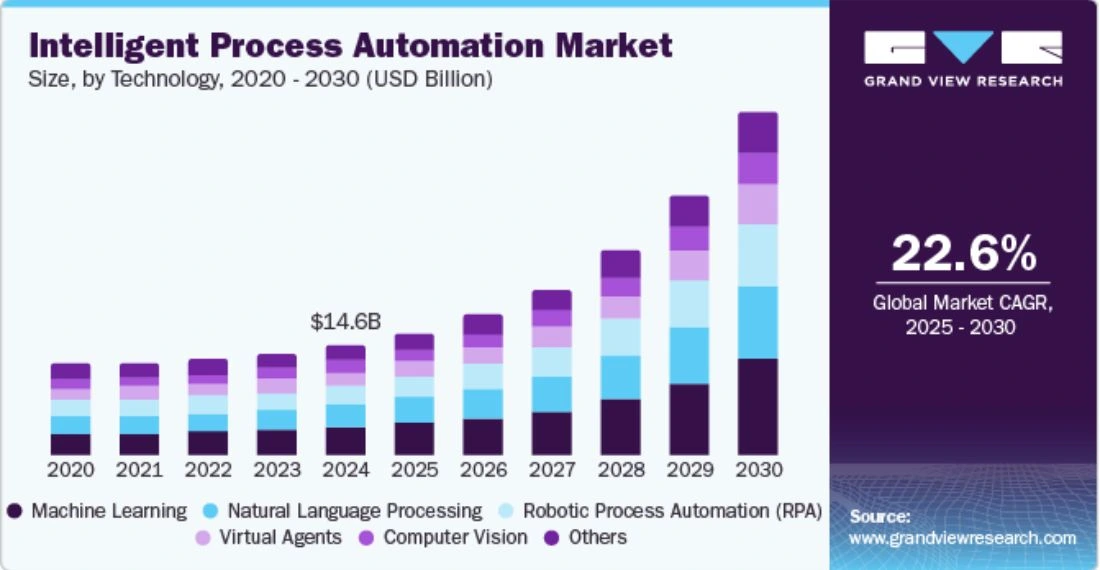
Intelligent workflow automation is becoming increasingly popular across various verticals, including finance, healthcare, HR, onboarding, and logistics. In fact, the intelligent process automation (IPA) market is expected to grow from $16.16 billion in 2025 to $44.74 billion by 2030.
The compound annual growth rate of 22.6%, as predicted by Grand View Research over the next five years, is one of the biggest reasons businesses need AI workflow automation. Let’s understand the other crucial reasons below:
Reduce Manual Triggers
Unlike traditional workflow automation tools, which rely on static rule-based systems, AI-driven workflow automation reduces and replaces them with speed & personalization. Even when processes change midway, AI workflow management is capable of analyzing and adapting, reducing the need for manual triggers.
For instance, ServiceNow’s AI agents have reduced the time to handle complex cases by 52%, driving significant business value.
Increase Task Visibility
In today’s dynamic business environment, workflow automation is crucial for analyzing and identifying patterns across multiple systems to enhance task visibility. Compared to its traditional counterpart, smart AI workflow automation uses predictive analytics to automate processes with human reasoning.
For example, UiPath has integrated deterministic software automation with non-deterministic AI capabilities, such as large language models (LLMs), to increase task visibility.
Enhance Error Handling
Modern businesses need high responsiveness and improved data accuracy, even if the volume is high and descriptions are unclear. By performing advanced functions with ML and NLP, AI workflow management processes massive amounts of data from various sources using bots to pull the data.
For example, IT Service Management (ITSM) companies use AI and ML-powered workflows to automate ticket triaging and routing without delays by interpreting employee intent.
Scale Processes
Implementing intelligent workflow automation requires organizations to ensure that the data analytics are straightforward and transparent. It gives decision-makers a centralized approach to achieving maximum efficiency, productivity, and profitability while keeping their processes scalable.
Improve Project Planning & Design
Whether you have fragmented workflows or a scattered tech stack, AI workflow builders now reduce decision-making time while catering to rising customer expectations. These upgrades work together to make fundamental shifts that improve project planning, design, and execution.
Empower Your Teams with Intelligent AI Workflows
Start your journey toward seamless, AI-powered operations without disrupting your current business operations.
Benefits of AI Workflow Automation
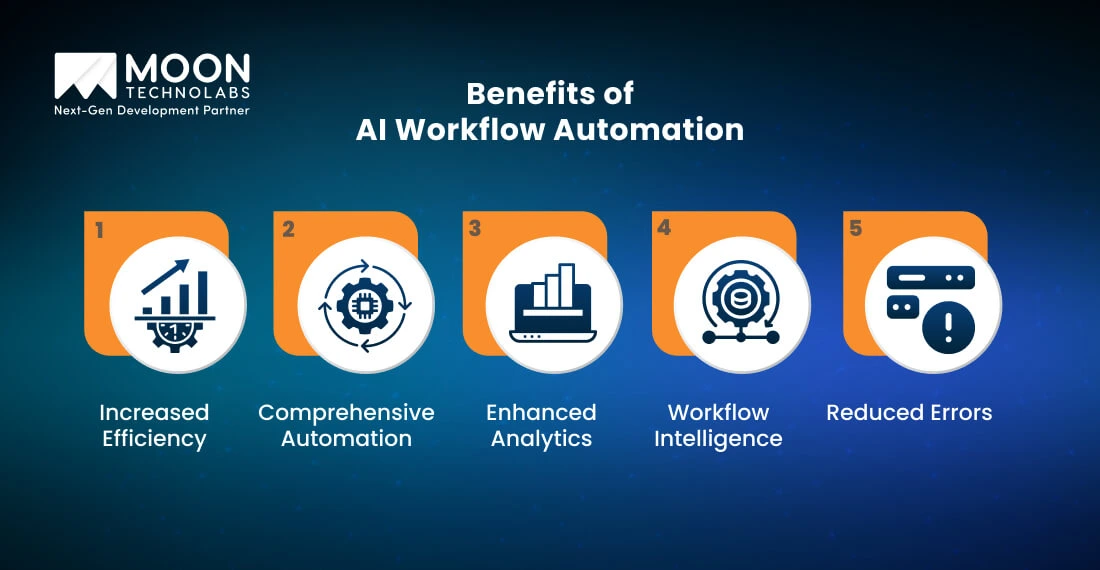
By integrating AI workflow management personalization across systems, your business can bring operational clarity through various benefits. Here’s a quick and short overview of businesses before and after AI workflow automation:
| Before AI Workflow Automation | After AI Workflow Automation |
|---|---|
| Manual and inconsistent customer and employee experiences, time-consuming | Personalized employee experiences with auto document collection |
| Costly human errors, mistakes in processing orders, and lost customers | Streamlined routine tasks of data entry, inventory tracking, and calendar management |
| Repetitive queries, longer wait times | Intent-based routing with proactive chatbot support |
| Delayed admin-heavy tasks with more time on approvals | ML-driven triage and intelligent decision-making |
Let’s understand these in detail:
Increased Efficiency
Combining AI workflow management with business process automation (BPA) improves the efficiency of each task. Whether you’re creating data entries or tracking inventory, AI workflows reduce limitations and make your tools resource-efficient.
Comprehensive Automation
AI-powered workflows eliminate the monotony of manual processes, ensuring that human effort is not wasted and resources are not lost. By combining numerous complex systems and workforces, they also make the process more affordable and error-free.
Enhanced Analytics
Businesses that use enhanced AI analytics to assess their workflow processes experience more precision and accuracy by prioritizing high-priority transactions and processes. They don’t have to chase down paperwork since the data is unified with intelligent process automation.
Workflow Intelligence
Intelligent workflow automation allows teams to resolve common queries automatically by identifying user intent, pulling customer experience data from CRMs, and implementing resolutions instantly. It turns reactive work desks into proactive service hubs that make real-time decisions based on consumer behavior analytics.
Reduced Errors
From intent recognition to escalation management, AI automation can bring strategic focus to all of your workflows. It can detect fraud before it happens, resolve tickets in seconds, and even speed up hiring cycles by weeks.
Key Components of AI Workflow Automation
AI automation in business workflow is a strategic architecture with three major components that drive the intelligence of each process. It’s a robust framework of advanced technologies that unifies reactive processes and makes them predictive.
Here’s a rundown of them while casting a look into what the future holds:
Machine Learning
Each intelligent workflow automation system is powered by machine learning (ML) models, which are trained to recognize patterns and predict outcomes that improve workflows. It focuses on data-driven decision automation while connecting all the siloed systems into context-aware workflows.
In the coming years, it will replace traditional automation with hyperautomation that doesn’t rely only on text. These systems will even integrate voice, video, and gesture recognition.
NLP (Natural Language Processing)
Natural language processing and understanding enable workflow across systems to interpret language-based inputs. It interprets all emails, messages, and voice commands in real time to facilitate AI workflow orchestration.
Data input is, therefore, a crucial aspect of AI workflow automation, which transforms workflow orchestration and data flow automation. By combining human language, also known as computational linguistics, with machine learning (ML), it mimics everyday human spoken language.
RPA (Robotic Process Automation)
RPA powers all the processing algorithms, which are the core behind decision-making. It propels decision-makers to navigate each stage of operations and data processing, dictating how a process works.
Using ML techniques, predictive algorithms, and sentiment analysis with traditional rule-based systems adds emotional intelligence to workflows. Instead of replacing humans, it augments decision-making processes, reducing the need for manual inputs.
How to Implement AI Workflow Automation Successfully?
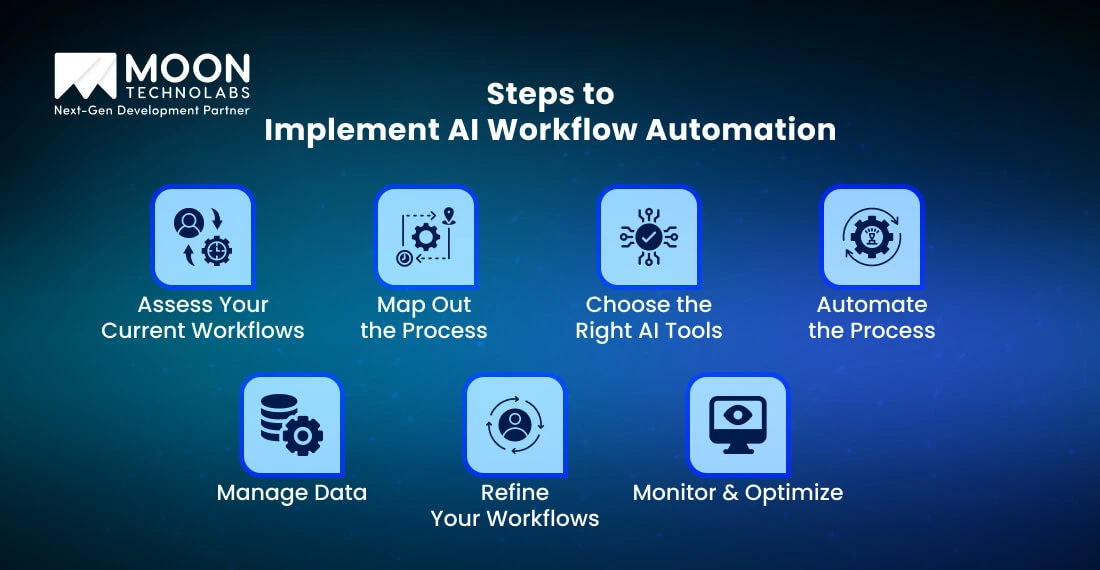
Implementing AI workflow management requires a strategic and accessible approach to ensure it isn’t only a technological upgrade. Building future-ready operations using the right tools proves highly transformational. Here’s how you should start:
Assess Your Current Workflows
Begin your journey by assessing your existing workflows to identify specific gaps or high-friction tasks across departments like finance, HR, sales, marketing, or customer support. Then, find processes to automate, like document approvals, for high-impact results.
Suggested AI workflow tools: Appian AI, Pipefy, UiPath
Map Out the Processes
Build a roadmap of the workflow orchestration tools to gain visibility into tasks, data, and decisions. Then, identify where to apply process intelligence with AI for speed, accuracy, and decision-making.
Suggested AI workflow tools: Lucidchart, Kissflow, Pulpstream
Choose the Right AI Tools
Combine the power of predictive analytics with AI, computer vision, NLP, and ML models to ensure long-term adaptability. Opt for low-code AI platforms, prebuilt AI models, and APIs that are workflow integration-ready.
Suggested AI workflow Tools: Azure Logic, Google Cloud AI
Automate the Process
Integrate AI workflow tools with CRMs, ERPs, data lakes, and messaging tools to foster advanced cross-departmental interactions. Use API-first architectures and integration hubs to centralize and sync data without duplication.
Suggested AI workflowTools: Zapier, MuleSoft, Workato
Manage Data
Bring Human-in-the-Loop (HITL) to manage data, making AI workflows more human-centric. Involve your teams early by training them with AI literacy sessions. Create internal champions and AI stewards across departments to boost adoption and comfort.
Refine your Workflows
Start pilot projects in one department or process to reduce human error. Based on this, aim to refine the workflows with an iterative approach before implementing them across other departments and processes.
Suggested AI workflow Tools: Power Automate, Automation Anywhere, AirSlate
Monitor & Optimize
Monitor KPIs like cycle time, accuracy, and user satisfaction with real-time intelligent analytics dashboards. Track performance continuously, flag anomalies, and uncover areas for continuous improvement with adaptive automation.
Suggested AI workflowTools: Datadog, AWS QuickSight, Tableau
Build Better Processes with the Right Automation Tools
Our experts can help you prioritize high-impact automation tailored to your systems with simplified complexities.
AI Workflow Automation Use Cases
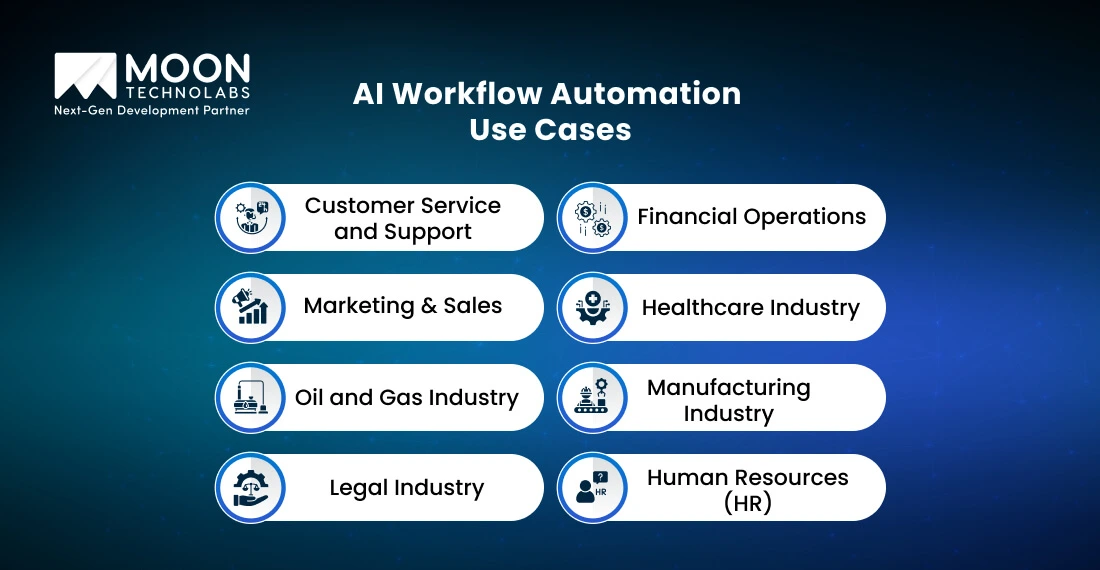
Intelligent workflow automation is a tailored innovation that powers industry-specific tasks. Whether your business wants to bring precision in handling customer queries or elevate supply chain operations, AI in workflows has numerous applications:
Customer Service and Support
In customer service, AI workflows build intelligent AI Copilots who answer customer queries through sentiment analysis and predictive routing.
Use case: NLP in CRM conversational AI chatbots to improve agent efficiency and response times.
Financial Operations
In finance, AI automates workflows such as invoice processing, fraud detection, and audit trails using predictive models.
Use case:Optical Character Recognition (OCR) and anomaly detection with auto-reads of invoice data PDFs for faster transactions and real-time compliance checks.
Marketing & Sales
AI in marketing process automation enhances lead scoring, campaign personalization, and segmentation with behavior analytics and predictive tools.
Use case: Automatic ranking and routing of leads based on engagement levels, improving conversions and team efficiency.
Healthcare Industry
AI automates patient onboarding, claims processing, and lab data extraction using natural language processing (NLP) and robotic process automation (RPA).
Use case: Systems can read lab reports and automatically schedule follow-ups, ensuring HIPAA compliance and improved care coordination.
Oil and Gas Industry
AI-powered IoT monitoring detects equipment anomalies and generates automated maintenance tasks.
Use case: Pipeline sensors trigger workflows for preventive service, reducing downtime and enhancing safety.
Manufacturing Industry
Computer vision and machine learning automate quality checks and inventory tracking for process optimization and supplier coordination.
Use case:ERP AI chatbots identify defects on the line and instantly alert teams, optimizing production and reducing waste.
Legal Industry
AI in the legal industry automates legal research processes by tracking cases and using NLP and RPA to process documents’ legal language.
Use case: AI parses lengthy contracts to highlight risky clauses and routes them for lawyer review.
Human Resources (HR)
HR onboarding is a crucial workflow process across many organizations. HR teams can automate onboarding processes with AI-powered workflow management systems.
Use case: Personalized employee experiences with automated compliance checks by parsing and matching roles in resumes.
Challenges with AI Workflow Automation
While AI workflow automation promises incredible operational agility, businesses need strategic implementation to overcome common roadblocks when deploying it. Addressing them with strategic best practices ensures success at scale.
Security and Privacy Concerns
Deep integration of AI workflow automation into business processes often requires access to sensitive data across departments. This naturally raises the question: How can organizations maintain transparency, data access, and automation speed without compromising on security?
Here’s how: Balance access with protection with built-in encryption, role-based access, and intelligent governance to protect sensitive information at every stage.
Exception Management
Even the most advanced AI systems can encounter outliers and cases when AI doesn’t follow patterns. Hence, the question is: How can organizations ensure these exceptions don’t interrupt the flow or compromise decision quality?
Here’s how: Implement intelligent escalation paths and human-in-the-loop oversight to identify anomalies, flag them for review, and make the systems learn from the feedback over time.
Implementation Costs
Businesses need to understand that implementing intelligent workflow automation demands careful planning and investment in internal capabilities and timelines. This can pose questions like: How can we implement it correctly in our infrastructure, talent, and budget?
Here’s how: Start with use cases that promise quick wins, such as automating approval workflows or ticket routing. This allows organizations to prove value early while minimizing upfront costs and risks.
Ethical Issues and Bias
Learning from historical data requires organizations to connect the dots, create data harmonizations, and replace human biases. Since departments have various tools, how can organizations layer AI automation and embed it effectively into systems that reduce friction?
Here’s how: Incorporate fairness checks across various datasets and build explainable AI (XAI) frameworks to bring accuracy in outputs.
Transform your Business with Moon Technolabs’ AI Workflow Automation Tool
With a custom AI workflow automation system, you can build enterprise-wide workflow intelligence that enables your teams to make workflows predictive and self-optimizing.
With over a decade of innovation as an AI-powered software development company, Moon Technolabs empowers your business to incorporate AI automation and HITL into your workflows.
To get started, we’ll conduct assessments to identify any bottlenecks or gaps in your existing business workflows. This will ensure that you invest in the right solution that can effectively reduce costs and time spent on operations.
Our solutions integrate machine learning, natural language processing, low-code platforms, and intelligent orchestration. From HR and finance to healthcare and customer service, we’ve enabled global brands to streamline operations and gain a competitive edge.
Future-proof your processes with us. Let’s connect for a free AI automation consultation today.
Conclusion
From a futuristic concept, AI workflow automation is now a strategic imperative. By integrating smart decision-making, intuitive orchestration, and seamless data flows, your business operates faster, better, and more intelligently.
This blog explored why businesses today need AI in their workflows now more than ever. The tangible benefits it brings across industries like HR, finance, healthcare, and customer support are some powerful reasons to shape its future outlook and your business.
The time to act is now. Embrace AI in your business workflows today and lead your industry tomorrow.
FAQs
01
What is the difference between RPA and workflow automation?
Although workflow automation and Robotic Process Automation (RPA) are related, they serve different purposes. The former focuses on automating entire processes and sequences, while the latter focuses on automating individual tasks.02
Can you build a customized AI automation tool based on my business needs?
Yes, we build customized AI automation tools tailored to any business need. We start by identifying the workflows that you want to automate and gather relevant information. Then, we choose a suitable tech stack to start building AI models that easily connect other systems to track performance.03
Can AI workflow automation integrate with my existing systems and tools?
Yes, workflow automation can be integrated with existing systems and tools. For example, you can integrate it with the CRM, which fetches data when the customer fills out a form. The CRM then sends a thank-you email based on the data received, and the sales team is notified.04
What technologies do you use for AI workflow automation?
We use a combination of technologies for AI workflow automation. These include machine learning, natural language processing, computer vision, and robotic process automation. We also utilize tools like Microsoft Power Automate and Zapier, combined with Optical Character Recognition (OCR) and Generative AI.




Jayanti Katariya is the CEO of Moon Technolabs, a fast-growing IT solutions provider, with 18+ years of experience in the industry. Passionate about developing creative apps from a young age, he pursued an engineering degree to further this interest. Under his leadership, Moon Technolabs has helped numerous brands establish their online presence and he has also launched an invoicing software that assists businesses to streamline their financial operations.
Submitting the form below will ensure a prompt response from us.
We refine our expertise to deliver innovative business solutions.





205 N Michigan Avenue, #810, Chicago, 60601, Illinois, United States
13500 Long Is Dr, Pflugerville, TX 78660, USA

C/105 Ganesh Meridian, S.G. Highway, Ahmedabad, GJ 380060


Ayse D.
Co-Founder France
“ I highly recommend Moon Technolabs as the quality of service is wonderful. We have hired this company to develop the product based on some complex & technical issues. We get the best quality services as compared with others in the market. Huge Thanks to Moon Technolabs as the team is always ready to give the solution all time.”

Justin G.
Founder & CEO USA
USA“ Moon Technolabs is a pioneer in the WebRTC based project as they have fixed complicated segments of the module by fulfilling different product lines by providing 24X7 customer support. We really recommended Moon Technolabs as they are able to develop products as per the module deadline and project timeline.”

Flavio S.
Founder & Managing Director Germany
“I am happy to recommend Moon Technolabs for their app development services. They successfully developed apps for me, and I am highly satisfied with the overall outcomes. The development team has swiftly addressed the issues with responsive and effective communication to understand the requirement quickly and actively resolve the back-and-forth problems that arose...”

Jay M.
Founder & CEOUSA“Moon Technolabs is the best company that provides advanced apps and websites development services in the USA and Europe. I am a newbie to develop my app with an external team. I am really happy to work with them as I am not that much mobile apps user. Here, the team and specially the CEO of Moon Technolabs helps me to let me know about the benefits of my app to generate revenue....”


Our Offices
India
C/105 Ganesh Meridian,S.G. Highway, Ahmedabad, GJ 380060USA
205 N Michigan Avenue, #810, Chicago, 60601, Illinois, United StatesContact Information


