


Build vs. Buy AI Agents: Everything You Need to Know

Artificial Intelligence Team
Last Updated: Oct 07, 2026 Total Views: 90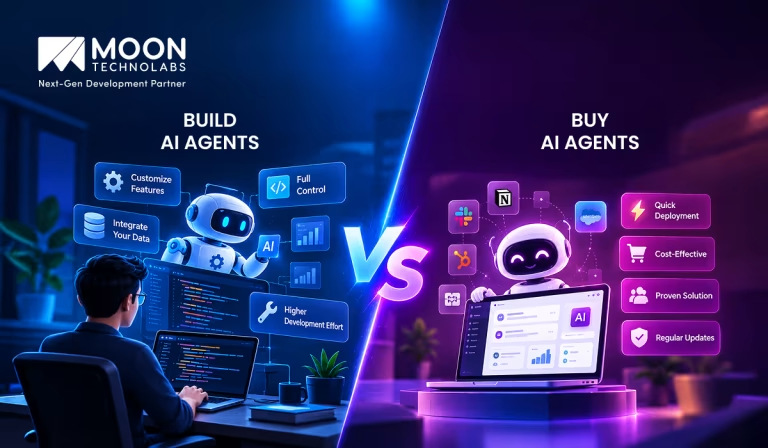
Table of Content


Blog Summary:
The Build vs Buy AI Agents decision is becoming critical for enterprise tech leaders. This guide explores key factors such as cost, customization, scalability, security, integration, and time to value. Learn how to compare both approaches, choose the right strategy for your organization, and build a practical roadmap for successful, long-term AI adoption.
Table of Content
AI agents are moving from experimentation to enterprise deployment, raising a key question for technology leaders: Should we build, buy, or combine both approaches?
The build vs buy AI agents comparison goes beyond development cost. Leaders must consider strategic differentiation, customization, time to market, TCO (Total Cost of Ownership), security, scalability, and long-term maintenance. As agentic AI advances, the right approach can significantly influence how quickly organizations turn AI investments into business value.
According to McKinsey’s AI survey, 40% of organizations earning over $1 billion are scaling AI agents, up from 27% last year. The research also found that 32% had chosen to build rather than buy at least one software product or feature using agentic coding tools.
What are AI agents?
AI agents are software systems that can understand information, make decisions, and take actions to complete tasks with minimal human oversight. Unlike traditional chatbots, they can handle multi-step processes, use tools, access data, and adapt their actions based on the situation.
Businesses use AI agents for customer support, workflow automation, research, data analysis, and other operational tasks. Depending on their needs, organizations can also work with specialized providers to build AI agents tailored to their specific workflows and business needs.
AI agents can connect to existing business applications and systems to perform tasks, not just provide information. By combining automation, reasoning, and decision-making, they can streamline workflows, support employees, and handle complex processes that would otherwise require significant manual effort.
Build vs Buy AI Agents: The Decision Framework
Here’s how to choose the right approach by considering your business needs, resources, goals, and priorities to find the best fit:
Business and Strategic Importance
First, determine how important the AI agent is to the business. If it supports a core business function, creates competitive differentiation, or depends heavily on proprietary knowledge, building AI agents may provide greater control and flexibility.
For common operational tasks such as customer support, employee assistance, or basic workflow automation, buying an existing solution may be more practical.
Key question: Is the agent a strategic differentiator or primarily an operational tool?
Complexity and Uniqueness of the Use Case
Workflow complexity is another major factor. Unique processes, specialized business rules, proprietary data, and complex integrations may favor a custom-built solution.
If the use case is common and commercial products already provide the required functionality, buying can reduce development effort and implementation risk.
Key question: How closely does the business requirement match existing market solutions?
AI Agent Capabilities and Customization
Evaluate the agent capabilities you need, such as reasoning, memory, tool usage, retrieval, workflow automation, and integration with enterprise systems.
Building AI agents provides greater control over models, workflows, integrations, and user experiences. Buying provides ready-to-use capabilities but may limit customization depending on the platform.
Key question: How much customization is required beyond standard features?
Time-to-Market
Time-to-market can strongly influence the decision. Buying AI agents typically enables faster deployment because the core platform, infrastructure, and features are already available.
Building usually requires more time for architecture, development, testing, security reviews, and deployment. However, it may provide greater control over the final solution.
Key question: How quickly does the business need the agent in production?
Total Cost of Ownership (TCO)
The decision should consider full lifecycle costs, not just the initial investment.
For build, costs can include engineering teams, infrastructure, model usage, integrations, monitoring, security, and ongoing maintenance.
To buy AI agents, costs can include licensing, implementation, customization, usage fees, support, and potential vendor switching costs.
Key question: What will the solution cost to operate and maintain over several years?
Security, Privacy, and Compliance
AI agents may process sensitive customer, employee, financial, or business data. Organizations should evaluate data protection, access controls, encryption, data residency, retention policies, auditability, and regulatory requirements.
Building can provide greater control over the security architecture, while established vendors may offer built-in enterprise security and compliance capabilities.
Key question: Which option provides the required level of security and governance?
Scalability and Performance
Consider how the agent will perform as usage grows. Important factors include user volume, response time, reliability, peak workloads, infrastructure capacity, and integration performance.
A commercial platform may provide managed infrastructure and scaling. With a custom solution, the organization has more architectural control but also greater responsibility for infrastructure and performance management.
Key question: Can the solution support current demand and future growth efficiently?
Risk and Maintenance Requirements
AI agents require continuous monitoring and improvement. Models evolve, business processes change, and integrations may need regular updates.
With build, the organization takes responsibility for maintenance, security, monitoring, testing, and model updates. With buy, some of this responsibility shifts to the vendor, but the organization takes on risks such as vendor dependency, pricing changes, and product changes.
Key question: Which risks does the organization want to manage internally versus transfer to a vendor?
Build AI Agents That Move Your Business Forward
Turn complex workflows into intelligent, scalable AI agents designed around your business needs and growth goals.
Build vs Buy AI Agents: How to Decide
Whether to build or buy an AI agent depends on your business needs, resources, timeline, and required level of customization. Consider the following factors before making a decision:
Is the AI Agent a Core Business Capability?
If the AI agent is central to your competitive advantage or a key part of your product, building may provide greater control and flexibility. If it supports a standard business function, a pre-built solution may be sufficient.
How Unique is Your Workflow or Use Case?
Consider how closely your requirements match existing AI agent solutions. Pre-built platforms can often handle standard workflows effectively, while highly specialized processes may require custom development.
Do You Need Custom AI Models, Tools, or Integrations?
If your agent needs specialized models, proprietary tools, internal databases, or complex integrations, building may offer more flexibility. For common integrations and capabilities, buying can reduce development effort.
How Quickly Do You Need to Deploy the Agent?
When speed matters, pre-built AI agents can shorten development and deployment timelines. Building from scratch generally requires more time for development, testing, integration, and optimization.
What is Your Budget?
Building an AI agent requires investment in development, infrastructure, testing, and ongoing maintenance. Buying can reduce upfront development costs, although subscription, licensing, or usage fees may apply over time.
What Level of Control Do You Need?
Building provides greater control over the agent’s architecture, features, data, and future development. Buying means relying more on the provider for updates, functionality, infrastructure, and product direction.
What are Your Security and Compliance Requirements?
Evaluate how the solution handles data protection, access controls, compliance standards, and security. Businesses with strict regulatory or data requirements may need a solution that offers specific controls or allows deeper customization.
Build vs Buy AI Agents: A Comparison of Key Differences
Here’s a clear breakdown of the key factors to consider when comparing both approaches, helping you understand their differences and choose what fits your needs:
| Aspect | Building AI Agent | Buying AI Agents |
|---|---|---|
| Customization | Highly customizable to specific business needs and workflows | Usually limited to the features and customization options offered by the vendor |
| Development Time | Longer development and testing cycle | Faster deployment with pre-built functionality |
| Upfront and Ongoing Costs | Higher initial investment; ongoing costs include infrastructure, development, and maintenance | Typically subscription or licensing fees; lower initial investment but recurring vendor costs |
| Integration Capabilities | Can be designed to integrate deeply with existing systems and APIs | Integration depends on the vendor’s supported connectors, APIs, and capabilities |
| Scalability | Can be scaled according to business requirements, but requires infrastructure planning | Often provides built-in scalability managed by the vendor |
| Security and Compliance | Organization has greater control over security architecture and compliance measures | Vendor manages much of the security, but compliance depends on the vendor’s standards and certifications |
| Maintenance and Updates | Requires an internal team to maintain, monitor, and update the agent | Vendor typically handles updates, maintenance, and infrastructure |
| Vendor Dependency and Lock-In | Lower vendor dependency; greater control over technology choices | Higher dependency on the vendor and potential switching costs |
| Control Over the AI Agent | Full control over architecture, models, data, workflows, and behavior | Control is limited to the configuration and capabilities provided by the vendor |
Why Choose a Pre-built AI Agent?
Opting for a pre-built AI agent gives organizations a fast, practical path forward to automation without the heavy engineering lift. For companies prioritizing speed, predictable budgeting, and operational simplicity, purchasing an off-the-shelf solution offers several key advantages:
Faster Deployment
Pre-built AI agents eliminate months of initial research, architectural design, and model training. Because the core orchestration layer, UI, and base workflows are already functional, deployment shifts from a quarters-long engineering roadmap to a process measured in days or weeks. This speed lets teams capture immediate operational efficiencies and achieve much faster time to value.
Lower Initial Development Costs
Building an AI agent in-house requires significant upfront capital to recruit specialized talent—such as machine learning engineers, backend developers, and MLOps specialists. Pre-built agents convert high upfront capital expenditure into predictable, subscription-based operating expenses. This model lowers the financial barrier to entry and frees up capital for other business priorities.
Ready-to-Use Capabilities
Off-the-shelf agents come equipped with battle-tested capabilities, including advanced natural language understanding, context management, multi-turn conversational abilities, and pre-configured prompt frameworks. Instead of spending months refining base behavior, your team can start using an agent built around proven, effective workflows from day one.
Easier Integrations
Leading AI agent platforms feature pre-built connectors and standard APIs for popular enterprise ecosystems—such as CRMs, helpdesks, and ERP systems (e.g., Salesforce, Zendesk, HubSpot, and Jira). These plug-and-play integrations remove the need to write and maintain complex custom middleware just to connect the agent to your primary databases and business software.
Vendor-managed Maintenance and Updates
AI technology advances rapidly. With a pre-built solution, the vendor handles the ongoing burden of model updates, prompt optimization, bug fixes, and infrastructure maintenance. As newer, faster, or more efficient foundational models emerge, the software provider handles backend upgrades automatically, ensuring your system stays up to date without internal technical debt.
Reduced Development Complexity
Developing custom agentic software involves navigating complex challenges like state management, vector database indexing, rate limits, and non-deterministic behavior. Choosing a pre-built agent abstracts away this underlying technical friction. Non-technical administrators can configure rules, adjust guardrails, and tweak workflows using low-code dashboards without filing developer tickets.
Lower Implementation Risk
Building custom software from the ground up can be challenging, especially in emerging fields like autonomous AI, where projects may face shifting requirements, scope creep, and performance concerns. Pre-built AI agents offer a more established approach, backed by proven software architectures, defined SLAs, built-in security frameworks, and real-world case studies that show performance before deployment.
Why Build a Custom AI Agent?
While pre-built solutions offer quick deployment for standard utilities, off-the-shelf software often falls short when managing unique, highly specialized operations. Custom-building an AI agent gives organizations full control over their code, data, and underlying architecture—vital for enterprises that need tailored execution and long-term control.
Highly Customized Workflows
Off-the-shelf agents rely on generalized assumptions about how businesses operate. Building a custom AI agent allows you to architect precise decision loops, prompt hierarchies, and multi-step reasoning chains tailored to your exact business logic. You can design every rule, edge case, and fallback mechanism to match your operational nuances rather than forcing your processes to fit vendor constraints.
Greater Control Over Agent Behavior
Without strict regulation, autonomous agents can exhibit non-deterministic behavior, silent failures, or hallucinations. Custom development lets you design custom guardrails, deterministic logic gates, and human-in-the-loop validation checkpoints directly into the orchestration layer. This ensures the agent stays within bounded parameters and executes actions safely and consistently.
Custom Integrations with Internal Systems
Enterprise environments often rely on proprietary databases, legacy software, and custom-built internal APIs where standard connectors don’t exist. Developing a custom agent enables native, deep system integration without third-party middleware or fragile workaround scripts, ensuring secure, reliable data flow across your technical stack.
Enhanced Data and Security Control
For organizations in heavily regulated industries like healthcare, finance, or defense, routing sensitive corporate data through multi-tenant third-party SaaS platforms introduces significant compliance and privacy risks. A custom-built agent can be deployed entirely within your private VPC or on-premises, air-gapped infrastructure—ensuring full governance, strict zero-data-retention compliance, and complete protection of sensitive data.
Competitive Differentiation
If an AI agent directly powers your core product or customer-facing value proposition, using the same commercial off-the-shelf tool as your competitors gives you no market advantage. Building a custom agent lets you turn proprietary data, unique domain expertise, and operational workflows into a defensible intellectual property moat competitors cannot easily replicate.
Flexibility to Evolve the Agent
Off-the-shelf platforms lock you into the vendor’s development roadmap, feature schedule, and UI limitations. Custom agent development gives you full ownership of your technical direction. You can quickly modify agent capabilities, add new tools, change memory structures, or adjust decision frameworks as your business strategy shifts or market demands change.
Greater Control Over Infrastructure and AI Models
Building in-house keeps your architecture model-agnostic. Rather than being locked into a single vendor’s LLM, a custom orchestration framework lets you swap foundational models, fine-tune open-source models, or route queries across providers based on cost, latency, or performance requirements. Additionally, controlling your infrastructure helps avoid steep vendor token markups at enterprise scale.
You May Also Like:
Build vs Buy AI Agents: Pros and Cons
Here’s a clear breakdown of the key pros and cons to consider, helping you understand the trade-offs and determine which approach aligns with your needs:
Build AI Agents
| Pros and Cons |
|---|
|
Buy AI Agents
| Pros and Cons |
|---|
|
When Each Approach Makes Sense
Build when you need highly specialized functionality, extensive customization, or complete control over the technology. Buy when speed, convenience, and access to established features are the main priorities. Businesses with a mix of standard and specialized requirements can also combine both approaches.
How to Choose the Right AI Agent Approach?
Evaluating your AI agent strategy requires balancing speed, control, and long-term costs. The following framework breaks down the essential steps to guide your choice:
Define Business Requirements
Determine if your intended agent serves as a standard operational utility (like automated IT helpdesk ticketing) or a core competitive moat that directly drives product value. Standardized workflows favor off-the-shelf software purchases, whereas proprietary logic and unique business models justify a custom build.
Identify the Agent’s Responsibilities and Workflows
Map out the tasks, decision loops, and tools your agent will touch. Workflows with high autonomy—such as updating databases, issuing refunds, or sending emails—carry operational risk and require tight determinism, custom guardrails, and automated testing frameworks that standard tools may not offer out of the box.
Evaluate Available AI Agent Platforms
Audit commercial SaaS and enterprise AI platforms to see if they meet at least 80% of your functional needs. Look for native system connectors, low-code interface builders for non-technical teams, and a clear vendor roadmap for adopting new foundational models.
Estimate Custom Development and Maintenance Costs
Look beyond developer salaries to account for long-term engineering debt. Custom software development requires continuous MLOps overhead, evaluation harnesses (LLM-as-a-judge pipelines) to catch silent failures, vector DB hosting, API token fees, and prompt maintenance whenever underlying models update.
Assess Security and Compliance Requirements
Factor in data residency and regulatory mandates like HIPAA, GDPR, or SOC 2. If third-party vendor platforms cannot meet your security standards under standard data processing agreements, strict air-gapped environments or private VPC deployments become mandatory, pointing toward a custom build.
Compare Long-term TCO
Model your costs over a 3-year horizon instead of focusing solely on upfront fees. Buying off-the-shelf offers speed and lower initial setup costs, but high usage volume can trigger steep vendor token markups. Custom builds require higher upfront capital expenditure but deliver significantly lower marginal costs as usage scales.
Consider a Hybrid Approach
Avoid treating this as a strict binary choice. Many enterprise teams adopt a modular hybrid model: they purchase foundational infrastructure, such as vector databases, model routing gateways, and observability suites—while custom-engineering the core business logic, memory states, and tool connections internally.
Plan for Scalability and Future AI Requirements
Because AI models evolve rapidly, your system architecture must remain completely model-agnostic. Choose a framework that lets you swap, upgrade, or fine–tune underlying LLMs with minimal disruption to broaden operational workflows.
Looking to Build AI Agents That Scale With Your Business?
Identify the right AI opportunities, streamline complex workflows, and create intelligent agents that deliver lasting value across your business.
Build vs. Buy AI Agents: Hybrid Approach
Here’s how a hybrid approach combines the flexibility of custom solutions with the speed and convenience of ready-made AI agents to meet your specific needs:
Combining Pre-built Platforms With Custom Development
A hybrid approach combines pre-built AI agent platforms with custom development to get the benefits of both. Businesses can use an existing platform for core capabilities such as reasoning, integrations, security, and monitoring, while developing custom features around their specific workflows and business requirements.
When a Hybrid Approach Makes Sense
A hybrid model works well when a business needs more flexibility than a ready-made solution offers but does not want to build an entire AI agent from scratch. It can reduce development time and costs while letting teams customize key parts of the agent, especially when requirements are unique or existing tools need to connect.
What Businesses Can Build vs. Buy
Businesses can typically buy foundational components such as AI models, agentic AI frameworks, authentication, monitoring, and common integrations. They can build business-specific components such as custom workflows, internal knowledge autonomous systems, approval processes, specialized tools, and user interfaces.
This approach lets companies focus custom development where it adds the most value while relying on proven solutions for standard capabilities.
Conclusion
Choosing between building and buying an AI agent depends on your business goals, technical requirements, budget, and long-term strategy. Building offers greater control and customization, while buying can provide faster deployment and access to proven capabilities.
For organizations with unique requirements or limited in-house expertise, partnering with an experienced AI development company can help evaluate the right approach and build solutions that align with business needs. In many cases, a hybrid strategy can provide the flexibility of custom development while leveraging the speed and scalability of existing AI platforms.
FAQs
01
How much does it cost to build an AI agent?
The cost varies based on the agent’s complexity, integrations, AI models, features, and development requirements. A simple agent may require limited development, while enterprise-grade agents with multiple integrations and workflows require a larger investment.02
Is buying an AI agent cheaper than building one?
Not necessarily. Buying may reduce initial development costs, but subscription, usage, customization, integration, and vendor fees can add to the long-term cost. Compare the TCO before deciding.03
How long does it take to build an AI agent?
Development time depends on the agent's complexity and the number of integrations required. A basic agent can be developed relatively quickly, while complex enterprise agents may require several development and testing phases.04
Is a hybrid approach possible for AI agents?
Yes. Businesses can use an existing AI platform or foundation model while developing custom workflows, integrations, business logic, and user experiences. This approach can balance speed, customization, and control.




Explore the latest insights on Artificial Intelligence, including Generative AI, Agentic AI, natural language processing, computer vision, automation, and enterprise AI solutions. This category covers industry trends, practical applications, implementation strategies, and innovations that help businesses leverage AI for smarter decision-making and digital transformation. Stay updated with evolving AI technologies that are reshaping industries worldwide.
Submitting the form below will ensure a prompt response from us.
We refine our expertise to deliver innovative business solutions.




205 N Michigan Avenue, #810, Chicago, 60601, Illinois, United States
13500 Long Is Dr, Pflugerville, TX 78660, USA

C/105 Ganesh Meridian, S.G. Highway, Ahmedabad, GJ 380060


Ayse D.
Co-Founder France
“ I highly recommend Moon Technolabs as the quality of service is wonderful. We have hired this company to develop the product based on some complex & technical issues. We get the best quality services as compared with others in the market. Huge Thanks to Moon Technolabs as the team is always ready to give the solution all time.”

Justin G.
Founder & CEO USA
USA“ Moon Technolabs is a pioneer in the WebRTC based project as they have fixed complicated segments of the module by fulfilling different product lines by providing 24X7 customer support. We really recommended Moon Technolabs as they are able to develop products as per the module deadline and project timeline.”

Flavio S.
Founder & Managing Director Germany
“I am happy to recommend Moon Technolabs for their app development services. They successfully developed apps for me, and I am highly satisfied with the overall outcomes. The development team has swiftly addressed the issues with responsive and effective communication to understand the requirement quickly and actively resolve the back-and-forth problems that arose...”

Jay M.
Founder & CEOUSA“Moon Technolabs is the best company that provides advanced apps and websites development services in the USA and Europe. I am a newbie to develop my app with an external team. I am really happy to work with them as I am not that much mobile apps user. Here, the team and specially the CEO of Moon Technolabs helps me to let me know about the benefits of my app to generate revenue....”


Our Offices
India
C/105 Ganesh Meridian,S.G. Highway, Ahmedabad, GJ 380060USA
205 N Michigan Avenue, #810, Chicago, 60601, Illinois, United StatesContact Information


