


AI Agent Development Cost: A Complete Pricing Guide

Artificial Intelligence Team
Last Updated: Sep 07, 2026 Total Views: 91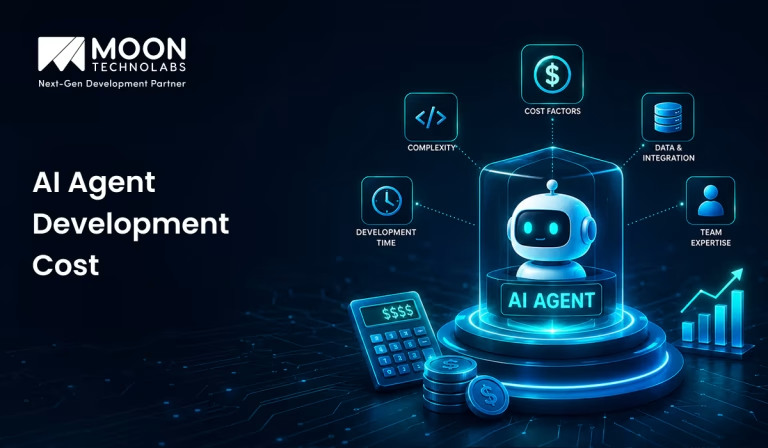
Table of Content


Blog Summary:
AI agent development costs vary significantly based on the agent’s complexity, integrations, autonomy, data requirements, and security needs. A basic agent may cost a few thousand dollars, while enterprise-grade systems can require significantly larger investments. This guide explains the major cost drivers, typical development ranges, and the factors that influence pricing, followed by a practical breakdown of development approaches and ongoing expenses.
Table of Content
AI agents are transforming how businesses automate workflows, improve customer experiences, and make faster decisions. But before investing in one, businesses need to understand the factors that influence development costs, including complexity, integrations, AI models, security, data infrastructure, and autonomy.
The global AI agent market is growing rapidly. Gartner forecasts AI agent software spending will reach $206.5 billion in 2026 and $376.3 billion by 2027. This guide explores AI agent development costs, pricing by complexity and use case, and the ongoing expenses businesses should consider.
AI Agent Market Size and Industry Trends
The AI agent market is experiencing rapid growth as businesses increasingly adopt intelligent systems to automate tasks, improve customer experiences, and streamline operations. Advancements in generative AI, automation, and natural language processing are driving wider adoption across industries. As AI agents become more capable and easier to integrate with existing business systems, they are expected to play an increasingly important role in customer service, sales, operations, and other business functions.
Key Trends Shaping the AI Agent Market
- AI agents are moving from chat to action: Modern AI agents can interact with business systems, call APIs, analyze information, and complete multi-step tasks with minimal human intervention. Businesses are using them for customer service, sales, marketing, and internal operations.For instance, a WhatsApp AI agent can automate customer conversations, provide instant responses, qualify leads, and handle routine support tasks through WhatsApp.
- Enterprise adoption is accelerating: Companies are deploying agents for customer support, software development, sales operations, IT service management, research, and back-office processes where repetitive knowledge work can be automated.
- Vertical AI agents are becoming a competitive advantage: Rather than relying on general-purpose tools, businesses are developing agents trained around industry-specific processes, regulations, data, and workflows.
- Integration is becoming more important than the AI model itself: The value of an agent increasingly depends on how well it connects with existing business systems, such as CRMs, ERPs, databases, communication tools, and internal applications.
- Trust and control are becoming market differentiators: As agents gain the ability to take real-world actions, enterprises are demanding stronger access controls, audit trails, approval mechanisms, and safeguards.
Factors Influencing the Cost of AI Agent Development
Here are the key factors that determine the overall investment required to develop, deploy, and maintain an AI agent for your business:
AI Agent Type and Complexity
The type and complexity of an AI agent have a major impact on development costs. A basic chatbot designed to answer frequently asked questions is generally less expensive than an autonomous agent capable of making decisions and completing multi-step tasks. Complex workflows also require more development, testing, and maintenance.
AI Models and Technology Stack
The AI model and technology stack selected for the project can significantly affect costs. Businesses may use commercial LLMs, open-source models, or customized AI solutions. Model performance, API usage, fine-tuning, hosting, and development frameworks all contribute to the overall cost.
Data and Knowledge Requirements
AI agents often need access to business-specific information to provide accurate and relevant responses. Preparing, cleaning, organizing, and connecting this data can require additional development work. Technologies such as RAG, vector databases, and embeddings may also increase implementation costs.
AI Agent Features and Functionalities
The number and complexity of features directly influence development cost and time. Basic text conversations require fewer resources, while advanced capabilities such as voice integration, multilingual support, document processing, personalization, recommendations, and automated task execution require additional development and testing.
Third-party Integrations and APIs
AI agents often need to connect with external platforms such as CRMs, payment gateways, databases, email systems, calendars, and customer support tools. The number and complexity of these integrations, along with third-party API or subscription fees, can increase the overall project cost.
Memory and Context Management
AI agents that need to remember previous conversations, user preferences, or business information require additional memory and context-management systems. Implementing short-term and long-term memory, information retrieval, and context handling can add to both development and infrastructure costs.
Security and Compliance Requirements
Security and compliance are important when AI agents handle sensitive business or customer information. Requirements such as data encryption, secure authentication, role-based access, privacy controls, audit logs, and regulatory compliance can increase development time and costs. Additional security testing and regular monitoring may also be required to protect the agent from potential threats.
Infrastructure and Computing Resources
The infrastructure required to develop, deploy, and operate an AI agent also affects its overall cost. Cloud hosting, GPUs, databases, storage, APIs, and monitoring services can contribute to ongoing expenses. Agents with high traffic, complex AI models, or real-time processing requirements may require more powerful infrastructure and a scalable architecture, leading to higher operational costs.
Make AI Agent Development Simpler and Smarter
We tackle development complexity, budget uncertainty, and scalability challenges with AI agent solutions tailored to your business needs.
AI Agent Development Cost Breakdown
Here’s a detailed breakdown of the costs to develop an AI agent, covering each stage of the development process:
Cost of AI Agent Planning and Research
The planning and research phase establishes the foundation for the AI agent. This stage includes understanding business requirements, defining the agent’s objectives, identifying target users, selecting appropriate AI technologies, and designing the overall workflow.
The cost may include business analysis, technical feasibility studies, technology selection, solution architecture, and project planning. Well-defined planning helps reduce development risks and prevents unnecessary costs later in the project.
Estimated Cost: $1,000 – $5,000
Cost of Data Collection and Preparation
AI agents often require high-quality data to deliver accurate and reliable results. Data-related costs can include collecting information from internal systems, databases, APIs, documents, websites, or other approved sources.
The preparation process may involve data cleaning, formatting, labeling, deduplication, validation, and structuring. If the agent requires domain-specific knowledge, additional costs may be involved in creating knowledge bases, embeddings, retrieval systems, or other data pipelines.
Estimated Cost: $2,000 – $15,000+
Cost of AI Model Development and Training
The AI model is one of the most important components of an intelligent agent. Costs at this stage depend on whether the project uses an existing foundation model through an API, an open-source model, fine-tuning, or a custom-trained model.
Expenses may include model selection, prompt engineering, fine-tuning, training infrastructure, experimentation, evaluation, and API usage. For many business applications, using an existing LLM can significantly reduce development time and infrastructure costs compared with building a model from scratch.
Estimated Cost: $3,000 – $30,000+
Cost of AI Agent Development and Integration
This stage involves building the actual AI agent and connecting it with the systems and tools it needs to perform tasks. Development may include conversation logic, reasoning workflows, tool calling, memory, retrieval-augmented generation (RAG), authentication, APIs, databases, and third-party integrations.
The overall cost depends heavily on the agent’s complexity. A simple customer support agent may require fewer integrations. In contrast, an enterprise agent that integrates with CRM, ERP, payment, communication, or internal business systems will require significantly more development and integration work.
Estimated Cost: $5,000 – $50,000+
Cost of Testing and Quality Assurance
Thorough testing is essential to ensure that an AI agent behaves reliably and safely. Testing can cover functional performance, response accuracy, hallucination rates, prompt robustness, security, data privacy, integration reliability, and edge cases.
AI agents may also require continuous evaluation because model behavior can vary depending on inputs and context. Quality assurance costs can therefore include automated testing, human evaluation, security testing, performance testing, and real-world user testing.
Estimated Cost: $2,000 – $10,000
Cost of Deployment and Monitoring
Once development and testing are complete, the AI agent needs to be deployed in a production environment. Deployment costs may include cloud infrastructure, databases, API services, authentication, networking, observability tools, and security configurations.
Ongoing monitoring is equally important. Businesses may need to track response quality, latency, token usage, infrastructure performance, errors, user feedback, and operational costs. Monitoring helps identify problems quickly and ensures that the agent continues to perform effectively after launch.
Estimated Cost: $1,000 – $10,000 for initial setup
Cost of Maintenance and Support
AI agent development does not end after deployment. Models, APIs, business requirements, security standards, and user expectations can change over time. Regular maintenance helps keep the agent accurate, secure, compatible, and efficient.
Maintenance expenses may include bug fixes, model or API upgrades, prompt optimization, knowledge-base updates, performance improvements, security patches, infrastructure management, and technical support. Long-term maintenance should therefore be considered an essential part of the overall AI agent investment.
Estimated Cost: $1,000 – $10,000+ per month
Custom AI Agents vs Pre-built AI Agent Platforms – Cost Comparison
Here’s a detailed cost comparison between custom-built AI agents and pre-built AI agent platforms, highlighting the investment, flexibility, scalability, and long-term value of each approach:
| Cost Factor | Custom AI Agents | Pre-built AI Agents |
|---|---|---|
| Initial Cost | High – requires custom development and technical expertise | Low to Medium, with ready-made tools reducing development costs |
| Development Time | Weeks to months | Days to weeks |
| Infrastructure | Medium to High – organization manages hosting and computing | Low, as the provider usually manages infrastructure |
| Maintenance | High – ongoing monitoring, updates, and troubleshooting | Low, as the provider handles most platform maintenance |
| Customization | Very High – fully tailored to business requirements | Medium to High, depending on platform capabilities |
| Integrations | Medium to High – custom integrations may require significant development | Low to Medium, with pre-built connectors often available |
| Scalability | Flexible but may require additional infrastructure investment | Easy to scale, although usage costs may increase |
| Security & Compliance | High control, but additional investment is required | Built-in security features can reduce implementation effort |
| Long-Term Cost | Potentially lower at high usage or scale | More predictable, with recurring subscription or usage fees |
| Best For | Enterprises with unique requirements and technical resources | Businesses seeking faster deployment and lower upfront costs |
Cost-saving Strategies for AI Agent Development
Here are practical strategies to reduce AI agent development costs while maintaining the performance, reliability, and scalability needed for long-term business use:
Start With an AI Agent MVP
Begin with a minimum viable product (MVP) that focuses on solving one specific business problem. This reduces upfront costs and allows businesses to test the agent, gather feedback, and improve it before investing in advanced features.
Prioritize Essential Agent Features
Avoid adding unnecessary features that increase development and maintenance costs. Focus on capabilities that directly support the agent’s primary purpose. Additional features can be introduced later based on user needs and business requirements.
Use Pre-trained AI Models and APIs
Building an AI model from scratch can be expensive and time-consuming. Pre-trained models and APIs provide ready-to-use AI capabilities at a lower cost. Businesses can also use smaller, more affordable models for simple tasks and reserve advanced models for complex operations.
Leverage Cloud-based AI Infrastructure
Cloud platforms eliminate the need for costly hardware and allow businesses to scale resources based on demand. Pay-as-you-go infrastructure and managed AI services can help reduce operational and maintenance expenses.
You May Also Like:
Roadmap to Developing an AI Agent: Step by Step
Here’s a step-by-step roadmap outlining the key stages involved in turning an AI agent idea into a functional, scalable, and production-ready solution:
Select AI Models
Choose the right AI model based on the agent’s purpose, accuracy requirements, response speed, cost, and capabilities. Consider models for language understanding, reasoning, vision, data analysis, or other specialized tasks.
Design Agent Architecture
Plan how the agent will interpret user requests, make decisions, access information, and take action. Define the key components, including the AI model, memory, knowledge base, APIs, tools, and security layer.
Develop and Integrate
Build the agent’s core workflows and connect it with the required tools and systems. Integrate databases, APIs, business applications, and external services. Begin with a basic prototype and gradually add advanced features.
Test Agent Performance
Test the agent to ensure it provides accurate, reliable, fast, and safe results. Evaluate its responses, decision-making, tool usage, error handling, and performance across both normal and unexpected scenarios.
Deploy and Optimize
Deploy the agent in a controlled production environment and monitor its performance. Continuously improve prompts, models, workflows, response speed, cost, security, and user experience based on real-world feedback and usage.
Future Trends Impacting AI Agent Development Costs
Here’s an overview of the emerging trends that are expected to influence AI agent development costs, pricing models, and overall investment requirements:
Growth of Agentic AI Adoption
The growing adoption of agentic AI will increase demand for systems that can plan, make decisions, use tools, and complete tasks autonomously. While advanced capabilities may increase development costs, pre-built frameworks and reusable components can help reduce time and expenses.
Multi-agent System Development
Businesses are increasingly exploring multi-agent systems where specialized AI agents collaborate on complex workflows. These systems can improve performance and scalability but may require additional investment in orchestration, communication, testing, and infrastructure.
AI Agent Integration With Enterprise Systems
AI agents will need to integrate with CRM, ERP, HR, finance, and other enterprise platforms. Custom APIs, secure data connections, authentication, and legacy-system integration can increase development costs, particularly for businesses with complex IT environments.
Advancements in Autonomous AI Agents
More autonomous agents will be able to manage complex workflows with minimal human involvement. Although building reliable autonomous systems requires advanced reasoning, memory, monitoring, and error handling, greater autonomy can deliver long-term savings through increased automation.
Increasing Focus on AI Security and Governance
As agents gain access to sensitive data and business systems, security and governance will become essential. Organizations will need to invest in access controls, monitoring, data protection, auditing, and compliance, adding to development costs while improving reliability and risk management.
Don’t Let AI Challenges Slow Your Growth
We simplify complex AI agent development, control costs, and build scalable solutions that effectively address your business challenges.
Why Choose Moon Technolabs for AI Agent Development?
At Moon Technolabs, we bring AI agent development beyond simple chatbots and prompt-based automation. We build task-oriented AI agents that can understand business context, make decisions, use tools, integrate with existing systems, and execute multi-step workflows, helping businesses automate processes that have traditionally required human intervention.
As an experienced AI agent development company, we focus on building agents that align with your actual business operations rather than forcing a one-size-fits-all solution. Our team works across LLMs, APIs, databases, automation platforms, and enterprise systems to create AI agents that fit seamlessly into your existing technology ecosystem.
Our approach goes beyond building an AI agent and calling the project complete. We help you refine agent workflows, integrate the right tools and data sources, and prepare the solution for real-world usage. With continuous optimization and post-launch support, we help ensure your AI agents remain effective as your business, users, and processes evolve.
Conclusion
AI agent development has no fixed price. The total cost depends on factors such as the agent’s complexity, AI model, data requirements, integrations, security, and ongoing maintenance.
Before setting a budget, businesses should define the AI agent’s use case, required features, and expected outcomes. Planning for the complete development lifecycle, from research and development to deployment and support, helps avoid unexpected costs.
With the right scope and technology, an AI agent can become more than just an automation tool. It can reduce manual work, improve operational efficiency, and deliver measurable long-term ROI.
FAQs
01
What platforms can an AI customer service agent integrate with?
AI customer service agents can integrate with platforms such as websites, CRMs, help desks, email, WhatsApp, and live chat tools. These integrations allow the agent to access customer information, automate support workflows, and provide faster, more personalized responses.02
How much do AI agents for customer service cost?
AI customer service agents can range from a few hundred dollars for basic solutions to several thousand dollars for fully customized systems. Ongoing costs may include AI usage, hosting, maintenance, and integrations.03
How long does it take to build a custom AI agent?
A basic AI agent can take a few weeks, while a complex, customized agent with integrations, testing, and advanced workflows may take several months.04
What hidden costs should I consider when developing an AI agent?
Consider ongoing AI/API usage, cloud hosting, third-party integrations, data preparation, security, maintenance, monitoring, updates, and future scaling. Planning for these costs upfront helps avoid unexpected expenses.



Explore the latest insights on Artificial Intelligence, including Generative AI, Agentic AI, natural language processing, computer vision, automation, and enterprise AI solutions. This category covers industry trends, practical applications, implementation strategies, and innovations that help businesses leverage AI for smarter decision-making and digital transformation. Stay updated with evolving AI technologies that are reshaping industries worldwide.
Submitting the form below will ensure a prompt response from us.
We refine our expertise to deliver innovative business solutions.





205 N Michigan Avenue, #810, Chicago, 60601, Illinois, United States
13500 Long Is Dr, Pflugerville, TX 78660, USA

C/105 Ganesh Meridian, S.G. Highway, Ahmedabad, GJ 380060


Ayse D.
Co-Founder France
“ I highly recommend Moon Technolabs as the quality of service is wonderful. We have hired this company to develop the product based on some complex & technical issues. We get the best quality services as compared with others in the market. Huge Thanks to Moon Technolabs as the team is always ready to give the solution all time.”

Justin G.
Founder & CEO USA
USA“ Moon Technolabs is a pioneer in the WebRTC based project as they have fixed complicated segments of the module by fulfilling different product lines by providing 24X7 customer support. We really recommended Moon Technolabs as they are able to develop products as per the module deadline and project timeline.”

Flavio S.
Founder & Managing Director Germany
“I am happy to recommend Moon Technolabs for their app development services. They successfully developed apps for me, and I am highly satisfied with the overall outcomes. The development team has swiftly addressed the issues with responsive and effective communication to understand the requirement quickly and actively resolve the back-and-forth problems that arose...”

Jay M.
Founder & CEOUSA“Moon Technolabs is the best company that provides advanced apps and websites development services in the USA and Europe. I am a newbie to develop my app with an external team. I am really happy to work with them as I am not that much mobile apps user. Here, the team and specially the CEO of Moon Technolabs helps me to let me know about the benefits of my app to generate revenue....”


Our Offices
India
C/105 Ganesh Meridian,S.G. Highway, Ahmedabad, GJ 380060USA
205 N Michigan Avenue, #810, Chicago, 60601, Illinois, United StatesContact Information


