


12 AI Agent Use Cases with Real ROI: Enterprise Examples Across Industries

Artificial Intelligence Team
Last Updated: Aug 13, 2026 Total Views: 91
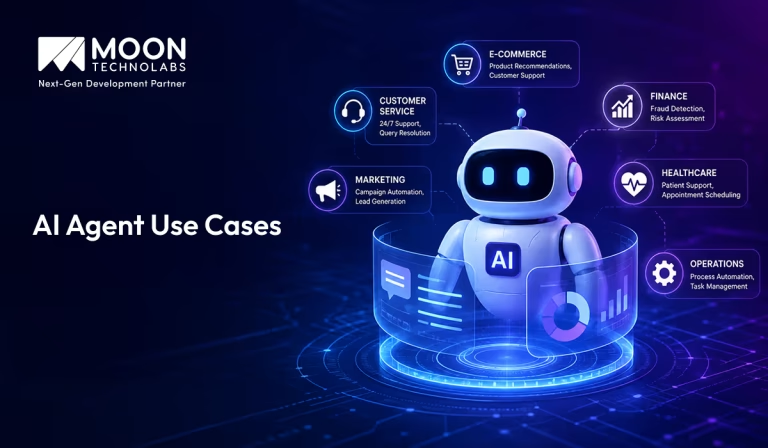
Table of Content


Blog Summary:
AI agents are quietly reshaping enterprise workflows, handling support tickets, qualifying leads, reconciling invoices, monitoring systems, and assisting employees without constant human input. But where are companies actually seeing ROI? This blog breaks down 12 proven AI agent use cases across industries, showing how enterprises are turning autonomous AI workflows into measurable gains in efficiency, cost savings, speed, and revenue.
Table of Content
Most enterprises don’t need another AI tool; they need fewer manual steps, faster decisions, and workflows that don’t stall when teams get busy. That’s where AI agents are proving useful. An AI agent can qualify a lead before a salesperson steps in, pull information from multiple systems to resolve a customer issue, review documents, or move a request through several stages without someone coordinating every step.
But not every process is worth handing to an agent. The real opportunity lies in choosing tasks where volume, repetitive work, delays, or labor costs make automation financially worthwhile. This guide breaks down 12 AI agent use cases across industries, focusing on what the agents actually do, where enterprises can see ROI, and why these workflows are strong candidates for agentic automation.
What is an AI Agent?
An AI agent is a software system that uses artificial intelligence to understand a goal, make decisions, and perform tasks with minimal human assistance. It can understand information, analyze situations, and determine the actions needed to complete a task.
AI agents can interact with users, applications, websites, databases, and other digital tools. They can perform tasks such as answering questions, organizing data, sending messages, scheduling activities, and automating repetitive work.
Unlike traditional software that follows instructions, an intelligent agent can adapt to different situations and choose the next best action based on the information available. This makes AI agents useful for businesses, customer support, education, software development, and many other fields.
Why AI Agents Matter for Enterprises?
AI agents are changing how enterprises handle work that requires more than a simple rule or prompt. They can interpret goals, coordinate multiple steps, use business systems, and respond to new information—making them especially useful for complex, evolving workflows. See why AI agents are becoming essential for enterprises:
Autonomous Execution
AI agents can take a business goal, break it into steps, and execute the workflow with minimal human intervention. This helps enterprises automate end-to-end processes instead of isolated tasks.
Adaptive Reasoning
Unlike rule-based automation, AI agents can understand context, handle exceptions, and adjust their approach when situations change. This makes them better suited for complex, dynamic enterprise workflows.
Cross-tool Integration
AI agents can connect with CRMs, ERPs, databases, communication platforms, and other enterprise tools. They can retrieve information from one system, act in another, and coordinate the entire workflow, reducing manual effort and tool switching.
How Do AI Agents Work?
AI agents follow a structured process to turn a goal into action. They interpret the request, gather relevant information, decide what to do next, execute tasks, and refine their approach based on the results.
The basic workflow can be understood in five stages:
Perception/Input
The agent first receives and understands information from its environment.
This input could be:
- A user’s question or instruction
- Text, images, audio, or video
- Data from databases or APIs
- Information from sensors or external systems
Example: A user asks, “Find me the best flight to London tomorrow.”
The agent identifies the destination, date, and objective from the request.
Reasoning/Planning
Next, the agent considers what needs to be done and develops a plan.
It may:
- Break a complex task into smaller steps
- Decide which information it needs
- Choose the appropriate tools
- Determine the order of actions
Example: The agent may plan to search available flights, compare prices and timings, and identify the best options.
Action/Tool Calling
The agent then takes action by using available tools or systems.
These tools might include:
- Web search
- APIs
- Databases
- Calculators
- Code execution
- Email or calendar systems
- Business applications
Example: The agent calls a flight-search API to retrieve real-time flight information.
Observation
After taking an action, the agent observes the result.
It checks:
- What happened?
- Did the tool return the expected information?
- Is more information needed?
- Did the action succeed or fail?
Example: The agent receives a list of available flights and examines their prices, duration, and departure times.
Iteration
If the task is not complete, the agent repeats the cycle.
It uses the new information to:
Observe → Reason → Act → Observe → Act
This loop continues until the agent reaches the desired outcome or determines that it cannot proceed.
Find Where AI Agents Can Deliver Real Business Value
Let our experts identify practical AI agent opportunities that improve efficiency, reduce operational costs, and generate measurable business results.
12 AI Agent Use Cases: Real-world Applications and Results
AI agents are transforming how businesses handle repetitive tasks, make decisions, and manage complex workflows. Unlike basic chatbots, they understand context, integrate with business systems, perform multi-step actions, and escalate tasks when human judgment is required.
These capabilities make AI agent use cases increasingly valuable for businesses seeking smarter automation, greater efficiency, and measurable ROI. Here are 12 practical AI agent use cases and the results they can deliver:
Customer Support Triage
Customer service agents automatically analyze incoming requests, identify intent and urgency, review customer history, and route tickets to the right team. They can also resolve common questions without human intervention.
Applications: Ticket classification, FAQ automation, sentiment detection, escalation, and response suggestions.
Results: Faster response times, improved resolution rates, reduced ticket backlogs, and more productive support teams.
Software Development & Debugging
AI agents assist developers throughout the software development lifecycle by analyzing code, identifying bugs, generating tests, reviewing changes, and troubleshooting errors.
Applications: Code generation, debugging, test creation, code reviews, refactoring, and documentation.
Results: Faster development cycles, reduced repetitive work, quicker bug resolution, and improved engineering productivity.
Sales & Lead Generation
AI agents research prospects, qualify leads, personalize outreach, manage follow-ups, and automatically keep CRM records up to date.
Applications: Lead scoring, prospect research, email personalization, account enrichment, follow-ups, and sales pipeline updates.
Results: Faster lead response, better sales prioritization, reduced administrative work, and more time for sales teams to engage with customers.
Clinical Documentation
AI agents help healthcare professionals by converting consultation information into structured notes, summarizing patient interactions, and preparing documentation for review.
Applications: Clinical notes, visit summaries, referral documentation, patient communications, and record organization.
Results: Reduced documentation burden, more consistent records, and more time for healthcare professionals to focus on patients.
Data & Analytics Queries
AI agents make business data easier to access by allowing users to ask questions in natural language. The agent can identify relevant data, generate queries, analyze results, and explain key trends, making AI agent use cases valuable for faster, more accessible business intelligence.
Applications: KPI analysis, SQL generation, reporting, anomaly detection, dashboards, and trend analysis.
Results: Faster access to insights, reduced manual reporting, and better data-driven decision-making across teams.
Knowledge Management
Organizations often have important information spread across documents, emails, wikis, policies, and internal systems. AI agents can connect these sources and help employees quickly find the information they need.
Applications: Enterprise search, document summarization, policy lookup, employee onboarding, and knowledge-base management.
Results: Less time spent searching for information, faster onboarding, improved knowledge sharing, and reduced knowledge silos.
Finance & Merchant Classification
AI agents can analyze transactions, invoices, and merchant information to automatically classify financial activity and identify unusual or ambiguous transactions, making this one of the most practical AI agent use cases in finance.
Applications: Merchant categorization, expense classification, invoice processing, reconciliation, and transaction enrichment.
Results: Reduced manual data entry, cleaner financial data, faster reconciliation, and more efficient finance operations.
Supply Chain & Inventory Forecasting
AI agents continuously monitor sales, inventory levels, supplier performance, and demand patterns to help businesses make better supply chain decisions. As one of the most practical AI agent use cases, they enable organizations to respond faster to changing demand and optimize operations.
Applications: Demand forecasting, inventory optimization, reorder recommendations, supplier monitoring, and stockout prediction.
Results: Lower excess inventory, fewer stockouts, improved purchasing decisions, and greater supply chain responsiveness.
Human Resource & Candidate Screening
AI agents automate repetitive recruiting tasks by reviewing applications against defined requirements, summarizing candidate profiles, scheduling interviews, and handling routine communications.
Applications: Resume screening, candidate matching, interview scheduling, candidate communication, and interview summaries.
Results: Faster hiring workflows, reduced recruiter workload, and more time for human-led candidate evaluation.
Compliance & KYC Processing
AI agents help compliance teams process large volumes of customer and business documentation. As one of the key AI agent use cases, they can extract information, identify missing details, organize cases, and flag applications that require additional review.
Applications: KYC checks, document extraction, customer onboarding, compliance workflows, and case summarization.
Results: Faster onboarding, more consistent processing, reduced manual review, and better focus on higher-risk cases.
Contract Review & Legal Extraction
AI agents can analyze lengthy contracts and quickly identify important clauses, obligations, renewal dates, and deviations from standard terms.
Applications: Contract summarization, clause extraction, obligation tracking, contract comparison, and risk identification.
Results: Faster contract review, improved visibility into obligations, and reduced time spent on routine legal analysis.
IT Helpdesk Automation
AI agents act as a first line of IT support by understanding employee issues, searching internal knowledge, performing approved troubleshooting steps, and escalating unresolved problems. As a practical AI agent use case, they help IT teams automate routine support while maintaining human oversight for complex issues.
Applications: Password and access requests, device troubleshooting, software support, ticket creation, and incident routing.
Results: Faster issue resolution, fewer repetitive support requests, improved employee productivity, and more time for IT teams to focus on complex problems.
You Might Also Like:
Challenges and Limitations of AI Agents
AI agents can perform complex tasks autonomously by reasoning, using tools, and making decisions based on available information. However, their ability to operate independently also introduces several important challenges and limitations, such as:
Compounding Errors
AI agents often complete tasks through multiple steps. A small mistake in an early step can affect later decisions, causing errors to build up throughout the process. This makes continuous monitoring and error correction important.
Non-determinism
AI agents may produce different results when given the same task. This can happen due to probabilistic model behavior, changing context, or differing tool responses. As a result, agents can be difficult to predict, test, and reproduce consistently.
Accountability
When an AI agent makes a decision or takes an action, it may be unclear who is responsible for the outcome. Developers, organizations, and users may all play a role. Clear policies, audit trails, and human oversight are necessary to ensure accountability.
Context Drift
During long or complex tasks, an AI agent may gradually lose focus on the original objective. New information or intermediate decisions can cause it to move away from the user’s intended goal. Regularly checking the agent’s progress can help prevent this.
Hallucinations
AI agents can generate information that sounds convincing but is incorrect or fabricated. If an agent uses this information for further decisions, the error can have a greater impact. Reliable data sources, verification, and human review can help reduce this risk.
The Future of AI Agents
AI agents are transforming the way businesses operate, communicate, and make decisions. Unlike traditional software, AI agents can understand context, perform tasks, learn from interactions, and take action with minimal human intervention.
These capabilities are driving new AI agent use cases across industries, from automating repetitive workflows to managing conversations and qualifying leads. Here’s what the future of AI agents looks like:
AI Chatbots
AI chatbots are evolving from simple question-and-answer tools into intelligent digital assistants. They can understand natural language, provide personalized responses, access business information, and assist customers 24/7.
Modern AI chatbots can help businesses:
- Answer customer questions instantly
- Provide product and service information
- Schedule appointments and demos
- Support customers throughout their journey
- Reduce response times and support costs
For businesses that rely on messaging channels for customer engagement, WhatsApp AI agents can take these capabilities further by handling conversations, answering customer queries, qualifying leads, and triggering actions directly within WhatsApp.
Lead Qualification
AI is changing the way businesses identify and prioritize potential customers. Instead of relying entirely on sales teams to review every inquiry, AI-powered lead qualification can analyze conversations, identify intent, evaluate prospects, and determine which leads are most likely to convert.
AI can help sales teams:
- Identify high-intent prospects
- Ask qualifying questions automatically
- Score and prioritize leads
- Capture important customer information
- Route qualified prospects to the right sales representative
This allows sales teams to spend less time sorting through leads and more time building relationships and closing opportunities.
Voice Agents
Voice AI is bringing intelligent automation to phone conversations. AI-based voice agents can communicate naturally with customers, understand spoken language, respond in real time, and complete tasks without requiring a human operator.
Businesses can use voice agents for:
- Inbound customer support
- Appointment scheduling
- Lead follow-ups
- Outbound sales calls
- Customer surveys
- FAQs and information requests
As voice technology becomes more natural and capable, AI-powered phone conversations will become an increasingly important part of customer experience.
Want to Build AI Agents That Deliver Results?
Connect with our team to discuss your challenges and explore AI agent solutions tailored to your business needs.
Build Your AI Agent with Moon Technolabs
What if your AI could take the next step instead of waiting for the next prompt? We, at Moon Technolabs, build AI agents that can monitor inputs, make decisions, trigger actions, and keep workflows moving.
Whether you need an AI agent to follow up with prospects, review incoming requests, extract information from documents, coordinate internal tasks, or support customers around the clock, we turn individual business processes into intelligent, automated workflows.
As an AI agent development company, we build around your existing processes instead of forcing your business into a predefined AI model. Our team connects the AI agent with the tools, databases, APIs, and platforms your business already uses, while adding the logic and safeguards needed for dependable execution.
The goal is simple: an AI agent that doesn’t just communicate; it contributes to the work.
Conclusion
These AI agent use cases show how enterprises are applying agents to real workflows, from qualifying leads and handling support requests to processing documents and streamlining operations. The strongest ROI comes when an agent is built around a specific task, connected to the right systems, and measured against a clear business outcome.
The takeaway is simple: don’t automate for the sake of automation. Find the workflows where delays, repetitive work, and manual handoffs are costing your business, then start there. With the right use case, AI agents can become a measurable part of enterprise operations, not just another AI experiment.
If you’re ready to turn a promising use case into a reliable business solution, hire AI developers who can build, integrate, and optimize the right agent for your needs.
FAQs
01
Can AI agents automate software development and debugging?
Yes. AI agents can automate many parts of the software development lifecycle, including writing and reviewing code, generating tests, identifying bugs, debugging issues, documenting code, and assisting with deployments. They can analyze requirements, use development tools, and iteratively improve solutions with human oversight.02
Are AI agents secure enough for enterprise applications?
Yes, they are secure enough for enterprise use when they are deployed with appropriate security controls. These include role-based access control, authentication, data encryption, activity monitoring, audit logging, sandboxing, and human approval for high-risk actions. Enterprises should also implement governance and testing to ensure that agents adhere to organizational security and compliance requirements.03
How do AI agents make autonomous decisions?
AI agents make decisions by combining their goals, available context, learned models, business rules, and information gathered from tools or external systems. They can evaluate possible actions, select the most appropriate one, execute it, and use the results to determine their next step. Organizations can define permission limits and approval workflows to control autonomous actions.04
How do AI agents reduce operational costs?
AI agents reduce costs by automating repetitive, time-consuming tasks, operating continuously, and reducing manual effort in routine processes. They can handle activities such as customer support, software testing, data processing, monitoring, reporting, and workflow management, allowing employees to focus on higher-value work while improving speed and scalability.



Explore the latest insights on Artificial Intelligence, including Generative AI, Agentic AI, natural language processing, computer vision, automation, and enterprise AI solutions. This category covers industry trends, practical applications, implementation strategies, and innovations that help businesses leverage AI for smarter decision-making and digital transformation. Stay updated with evolving AI technologies that are reshaping industries worldwide.
Submitting the form below will ensure a prompt response from us.
We refine our expertise to deliver innovative business solutions.





205 N Michigan Avenue, #810, Chicago, 60601, Illinois, United States
13500 Long Is Dr, Pflugerville, TX 78660, USA

C/105 Ganesh Meridian, S.G. Highway, Ahmedabad, GJ 380060


Ayse D.
Co-Founder France
“ I highly recommend Moon Technolabs as the quality of service is wonderful. We have hired this company to develop the product based on some complex & technical issues. We get the best quality services as compared with others in the market. Huge Thanks to Moon Technolabs as the team is always ready to give the solution all time.”

Justin G.
Founder & CEO USA
USA“ Moon Technolabs is a pioneer in the WebRTC based project as they have fixed complicated segments of the module by fulfilling different product lines by providing 24X7 customer support. We really recommended Moon Technolabs as they are able to develop products as per the module deadline and project timeline.”

Flavio S.
Founder & Managing Director Germany
“I am happy to recommend Moon Technolabs for their app development services. They successfully developed apps for me, and I am highly satisfied with the overall outcomes. The development team has swiftly addressed the issues with responsive and effective communication to understand the requirement quickly and actively resolve the back-and-forth problems that arose...”

Jay M.
Founder & CEOUSA“Moon Technolabs is the best company that provides advanced apps and websites development services in the USA and Europe. I am a newbie to develop my app with an external team. I am really happy to work with them as I am not that much mobile apps user. Here, the team and specially the CEO of Moon Technolabs helps me to let me know about the benefits of my app to generate revenue....”


Our Offices
India
C/105 Ganesh Meridian,S.G. Highway, Ahmedabad, GJ 380060USA
205 N Michigan Avenue, #810, Chicago, 60601, Illinois, United StatesContact Information


