


The Complete Guide to WhatsApp AI Agents

Jayanti Katariya
Last Updated: Apr 29, 2026 Total Views: 521
Table of Content


Blog Summary:
The WhatsApp AI Agent is a powerful tool for businesses, offering 24/7 customer support, automated responses, and enhanced efficiency. In this blog, we cover its key features, the benefits it offers, real-world use cases, and a step-by-step guide to building and integrating it into your WhatsApp business account for optimal performance.
Table of Content
WhatsApp is no longer just a messaging app, but a powerful platform for AI-based communication. In fact, more than 100 billion messages are sent on WhatsApp every day, according to TechCrunch, making it a central hub for real-time conversations across the globe.
WhatsApp AI agents are reshaping how businesses interact with users by providing instant responses, automating tasks, and delivering personalized experiences. These intelligent agents work 24/7, helping companies boost efficiency while giving users faster, smoother support, making them an essential part of modern digital engagement.
What are WhatsApp AI Agents?
WhatsApp AI agents are tools that use artificial intelligence to automate communication between businesses and customers via the WhatsApp Business API. The AI agents answer complex queries, handle customer complaints, and process payments, thus offering round-the-clock assistance.
Using natural language processing and machine learning, the AI agents provide personalized, efficient customer service while handling multiple conversations simultaneously.
When WhatsApp AI agents are integrated with the WhatsApp Business API, businesses can automate routine processes, such as responding to frequently asked questions and notifying customers of new developments.
What are the Key Features of WhatsApp AI Agents?
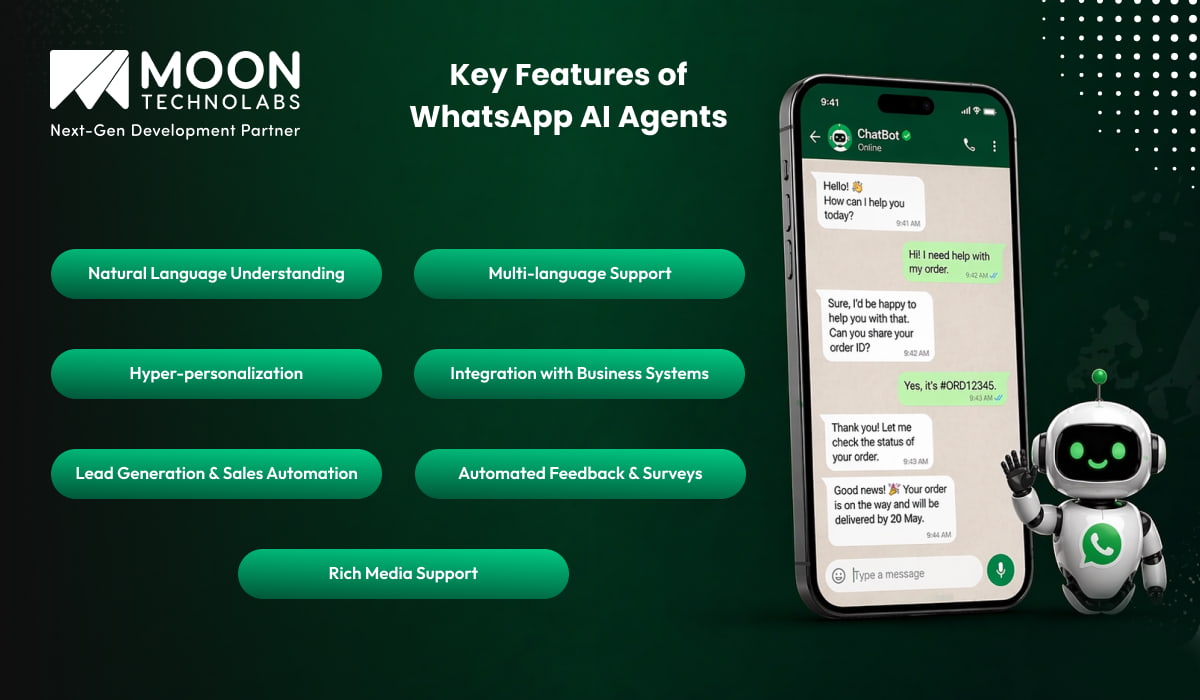
WhatsApp AI agents are transforming the way businesses interact with customers by offering intelligent, scalable, and real-time communication. Here are the advanced features that make them a powerful tool:
Natural Language Understanding
Powered by advanced AI, these agents can understand and respond to human language in conversation. They interpret user intent, context, and tone, making interactions feel more natural and less robotic. This leads to smoother and more natural conversations.
Multi-language Support
WhatsApp AI agents can communicate in multiple languages, making them ideal for businesses with a global or diverse customer base. They break language barriers and ensure that users can interact in their preferred language, enhancing accessibility and user experience.
Hyper-personalization
AI agents can analyze customer data, past interactions, and preferences to deliver highly personalized responses. They create a more engaging and relevant customer journey, boosting loyalty and conversions from recommending products to tailoring messages.
Integration with Business Systems
These agents can seamlessly integrate with CRM systems, databases, and other business tools. This allows them to fetch real-time information, update records, and automate workflows, making operations more efficient and eliminating manual effort.
Lead Generation & Sales Automation
WhatsApp AI agents can capture leads, qualify prospects, and even guide users through the sales funnel. By automating follow-ups, answering product queries, and suggesting solutions, they help businesses increase conversions and streamline their sales processes.
Automated Feedback & Surveys
WhatsApp AI agents can automatically send follow-up messages after interactions to collect customer feedback and conduct surveys. By analyzing this data, businesses can gain valuable insights into customer satisfaction, identify pain points, and improve their services or products. This automated process saves time and ensures more consistent feedback collection.
Rich Media Support
WhatsApp AI agents can handle a variety of rich media formats, including images, videos, documents, and even voice messages. This capability allows businesses to send product demos, promotional materials, or troubleshooting guides in a more engaging, interactive way. It enhances the communication experience by providing richer content beyond just text, making it easier for customers to understand and interact with the business.
WhatsApp AI Agent vs Traditional Chatbots
Take a closer look at the key differences between WhatsApp AI agents and traditional chatbots, and understand how WhatsApp AI agents go beyond basic rule-based chatbots:
| Parameter | Traditional Chatbots | WhatsApp AI Agent |
|---|---|---|
| Definition | A rule-based system that follows predefined scripts and flows to respond to user inputs. | An AI-powered system that understands user intent, maintains context, and performs actions autonomously. |
| Technology | Decision trees, keyword matching, static logic | Artificial Intelligence (LLMs), NLP, machine learning, and integrations |
| Conversation Flow | Linear and structured | Dynamic and adaptive |
| Understanding Capability | Limited to predefined inputs | Interprets natural language, intent, and context |
| Context Awareness | Minimal or no context retention | Maintains multi-turn conversation context |
| User Interaction | Menu-driven (buttons, options) | Free-flowing, human-like customer conversations |
| Flexibility | Breaks when input deviates from the script | Adapts to unexpected queries |
| Task Execution | Provides information only | Performs actions (bookings, updates, etc.) |
| Decision Making | Predefined rules only | Intelligent, real-time decision-making |
| Business Impact | Handles basic queries | Drives sales, support, and automation |
With our expertise, transform your WhatsApp into a smart AI-powered channel to automate conversations, boost engagement, and drive business growth effortlessly.
How to Build a WhatsApp AI Agent?
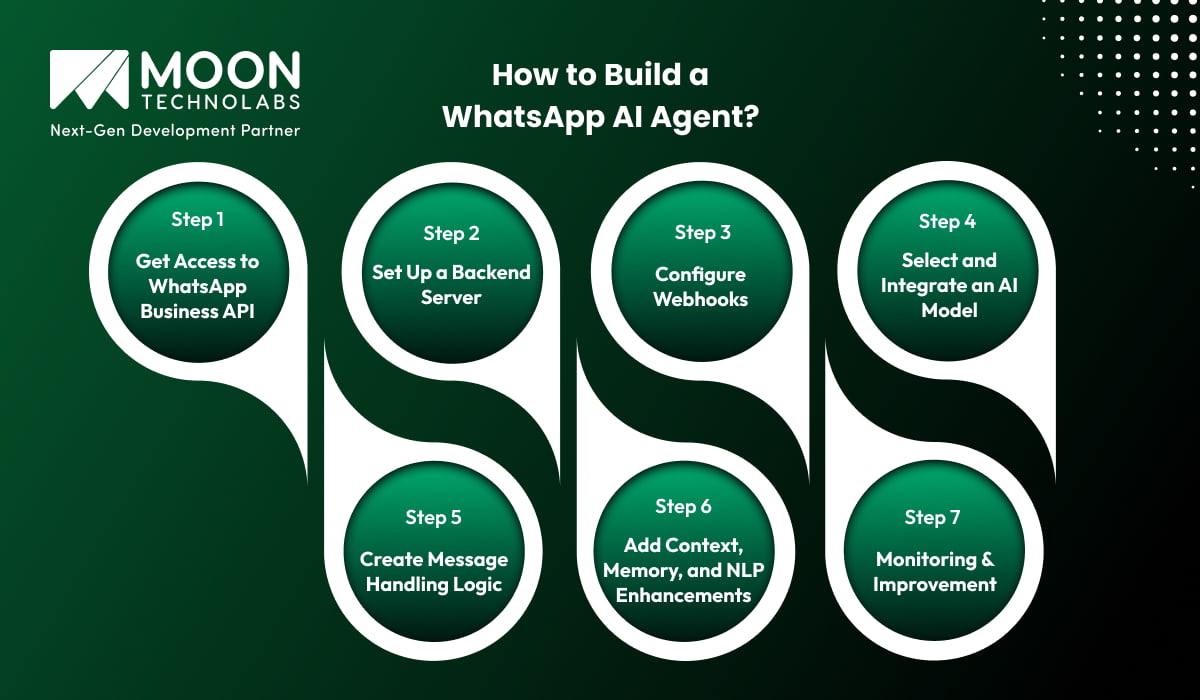
Building a WhatsApp AI agent helps businesses automate conversations, provide instant support, and deliver personalized experiences at scale. As messaging becomes central to customer engagement, AI-powered assistants enable instant responses and smarter interactions. Here are the steps to build one:
Step 1: Get Access to WhatsApp Business API
To build an AI agent, you first need access to the WhatsApp Business API:
- Apply through Meta or an official business solution provider.
- Verify your business and phone number.
- Set up a WhatsApp Business account and configure your messaging profile.
Step 2: Set Up a Backend Server
Your backend server acts as the brain of your AI agent:
- Choose a tech stack such as Node.js, Python, or Java.
- Host your server on platforms like Google Cloud, AWS, or Azure.
- Ensure your server can handle incoming requests and send responses via API calls.
This server will receive messages from WhatsApp and process them using your AI logic.
Step 3: Configure Webhooks
Webhooks allow WhatsApp to send real-time message updates to your server:
- Set up an endpoint (URL) on your backend.
- Configure webhook settings in your WhatsApp API dashboard.
- Verify the webhook using a token provided during setup.
Once configured, every incoming message from a user will be automatically forwarded to your server.
Step 4: Select and Integrate an AI Model
Next, choose an AI model and integrate it to generate intelligent responses:
- Use models like OpenAI GPT models or other NLP frameworks.
- Send incoming user messages to the AI model via API.
- Receive and format AI-generated responses before sending them back to WhatsApp.
Select a model based on your use case, customer support needs, sales requirements, FAQs, and conversational assistance.
Step 5: Create Message Handling Logic
Decide how your bot should respond to different messages:
- Understand the user’s message (question, request, complaint).
- Choose the response type:
- Simple queries: use predefined replies
- Complex queries: use AI responses
- Critical issues: transfer to a human agent
- Create basic flows for greetings, FAQs, and support
- Add fallback replies if the bot doesn’t understand
This helps your bot respond clearly and consistently.
Step 6: Add Context, Memory, and NLP Enhancements
To make your AI agent feel more human and useful, enhance it with context awareness and smarter language understanding.
Maintain conversation context: Store previous messages (short-term memory) to allow multi-turn conversations.
User profiling: Save user preferences, history, and past interactions for personalization.
Session management: Track ongoing conversations and reset context when needed.
NLP enhancements:
- Intent recognition (e.g., order status, complaint, inquiry)
- Entity extraction (dates, names, product IDs)
Prompt engineering: Design structured prompts for your AI model to improve accuracy and tone.
Multilingual support: Detect and respond in the user’s preferred language.
These improvements significantly boost response relevance and user experience.
Step 7: Monitoring & Improvement
After deployment, continuous monitoring and optimization are critical.
- Track key metrics: Response time, resolution rate, user satisfaction, fallback rate.
- Log conversations: Store chat records for debugging, training, and compliance.
- Human review loop: Regularly review conversations to identify gaps and improve responses.
- Model fine-tuning: Update prompts or retrain models based on real user interactions.
- A/B testing: Test different response styles, flows, or models to improve performance.
- Alerts & reliability: Set up alerts for downtime, API failures, or unusual activity.
Continuous iteration ensures your AI agent becomes smarter and more effective over time.
You Might Also Like:
Real-world Use Cases of WhatsApp AI Agent
Let’s explore how different industries are applying WhatsApp AI agents in real-world scenarios to optimize processes, boost customer satisfaction, and drive better business outcomes:
| Industry | Primary Use Cases | Outcomes |
|---|---|---|
| Healthcare | Appointment scheduling, reminders, symptom triage, and prescription follow-ups. | Fewer no-shows, better patient engagement, and efficient operations. |
| Finance | Account inquiries, transaction alerts, fraud detection, and customer support. | Improved customer satisfaction, quicker service, better security. |
| Ecommerce & Retail | Product recommendations, order tracking, cart recovery, and customer support. | Higher conversions, reduced cart abandonment, enhanced customer experience. |
| Real Estate | Lead qualification, property inquiries, virtual tours, and appointment scheduling. | Faster lead conversion, more customer engagement, and reduced manual work. |
| Education | Course info, admission support, fee reminders, student FAQs. | Improved enrollment, streamlined communication, and reduced admin work. |
| Travel & Hospitality | Booking confirmations, itinerary updates, travel alerts, and support. | Optimized customer experience, increased bookings, and real-time communication. |
| Logistics & Delivery | Shipment tracking, delivery updates, and delay notifications. | Greater transparency, reduced queries, improved delivery efficiency. |
| Internal Operations | HR support, onboarding, IT helpdesk, and internal notifications. | Increased productivity, faster issue resolution, and reduced costs. |
Implement AI-powered WhatsApp agents that automate responses, streamline communication, and deliver faster, more efficient customer interactions at scale.
Benefits of Developing WhatsApp AI Agents
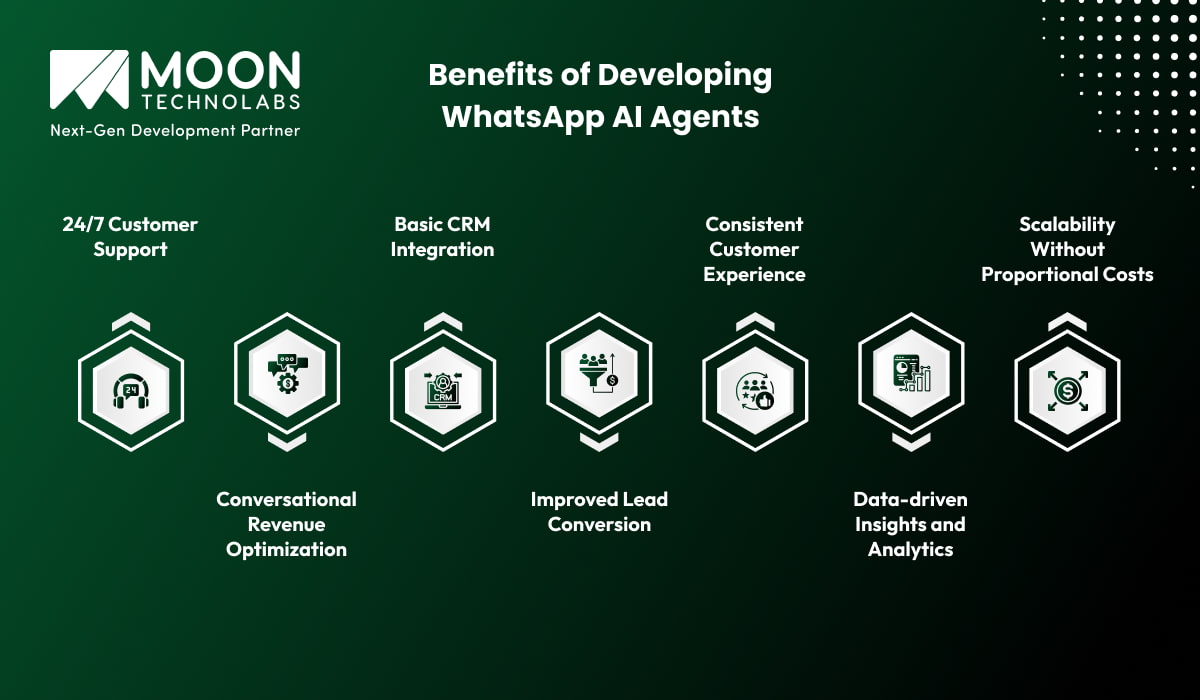
24/7 Customer Support
They can provide round-the-clock support, a major benefit of WhatsApp AI agents. Unlike human agents, AI agents never sleep, ensuring customer queries are addressed instantly and significantly improving customer satisfaction while reducing response delays.
Conversational Revenue Optimization
WhatsApp AI agents can actively engage users in personalized, real-time conversations that guide them through the buying journey. By recommending products, answering objections, and offering tailored suggestions, these agents help businesses maximize revenue opportunities. They can also trigger upsells and cross-sells at the right moment, improving overall conversion value.
Basic CRM Integration
AI agents can seamlessly integrate with basic CRM systems to capture and organize customer data. This allows businesses to track interactions, store preferences, and maintain a centralized view of each customer. With this customer information, companies can deliver more targeted communication and improve relationship management without manual effort.
Improved Lead Conversion
By instantly responding to inquiries and nurturing leads through automated conversations, WhatsApp AI agents significantly increase the chances of converting prospects into customers. They can qualify leads, answer frequently asked questions, and guide users toward taking action, reducing drop-offs in the sales funnel.
Consistent Customer Experience
Consistency is key to building trust, and AI agents ensure that every customer receives accurate, uniform information. Unlike human agents, whose responses may vary, AI systems deliver standardized messaging aligned with brand guidelines. This consistency enhances brand reliability and creates a more exceptional customer experience.
Data-driven Insights and Analytics
WhatsApp AI agents can track and analyze conversation data to uncover valuable insights about customer behavior, preferences, and common pain points. Businesses can use this data to refine marketing strategies, improve products or services, and optimize customer journeys. Over time, these insights help in making more informed, strategic decisions that drive growth.
Scalability Without Proportional Costs
As your business grows, handling a higher volume of customer interactions typically requires hiring more support staff. WhatsApp AI agents can manage thousands of conversations simultaneously without increasing operational costs. This makes it easy to scale customer support and sales efforts during peak times, such as product launches or festive seasons, without compromising response quality.
Why Choose Moon Technolabs for WhatsApp AI Agent Development?
Choosing Moon Technolabs for your WhatsApp AI agent requirements ensures you get a blend of technical expertise, scalability, and business-focused solutions.
With an expertise in AI agent development services, we help businesses automate conversations, improve customer engagement, and streamline operations through intelligent WhatsApp integrations tailored to specific industry requirements:
- Expertise in building customized AI agents for WhatsApp for diverse business use cases.
- End-to-end AI agent solutions, from strategy to deployment.
- Seamless integration with CRM, APIs, and third-party platforms.
- Focus on scalable, secure, and high-performance AI solutions.
- Dedicated support and continuous optimization for evolving business needs.
- Experience across industries like e-commerce, healthcare, and finance.
Conclusion
Building a WhatsApp AI agent requires integrating the WhatsApp Business Platform with a backend server and an AI model that can process and respond to messages in real time.
At its core, the system follows a straightforward flow: incoming messages are received via webhooks, passed to an AI model for interpretation and accurate response generation, and then sent back to WhatsApp. A well-structured API setup and smooth message pipeline are key to ensuring reliability.
However, the real value of a WhatsApp AI agent goes beyond basic message handling. As the system scales, monitoring performance and optimizing API usage also become crucial for maintaining efficiency.
When implemented effectively, a WhatsApp AI agent becomes more than just a chatbot; it transforms into an intelligent communication layer that automates and enhances interactions within WhatsApp.
FAQs
01
What is a WhatsApp AI agent and how does it work?
A WhatsApp AI agent is an automated assistant that uses artificial intelligence to interact with customers on WhatsApp. It understands user messages, processes intent, and responds in real time using chatbots, NLP, and sometimes machine learning models. It can handle tasks like answering FAQs, taking orders, booking appointments, and providing support.02
Are WhatsApp AI agents secure for customer communication?
Yes, WhatsApp AI agents are secure when built using the official WhatsApp Business API. They follow WhatsApp's end-to-end encryption standards, and additional security measures such as authentication, data encryption, and compliance protocols can be implemented to protect sensitive customer information.03
Can WhatsApp AI agents completely replace human agents?
No, they cannot fully replace human agents. AI agents are great for handling repetitive and simple queries, but complex, emotional, or highly specific issues still require human support. Most businesses use a hybrid model in which AI handles first-level support, and humans manage escalations.04
Which AI is best for WhatsApp?
There is no single “best” AI, but popular choices include OpenAI models, Google Dialogflow, IBM Watson, and Meta’s own AI tools. The best option depends on your needs, including your budget, language support, ease of integration, and use-case complexity.05
What industries benefit most from WhatsApp AI agents?
WhatsApp AI agents are widely used across industries such as e-commerce, healthcare, finance, travel, education, and logistics. Any business that handles high volumes of customer interactions can benefit from faster responses, automated support, and improved customer engagement.06
Can WhatsApp AI agents handle complex customer queries effectively?
Yes, WhatsApp AI agents can handle complex customer queries effectively by leveraging advanced natural language processing and machine learning. They can understand context, provide accurate responses, and even escalate issues when needed. While not perfect, they significantly improve response time, consistency, and customer experience when properly trained and integrated.




Jayanti Katariya is the CEO of Moon Technolabs, a fast-growing IT solutions provider, with 18+ years of experience in the industry. Passionate about developing creative apps from a young age, he pursued an engineering degree to further this interest. Under his leadership, Moon Technolabs has helped numerous brands establish their online presence and he has also launched an invoicing software that assists businesses to streamline their financial operations.
Submitting the form below will ensure a prompt response from us.
We refine our expertise to deliver innovative business solutions.





205 N Michigan Avenue, #810, Chicago, 60601, Illinois, United States
13500 Long Is Dr, Pflugerville, TX 78660, USA

C/105 Ganesh Meridian, S.G. Highway, Ahmedabad, GJ 380060


Ayse D.
Co-Founder France
“ I highly recommend Moon Technolabs as the quality of service is wonderful. We have hired this company to develop the product based on some complex & technical issues. We get the best quality services as compared with others in the market. Huge Thanks to Moon Technolabs as the team is always ready to give the solution all time.”

Justin G.
Founder & CEO USA
USA“ Moon Technolabs is a pioneer in the WebRTC based project as they have fixed complicated segments of the module by fulfilling different product lines by providing 24X7 customer support. We really recommended Moon Technolabs as they are able to develop products as per the module deadline and project timeline.”

Flavio S.
Founder & Managing Director Germany
“I am happy to recommend Moon Technolabs for their app development services. They successfully developed apps for me, and I am highly satisfied with the overall outcomes. The development team has swiftly addressed the issues with responsive and effective communication to understand the requirement quickly and actively resolve the back-and-forth problems that arose...”

Jay M.
Founder & CEOUSA“Moon Technolabs is the best company that provides advanced apps and websites development services in the USA and Europe. I am a newbie to develop my app with an external team. I am really happy to work with them as I am not that much mobile apps user. Here, the team and specially the CEO of Moon Technolabs helps me to let me know about the benefits of my app to generate revenue....”


Our Offices
India
C/105 Ganesh Meridian,S.G. Highway, Ahmedabad, GJ 380060USA
205 N Michigan Avenue, #810, Chicago, 60601, Illinois, United StatesContact Information


