


Agentic AI Frameworks: Top Platforms and Enterprise Guide

Jayanti Katariya
Last Updated: Apr 24, 2026 Total Views: 265
Table of Content


Blog Summary:
Agentic AI is reshaping how enterprises can build intelligent systems. The framework that powers these systems can make a difference. This guide will take you through the top agentic AI frameworks of 2026. Learn what makes each one distinct and how to evaluate them against real-world requirements. Whether you are choosing a stack or scaling an existing system, you need this clarity before you build.
Table of Content
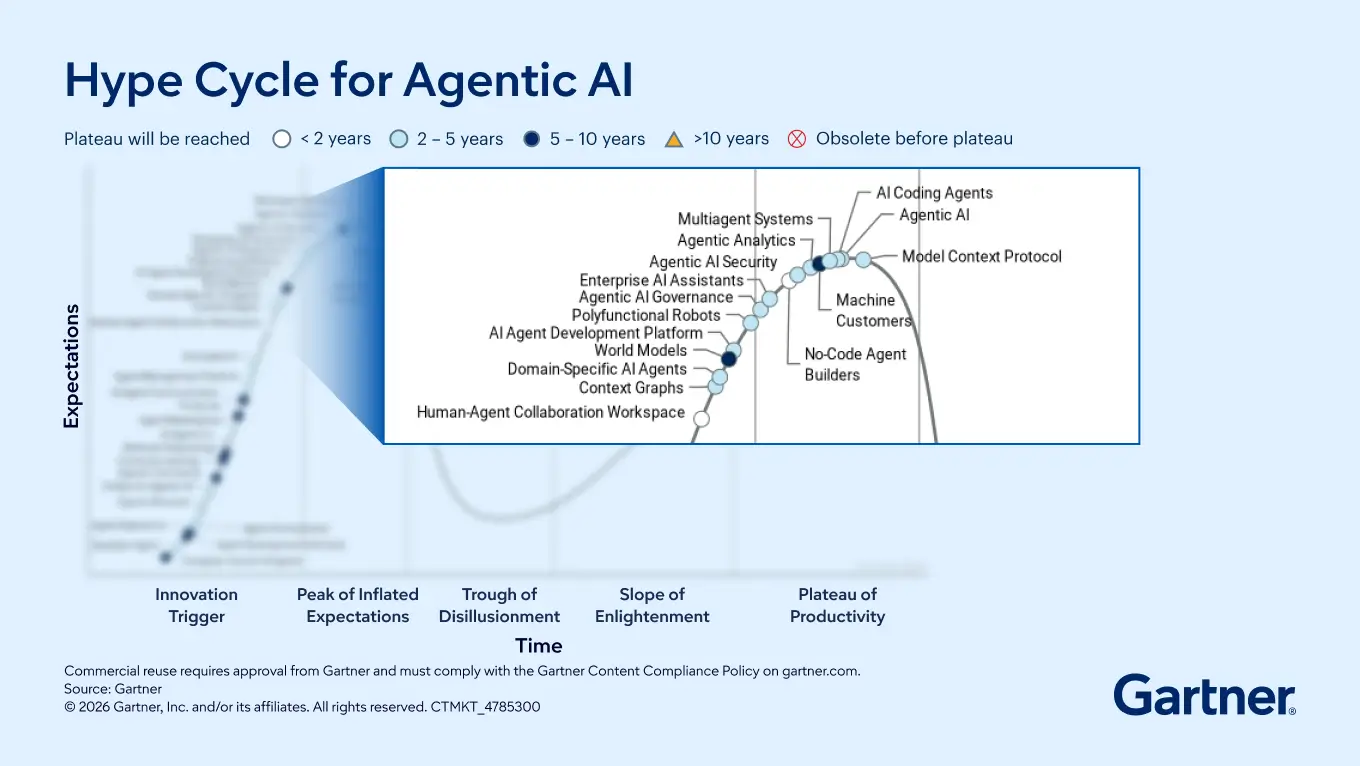
Over 60% of the enterprise AI investments are shifting towards multi-step and autonomous AI systems. Yet, most teams fail, not at the model level but at the architectural level.
Choosing the wrong framework can create ceilings on scale, coordination, and your system’s ability to handle the unexpected. By the time they appear, eliminating them becomes expensive.
Agentic AI systems are only as capable as the infrastructure that powers their decision-making, coordination, and memory. LangGraph, CrewAI, AutoGen, and other platforms promise autonomy. However, each solves a fundamentally different problem at a distinct scale.
Before your team starts writing the code for agent logic, you must make the right framework decision. This guide will break down every major agentic AI framework in 2026, helping you evaluate, compare, and confidently choose the right one.
Why do Frameworks Matter for Agentic AI Systems?
Building your agentic AI system without a framework is possible. But that kind of decision feels fine on day one. However, it becomes a serious problem in month three.
Frameworks aren’t just convenience layers. They are the structural backbone that determines how reliable your agents can act, think, and recover when things go wrong. Here’s why foundation matters from the start.
- They define how your agents can make decisions. With a structured reasoning layer, autonomy can become unpredictable very fast.
- It handles complexities you haven’t encountered t. Pre-built resolution logic is important for multi-step tasks, tools, and failures.
- You can standardize how your agents communicate. This is especially useful when multiple agents are collaborating on a shared goal.
- They make System debugging easier and more effective. Raw LLM pipelines are hard to trace when something breaks.
A customer support agent handling tickets autonomously sounds powerful. This works best till a single missed detail sends the agent in the wrong direction, derailing your entire workflow.
The right framework doesn’t just support your system; it quietly determines its ceiling.
Benefits of Agentic AI Frameworks
Choosing the right agentic AI framework will make development easy. It also shapes what your system can deliver. Here’s what you get when you invest in the right foundation.
Autonomous Decision-making
Frameworks offer a structured reasoning layer to your agents. It lets them break down complex goals, prioritize actions, and make decisions without manual intervention. Your system stops being just another tool you operate. It becomes an independent system.
Dynamic Adaptability
Real-world tasks may not go as planned. Agentic frameworks help systems detect when the defined approach isn’t working. It also gives them a course correction in real time, without having to restart from scratch. This resilience separates a demo from a protection-ready system.
Tool Use and Integration
A framework provides standard interfaces for agents, enabling them to call external APIs, run code, and interact with third-party services efficiently. Your agents can dynamically reach for the right tool at the right time, instead of hardcoding these integrations.
Continuous Learning and Memory
Every interaction starts from zero without memory. Frameworks provide short-term context management along with long-term memory storage. This allows agents to learn from past interactions, improve output quality, and retain user preferences.
Multi-Agent Coordination
Some tasks are simply too complex for a single agent. Frameworks enable multiple specialized agents to collaborate seamlessly. It divides responsibilities, shares context, and synchronizes outputs, without stepping on each other.
Put together, these capabilities don’t just make agentic systems smarter. They also make them genuinely deployable at enterprise scale.
Core Components That Power Agentic Systems
Understand what happens under the hood before assessing the framework. Every capable agentic system is built on five core components. This is irrespective of the framework it uses for the foundation. You should understand them to interpret the framework comparisons.
Planning and Reasoning Module
This module helps your agent think before they act. The planning module will break down each goal into a sequence of steps. This allows the agent to determine what will happen first and anticipate potential blockers. Your agents may rush into execution without adequate planning, increasing the risk of errors.
Memory Management
Agents without memory start every interaction from scratch. That’s why memory management is important. It handles what the agent remembers right now (short-term) and what it retains across sessions (long-term). This component will also retrieve relevant context as needed. Interactions will feel intelligent instead of repetitive.
Tool Integration (Action Module)
At some point in the interaction, agents need to take some action. The action module manages how agents interact with the outside world. It can call APIs, run searches, write to databases, and trigger workflows. The component becomes the bridge between reasoning and real-world impact.
Perception Component
Agents receive information from user inputs, documents, live data feeds, and other agents. Think of this component as the system’s ability to observe the environment before responding. Better perception indicates increased situational awareness. This improves decision quality.
Learning and Reflection Loop
The best AI agentic systems don’t just complete tasks; they also get better at completing them. This loop lets agents evaluate their own inputs, identify what worked, and adjust the approaches. This turns a capable agent into a continuously improving one.
All five components together form the engine behind every agentic system it builds.
Our team helps you choose, build, and scale the right agentic AI architecture before complexity becomes an issue.
Top Agentic AI Frameworks in 2026
From how your agents reason to how confidently your system can manage real-world pressure, the framework you choose will shape everything. Here are ten platforms that lead conversations in 2026.
LangGraph
This tool brings a graph-based approach to agent orchestration. Using LangGraph, you can define workflows as nodes or edges instead of rigid linear chains. This structure offers precise control over agent transitions, making it suitable for complex and multi-step workflows. This is useful in places where you need conditional logic or human-in-the-loop checkpoints.
The framework is built on LangChain, offering a rich ecosystem of integrations. It enables stateful and cyclical execution that no other frameworks can match. The flip side is a steep learning curve, as most teams are unfamiliar with graph-based thinking.
Reliability and control matter more than setup speed for enterprise teams building production-grade pipelines. That’s where LangGraph is a strong choice.
AutoGen
AutoGen by Microsoft is built on a single core idea: agents collaborate to solve their problems. It enables multiple AI agents to collaborate using structured conversations. Each agent plays a defined role in attaining the goals.
What makes this system powerful is its flexibility. Agents can be fully autonomous, human-assisted, or in between. This depends on what their tasks demand. The AI agentic framework can manage complex reasoning tasks well and integrates with existing Microsoft tooling.
It can be difficult to debug conversation-heavy architectures, especially when something goes wrong mid workflow, using this tool. This is the right choice if your use case needs agents to collaborate across roles. Its best use cases include research pipelines, code-review workflows, and multi-perspective analysis systems.
CrewAI
The tool takes a role-based approach for multi-agent collaboration. Each agent is assigned a specific role, set of tools, and goal, akin to building an actual team. Eventually, it becomes intuitive to design, especially if your teams think in terms of responsibilities instead of technical abstractions.
The framework is fast to set up, provides a readable structure, and handles delegation between agents seamlessly. It works best for content pipelines, business workflow orchestration, and research automation, where distinct roles are assigned to specific tasks.
It poses limitations at scale. You will note it is highly difficult to manage complex agent interactions as the crew grows. If you want multi-agent power without the architectural overhead, this is the tool for you. It provides an accessible and production-friendly entry point.
OpenAI Agents
OpenAI agents have evolved from the Swarm framework. It offers a lightweight and opinionated way to build agentic AI systems using the OpenAI model ecosystem. The architecture is simple, comprising agents, handoffs, and guardrails. It is fast to prototype and easy to use.
Tight integration with GPT-4o and other OpenAI models helps optimize performance across the ecosystem without requiring additional configuration. It starts showcasing limitations when used outside the ecosystem. If you want model flexibility or deep customizations, you might feel the system is restrictive.
It also lacks the advanced orchestration features that LangGraph offers. Despite that, if your team is invested in the OpenAI stack and needs a reliable agent workflow without the complexity of a framework, this is the one for you. It offers a practical and well-supported starting point.
SuperAGI
SuperAGI is built for enterprise deployment from the ground up. It extends an open-source framework comprising a visual agent management interface. This is one of the few platforms where non-engineering stakeholders can observe, manage, and interact with agents.
You can use this tool for concurrent agent execution, long-term memory, and a growing library of out-of-the-box tool integrations. The way it provides operational visibility gives it a distinctive edge. You can use the tool to monitor agent performance, track resource usage, and intervene as needed via the UI instead of raw logs.
The trade-off is a smaller ecosystem compared to LangChain frameworks. Its community support is still maturing.
This system is a strong fit for enterprises that need governance and observability baked into their infrastructure from the start.
LlamaIndex
One of the top AI agentic frameworks, LlamaIndex, started as a data framework for LLMs. It gradually evolved into a capable agentic platform with clear specialization, offering retrieval-augmented generation at scale.
This tool performs better than other tools if you need an agentic system to manage large volumes of structured or unstructured data. It extends robust data connectors, flexible indexing strategies, and agent workflows, all tightly optimized for knowledge retrieval.
This framework works best when your agent’s main work is to find and use the data. However, if the agent needs to perform actions, other frameworks are better.
LlamaIndex is best suited for knowledge-intensive enterprise applications, such as legal research tools, internal knowledge assistants, and document-heavy workflows. You can use it for systems in which the quality of the retrieved text determines the agent’s output quality.
Semantic Kernel
Semantic Kernel is the enterprise-grade SDK designed by Microsoft. It helps build AI agents and copilots with deep integrations across the Microsoft ecosystem. This includes Azure OpenAI, Microsoft 365, and others.
As it supports Python and C#, it is one of the few frameworks that enterprise .NET teams can use without switching languages. The plugin architecture lets developers wrap existing business logic, offering a clean output to the agents. You no longer need to integrate AI into your legacy systems.
It is a mature and well-documented framework, backed by Microsoft’s enterprise support infrastructure. The flip side is that it can feel more verbose than lightweight frameworks. If your enterprise uses Azure and is built on a .NET infrastructure, this foundation seems like a natural and strategic choice.
Haystack
Deepset builds haystack and is a framework designed for building production-ready NLP and agent pipelines. It prioritizes search, question answering, and document processing. The pipeline-based architecture makes it modular. You can compose components together, swap them as needed, and test each piece independently. This offers maintenance advantages.
As one of the promising agentic AI frameworks for 2026, it supports a wide range of LLMs and vector databases, extending flexibility on the infrastructure side. However, it becomes less competitive in a multi-agent orchestration requirement as it needs agent-network orientation, which is not the framework’s foundation.
If you need document intelligence, enterprise search, or retrieval-heavy workflows, this tool offers production reliability and component-level control.
DSPy
This agentic AI framework takes a different approach from the others in the list. Instead of manually crafting prompts, DSPy lets you define what you want the system to do. It will then optimize the prompts and reasoning steps automatically using a programming model.
This framework is exceptionally powerful for teams that want to move beyond prompt engineering to build systems that improve through optimization rather than manual tuning.
You can use this framework for research-oriented applications and systems, where output quality must be measurable and systematically improved. It has a steep learning curve because you need to shift how you think about LLMs. If you are ready to shift the mindset, this tool offers systematic reliability and performance optimization that other prompt pipelines can never extend.
AutoAgent
This is a fully automated agentic AI framework that allows users to create and deploy AI agents with minimal manual intervention. In some cases, you can deploy the agents with natural language instructions alone. The tool is designed to lower the barrier to agentic AI adoption. Using this framework, your teams can effectively access deep AI engineering expertise.
Using this tool, you can automatically manage agent creation, tool assignment, and even workflow configuration, speeding up initial deployment. It is the best fit for rapid prototyping, internal tooling, and other use cases, where time to deployment matters more.
The trade-off is predictable. Automation at this stage also means less transparency into how agents are structured. This can create challenges, especially when you are debugging or customizing at scale. It is fit for teams that need functional agent systems, with a solid plan to layer in more as their requirements mature.
Each framework on this list is capable. However, none of them is universally the best. Your choice of framework depends on what you are building, what the team needs, and where you need your system to perform six months from initial setup.
Moon Technolabs brings the technical depth and enterprise experience needed to turn your agentic AI vision into a production reality.
How to Choose the Right Agentic AI Framework?
From how your agents reason amid complex workflows to how confidently your system manages real-world pressure, the right framework will shape it all. With these ten strong options available for you, the decision is no longer about finding the best framework. It is about adopting the one that fits your context. Here’s how you can evaluate the best fit before you commit.
Evaluate Autonomy and Reasoning Capabilities
Start by asking how much independent decision-making your system needs. Some frameworks may need deep reasoning and planning support. Others keep agents on a tight leash. Match the autonomy level of your framework to the complexity of the user case. Over-engineering a simple workflow can be as expensive as under-building a complex one.
Performance Under Scale
If your framework works beautifully in the prototype stage, it may quietly fall apart under production load. You must test the framework to understand how it manages concurrent agent execution, latency under stress, and resource consumption as complexity rises. Scale isn’t just another future problem; it is a design decision you must make.
Multi-agent Coordination Support
If your system requires agents to collaborate across roles and tasks, the framework should have native support for this. Evaluate how well it can manage delegation, context sharing, and conflict resolution between agents working in parallel.
Security and Governance
Enterprise deployments require more than just a capable agent. They need an auditable and controllable agentic AI framework. You should choose frameworks that offer access controls, interventions, and logging that satisfy compliance requirements.
Tool and API Integration
Choose a framework that can connect your agents to the world in which your business operates. Look for frameworks that offer broad, stable integration support so your agents can think and act.
How Moon Technolabs Helps You Build Agentic AI Solutions?
Understanding frameworks is one thing. Building production-ready agentic systems that deliver business outcomes is another. That’s where Moon Technolabs comes in.
We work with product teams and enterprises to design, develop, and deploy agentic AI solutions built for the real-world complexities. From helping you select the right framework for your architecture to building multi-agent systems that integrate with existing infrastructure, we bring technical depth and domain experience.
We don’t believe in one-size-fits-all AI. Each engagement starts with an understanding of your workflows, scale requirements, and where autonomous decisions can create measurable impact for your business.
Conclusion
Agentic AI frameworks are no longer a concept in the making. It is an architectural decision your team is already facing. The frameworks covered in this guide represent what’s available in 2026, their distinct strengths, ideal use cases, and where they don’t fit. A well-informed shortlist is just the beginning. You must match the right framework to your problem, build on it correctly, and scale without losing control of what your agents are doing.
The teams that get this early will build systems that compound in value over time. If you are ready to move from evaluation to execution, Moon Technolabs is ready to build your agentic AI system. Get in touch with our experts today.
FAQs
01
What are the 4 stages of agentic AI?
Perception, reasoning, action and learning are the four stages of agentic AI wherein agents observe, plan, execute, and continuously improve based on outcomes from each stage.02
What are the four pillars of agentic AI?
Autonomy, memory, tool use and goal orientation are the four pillars that allow agents to operate independently and purposefully.03
What are the 5 types of agentic AI?
Reactive, deliberative, collaborative, learning, and hybrid agents are the five types that help agents process information and make decisions.04
How many agentic AI frameworks are there?
There are 10-15 AI frameworks in the ecosystem. LangGraph, CrewAI, OpenAI, and AutoGen are among the most commonly used.05
What programming languages are used in agentic AI?
Python, JavaScript, TypeScript, and C# are the most widely used programming languages for Agentic AI.




Jayanti Katariya is the CEO of Moon Technolabs, a fast-growing IT solutions provider, with 18+ years of experience in the industry. Passionate about developing creative apps from a young age, he pursued an engineering degree to further this interest. Under his leadership, Moon Technolabs has helped numerous brands establish their online presence and he has also launched an invoicing software that assists businesses to streamline their financial operations.
Submitting the form below will ensure a prompt response from us.
We refine our expertise to deliver innovative business solutions.




205 N Michigan Avenue, #810, Chicago, 60601, Illinois, United States
13500 Long Is Dr, Pflugerville, TX 78660, USA

C/105 Ganesh Meridian, S.G. Highway, Ahmedabad, GJ 380060


Ayse D.
Co-Founder France
“ I highly recommend Moon Technolabs as the quality of service is wonderful. We have hired this company to develop the product based on some complex & technical issues. We get the best quality services as compared with others in the market. Huge Thanks to Moon Technolabs as the team is always ready to give the solution all time.”

Justin G.
Founder & CEO USA
USA“ Moon Technolabs is a pioneer in the WebRTC based project as they have fixed complicated segments of the module by fulfilling different product lines by providing 24X7 customer support. We really recommended Moon Technolabs as they are able to develop products as per the module deadline and project timeline.”

Flavio S.
Founder & Managing Director Germany
“I am happy to recommend Moon Technolabs for their app development services. They successfully developed apps for me, and I am highly satisfied with the overall outcomes. The development team has swiftly addressed the issues with responsive and effective communication to understand the requirement quickly and actively resolve the back-and-forth problems that arose...”

Jay M.
Founder & CEOUSA“Moon Technolabs is the best company that provides advanced apps and websites development services in the USA and Europe. I am a newbie to develop my app with an external team. I am really happy to work with them as I am not that much mobile apps user. Here, the team and specially the CEO of Moon Technolabs helps me to let me know about the benefits of my app to generate revenue....”


Our Offices
India
C/105 Ganesh Meridian,S.G. Highway, Ahmedabad, GJ 380060USA
205 N Michigan Avenue, #810, Chicago, 60601, Illinois, United StatesContact Information


