


Demystifying AI Agent Architecture: A Blueprint for Enterprise Systems

Artificial Intelligence Team
Last Updated: Sep 28, 2026 Total Views: 84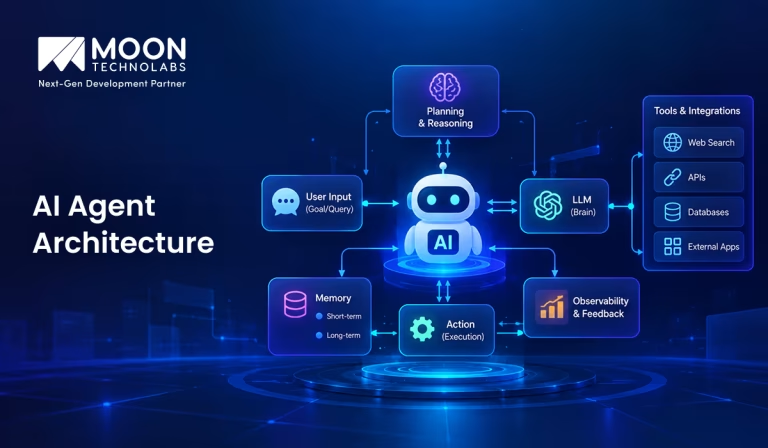
Table of Content


Table of Content
In today’s AI landscape, excitement is shifting from AI chatbots to AI agents—smart systems that can plan steps, use different tools, and complete complex tasks on their own.
The big catch is that building an AI agent that actually works without crashing, getting stuck in loops, or making silly mistakes is surprisingly difficult. Moving these ideas from a fun weekend project into a robust AI agent architecture for the real world takes careful planning.
This guide breaks down the most important strategies you need to know, from keeping your system organized and setting clear rules to making sure your agents stay safe, helpful, and easy to trust.
What is AI Agent Architecture?
AI agent architecture refers to the structure and design that enables an AI agent to perceive information, understand goals, make decisions, and take actions autonomously. It typically includes components such as input processing, memory, reasoning, planning, tool use, and action execution. These components work together to help the agent understand its environment, process user requests, decide what to do, and complete tasks.
A typical AI agent orchestration architecture follows a cycle of perception → reasoning → planning → action → feedback.
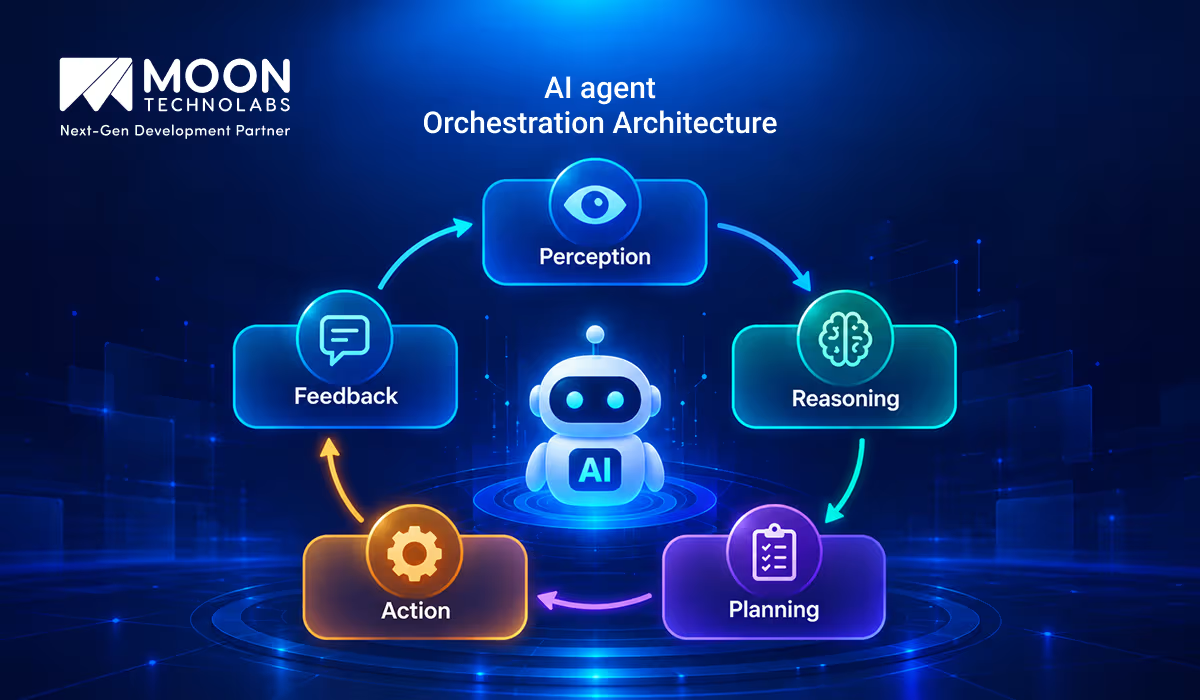
The agent receives information from users or external systems, analyzes it using an AI model, creates a plan, uses available tools or APIs when required, and evaluates the results to determine the next step. This agent architecture allows AI agents to handle complex tasks, adapt to changing situations, and perform multi-step operations with limited human intervention.
The 4 Pillars of AI Agent Architecture
Here are the essential core components required to transform a basic language model prompt into a reliable, enterprise-grade autonomous system:
Pillar 1: The Reasoning Engine — The Brain
Find a laptop suitable for programming under my budget and co
The reasoning engine is the intelligence at the core of an AI agent. It typically runs on an LLM that understands instructions, interprets context, evaluates information, and makes decisions.
Unlike a traditional chatbot that simply generates a response, an AI agent uses its reasoning engine to determine what needs to be done and what to do next.
Key Responsibilities:
- Understand the user’s intent and objectives
- Analyze available information and context
- Make decisions based on goals and constraints
- Determine when additional information is required
- Select appropriate tools or actions
- Interpret the results returned by tools
Example:
If a user says:
“Find the best flight to Delhi and add it to my calendar.”
The reasoning engine breaks the request into logical steps: understand the travel requirements, determine what information is missing, search for flights, evaluate the results, and then prepare the calendar action.
In simple terms: The reasoning engine handles thinking and decision-making.
Pillar 2: Memory Systems — Context & State Management
An AI agent needs memory to maintain context, continuity, and state while working towards a goal.
Without memory, an agent may treat every interaction as a completely new task. Memory allows it to remember relevant information, track what has already happened, and maintain the current state of a workflow.
Types of Memory:
- Short-Term Memory: Maintains the current conversation and immediate context.
- Long-Term Memory: Stores useful information across sessions, such as preferences or historical interactions.
- Working Memory: Holds temporary information required while completing a task.
- External Knowledge: Retrieves information from documents, databases, APIs, or knowledge bases when the agent needs additional context.
Example:
The customer-support agent may remember that a customer has already provided their order number and has completed the identity-verification step. It does not need to ask for the same information again.
In simple terms: Memory allows an agent to remember what matters and maintain state.
Pillar 3: Planning & Reasoning Protocols — The Strategy
Reasoning alone is not enough for complex tasks. An AI agent also needs a strategy for deciding how to achieve its objective.
Planning and reasoning protocols define how the agent transforms a high-level goal into a sequence of smaller actions.
A typical agent loop looks like:
Goal → Plan → Act → Observe → Re-plan → Complete
The agent may break a complex task into multiple steps, execute them one at a time, evaluate the results, and adjust its plan as conditions change.
Key Capabilities:
- Break complex objectives into smaller tasks
- Establish dependencies between actions
- Prioritize tasks
- Evaluate intermediate results
- Recover from failures
- Re-plan when new information becomes available
- Determine when the objective has been achieved
Example:
For the request:
“Prepare a market analysis and email it to me.”
The agent could plan:
- Gather relevant market data
- Analyze the information
- Identify important trends
- Generate the report
- Review the output
- Send the final report by email
In simple terms: Planning determines how the agent will accomplish its goal.
Pillar 4: Tool Integration & Execution Layer — The Hands
Tools give an AI agent the ability to interact with the real world.
An LLM can reason about what should happen, but tools let the AI agent perform the required action. The execution layer connects the agent to external systems, APIs, databases, applications, and services.
Common Agent Tools:
- Web and search tools
- Databases and SQL
- REST APIs
- Code execution environments
- Email and messaging systems
- CRM and enterprise applications
- File systems and document stores
- Calendar and scheduling systems
Example:
An AI travel agent might use:
Search API → Flight Database → Payment System → Calendar API
The reasoning engine decides which tool to use and why, while the execution layer handles the actual interaction with those systems.
Key Agent Orchestration Patterns
Here are the primary workflow patterns and control strategies used to coordinate decision-making, manage tool execution, and direct autonomous agent behaviors:
Single-agent Design Patterns
A single agent handles the task using reasoning, tools, and structured workflows.
ReAct
The agent alternates between reasoning, taking actions, observing results, and continuing until the task is complete.
Best for: Research, troubleshooting, and tool-based tasks.
Plan-and-Execute
The agent creates a plan first and then executes each step.
Best for: Complex, multi-step workflows.
Reflection
The agent generates an answer, reviews it for errors, and improves it.
Best for: Coding, writing, and quality-sensitive tasks.
Tool Calling
The agent decides when to use external tools such as APIs, databases, search, or calculators.
Best for: Tasks requiring external or real-time information.
Human-in-the-Loop
The agent pauses for human approval before performing sensitive or important actions.
Best for: High-impact or approval-based workflows.
Multi-agent Design Patterns
Multiple specialized agents collaborate to complete a larger task.
Supervisor
A central agent assigns tasks to specialized agents and combines their results.
Example: Research Agent → Data Agent → Writing Agent.
Sequential Handoff
Agents work one after another, passing results to the next agent.
Example: Research → Analysis → Writing → Review.
Parallel Collaboration
Multiple agents work on different parts of a task simultaneously, and their results are combined.
Best for: Faster processing and independent research.
Debate
Agents generate and critique different solutions before producing a final result.
Best for: Complex reasoning and validation.
Peer-to-Peer
Agents communicate directly and dynamically delegate tasks to one another.
Best for: Flexible and decentralized workflows.
Hierarchical
Agents are organized into multiple levels, with higher-level agents coordinating specialized sub-agents.
Best for: Large and complex workflows.
How an AI Agent Works: Architecture Flow
An AI agent is a system that can understand a goal, gather relevant information, make decisions, use tools, and continuously evaluate its progress to complete a task. You can understand the process as a five-step architecture flow, which includes:
Step 1: Goal Ingestion & Normalization
The process begins when the user provides a goal, request, or instruction. The AI agent interprets the input and converts it into a structured representation that the system can work with.
During this stage, the agent identifies:
- The user’s main objective
- Required inputs and constraints
- Expected output
- Important preferences or conditions
Step 2: Context Retrieval & Memory Query
Once the agent understands the goal, it gathers the information needed to make an informed decision. It may retrieve information from memory, databases, documents, APIs, or external systems.
The agent determines:
- What information is already available
- What additional context is required
- Which previous interactions or stored information may be relevant
This step helps the agent avoid making decisions based only on the current user input.
Step 3: Plan Formulation
The agent then creates a plan of action for achieving the goal. It breaks complex tasks into smaller, manageable steps.
A plan may include:
- Identify the required resources
- Select appropriate tools
- Execute the necessary actions
- Evaluate the results
- Adjust the plan if required
The plan is dynamic, meaning the agent can modify it when it receives new information or unexpected results.
Step 4: Tool Execution & Environment Response
The agent executes the planned actions by interacting with its environment through tools and external systems.
Depending on the task, tools may include:
- Web search
- APIs
- Databases
- Code execution
- File systems
- Business applications
- Sensors or other external systems
After each action, the environment returns a response or observation. The agent uses this feedback to decide what to do next.
Step 5: Reflection & Loop Termination
After executing an action, the agent evaluates the result against the original goal. This is the reflection stage.
The agent asks:
- Did the action produce the expected result?
- Is the goal complete?
- Is more information required?
- Should the plan be changed?
- Has an error occurred?
If the goal has been achieved, the loop terminates, and the agent provides the final result.
If the goal has not been achieved, the agent returns to planning or tool execution and continues the cycle.
AI Agent Architecture: Real-world Use Cases
Here are the primary industry use cases and operational scenarios demonstrating how businesses deploy autonomous agents to handle complex, multi-step workflows:
Customer-support Agent
Customer question
↓
Understand intent
↓
Retrieve account/order information
↓
Search knowledge base
↓
Decide response or action
↓
Update CRM / issue refund / escalate
Example:
A customer asks, “Where is my order, and can I change the delivery address?”
The agent can:
- Identify the customer.
- Query the order-management API.
- Check shipment status.
- Determine whether the address can still be changed.
- Update the order if permitted.
- Tell the customer what happened.
The important distinction is that the agent isn’t merely generating an answer; it can take an authorized action.
Software-development Agent
A coding agent can operate across an entire development workflow:
Issue / requirement
↓
Understand codebase
↓
Search relevant files
↓
Plan implementation
↓
Modify code
↓
Run tests
↓
Analyze failures
↓
Fix → retest
↓
Create PR
Example:
“Add OAuth login to the application.”
The agent might inspect the repository, identify the authentication architecture, modify several files, install or configure dependencies, run tests, and prepare a pull request.
Human review can remain mandatory before merging or deploying.
Healthcare Administration
Agents can automate administrative workflows without replacing clinical decision-making.
Example workflow:
Patient request
↓
Identify appointment requirement
↓
Check scheduling system
↓
Find eligible slots
↓
Verify insurance information
↓
Book appointment
↓
Send confirmation
Other applications include:
- Medical-document summarization
- Prior-authorization workflow assistance
- Appointment scheduling
- Patient-message routing
- Medical coding assistance
For high-impact clinical decisions, additional validation and human oversight are important.
E-commerce Shopping Agent
An agent can handle a multi-step shopping task:
“Find a laptop suitable for programming under my budget and compare the options.”
Architecture:
User requirements
↓
Clarify constraints
↓
Search product catalog
↓
Filter products
↓
Compare specifications
↓
Check availability/price
↓
Present options
↓
Optional purchase workflow
The agent can use product APIs, inventory systems, payment systems, and order-management APIs.
Best Practices for Designing AI Agent Architectures
Here are the critical engineering rules and proven development strategies needed to build secure, stable, and high-performing autonomous systems for production environments:
Modular and Role-based Separation
Isolate LLM reasoning from deterministic code execution to ensure system reliability. Avoid monolithic designs by breaking complex workflows into specialized components with single responsibilities, allowing individual modules to manage distinct tasks effectively without overloading a single prompt with conflicting logic.
Implement Structured Reasoning Loops
Embrace plan-act-observe patterns instead of brittle single-shot responses to guide agents through complex workflows. Define clear stopping criteria and strict iteration limits to prevent endless execution loops, ensuring your agent completes tasks efficiently while maintaining total control over its progress.
Build Deep Observability from Day One
Capture every tool call, prompt version, latency metric, and state change from the earliest development phase. Incorporate continuous automated evaluation pipelines to track performance drift, reasoning quality, and failure rates over time, ensuring you can quickly diagnose issues and optimize system behavior.
Enforce Strict Guardrails and Human Oversight
Sandbox tool execution using explicit schemas, environment limits, and sanitized outputs to prevent unauthorized system access or data leaks. Implement human-in-the-loop checkpoints that pause workflows and require explicit approval before executing sensitive tasks like financial transactions or data modifications.
The Future of AI Agent Architecture
Next-generation AI agent architecture is shifting toward collaborative multi-agent networks and lightweight models. Instead of relying on one general-purpose model, future designs assign complex workflows to teams of specialized sub-agents, such as planners, coders, and auditors, that communicate through standardized protocols to execute complex business tasks autonomously.
At the same time, next-gen agent architecture in AI prioritizes real-time reflection and built-in safety checks over brute scale. By integrating self-correction loops and persistent memory, agents will continuously audit their own actions before taking real-world steps, transforming from passive tools into self-optimizing, reliable digital problem solvers.
Why Choose Moon Technolabs to Build Your AI Agent Infrastructure?
Choosing the right technology partner is essential for building secure, scalable, and intelligent AI agent infrastructure. Moon Technolabs brings expertise in artificial intelligence, automation, cloud technologies, and custom software development to help businesses create AI agent systems aligned with their operational needs.
As an experienced AI agent development company, we work across key components such as agent architecture, LLM integration, APIs, databases, memory systems, and third-party tools to build reliable, efficient AI-driven workflows. Focused on scalability, performance, and seamless integration, we help businesses move from AI experimentation to production-ready agent solutions.
Our team can build AI agents designed to automate repetitive processes, assist employees, analyze information, and support customer interactions. Whether you need a single intelligent agent or a connected multi-agent ecosystem, we can help establish the technical foundation needed for long-term AI adoption.
Conclusion
Mastering AI agent architecture requires a deliberate balance between autonomous reasoning and strict engineering control. By adopting modular components, structured reasoning loops, comprehensive observability, and rigorous guardrails, organizations can build scalable, production-ready systems that deliver reliable business value.
Building these sophisticated architectures takes specialized expertise, so it’s essential to hire AI developers who can bridge the gap between cutting-edge LLM capabilities and secure, enterprise-grade system design.
FAQs
01
How much does it cost to build a custom AI agent for my business?
The cost depends on complexity. A simple task-automation agent is relatively inexpensive, while an enterprise-grade agent integrating multiple internal databases, custom tools, and strict security guardrails requires more specialized engineering and a larger investment.02
How long does it take to develop and launch an AI agent?
A basic prototype can be built in a few weeks, but creating a production-ready agent that handles edge cases safely usually takes anywhere from two to three months, including thorough testing, observability setup, and safety guardrails.03
Can we integrate our existing company software and databases with the agent?
Yes! Modern AI agents are specifically designed to connect with your existing tech stack—like CRMs, ERPs, and internal databases—using secure APIs so they can fetch real-time data and take meaningful actions on your behalf.04
How do we ensure the agent doesn't leak sensitive data or hallucinate wrong information?
We prevent this by building strict engineering guardrails. This includes sandboxing tool access, restricting the agent to verified company knowledge bases, and implementing human approval steps for sensitive tasks like sending emails or processing transactions.



Explore the latest insights on Artificial Intelligence, including Generative AI, Agentic AI, natural language processing, computer vision, automation, and enterprise AI solutions. This category covers industry trends, practical applications, implementation strategies, and innovations that help businesses leverage AI for smarter decision-making and digital transformation. Stay updated with evolving AI technologies that are reshaping industries worldwide.
Submitting the form below will ensure a prompt response from us.
We refine our expertise to deliver innovative business solutions.





205 N Michigan Avenue, #810, Chicago, 60601, Illinois, United States
13500 Long Is Dr, Pflugerville, TX 78660, USA

C/105 Ganesh Meridian, S.G. Highway, Ahmedabad, GJ 380060


Ayse D.
Co-Founder France
“ I highly recommend Moon Technolabs as the quality of service is wonderful. We have hired this company to develop the product based on some complex & technical issues. We get the best quality services as compared with others in the market. Huge Thanks to Moon Technolabs as the team is always ready to give the solution all time.”

Justin G.
Founder & CEO USA
USA“ Moon Technolabs is a pioneer in the WebRTC based project as they have fixed complicated segments of the module by fulfilling different product lines by providing 24X7 customer support. We really recommended Moon Technolabs as they are able to develop products as per the module deadline and project timeline.”

Flavio S.
Founder & Managing Director Germany
“I am happy to recommend Moon Technolabs for their app development services. They successfully developed apps for me, and I am highly satisfied with the overall outcomes. The development team has swiftly addressed the issues with responsive and effective communication to understand the requirement quickly and actively resolve the back-and-forth problems that arose...”

Jay M.
Founder & CEOUSA“Moon Technolabs is the best company that provides advanced apps and websites development services in the USA and Europe. I am a newbie to develop my app with an external team. I am really happy to work with them as I am not that much mobile apps user. Here, the team and specially the CEO of Moon Technolabs helps me to let me know about the benefits of my app to generate revenue....”


Our Offices
India
C/105 Ganesh Meridian,S.G. Highway, Ahmedabad, GJ 380060USA
205 N Michigan Avenue, #810, Chicago, 60601, Illinois, United StatesContact Information


