


$18.77B
Projected Market Size by 2033

Jayanti Katariya
Last Updated: April 01, 2026 Total Views: 387
Table of Content


Blog Summary:
You must be wondering how top financial companies manage billions in assets so effortlessly. The answer is wealth management software. It’s a robust platform that automates portfolio management, ensures compliance, and delivers personalized insights. This blog covers different types of wealth management solutions, essential advantages, the step-by-step process, future trends, real-world cost breakdowns, and much more.
Table of Content
At Moon Technolabs, we’ve spent years building wealth management software for financial institutions, and we’ve seen firsthand how critical modern technology is to success. Wealth management in today’s era is no longer about spreadsheets and handshakes—it now requires speed, precision, and intelligence at its core. Financial institutions that are swiftly adapting this technology are thriving in a fluctuating market, while those still relying on legacy systems are falling behind.
This massive growth signals a clear industry shift. It’s non-negotiable to understand and move towards wealth management software development for financial advisors, fintech founders, and enterprise decision-makers. It’s crucial for long-term pertinence and expansion.
Before moving on to the main aspects of wealth management software, let’s first understand the basics.
Wealth management software refers to a specialized digital platform that simplifies and automates the complex management of high-net-worth individuals and their financial advisors. Wealth management platforms are robust and have more advanced characteristics than basic budgeting apps. They integrate a wide array of financial services like portfolio management, tax optimization, estate planning, and risk assessment into a single interface.
Wealth management software utilizes real-time data and advanced analytics, which provides a
360° view of an investor’s assets. Some of the essential benefits are holistic reporting, precision rebalancing, and enhanced compliance monitoring. Basically, wealth management software transforms unorganized financial data into actionable insights. Hence, individuals can make more informed investment decisions and preserve their wealth over the long term.
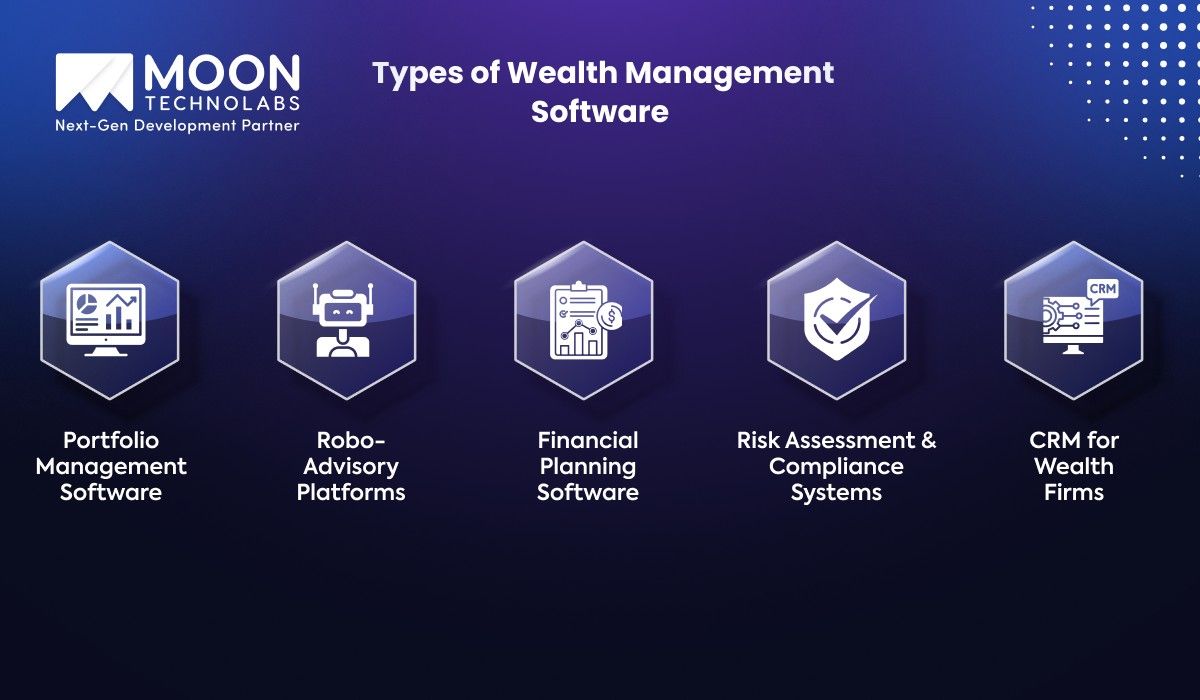
Modern wealth management utilizes sophisticated technologies to deliver personalized investment strategies. Let’s explore the different essential solutions revolutionizing the wealth management sector:
Portfolio management software (PMS) is a centralized hub for portfolio tracking, analyzing, and managing multiple assets. Real-time tracking consolidates portfolio data from various brokerage accounts to provide a live view of holdings.
Portfolio performance analytics involves calculating key metrics, such as the internal rate of return (IRR) and time-weighted return (TWR), to measure performance against benchmarks. Portfolio rebalancing tools automatically suggest trades to bring it back in line with the client’s original asset allocation strategy.
Robo-advisors are automated digital platforms that provide algorithm-driven financial planning services with minimal human intervention. It uses modern portfolio theory to automatically diversify investments based on a user’s goals. It also utilizes sophisticated algorithms to identify opportunities that sell securities at a loss to offset capital gains taxes.
This wealth management solution helps financial institutions achieve their long-term financial goals strategically. Financial advisors use it to visualize milestones such as retirement, education funding, or estate transfers.
These tools also allow advisors to assess various scenarios in the financial industry, such as market trends and life events, and to make informed investment decisions. The financial planning software strengthens trust and fosters long-term client relationships by enhancing transparency and helping clients understand the rationale behind recommendations.
Wealth management systems can be considered the guardrails for financial companies, protecting both advisors and clients. It goes beyond simple questionnaires to determine a client’s true emotional and financial capacity for volatility. It ensures that every trade and recommendation adheres to local laws (such as the SEC or GDPR).
Moreover, it maintains a digital paper trail of all communications and transactions to simplify reporting.
CRM systems are in charge of the firm’s wealth management operations. It’s not like the generic CRM. These are custom solutions that control complex household structures and financial data. These types of wealth management solutions enable registered investment advisors to see the full picture of family wealth.
It provides workflow automation like client onboarding, meeting reminders, and document signing. Moreover, it allows advisors to provide a white-glove service to hundreds of clients simultaneously.
You Might Also Like:
As the financial industry expands, wealth management software is now a necessity for financial institutions. Let’s check out why:
Wealth management software integrates scattered data into a cohesive environment. By automating back-office tasks, institutions can reduce operational costs and eliminate the human error associated with manual data entry. This allows firms to scale their operations without a linear increase in headcount.
Market trends shift in milliseconds, and data is the ultimate hero. Advanced software provides real-time data analytics and speculative scenario modeling that human advisors simply cannot replicate at scale. Institutions are capitalizing on Big Data and AI-driven insights to identify emerging market trends and optimize asset allocation based on precise risk-to-reward ratios, and monitor portfolio performance.
The regulatory ecosystem, including GDPR, MiFID II, and SEC authorizations, is increasingly demanding. Wealth management software automatically performs regular security audits, ensures data privacy, and generates standardized reports with a single click. This automation greatly minimizes the risk of heavy fines.
Today’s investors expect transparency, speed, and 24/7 access. Modern wealth management platforms provide client portals where investors can view their portfolio performance, communicate with advisors, and sign documents digitally.
Above all, these digital tools use financial data to help advisors offer hyper-personalized advice. Instead of generic investment strategies, advisors can tailor portfolios to a client’s specific ESG (Environmental, Social, and Governance) preferences, life goals, and real-time financial changes.
Off-the-shelf solutions cannot fully add value to dynamic workflows. Our team provides tailored solutions designed to integrate your data and reduce operational costs substantially.
Developing custom wealth management software involves structuring a high-performance engine for financial growth. The wealth management platforms allow organizations to scale while keeping the human connection intact. Let’s check the benefits in detail:
In this fluctuating market, asset allocations can quickly drift away from a client’s risk tolerance. Automated rebalancing uses sophisticated algorithms to monitor investment portfolios around the clock.
When an asset class exceeds its target weight, the software automatically executes trades to bring the portfolio back in line. It provides consistent risk management and expels the emotional decision-making associated with manual trading.
The contemporary wealth management software provides dynamic dashboards that allow for tracking performance, monitoring market trends, and assessing tax liabilities in real time. This high standard of insight allows advisory services to make data-driven decisions instantly, providing a competitive edge in fast-moving markets.
Wealth management firms are prime targets for cyber threats. Custom software development enables the integration of multi-layered security protocols, including end-to-end encryption, biometric authentication, and blockchain-based audit trails. Furthermore, automated compliance modules ensure that every transaction adheres to global regulations, significantly reducing the risk of human error and legal penalties.
As a firm’s AUM grows, so does the complexity of its operations. A scalable software architecture ensures that whether you are managing 10 clients or 10,000, the system performance remains uninterrupted.
Cloud-native development allows firms to expand their storage and processing power on demand, supporting long-term business elasticity without needing a complete infrastructure revamp.
Wealth management software development portals provide 24/7 access to clients’ financial health, fostering trust and transparency. Features like secure messaging, portfolio tracking visualizations, and self-service document vaults turn the advisor-client relationship into a collaborative partnership. Ultimately, it results in higher retention rates and brand loyalty.
You Might Also Like:
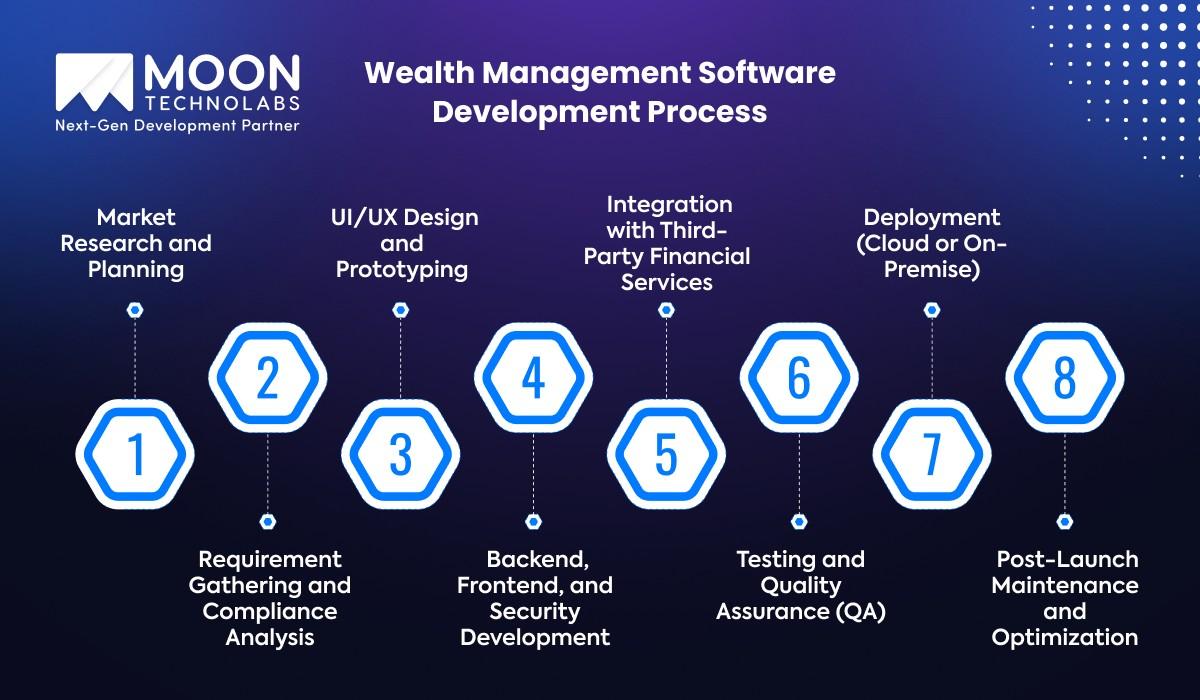
When you develop wealth management software, it requires balancing sophisticated financial logic with ironclad security. It is recommended to follow a structured lifecycle to build a product that earns user trust and scales effectively:
The first stage is about analyzing the current market landscape, identifying competitors, and defining your unique value proposition. You’ll determine if you are targeting high net-worth individuals (HNIs), retail investors, or institutional firms.
The fintech software development is heavily regulated. This phase involves outlining the functional requirements, like portfolio tracking, and the non-functional requirements, like data encryption. It is important that you make sure that the software complies with global and local standards to avoid legal pitfalls.
The next phase is to make the fintech user experience simple and clean. Here, designers create wireframes and interactive prototypes to ensure the interface is intuitive. The goal is to make financial dashboards easy to read and maintain a premium feel that attracts people as well as inspires them.
The next step is to build the client-side interface, i.e. frontend, and the server-side logic, i.e. backend. By now, we all know that wealth management deals with sensitive financial data. Hence, security development needs to be integrated into the code from day one. This may involve multi-factor authentication (MFA) and end-to-end encryption.
The next phase in wealth management software development involves API integration for:
The system undergoes rigorous testing and quality assurance before actually going live. It includes unit testing to verify individual components and penetration testing to identify vulnerabilities. Also, the user acceptance testing (UAT) is required to ensure the software meets the needs of actual investors.
The deployment stage is where the software is moved to a live environment. You can choose cloud deployment for better scalability and cost-efficiency. Alternatively, on-premise deployment is also available if your firm requires total physical control over data servers.
The last step involves monitoring the software for bugs, updating security patches, and gathering user feedback to roll out new features. Optimization ensures the platform stays fast and reliable as the user base grows.
Not Sure Where to Start? Let’s Figure It Out Together
Wealth management software development can get complex. Hence, our fintech development experts will walk you through your estimated timelines, and answer your toughest questions right away.
The future of wealth management software involves creating an interconnected ecosystem that anticipates investor needs, rather than just simple dashboards. Let’s look at some of the core innovations:
The wealth management industry is evolving from robo-advisors to fully functional Agentic AI development. It follows a hybrid intelligence system, shifting from basic automation.
The AI agents can autonomously monitor global macro-trends, sentiment from earnings calls, and real-time news to suggest portfolio shifts. Its impact will reduce time spent on research, allowing human advisors to focus on high-level strategy and emotional coaching.
Blockchain is moving from a crypto-only niche to the foundational infrastructure for tokenization. Wealth management platforms are designed to handle on-chain assets, including tokenized real estate, private equity, and fine art. Its impact lowers the barrier to entry for wealthy investors seeking access to elite asset classes that were previously reserved for the ultra-wealthy.
Future software is using Deep Learning and Bayesian models to predict regime changes in the market before they occur. This enables proactive risk mitigation, allowing wealth managers to move assets to safety before volatility spikes.
This innovation utilizes artificial intelligence to integrate a client’s behavioral analysis, life events, and even social media sentiment into their financial plan. It allows portfolios to automatically adjust in real time to the user’s changing life goals.
Open finance APIs allow wealth management software to securely pull data from every corner of a client’s life, including mortgages, payroll, insurance, and retail accounts. This innovation provides a 360° view of net worth, which enables embedded wealth by offering investment advice at the exact moment a client has excess cash in their checking account.
The wealth management software development cost generally starts from $60,000 and goes up to $500,000. A basic minimum viable product (MVP) is possible at the lower end, but full enterprise-grade wealth management solutions that compete with industry leaders usually require massive investments. The figures below explain the cost of developing financial platforms.
| Company Type | Approximate Cost Range |
|---|---|
| Small-Scale/MVP | $60,000 – $120,000 |
| Medium-Scale | $150,000 – $350,000 |
| Enterprise-Grade | $400,000 – $1,000,000+ |
The total investment is driven by four primary drivers:
Wealth management app development costs scale directly with the depth of the user experience:
| Complexity Level | Cost Range | Best For? |
|---|---|---|
| Low | $40k to $90k | Basic portfolio viewing and manual data entry. |
| Medium | $100k to $250k | Automated rebalancing, CRM sync, and advanced analytics. |
| High | $300k & moree | AI predictive modeling, asset tokenization, and full-scale enterprise security. |
A standard financial software development project requires a multidisciplinary team including the Project Manager, UI/UX Designer, Backend/Frontend Devs, and QA. The project completion timeline is usually 4-10 months from the initial discovery phase to the final security audit and launch.
Post-launch costs are non-negotiable in fintech. Plan to spend 15% to 25% on security updates form your initial budget annually, cloud hosting, and compliance audits.
Be it institutional giants or tech-savvy retail investors, these successful models represent the gold standard in modern wealth management software:
These are the multifunctional solutions designed for large financial institutions, private banks, and RIAs (Registered Investment Advisors). They focus on compliance and integrate complex back-office functions with front-end client portals. Its key features are comprehensive portfolio accounting, multi-currency support, and deep regulatory reporting tools. Examples are Envestnet or SS&C Advent.
Robo-advisors have transformed the industry by equalizing wealth management through automation. These platforms use algorithms to manage portfolios based on a user’s risk tolerance and eliminate the need for human intervention for routine tasks.
Its essential features are automated tax-loss harvesting, low-fee structures, and seamless mobile onboarding. Some good examples include Betterment and Wealthfront.
Filthy rich often want a human touch for challenging decisions. Hybrid models combine algorithmic efficiency with human expertise. This software facilitates a collaborative environment in which clients use digital tools for tracking but consult a human advisor for legacy planning or during volatile market shifts.
Main features include Co-browsing capabilities, integrated video conferencing, and “what-if” scenario modeling tools for advisors. A successful example of this model is Vanguard Personal Advisor Services.
The wealth management software development revolves around the artificial intelligence and machine learning edge. AI-driven platforms analyze alternative data, such as social media sentiment, satellite imagery, or real-time geopolitical shifts, to predict market movements.
Major features are predictive analytics, sentiment analysis, and hyper-personalized portfolio construction. A good example of this software is BlackRock’s Aladdin.
Scale Your Financial Services with Custom Software Solutions
At Moon Technolabs, we specialize in developing robust Robo-advisors, hybrid models, and high-security investment portals that offer seamless UX and impenetrable data protection.
After years of developing wealth management solutions, we’ve witnessed how the right technology transforms financial firms from operational bottlenecks to growth engines. Wealth management software has transitioned from a luxury for elite firms to a fundamental necessity for survival. It’s no longer just about portfolio tracking—it’s about building intelligent systems that empower advisors, delight clients, and drive sustainable business growth.
The platforms that succeed in today’s competitive landscape are those built by teams who understand both the financial industry and cutting-edge technology. At Moon Technolabs, we combine deep fintech expertise with agile development practices to create wealth management solutions that scale with your business. Whether you’re building your first investment platform or modernizing legacy systems, the true value lies in partnering with developers who have invested years in solving fintech’s hardest problems—from real-time market data integration to bulletproof compliance automation. Ready to transform your wealth management capabilities? Let’s build something exceptional together.
01
02
03
04
05

Jayanti Katariya is the CEO of Moon Technolabs, a fast-growing IT solutions provider, with 18+ years of experience in the industry. Passionate about developing creative apps from a young age, he pursued an engineering degree to further this interest. Under his leadership, Moon Technolabs has helped numerous brands establish their online presence and he has also launched an invoicing software that assists businesses to streamline their financial operations.


Submitting the form below will ensure a prompt response from us.
We refine our expertise to deliver innovative business solutions.





205 N Michigan Avenue, #810, Chicago, 60601, Illinois, United States
13500 Long Is Dr, Pflugerville, TX 78660, USA

C/105 Ganesh Meridian, S.G. Highway, Ahmedabad, GJ 380060


Ayse D.
Co-Founder France
“ I highly recommend Moon Technolabs as the quality of service is wonderful. We have hired this company to develop the product based on some complex & technical issues. We get the best quality services as compared with others in the market. Huge Thanks to Moon Technolabs as the team is always ready to give the solution all time.”

Justin G.
Founder & CEO USA
USA“ Moon Technolabs is a pioneer in the WebRTC based project as they have fixed complicated segments of the module by fulfilling different product lines by providing 24X7 customer support. We really recommended Moon Technolabs as they are able to develop products as per the module deadline and project timeline.”

Flavio S.
Founder & Managing Director Germany
“I am happy to recommend Moon Technolabs for their app development services. They successfully developed apps for me, and I am highly satisfied with the overall outcomes. The development team has swiftly addressed the issues with responsive and effective communication to understand the requirement quickly and actively resolve the back-and-forth problems that arose...”

Jay M.
Founder & CEOUSA“Moon Technolabs is the best company that provides advanced apps and websites development services in the USA and Europe. I am a newbie to develop my app with an external team. I am really happy to work with them as I am not that much mobile apps user. Here, the team and specially the CEO of Moon Technolabs helps me to let me know about the benefits of my app to generate revenue....”


Our Offices
India
C/105 Ganesh Meridian,S.G. Highway, Ahmedabad, GJ 380060USA
205 N Michigan Avenue, #810, Chicago, 60601, Illinois, United StatesContact Information


