


Top 10 Agentic AI Trends: What Businesses Need to Know

Artificial Intelligence Team
Last Updated: Sep 30, 2026 Total Views: 92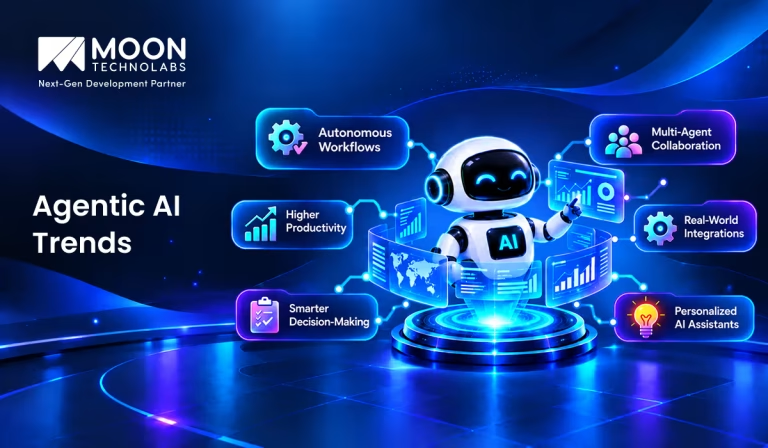
Table of Content


Blog Summary:
Agentic AI is rapidly transforming how businesses operate, innovate, and make decisions. As these intelligent systems become more capable and autonomous, organizations are exploring new ways to improve efficiency, productivity, customer engagement, and business outcomes. This blog explores the latest agentic AI trends shaping the business landscape and explains what organizations should understand to prepare for the next phase of AI-driven transformation.
Table of Content
What happens when AI can move from understanding a request to actually getting the job done? That is where agentic AI changes the game–moving beyond generating responses to planning, acting, and getting things done. AI systems are becoming capable of planning tasks, choosing the right tools, interacting with software, and taking actions based on changing conditions—not simply generating an answer.
For businesses, these Agentic AI trends open up possibilities across development, operations, customer experience, research, and automation. At the same time, new approaches to agent architecture, model selection, context, and tool connectivity are shaping how these systems are built
What Makes Agentic AI Different From Traditional AI?
Traditional AI is generally designed to respond to specific inputs, such as answering questions, recognizing patterns, or generating content. It typically waits for a user or system to provide an instruction and then produces an output based on its training and available context.
Agentic AI takes a more goal-oriented approach. Instead of simply responding to a prompt, an AI agent can break a goal into multiple steps, plan how to complete them, use external tools or systems, evaluate results, and determine what to do next. This allows it to handle more complex workflows with less manual direction.
The key difference is action and autonomy. Traditional AI primarily helps users make decisions or complete individual tasks, while agentic AI can participate in entire workflows and take authorized actions. With the right integrations, security controls, and human oversight, businesses can use AI agents to automate processes rather than simply generate information.
Top 10 Agentic AI Trends You Need to Know
Here are the top agentic AI trends shaping the future of business and technology. Let’s take a closer look at what’s ahead:
Autonomous AI Agents Are Moving From Assistance to Execution
AI agents are moving beyond answering questions and suggesting actions. They can now understand goals, plan tasks, make decisions, use connected tools, and complete multi-step workflows with limited human intervention. This is creating new opportunities for automation across operations, research, customer service, and business processes.
Multi-agent Systems Are Enabling Collaborative AI
Multi-agent systems divide complex workflows among specialized AI agents that collaborate toward a shared goal. One agent can research information, another can analyze findings, and another can handle execution. This coordinated approach enables businesses to manage complex tasks more efficiently while giving each agent a clearly defined role.
AI Coding Agents Are Transforming Software Development
AI coding agents are moving beyond autocomplete and basic code suggestions. They can analyze repositories, generate code, run tests, identify bugs, review changes, and support implementation across development workflows. As these capabilities improve, engineering teams can delegate repetitive development tasks while developers focus on architecture and critical decisions.
MCP and Agent Tool Connectivity Are Becoming Critical
AI agents become significantly more useful when they can interact with external tools, applications, and data sources. Model Context Protocol (MCP) is helping standardize these connections, making it easier for agents to discover and use available capabilities. Choosing the right agentic AI framework can also play an important role in how these tools, models, memory, and workflows are orchestrated.
Context Engineering Is Replacing Prompt-only Thinking
Building effective AI agents requires more than writing detailed prompts. Context engineering focuses on giving agents the right information, memory, tools, instructions, and user data at the right time. By managing context throughout an interaction, businesses can improve agent reliability and enable more informed decisions across complex workflows.
Vertical AI Agents Are Becoming More Specialized
General-purpose AI agents are useful across many scenarios, but businesses increasingly need solutions built around specific industries and workflows. Vertical AI agents combine domain knowledge with task-specific capabilities, enabling more relevant automation for healthcare, finance, legal services, retail, customer support, and software development.
Agentic Customer Experience is Moving Beyond Chatbots
Customer-facing AI is evolving from scripted chatbots into systems that can understand requests and take action. An AI agent can access business systems, check information, update records, initiate processes, and provide confirmation within a single interaction. This enables more proactive and personalized customer experiences.
Agentic Commerce is Changing How Consumers Buy
Agentic commerce is making AI more active throughout the purchasing journey. Instead of simply recommending products, agents can understand customer preferences, discover relevant options, compare products, and assist with purchasing tasks. This could make online buying more personalized while reducing the need for customers to navigate multiple platforms manually.
Small Language Models Are Powering Efficient AI Agents
Not every agent task requires a large language model. Smaller models can handle focused activities with lower latency and infrastructure requirements, making them valuable for specialized workflows. Businesses can combine small and large models based on task complexity, balancing performance, operating costs, speed, privacy, and scalability.
Browser Agents Are Automating Web-based Workflows
Browser agents can interact with websites by navigating pages, entering information, extracting data, and completing repetitive online tasks. This creates opportunities to automate processes where traditional APIs are unavailable. As adoption grows, businesses will need to address reliability, authentication, security, permissions, and human oversight for production use.
How Agentic AI is Changing the Way AI Works?
Agentic AI represents a shift from AI that generates outputs to AI systems that can pursue objectives and execute workflows. Instead of stopping after producing an answer, an agent can reason through a task, use connected tools, evaluate what happened, and decide what to do next.
This changes AI from a primarily responsive technology into an active component of business processes.
- From generating responses to taking actions: AI can move beyond answering prompts to executing tasks and achieving defined goals.
- From single tasks to multi-step workflows: Agents can break complex objectives into smaller steps, execute them, and adjust based on results.
- From static responses to dynamic decision-making: Agents can evaluate information, make context-based decisions, and determine the next action.
- From standalone AI to connected systems: AI agents can interact with APIs, databases, CRMs, ERPs, browsers, and other business tools.
- From constant human direction to managed autonomy: Agents can handle routine processes independently while escalating sensitive or complex decisions to humans.
- From individual models to agent collaboration: Multiple specialized agents can work together, with each agent handling a specific part of a larger workflow.
- From isolated automation to continuous workflows: Agents can monitor events, respond to changes, take action, and continue processes without requiring a new prompt for every step.
Dealing With Complex Workflows and Repetitive Processes?
Our experts design agentic AI solutions that streamline workflows, support decision-making, and help your teams work more efficiently.
What Makes an AI System Truly Agentic?
An AI system becomes truly agentic when it can do more than respond to a prompt. It needs to understand a goal, determine the required steps, interact with external systems, evaluate outcomes, and adjust its actions as circumstances change. These agentic AI capabilities allow AI to participate in complete workflows and perform tasks with a defined level of autonomy:
Goal-oriented Execution
Agentic AI starts with an objective rather than a simple request for information. The system identifies what needs to be accomplished and works toward that outcome. For example, instead of only identifying a sales lead, an agent could qualify the lead, gather relevant information, update the CRM, and initiate the next approved action.
Planning and Reasoning
Complex business tasks rarely involve a single step. An agent can break a broader objective into smaller tasks, determine their sequence, and decide how to handle each step. It can also reconsider its plan when a task fails, or new information changes the situation.
Tool and API Usage
An AI agent becomes significantly more useful when it can interact with the systems where work actually happens. Through APIs, tools, databases, browsers, and enterprise applications, agents can retrieve information, update records, trigger workflows, and perform other authorized actions instead of simply providing instructions to a human.
Memory and Context
Agents need access to relevant context to make consistent decisions across a workflow. This can include previous interactions, task history, user preferences, business rules, and the process’s current state. Persistent memory can also help agents continue longer-running tasks without losing track of what has already happened.
Autonomous Decision-making
Within clearly defined boundaries, an agent can decide the next action without requiring human approval for every routine step. Businesses can control this autonomy through permissions, business rules, spending limits, and escalation conditions, allowing agents to operate independently where the risk is low.
Feedback and Adaptation
Agentic AI systems can evaluate whether an action produced the expected result and determine what to do next. If an API fails, information is missing, or a customer’s request changes, the agent can adjust its approach, retry an appropriate action, or escalate the issue rather than simply stopping.
Human Oversight
Agentic AI does not mean removing humans from every workflow. For sensitive decisions or high-impact actions, businesses can require human approval before an agent proceeds. Approval checkpoints, audit logs, access controls, and escalation rules help organizations maintain control while still benefiting from automated execution.
Why Does Agentic AI Matter for Businesses?
Discover why agentic AI matters for businesses and how these intelligent systems can transform operations, improve efficiency, and create new opportunities:
Moving Beyond Isolated AI Assistants
Traditional AI assistants typically respond to individual prompts and rely on users to decide what happens next. Agentic AI takes a more goal-oriented approach. An AI agent can interpret an objective, determine the required steps, use connected tools, and keep working until the task reaches a defined outcome.
For businesses, this means AI can support complete processes rather than simply providing suggestions or generating responses.
Automating Complete Workflows
Many business processes involve multiple steps, systems, and decisions. Agentic AI can coordinate these activities within a single workflow, enabling agentic AI process automation across interconnected business operations.
For example, a sales agent could identify a qualified lead, research relevant information, update the CRM, prepare a personalized follow-up, and notify a sales representative. Automating the workflow, not just one task, can reduce repetitive work and improve process consistency.
Connecting AI to Enterprise Systems
AI agents become more useful when they can interact with the systems employees already use. Through APIs, tools, and integrations, agents can work with CRMs, ERPs, databases, customer support platforms, internal knowledge bases, and other enterprise applications.
This connectivity allows an agent to retrieve information, update records, trigger processes, and perform authorized actions without requiring employees to move information between agentic systems manually.
Reducing Manual Intervention
Agentic AI can take over repetitive tasks that previously required employees to monitor every step. Depending on the workflow, agents can operate independently for routine activities while requesting human approval when a decision involves sensitive data, financial transactions, or other high-impact actions.
The goal is not necessarily to remove people from workflows. Instead, businesses can shift human effort toward tasks that require judgment, creativity, relationship management, and strategic decision-making.
Creating AI-driven Operational Processes
The broader opportunity lies in redesigning business processes around AI capabilities rather than simply adding AI to existing workflows. Organizations can build processes where agents continuously monitor information, identify tasks, take authorized actions, and escalate expectations to human teams.
This creates a more dynamic operating model in which AI becomes an active participant in business operations. As agentic AI matures, businesses can move from isolated automation projects to connected, AI-driven workflows designed around measurable business outcomes.
Build AI Agents That Actually Get Things Done
Create intelligent agents that can plan, act, adapt, and automate complex processes around your unique business requirements.
Why Choose Moon Technolabs for Agentic AI Development?
Moon Technolabs takes a practical approach to building AI agents that can do more than generate responses. We design systems that understand objectives, break complex work into steps, use connected tools, and act on outcomes—so businesses can automate processes that previously required constant human involvement.
Our agentic AI development services are built around your existing workflows, applications, and business requirements. From designing agent architectures to integrating APIs and deploying production-ready systems, our team creates AI solutions that are useful today and flexible enough to evolve as your business grows.
Conclusion
Agentic AI is changing how businesses approach automation—from agents that execute repetitive tasks to multi-agent systems that coordinate complex workflows. The latest agentic AI trends show a shift from AI that simply responds to AI that understands context, uses tools, and takes action.
For businesses, the real opportunity lies in identifying processes where autonomous decision-making can create measurable impact. Working with an experienced AI development company like Moon Technolabs can help translate these agentic AI capabilities into solutions that fit existing systems, workflows, and long-term business goals.
FAQs
01
What can AI agents actually do for my business?
AI agents can handle multi-step tasks such as customer support, lead qualification, data analysis, appointment scheduling, document processing, research, and workflow automation. They can connect with business tools, make decisions within defined rules, and take actions with limited human intervention.02
How much does it cost to build an AI agent?
The cost depends on the agent's complexity, features, integrations, AI models, data requirements, and level of autonomy. A simple task-specific agent typically requires less investment than a custom enterprise solution involving multiple agents, complex workflows, and extensive integrations. A detailed assessment of your requirements is usually needed to estimate the development cost.03
Can AI agents integrate with our existing business systems?
Yes. AI agents can integrate with systems such as CRMs, ERPs, databases, customer support platforms, payment systems, and other business applications through APIs, connectors, and tools. This lets agents access relevant information and act within existing workflows rather than operating as standalone applications.04
Can we build a custom AI agent for our specific workflow?
Yes. Custom AI agents can be built to fit your specific workflow, business rules, data sources, tools, and objectives. They can automate tasks, coordinate multiple steps, and involve human approval whenever needed.05
How secure are AI agents for handling business data?
AI agent security depends on how you design and deploy the system. Security measures can include role-based access, least-privilege permissions, encryption, authentication, data isolation, activity logging, and human approval for sensitive actions. For enterprise deployments, consider security and governance throughout the agent's architecture and development lifecycle.



Explore the latest insights on Artificial Intelligence, including Generative AI, Agentic AI, natural language processing, computer vision, automation, and enterprise AI solutions. This category covers industry trends, practical applications, implementation strategies, and innovations that help businesses leverage AI for smarter decision-making and digital transformation. Stay updated with evolving AI technologies that are reshaping industries worldwide.
Submitting the form below will ensure a prompt response from us.
We refine our expertise to deliver innovative business solutions.





205 N Michigan Avenue, #810, Chicago, 60601, Illinois, United States
13500 Long Is Dr, Pflugerville, TX 78660, USA

C/105 Ganesh Meridian, S.G. Highway, Ahmedabad, GJ 380060


Ayse D.
Co-Founder France
“ I highly recommend Moon Technolabs as the quality of service is wonderful. We have hired this company to develop the product based on some complex & technical issues. We get the best quality services as compared with others in the market. Huge Thanks to Moon Technolabs as the team is always ready to give the solution all time.”

Justin G.
Founder & CEO USA
USA“ Moon Technolabs is a pioneer in the WebRTC based project as they have fixed complicated segments of the module by fulfilling different product lines by providing 24X7 customer support. We really recommended Moon Technolabs as they are able to develop products as per the module deadline and project timeline.”

Flavio S.
Founder & Managing Director Germany
“I am happy to recommend Moon Technolabs for their app development services. They successfully developed apps for me, and I am highly satisfied with the overall outcomes. The development team has swiftly addressed the issues with responsive and effective communication to understand the requirement quickly and actively resolve the back-and-forth problems that arose...”

Jay M.
Founder & CEOUSA“Moon Technolabs is the best company that provides advanced apps and websites development services in the USA and Europe. I am a newbie to develop my app with an external team. I am really happy to work with them as I am not that much mobile apps user. Here, the team and specially the CEO of Moon Technolabs helps me to let me know about the benefits of my app to generate revenue....”


Our Offices
India
C/105 Ganesh Meridian,S.G. Highway, Ahmedabad, GJ 380060USA
205 N Michigan Avenue, #810, Chicago, 60601, Illinois, United StatesContact Information


