


Agentic AI Process Automation: Benefits, Use Cases, and Future

Artificial Intelligence Team
Last Updated: Sep 14, 2026 Total Views: 86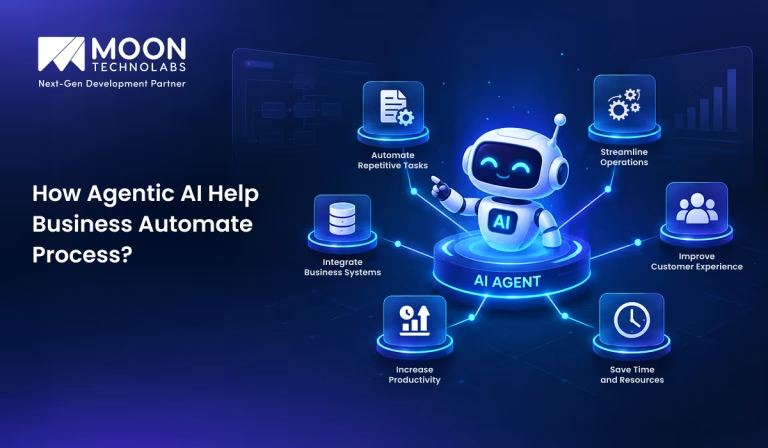
Table of Content


Blog Summary:
Agentic AI is changing process automation by enabling systems to interpret data, make decisions, coordinate workflows, and take action with minimal human intervention. As businesses move beyond static, rule-based automation, intelligent agents can handle dynamic processes, respond to changing conditions, and improve workflows over time. This shift is creating more adaptive, scalable, and autonomous business operations.
Table of Content
Traditional automation is good at following instructions, but what happens when a workflow doesn’t go exactly as planned? This is where agentic AI process automation stands out. AI agents can evaluate information, decide what to do next, use different tools or systems, and adjust their actions as conditions change. Instead of simply automating individual tasks, businesses can use agentic AI to manage entire workflows with greater autonomy.
In this blog, we’ll look at how agentic AI process automation works, the benefits and real-world use cases it offers, and what its future could mean for modern businesses.
What is Agentic AI Process Automation?
Agentic AI process automation goes beyond simply automating predefined steps. It uses AI agents that can understand a business goal, assess available information, decide what to do next, and carry out the required actions across different systems.
For example, instead of just routing a customer request, an AI agent can understand the issue, check account details, retrieve relevant information, and determine the appropriate response.
What makes it different is its ability to handle unpredictable processes. If a document is missing, a request falls outside the usual rules, or new information becomes available, the agent can adapt its next steps instead of stopping at an exception. It can also work with tools such as CRM platforms, email, databases, and internal applications to complete a process end to end.
For businesses, this means automation can move from individual tasks to entire workflows. Teams can use agentic AI to manage processes such as invoice handling, employee onboarding, customer issue resolution, lead qualification, and compliance checks, while keeping people involved where judgment, approval, or accountability is required.
Key Benefits of Agentic AI Process Automation
Here are the key benefits of intelligent process automation, highlighting how organizations can improve decision-making, strengthen process consistency, increase agility, and adapt more effectively to evolving business demands:
Autonomous Goal Execution
Intelligent process automation enables systems to independently understand objectives, plan tasks, and execute workflows with minimal human intervention. Instead of simply following predefined rules, intelligent automation can make context-based decisions and work toward desired business outcomes.
Advanced Exception Handling
Unlike traditional automation, intelligent automation can identify unexpected situations and respond appropriately. It can analyze exceptions, determine the best course of action, adapt workflows, and escalate complex issues to the right teams, reducing disruptions and improving process reliability.
Broader Automation Coverage
Intelligent process automation extends automation beyond repetitive, rule-based tasks to include complex, knowledge-intensive processes. By combining AI, machine learning, natural language processing, and business process automation, organizations can automate a wider range of cross-departmental business activities.
Continuous Learning and Improvement
Intelligent automation systems can learn from process data, outcomes, and user feedback to improve performance over time. As they evolve, they can identify inefficiencies, optimize workflows, and make increasingly accurate decisions, helping organizations achieve greater productivity and operational efficiency.
Bring Autonomous Intelligence Into Your Business Workflows
Talk to our experts about building agentic AI automation tailored to your processes, systems, goals, and operational challenges.
How Does It Work?
Agentic AI process automation uses AI agents to understand tasks, make decisions, and complete workflows with minimal human intervention. Instead of following only fixed rules, these agents can analyze data, understand context, choose the next action, and adapt when situations change.
The process typically starts with identifying a goal, then planning and executing a series of actions across different tools or systems. The AI continuously monitors results, handles exceptions, and adjusts its approach when needed. This makes agentic AI useful for automating complex business processes such as customer support, data processing, lead management, and operations.
Agentic AI vs Traditional Process Automation: Key Differences
Understand how autonomous AI agents differ from rule-based systems in decision-making, adaptability, and workflow execution. Here is a quick comparison; have a look:
| Aspect | Agentic AI Process Automation | Traditional Process Automation |
|---|---|---|
| Decision-Making | Makes context-aware decisions and adapts to situations | Follows predefined rules and instructions |
| Flexibility | Can handle changing conditions and unexpected scenarios | Works best with predictable, structured processes |
| Learning | Can learn from data, feedback, and past interactions | Generally does not learn or improve independently |
| Task Execution | Plans and executes multiple steps to achieve a goal | Executes specific, predefined tasks |
| Handling Exceptions | Can identify issues and determine alternative actions | Usually requires predefined exception rules or human intervention |
| Data Handling | Can work with structured and unstructured data | Primarily relies on structured data |
| Human Intervention | Requires less supervision for complex workflows | Often needs human input when conditions change |
| Scalability | Can adapt as workflows and business requirements evolve | Scaling may require additional rules and workflow configurations |
| Best For | Complex, dynamic, and decision-driven workflows | Repetitive and rule-based processes |
Common Use Cases of Agentic AI Process Automation
Here are the common use cases of agentic AI process automation across modern business operations and workflows:
Customer Support and Service
Agentic AI can automate customer interactions across chat, email, and other service channels. AI agents can understand customer intent, resolve routine issues, retrieve relevant information, initiate actions such as refunds or replacements, and escalate complex cases when they require constant human intervention. This enables faster resolution while delivering more consistent and personalized customer experiences.
IT Operations and Support
In IT environments, agentic AI can monitor systems, identify incidents, troubleshoot issues, and autonomously execute predefined remediation actions. Agents can handle tasks such as password resets, access requests, system diagnostics, ticket classification, and incident resolution. They can also learn from previous incidents to improve response times and reduce the workload on IT teams.
Supply Chain and Logistics
Agentic AI systems can help organizations manage and optimize supply chain processes by continuously analyzing demand, inventory, orders, shipments, and supplier information. Specialized AI agents can identify potential disruptions, recommend alternative suppliers or routes, adjust replenishment plans, and coordinate actions across multiple systems.
This supports more resilient and responsive supply chain operations. Companies can implement these capabilities by building AI agents designed to analyze data, make decisions, and take action autonomously.
Finance and Accounting
Agentic systems can automate finance processes such as invoice processing, payment reconciliation, expense management, financial reporting, and accounts receivable and payable workflows. AI agents can validate transactions, identify anomalies, follow up on outstanding items, and route exceptions for review. This reduces manual effort, improves accuracy, and accelerates financial operations.
Marketing and Sales Operations
Agentic AI can support marketing and sales teams by automating lead qualification, customer research, campaign execution, follow-ups, and sales administration. AI agents can analyze customer and market data, identify opportunities, personalize outreach, update CRM systems, and recommend next-best actions. This allows teams to focus more on strategy, relationship building, and revenue-generating activities.
Essential Features of an Agentic AI Process Automation Platform
Here are the essential features that an agentic AI process automation platform should have to support intelligent, flexible, and scalable automation:
Intuitive Interface and Low-code Capabilities
An agentic AI process automation platform should make automation accessible to both technical and business users. An intuitive interface, visual workflow builders, and low-code tools enable teams to design, deploy, and modify intelligent workflows without extensive programming expertise.
Flexible AI Model Selection
Businesses should be free to choose AI models based on their specific requirements. Support for multiple models allows organizations to balance accuracy, performance, cost, privacy, and use-case requirements while avoiding dependence on a single AI provider.
Enterprise System Integrations
Seamless integration with existing enterprise applications is essential for effective automation. The platform should connect to CRM, ERP, HR, finance, databases, APIs, cloud applications, and other business systems so AI agents can access information and execute tasks across the organization.
Real-time Data Processing
Agentic AI automation requires timely, relevant information. Real-time data processing enables AI agents to monitor events, analyze incoming data, respond to changing conditions, and trigger appropriate actions without relying solely on predefined schedules or outdated information.
Security and Compliance Controls
Enterprise AI automation must protect sensitive business and customer data. Robust security features such as role-based access controls, encryption, audit trails, data governance, and compliance capabilities help organizations deploy AI-powered workflows while meeting regulatory and internal security requirements.
Workflow Orchestration
Effective orchestration enables AI agents, automation bots, applications, APIs, and human teams to work together within a single process. Enterprise workflow automation helps coordinate these components across complex business processes, ensuring tasks are coordinated, decisions are made at the right stage, and exceptions can be routed to humans when necessary.
Scalability and Performance
An enterprise-ready platform should scale as automation requirements grow. It must support high workflow volumes, concurrent AI agents, increasing data workloads, and expanding business operations while maintaining reliable performance, availability, and responsiveness.
Challenges of Implementing Agentic AI Process Automation
Here are the common challenges organizations may face when implementing agentic AI process automation across their business operations; have a look:
Managing Autonomous Decision-making
AI agents can make decisions independently, but ensuring those decisions are accurate and aligned with business goals can be difficult. Clear rules, limits, and continuous monitoring help prevent unexpected outcomes.
Data Security and Privacy
AI agents often handle sensitive business and customer data, creating security and privacy risks. Strong access controls, encryption, and data governance are essential to protect information.
Integrating With Existing Systems
Connecting AI agents to existing applications and legacy systems can be complex because of different technologies, APIs, and data formats. Effective integration requires compatible APIs and well-designed workflows.
Maintaining Human Oversight
Human supervision is still important for critical decisions. Approval checkpoints, monitoring, and escalation procedures help ensure humans can intervene when necessary while maintaining the benefits of automation.
The Future of Agentic AI Process Automation
Here’s what the future of agentic AI process automation could look like as AI agents become more autonomous, adaptable, and deeply integrated into business operations:
Autonomous Execution
Autonomous AI agents can understand business objectives, determine required steps, and execute tasks across multiple autonomous systems with limited human intervention. They can retrieve information, validate inputs, make routine decisions, trigger actions, and resolve exceptions, enabling faster execution while reducing repetitive manual work.
Dynamic Orchestration
The next generation of automation will not rely solely on fixed workflows. Agentic AI can dynamically orchestrate processes based on real-time data, business priorities, and changing circumstances. Multiple agents can collaborate across applications and functions, adapting workflows when exceptions occur and selecting the most appropriate next action.
Human-in-the-Loop Governance
Autonomy must be balanced with oversight. Human-in-the-loop governance ensures that organizations define where agents can act independently and where human approval is required. Controls such as approval thresholds, escalation mechanisms, audit trails, access policies, and continuous monitoring help keep AI-driven processes secure, transparent, and accountable.
Is Agentic AI Process Automation Right for Your Business?
Agentic AI process automation can be a strong fit for businesses that handle repetitive, time-consuming, or complex workflows. It can help teams automate tasks such as customer support, data entry, document processing, lead management, and routine decision-making while reducing manual effort and improving efficiency.
However, it may not be necessary for every business process. Companies should consider workflow complexity, data security, integration needs, and expected return on investment before adopting it. Starting with a specific, high-impact process can help businesses evaluate the benefits and scale automation gradually.
Ready to Make Your Business Processes More Intelligent?
Partner with our experts to build agentic AI solutions that automate complex processes, improve responsiveness, and deliver measurable business value.
How Moon Technolabs Helps With Agentic AI Automation?
Moon Technolabs helps businesses implement intelligent automation solutions tailored to their unique workflows and operational needs. From identifying automation opportunities to designing, developing, integrating, and deploying AI agents, our team ensures a smooth transition from manual processes to intelligent, automated workflows.
As an experienced agentic AI development company, we combine AI expertise with business process automation to build scalable solutions that can make decisions, execute tasks, and adapt to changing requirements. We help businesses improve productivity, reduce operational costs, and unlock greater value from their existing processes.
A Final Word
Agentic AI process automation is reshaping the way businesses manage operations by combining intelligent decision-making with automated task execution. From reducing repetitive manual work and operational costs to improving productivity and customer experiences, it offers valuable benefits across various industries and use cases.
As agentic AI continues to evolve, businesses that adopt it strategically can streamline complex workflows, respond faster to changing needs, and gain a competitive advantage. The key is to identify the right processes, implement AI responsibly, and scale automation as business requirements grow.
FAQs
01
Is agentic AI the same as automation?
No. Traditional automation follows predefined rules, while agentic AI can understand goals, make decisions, adapt to changing conditions, and take actions autonomously. Agentic AI can enhance automation by handling complex, dynamic workflows that typically require human judgment.02
Will AI replace RPA?
Artificial Intelligence is unlikely to replace RPA completely. Instead, AI and RPA are increasingly converging. RPA excels at structured, repetitive tasks, while AI handles unstructured information and decision-making. Together, they enable more intelligent and flexible business process automation.03
Is there a difference between an AI agent and agentic AI?
Yes. An AI agent is a software system designed to perform tasks and take actions toward a goal. Agentic AI refers more broadly to AI systems with autonomous, goal-oriented behavior, often involving multiple agents, tools, planning, and decision-making.04
Which AI tool is best for workflow automation?
No single tool is best for every workflow. Microsoft Power Automate, UiPath, and Automation Anywhere are strong choices for enterprise automation. AI-native platforms may be better for complex, dynamic workflows requiring reasoning, decision-making, and autonomous actions.



Explore the latest insights on Artificial Intelligence, including Generative AI, Agentic AI, natural language processing, computer vision, automation, and enterprise AI solutions. This category covers industry trends, practical applications, implementation strategies, and innovations that help businesses leverage AI for smarter decision-making and digital transformation. Stay updated with evolving AI technologies that are reshaping industries worldwide.
Submitting the form below will ensure a prompt response from us.
We refine our expertise to deliver innovative business solutions.





205 N Michigan Avenue, #810, Chicago, 60601, Illinois, United States
13500 Long Is Dr, Pflugerville, TX 78660, USA

C/105 Ganesh Meridian, S.G. Highway, Ahmedabad, GJ 380060


Ayse D.
Co-Founder France
“ I highly recommend Moon Technolabs as the quality of service is wonderful. We have hired this company to develop the product based on some complex & technical issues. We get the best quality services as compared with others in the market. Huge Thanks to Moon Technolabs as the team is always ready to give the solution all time.”

Justin G.
Founder & CEO USA
USA“ Moon Technolabs is a pioneer in the WebRTC based project as they have fixed complicated segments of the module by fulfilling different product lines by providing 24X7 customer support. We really recommended Moon Technolabs as they are able to develop products as per the module deadline and project timeline.”

Flavio S.
Founder & Managing Director Germany
“I am happy to recommend Moon Technolabs for their app development services. They successfully developed apps for me, and I am highly satisfied with the overall outcomes. The development team has swiftly addressed the issues with responsive and effective communication to understand the requirement quickly and actively resolve the back-and-forth problems that arose...”

Jay M.
Founder & CEOUSA“Moon Technolabs is the best company that provides advanced apps and websites development services in the USA and Europe. I am a newbie to develop my app with an external team. I am really happy to work with them as I am not that much mobile apps user. Here, the team and specially the CEO of Moon Technolabs helps me to let me know about the benefits of my app to generate revenue....”


Our Offices
India
C/105 Ganesh Meridian,S.G. Highway, Ahmedabad, GJ 380060USA
205 N Michigan Avenue, #810, Chicago, 60601, Illinois, United StatesContact Information


