
Jayanti Katariya
Last Updated: February 10, 2026 Total Views: 241
Table of Content


Blog Summary:
The blog discusses key differences between SIP Trunking Vs VoIP, both of which are very popular business communications technologies. It outlines their benefits and use cases and compares them extensively on cost, setup, call quality, scalability, and security. The article helps businesses define which solution is most appropriate for their needs based on factors such as infrastructure, call volume, and mobility requirements.
Table of Content
When your enterprise communication becomes expensive, unreliable, and clunky, the pressure to choose the right technology becomes real. Most companies that reach this point are stuck between the two most popular solutions: SIP Trunking and VoIP.
While both promise to improve connectivity, lower costs, and modernize your business’s calling capabilities, many IT managers worry about security and privacy. Clarify how each technology safeguards sensitive data to help you make confident choices.
Before committing to a proper approach, you must understand which option actually offers what you need. This blog breaks down the key differences between SIP Trunking and VoIP to help you choose the solution that perfectly aligns with your business goals.
If VoIP is the call, SIP trunking is the backbone—built for reliability, scale, and speed. ⚙️🚀
SIP Trunking is a smarter and Internet-powered way to manage all your business calls. Instead of relying on traditional phone systems, this approach uses the Internet to route your voice, video calls, and messaging.
You will replace clunky cables with a clean digital pipeline to accomplish the job faster and more flexibly. For example, if someone on your team calls a client, SIP will route the call over the Internet. This way, the call will be completely seamless for all parties involved.
This is a perfect approach if you want to keep your current PBX system while upgrading the way it connects. This is a simple, modern system built for growth.
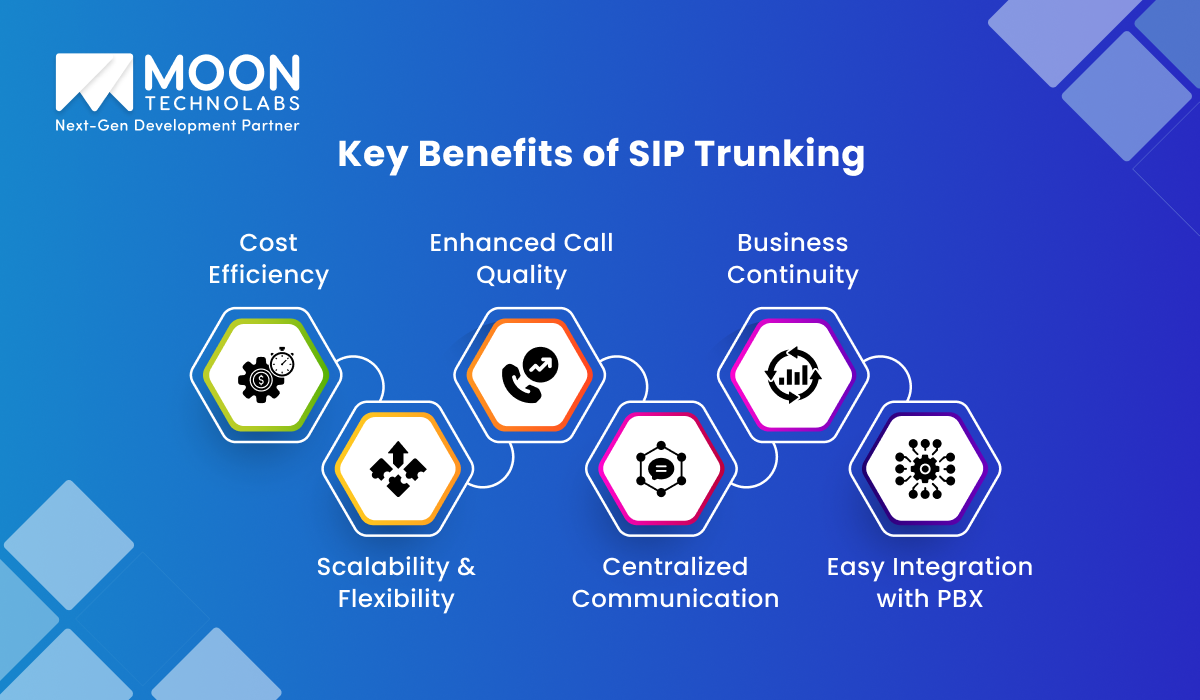
Let’s take a look at how SIP trunking streamlines communication, helps you scale, and lets you operate with confidence.
If you are tired of the unpredictable call charges and multiple physical phone lines, SIP trunking can reduce these unnecessary expenses. You pay for channels you need while enjoying lower rates for long-distance calls. It eliminates maintenance, making communication budgets predictable and scalable.
You don’t need to wait for technicians to install hardware or add new lines with SIP trunking. It can scale channels on demand, making it perfect for busy seasons and growing teams. This system grows with you, making adjustments seamless, quick, and aligned with business needs.
Quality is crucial when communicating with customers, partners, or internal teams. SIP trunking uses a high-bandwidth internet connection to deliver clearer, more reliable audio. It reduces static, dropped calls, and poor quality, making communication smooth and professional.
Make managing communication across locations effortless by implementing SIP trunking. You can centralize call routing, monitoring, and reporting with a single system. This simplifies operations, giving your IT team better control and visibility across the organization.
Don’t let unexpected outages stop your business. This approach allows you to reroute calls instantly to backup numbers or remote devices. You can also continue communication without interruption, even if your main location goes down. It offers in-built resilience to protect customer experience.
You can modernize your on-premises PBX with SIP trunking, but it’s important to ensure it’s compatible with your current hardware and software. This ensures a smooth upgrade process and helps you plan for integration challenges.
SIP trunking fits where you need reliability, scale, and centralized control.
SIP trunking helps unify all locations with a single communication system. For multi-location teams, it helps centralize everything, simplify routing, and reduce costs, ensuring seamless connectivity.
Call centres thrive on high call volumes and consistent quality, both of which are fully supported by SIP trunking. It provides scalable channels with smart routing and crystal clear audio to enable agent productivity and smooth, uninterrupted conversations.
SIP trunking ensures everyone is reachable on the business phone, regardless of location, making it useful for distributed teams. Your employees can use their desk phones or mobile phones, making communication accessible. It is best for enterprises that have embraced flexible work models.
If you experience heavy call traffic, you need a reliable connection, and SIP trunking offers that. It can handle large call volumes without compromising quality while offering instant scaling. It is built for enterprises where communication impacts operations and customer service.
If you want to move away from traditional phone lines, SIP offers a smooth and low-risk transition. It works with PBX, allowing you to modernize communication without replacing everything, making upgrades simple and cost-effective without disrupting business.
It connects video, voice, and messaging tools through a streamlined channel, enabling unified communication. This system can remove silos, simplify management, and ensure the team communicates through a consistent, integrated experience across devices and platforms.
You Might Also Like:
VoIP, Voice over Internet Protocol, is a technology that lets you make phone calls over the Internet without traditional phone lines. For instance, if you have accepted a WhatsApp or Zoom call, you have experienced this approach, as both are VoIP services.
It will convert your voice into digital data that can travel instantly via an internet connection. This way, you don’t need to invest in bulky hardware or depend on physical lines. It extends your team’s freedom to take calls from anywhere, making communication accessible.
So, whether you are at your desk, on your laptop, or on the go with your mobile app, VoIP makes communication smooth, reliable, and convenient.
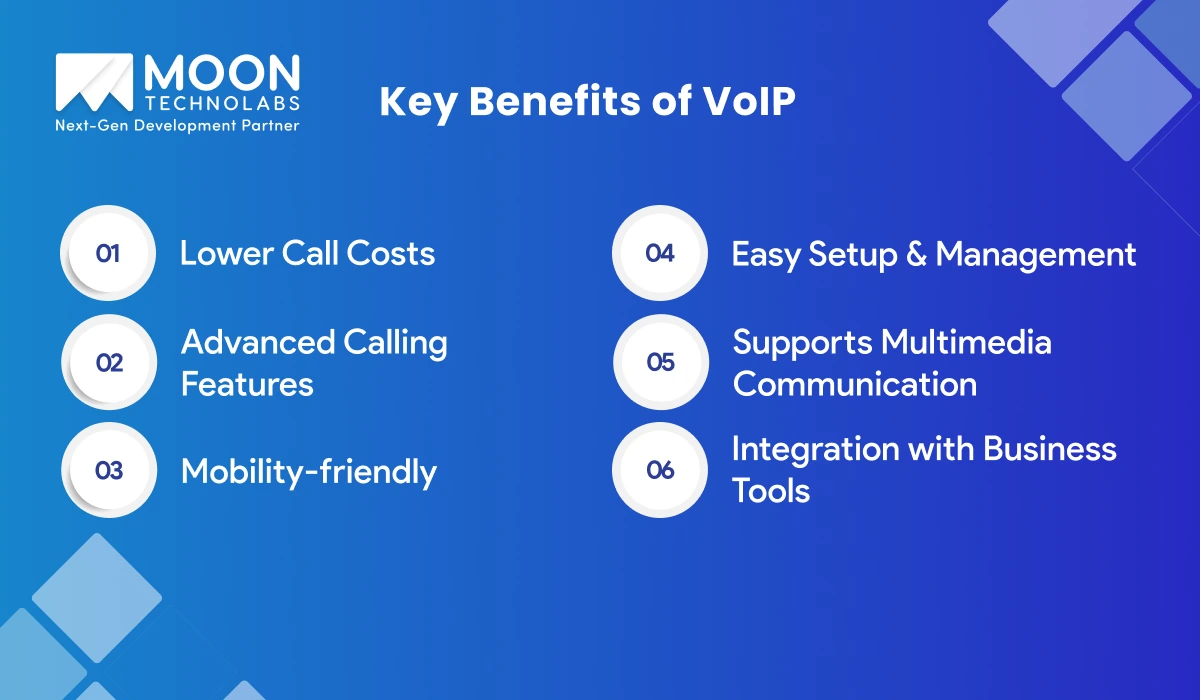
VoIP gives you a modern, cost-effective, and flexible way to communicate. Let’s see how it helps you work smarter every day.
If you are tired of unpredictable phone bills, VoIP can help cut costs by routing calls over the Internet rather than through traditional phone carriers. With a monthly predictable plan, it eliminates hidden charges and pricey fees, keeping communication expenses under control.
This approach offers powerful built-in features like call routing, auto-attendants, call recording, and voicemail-to-email. With these tools, your team can respond faster, deliver exceptional customer experiences, and stay organized. You don’t need complicated hardware or separate software for these functions.
If you have a distributed team, VoIP can ensure proper connectivity using a single business number. Your employees can take their calls on mobile apps or laptops, ensuring seamless communication. It is built for flexible teams.
VoIP eliminates the need for messy installations and outdated hardware. With an easy setup and a simple dashboard for managing users or extensions, it offers more control, fewer IT issues, and a system that adapts to your growth.
Apart from voice calls, VoIP also supports video meetings, messaging, conferencing, and file sharing from a single platform. Your team can switch modes without juggling tools, making collaboration smooth, fast, and natural for everyday communication.
VoIP can effortlessly connect with your CRM, helpdesk, and collaboration software. It automatically logs calls, allowing customer details to pop up instantly and enabling smooth workflows. With these integrations, you can save time, reduce manual tasks, and deliver more personalized communication.
VoIP shines when businesses need flexibility, affordability, and smart communication tools. Here are all the ways VoIP makes a real difference to growing businesses.
It offers powerful communication features without the expensive hardware or setup, making it the best choice for SMBs. It lets teams stay connected and manage calls efficiently. This is a practical upgrade for everyday communication and operations.
If you have a distributed team, using VoIP can make your team more accessible through a unified system. Your employees can take their calls on mobile apps and laptops, enabling smooth, consistent collaboration regardless of location.
Your support team will have access to features such as call routing, analytics, recording, and integration with helpdesk systems. You can respond faster, reduce wait times, and enhance customer experiences without relying on traditional phone lines.
VoIP offers advanced communication features to businesses without the upfront costs. You will pay for what you need, scale as your business grows, and avoid the high installation or maintenance costs associated with traditional systems.
If you rely on video calls, conferencing, messaging, and seamless internal communication, VoIP is a great bet. It removes the need for multiple apps, offering an efficient, streamlined communication experience for modern collaboration.
VoIP slashes international calling costs, a benefit for enterprises managing global clients or distributed teams. With Internet calls offering clear audio at affordable rates, you can make communication simple, predictable, and budget-friendly.
We will break things down for you to clearly see how these options fit your business. With this detailed comparison, you can choose the approach that aligns with your communication goals, budget, and long-term growth.
SIP Trunking will connect your existing PBX system to the Internet to manage calls. VoIP uses internet-enabled devices directly to enable communication. If you want to keep your existing PBX system, go with SIP trunking; if you need an all-digital setup, choose VoIP.
VoIP has a low upfront cost because you don’t need to set up PBX hardware. SIP trunking is cheaper in the long run if you have a PBX system in place. If you want to build a communication system from scratch, go with VoIP. In case you want to modernize your system, choose SIP trunking.
You need a stable PBX system with compatible SIP software and hardware, making it ideal for companies with existing setups. VoIP requires a reliable Internet connection and compatible devices, which speeds deployment. You should choose based on your current systems and how you aim to simplify the systems.
When you pair both approaches with a strong Internet connection, you can enjoy great quality. SIP trunking is more reliable for enterprises as it supports redundancy and stable routing. VoIP quality depends on bandwidth, making it better suited to flexible environments than to heavy-duty calling operations.
VoIP scales easily, allowing you to add users instantly. SIP trunking, on the other hand, scales your system by adding channels, offering a more controlled growth for enterprises. VoIP is great if you want simple and fast expansion. You can choose SIP if you want a more structured scaling.
SIP trunking works best for enterprises that need centralized control, have heavy call loads, or require PBX compatibility. VoIP is best for growing teams and remote working enterprises that need low-maintenance setups. Your choice will depend on whether you need system control or simplicity.
SIP Trunking offers enterprise-grade protection by integrating with existing controlled PBX environments. VoIP relies on the provider’s safeguards. If you need strong security and compliance, you should choose SIP.
VoIP offers more built-in features, such as messaging, call analytics, and video calls. On the other hand, SIP prioritizes enhancing call capabilities using a PBX. So, if you want all-in-one communication, use VoIP and go with SIP in case you need to strengthen your PBX system.
You Might Also Like:
If you rely on an on-premise PBX and want to modernize it while keeping the phone system intact, you should choose SIP trunking. This option helps upgrade your communication stack while maintaining the infrastructure you already possess.
Let’s say, your business handles high call volume and operates from multiple locations that need reliable voice lines, SIP provides the stability and control you need. It is also a great asset when business continuity is important, as it can reroute calls within seconds of an outage or emergency.
If you are moving away from an expensive PSTN line while maintaining full control over your telephone setup, you should choose SIP trunking.
When you want a phone system that is cloud-based, accessible, and simple, you should go with VoIP. This also works well when you want quick deployment and don’t need to deal with hardware, servers, or in-office wiring.
Sometimes, you might be working on a tight budget but still need advanced calling features such as call recording, IVR, analytics, and app integrations. VoIP can make these a reality for your business communication.
VoIP is also great for remote teams or employees who travel frequently. This approach gives them the freedom to call, message, and collaborate from any device. You can choose VoIP when flexibility, affordability, rapid setup, and modern features are your goals, without the operational burden of managing physical equipment.
Invest in custom telecom software development aligned with your workflow, delivering advanced features that extend seamless scalability and mobility to support diverse team sizes.
Choosing between SIP trunking and VoIP comes down to how you want to ensure communication within your business today and in the future. If you want to modernize your existing PBX with reliable, high-volume calling, go with SIP trunking. It will provide the complete control and stability that you need.
However, if you need a more flexible and cloud-based system that is easy to scale and budget-friendly, you should choose VoIP. You don’t have to navigate the space alone, especially when deciding the best-fit approach.
Moon Technolabs is a leading VoIP software development company that helps build the right communication solution customized to your goals. Connect with us to make your business communication future-ready.
01
02
03
04
05

Jayanti Katariya is the CEO of Moon Technolabs, a fast-growing IT solutions provider, with 18+ years of experience in the industry. Passionate about developing creative apps from a young age, he pursued an engineering degree to further this interest. Under his leadership, Moon Technolabs has helped numerous brands establish their online presence and he has also launched an invoicing software that assists businesses to streamline their financial operations.


Submitting the form below will ensure a prompt response from us.
We refine our expertise to deliver innovative business solutions.





500 N Michigan Avenue, #600, Chicago IL 60611
13500 Long Is Dr, Pflugerville, TX 78660, USA

C-105, Ganesh Meridian, S.G. Highway, Ahmedabad, GJ 380060


Ayse D.
Co-Founder France
“ I highly recommend Moon Technolabs as the quality of service is wonderful. We have hired this company to develop the product based on some complex & technical issues. We get the best quality services as compared with others in the market. Huge Thanks to Moon Technolabs as the team is always ready to give the solution all time.”

Justin G.
Founder & CEO USA
USA“ Moon Technolabs is a pioneer in the WebRTC based project as they have fixed complicated segments of the module by fulfilling different product lines by providing 24X7 customer support. We really recommended Moon Technolabs as they are able to develop products as per the module deadline and project timeline.”

Flavio S.
Founder & Managing Director Germany
“I am happy to recommend Moon Technolabs for their app development services. They successfully developed apps for me, and I am highly satisfied with the overall outcomes. The development team has swiftly addressed the issues with responsive and effective communication to understand the requirement quickly and actively resolve the back-and-forth problems that arose...”

Jay M.
Founder & CEOUSA“Moon Technolabs is the best company that provides advanced apps and websites development services in the USA and Europe. I am a newbie to develop my app with an external team. I am really happy to work with them as I am not that much mobile apps user. Here, the team and specially the CEO of Moon Technolabs helps me to let me know about the benefits of my app to generate revenue....”


Our Offices
India
C-105, Ganesh Meridian, S.G. Highway, Ahmedabad, GJ 380060USA
500 N Michigan Avenue, #600, Chicago IL 60611Contact Information


