
Jayanti Katariya
Last Updated: April 06, 2026 Total Views: 390
Table of Content


Blog Summary:
This guide offers detailed insight into the SaaS development process – it covers various steps such as research, planning, development, deployment, scaling, etc. It also lets you walk through complete information regarding SaaS development costs. Keep reading the entire post to plan your next project better.
Table of Content
Do you know many SaaS products fail even though they are developed with a strong idea and have a market demand? So, you may be thinking about the actual reason behind failure, right? Well, the reason could be an inferior technology choice, an absence of a clear strategy, or an unstructured SaaS development process.
You need to keep in mind that a successful SaaS product is much more than just a brilliant idea, which starts with a clear foundation. From strategy building to deployment, you need to plan everything properly and implement a better strategy to carry out the development process in the right direction.
This guide explains a complete SaaS development process to turn your SaaS development idea into a reality. Let’s explore now.
The SaaS industry witnessed major growth and has a huge impact on how businesses function at different levels, whether it’s human resources, IT infrastructure, or CRM. It prompts organizations to abandon their traditional software and adopt the cloud-based solutions that are available with more flexibility and scalability.
As per Hostinger, the worldwide SaaS spending was predicted to reach up to $300 billion by 2025, driven by the growing demand for AI platforms, remote work tools, industry-based apps, and more.
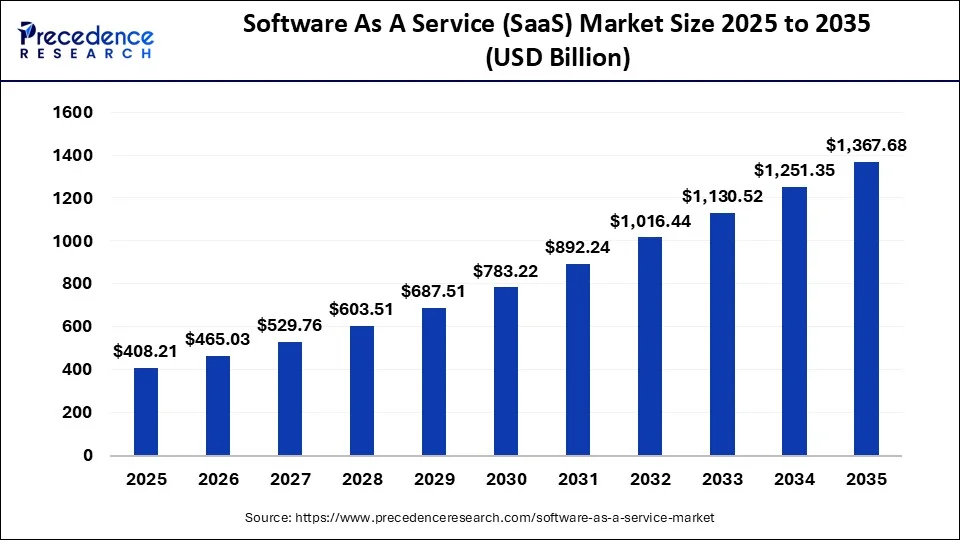
Its global market size is also growing tremendously, which is likely to reach up to $465.03 billion in 2026 and $1367.68 billion by 2035. It’s predicted to expand at a CAGR of 12.85% during these periods, as per Precedence Research.
On the other hand, vertical SaaS is nowadays gaining great momentum, with niche solutions tailored specifically for fintech, healthcare, and logistics. Many factors that fuel this growing momentum, including quick deployment, fast upfront costs, smooth integration, etc. These make SaaS perfect for modern businesses and thus prompt entrepreneurs to invest in it.
SaaS is a cloud-based delivery model. It prevents organizations from having their own infrastructure for software hosting. It favors software hosting on remote servers, and all users can access it through a web browser.
In the SaaS model, users don’t need to install the software on their devices to access it. Besides, organizations don’t need to stress about maintenance of the software as it’s covered by the service provider.
Those seeking to use the SaaS product for their organization don’t need to buy a one-time license. Instead, they need to subscribe to the software and get an option to pay either monthly or annually. From security and updates to uptime, the service provider is concerned about handling everything.
Some of the most popular SaaS products are as follows:
SaaS adoption is decisive for businesses for many reasons, such as predictable costs, fast adoption, etc. It also gives them the flexibility to scale up or down based on their actual requirements. That’s the reason why SaaS is considered to be a smart choice for businesses.
When it comes to SaaS development, it’s much more than just writing code. It requires a lot of planning, strategy building, and making smart decisions. We will describe various steps below to help you understand the entire SaaS development process better:
Before you make your way to write code for your SaaS app development, you should first validate your idea. Doing in-depth market research allows you to understand whether or not your software will cater to real problems for a real audience. You can do it in the following steps:
You need to understand that a validated idea is the greatest foundation for building a successful SaaS app.
After validation of your idea, it’s now the right time to make an important technical decision. It’s crucial to know that the tech stack and architecture directly impact the scalability, performance, and maintenance cost of products.
At this step, you can perform the following steps:
No matter how powerful a SaaS product you create, it will still face difficulty in gaining the user’s attention without a proper UI/UX design. You need to understand that UI/UX design is not only about aesthetics, but it’s also about crafting an experience that feels completely effortless and intuitive from its first interaction.
For UI/UX design, you can perform the following steps:
Once you complete the designing process, you need to now perform SaaS product development. Frontend improves the UI of your app, whereas backend powers everything. Whether it’s backend or frontend development, you need to move with the right strategy. You need to do the following important activities:
As far as multi-tenancy is concerned, it’s the most important thing for a SaaS product. It ensures a single app instance caters to various customers while making their data fully secured and isolated. During this step, you need to do the following activities:
Third-party integration with a SaaS product is necessary to improve its functionality and usability. A smooth integration is necessary for your software with those tools that businesses rely on for their daily operations. You need to use the following tools with your solution:
Rather than being a SaaS development step, it’s an ongoing process that takes place throughout the development lifecycle. It includes the following important activities:
This is the final phase, which involves beginning the actual journey of your products. During this step, you need to do the following important practices:
Let’s build advanced SaaS products that drive performance and boost your business growth. Speak with our experts for more information.
Developing a SaaS product is a decisive step, which requires a higher investment. So, it’s important to understand this cost to make your budget accordingly.
Well, the average cost of SaaS development starts from $30,000 and goes up to $100,000 or even beyond this. It depends on numerous factors as well, including team size, product’s complexity, technology choices, geographic location, and more.
Let’s have a quick look at all these factors in-depth:
We transform your unique SaaS idea into a comprehensive product with our expert guidance. Our team designs scalable architecture and ensures seamless development.
Developing a high-grade SaaS product requires much more than just technical expertise – we understand it well. Our developers work with you to understand your vision, predict challenges, and deliver extraordinary solutions to help your business grow.
With 16+ years of experience in SaaS development, we not only code but also develop solutions that solve real issues and boost measurable business outcomes. Our SaaS development expertise is as follows:
We provide custom SaaS development services to build solutions based on your specific needs. Before developing your solution, we understand your business objectives, project requirements, target audience, market scenarios, etc. Our development team performs the following tasks:
Our team creates a cloud architecture that can scale easily without putting in hard effort, and thus can cater to the demand of a growing user base. To build a scalable cloud architecture with maximum security, we do the following things:
As a SaaS development company, we manage every step of app development with proper planning, right from wireframing to final deployment. Our team handles the following tasks:
We don’t leave you even after launching your app successfully. We provide you with ongoing maintenance and support to keep your SaaS platform relevant even with fast changes in technology, user behavior, etc. Our SaaS development team improves the performance of your app in the following ways:
Developing a SaaS solution is a complete journey that requires a strategic approach and thorough planning to carry out every step properly. Before proceeding to code your app, you need to prepare yourself by defining the purpose, goals, target users, market scenario, etc. of your future product. Besides, you need to understand every development step better and implement the right strategy to accomplish it. Partner with a professional software product development agency like us to carry out the entire software development process hassle-free and launch your product successfully.
01
02
03
04
05

Jayanti Katariya is the CEO of Moon Technolabs, a fast-growing IT solutions provider, with 18+ years of experience in the industry. Passionate about developing creative apps from a young age, he pursued an engineering degree to further this interest. Under his leadership, Moon Technolabs has helped numerous brands establish their online presence and he has also launched an invoicing software that assists businesses to streamline their financial operations.

Submitting the form below will ensure a prompt response from us.
We refine our expertise to deliver innovative business solutions.





205 N Michigan Avenue, #810, Chicago, 60601, Illinois, United States
13500 Long Is Dr, Pflugerville, TX 78660, USA

C/105 Ganesh Meridian, S.G. Highway, Ahmedabad, GJ 380060


Ayse D.
Co-Founder France
“ I highly recommend Moon Technolabs as the quality of service is wonderful. We have hired this company to develop the product based on some complex & technical issues. We get the best quality services as compared with others in the market. Huge Thanks to Moon Technolabs as the team is always ready to give the solution all time.”

Justin G.
Founder & CEO USA
USA“ Moon Technolabs is a pioneer in the WebRTC based project as they have fixed complicated segments of the module by fulfilling different product lines by providing 24X7 customer support. We really recommended Moon Technolabs as they are able to develop products as per the module deadline and project timeline.”

Flavio S.
Founder & Managing Director Germany
“I am happy to recommend Moon Technolabs for their app development services. They successfully developed apps for me, and I am highly satisfied with the overall outcomes. The development team has swiftly addressed the issues with responsive and effective communication to understand the requirement quickly and actively resolve the back-and-forth problems that arose...”

Jay M.
Founder & CEOUSA“Moon Technolabs is the best company that provides advanced apps and websites development services in the USA and Europe. I am a newbie to develop my app with an external team. I am really happy to work with them as I am not that much mobile apps user. Here, the team and specially the CEO of Moon Technolabs helps me to let me know about the benefits of my app to generate revenue....”


Our Offices
India
C/105 Ganesh Meridian,S.G. Highway, Ahmedabad, GJ 380060USA
205 N Michigan Avenue, #810, Chicago, 60601, Illinois, United StatesContact Information


