
Jayanti Katariya
Last Updated: September 11, 2025 Total Views: 5104

Table of Content


Blog Summary:
Payroll Service Costs have a significant impact on various organizational aspects, including employee retention, compliance, and overall efficiency. Outsourcing payroll can save businesses time, reduce errors, minimize compliance risks, and optimize operational costs. This blog will help you select effective strategies and service features to achieve maximum ROI through cost-effective payroll management, ultimately supporting long-term business success.
Table of Content
Spending every last day of the month hunched over spreadsheets and calculating employee salaries can often stretch into long hours. Even a simple miscalculation in compliance errors or tax deductions can cost a company thousands in penalty fees and damage trust.
Payroll service costs represent more than just monthly subscriptions. They are a strategic investment that touches every aspect of your organization’s business operations, right from regulatory compliance to employee satisfaction.
Hence, it requires an organization to look beyond surface-level pricing and ensure that it comprehensively examines the value proposition. In this blog, we’ll delve deeper into the details of how much a payroll service costs and the benefits of outsourcing it compared to in-house costs.
Calculating true in-house cost for payroll services is a time-consuming process, and the numbers over the past years have been astounding:
Hence, if we take an example of an organization with up to 300 employees, there would be 792 potential errors (3600 x 22%). It would increase its annual payroll error costs totaling USD 2,30,472 (792 x 291 per transaction). Such an amount can also significantly impact small businesses, as hidden expenses can accumulate rapidly.
Before we understand the payroll models in-depth, here’s a tabular overview of typical structures of costs for payroll services:
| Payroll Model | Cost Structure |
|---|---|
| Per Employee Per Month (PEPM) Model | Monthly base fee plus per employee
E.g. base fee USD 40 + USD 6/employee x total employees. |
| Per-pay Cycle Plus Per Employee Process Pricing | From USD 45 to USD 75 per payroll plus USD 2 to USD 5 per employee |
| Flat Monthly or Annual Fees | Range from USD 20 to USD 200 monthly |
| Custom Enterprise Solutions Fees | Custom-tailored prices with volume discounts |
This is the most common approach, where businesses pay a base fee plus a per-employee charge. For example, a company with 25 employees might pay a monthly base fee of USD 40, plus USD 6 per employee (x25), totaling USD 190 per month. This model scales naturally with business growth.
Charges are based on payroll frequency, typically ranging from USD 45 to USD 75 per payroll run, plus USD 2 to USD 5 per employee. This model benefits businesses with seasonal workforce fluctuations, as they only pay when processing payroll.
Fixed pricing regardless of employee count, ranging from USD 20 to USD 200 monthly. Ideal for small businesses with stable workforce sizes, offering predictable budgeting.
Tailored pricing for large organizations with complex needs, often including volume discounts and specialized compliance requirements.
Cut unnecessary payroll overheads by automating and outsourcing with us, and save big on staff time and expensive compliance errors.
Start Saving Payroll Costs
It is observed that among people who consider quitting, only about 7.5% actually follow through and leave. Let’s see how it increases the costs for payroll services for an organization:
Hence, the financial consequences can be dramatic for organizations of all sizes.
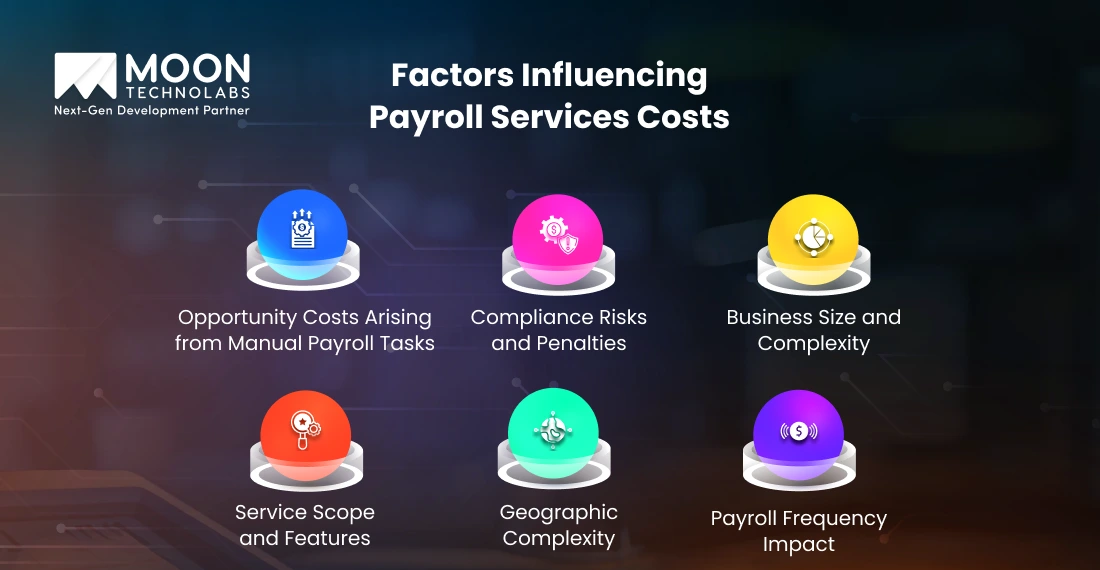
Large and small business owners need to invest a significant amount of time in manual payroll tasks that can be automated. They typically spend between 5 and 15 hours per month. At a rate of USD 60 per hour, paid to professionals to fulfill these tasks, they could be looking at at least USD 900 per month in opportunity costs.
Annual compliance risks arising from compliance issues affect most businesses. Additionally, they must pay penalties ranging from USD 1,000 to USD 25,000. Even though these costs vary depending on the violation levels, the tax filing mistakes alone can cost up to USD 280 for every incorrect form filed.
The costs of payroll services can vary based on the business size and service requirements. Small businesses with up to 25 to 200 employees can expect to pay between USD 125 and USD 450 per month for basic payroll services.
These services typically encompass basic payroll processing, tax filings, and direct deposit services. However, this range can increase for businesses that also offer timekeeping, HR solutions, and benefits management. They can expect to pay between USD 325 and USD 2,450 per month.
Basic payroll processing includes wage calculation, tax withholding, and direct deposits. Comprehensive solutions will add benefits management, time tracking, HR support, and advanced compliance tools. While initially more expensive, these packages often provide superior value through integrated functionality.
Multi-state operations incur costs that are 15-30% higher due to varying tax laws and compliance requirements across different states. International payroll can multiply costs significantly.
Monthly processing is the most cost-effective option, reducing annual processing fees by 20-40% compared to weekly schedules. On the other hand, bi-weekly/weekly processing increases costs but may improve employee satisfaction and cash flow management.
The choice between in-house and outsourced payroll services is primarily driven by strategic focus and risk management. Companies spending more than USD 500 per month on payroll services and activities often find that outsourcing reduces the payroll services costs and provides superior value.
Resources for core business development also increase while ensuring professional-grade accuracy and compliance.
Here’s a short comparison of costs involved in outsourcing payroll services vs in-house costs:
| Particulars | In-house Costs (USD) | Outsourcing Costs (USD) |
|---|---|---|
| Training and Updates | 2000 to 8000 annually | Usually included; minimal to none |
| Error corrections | 5000 to 25000 annually | 2000 to 8000 annually |
| Compliance risks | 10000 to 50000 potential exposure | 1,000 to 5,000 annually; risk mostly transferred |
| Access to experts | Needs additional costs | Included with expert support |
| Software licenses | 1000 to 5000 annually | Included in the total service fee |
| Staff Salaries | 54000 to 78000 annually | None or greatly reduced |
| Opportunity costs | 15000 to 40000 with a diverted strategic focus | Minimal, focus retained on core business |
| Scalability and support | Costly and limited | Included, adaptive and easily scalable |
However, some considerations vary based on the industry:
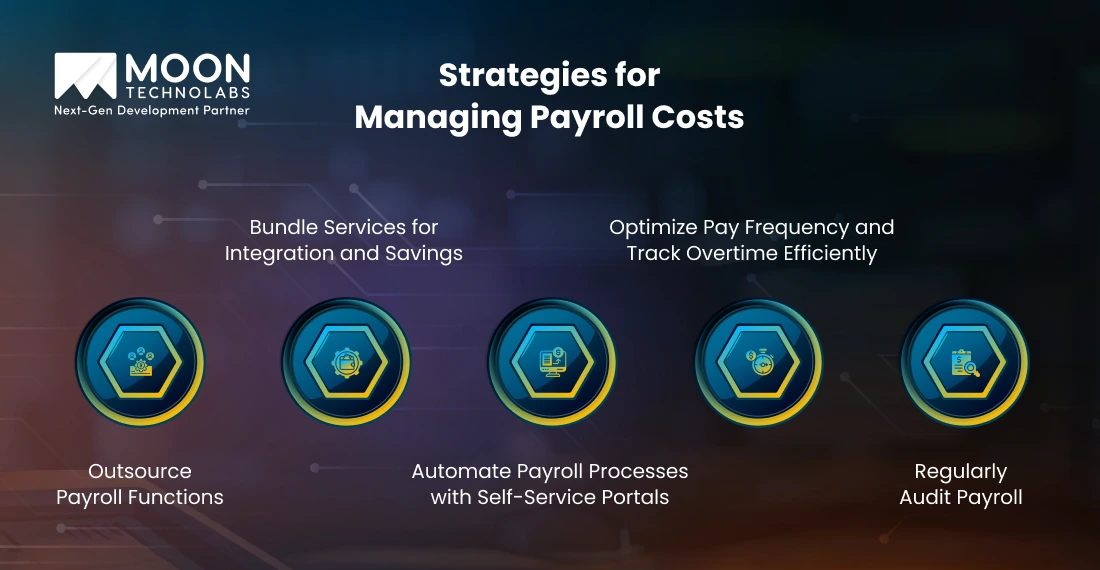
For cost reduction, there are proven strategies that businesses can follow to ensure payroll services costs are well-controlled and continue to deliver measurable results across multiple dimensions:
Payroll services deliver exceptional ROI when businesses transition from manual, in-house tasks to professional providers.
One of them is bundling services with payroll. For example, organizations can pair them up with HR and time tracking to reduce total costs up to 25% and also improve integrations.
Implement self-service employee portals with automated payroll processing to access pay stubs and update information accordingly. This can help reduce administration costs and overheads by up to 15%.
Adjusting payroll frequency to best fit business and employee needs, such as switching from weekly to bi-weekly or monthly, can reduce payroll processing costs. Efficient overtime tracking ensures compliance and guards against costly errors.
Annual contract negotiations for multiple years can often help businesses secure discounts of up to 30%. Regular service audits and reviews help businesses identify features that are not frequently used, allowing them to find more optimization opportunities. It can help save up to 20% of service costs.
Outsource your payroll to our experts for accurate, error-free payroll and more time to focus on your business growth.
Hire An Expert Team
Choosing the best payroll services software depends on the business’s growth trajectory. Based on it, their levels of risk tolerance and allocation of resources also differ. Here are some tips on choosing the one that fits best with your organization:
Evaluating your business needs begins by assessing different aspects. For rapidly expanding companies, outsourcing software development is a more cost-effective option for achieving scalability, as it avoids the delays and additional costs associated with growing internal teams.
Similarly, if your business has a low tolerance for errors, professional services offer reliable accuracy and compliance.
Comparing the pricing models and fees to ensure they fit your current budget and growth plans. Look for transparent pricing structures, whether per employee, per process, or flat fees. Select software that can scale easily as your business expands, thereby avoiding costly upgrades or replacements later.
Checking compliance helps organizations in verifying the software’s ability to stay up-to-date with tax laws and labor regulations. It includes strong accuracy in automatic tax calculations and filings, which minimizes costly payroll errors and penalties.
Assessing the ease of use and support enables your organization to choose a payroll software with an intuitive interface that reduces administrative burden and mistakes. It also offers you access to reliable customer support, including dedicated account managers and responsive help desks.
The payroll service is likely to continue evolving in response to technological advancements and shifting workforce expectations. These innovations promise greater flexibility, improved compliance, enhanced employee experience, and smarter data-driven decision-making.
Here are some key trends to watch in the coming years:
Employees increasingly expect real-time access to their earned wages before traditional payday. Payroll services are evolving to offer on-demand payouts, improving employee satisfaction and financial well-being.
As businesses expand internationally, payroll management solutions are evolving to manage multi-country payrolls seamlessly. This trend encompasses handling diverse tax laws, currencies, and compliance requirements within a single platform.
Payroll services are increasingly integrated with comprehensive HR management systems. This unified approach streamlines workforce management, automates workflows, and delivers a cohesive employee experience.
The use of advanced analytics in payroll is gaining traction, enabling businesses to gain actionable insights. Analytics help optimize labor costs, predict trends, and improve decision-making related to compensation and workforce planning.
Is your organization struggling to manage complex, costly, and time-consuming internal payroll services?
At Moon Technolabs, we specialize in developing payroll software solutions tailored to organizations of all sizes and industries. By understanding the unique business challenges of our clients, we provide seamless payroll processing, tax compliance, and integration with HR systems.
Our expert solutions reduce administrative burdens, mitigate risks, and enhance employee satisfaction through timely and accurate payments. Let our experts transform your payroll operations with precision and reliability. Connect with us today to streamline your payroll and empower your workforce.
Payroll service costs go beyond simple fees, affecting compliance, employee retention, and operational efficiency. Hence, choosing outsourced payroll services can offer significant time savings, error reductions, and compliance assurance that outweigh traditional in-house expenses.
Ultimately, choosing the right payroll service strikes a balance between cost and value, ensuring seamless payroll management that supports business growth and fosters employee trust.
Start optimizing your payroll investments for long-term success today.
01
02
03
04
05

Jayanti Katariya is the CEO of Moon Technolabs, a fast-growing IT solutions provider, with 18+ years of experience in the industry. Passionate about developing creative apps from a young age, he pursued an engineering degree to further this interest. Under his leadership, Moon Technolabs has helped numerous brands establish their online presence and he has also launched an invoicing software that assists businesses to streamline their financial operations.


Submitting the form below will ensure a prompt response from us.
We refine our expertise to deliver innovative business solutions.





500 N Michigan Avenue, #600, Chicago IL 60611
13500 Long Is Dr, Pflugerville, TX 78660, USA

C/105 Ganesh Meridian, S.G. Highway, Ahmedabad, GJ 380060


Ayse D.
Co-Founder France
“ I highly recommend Moon Technolabs as the quality of service is wonderful. We have hired this company to develop the product based on some complex & technical issues. We get the best quality services as compared with others in the market. Huge Thanks to Moon Technolabs as the team is always ready to give the solution all time.”

Justin G.
Founder & CEO USA
USA“ Moon Technolabs is a pioneer in the WebRTC based project as they have fixed complicated segments of the module by fulfilling different product lines by providing 24X7 customer support. We really recommended Moon Technolabs as they are able to develop products as per the module deadline and project timeline.”

Flavio S.
Founder & Managing Director Germany
“I am happy to recommend Moon Technolabs for their app development services. They successfully developed apps for me, and I am highly satisfied with the overall outcomes. The development team has swiftly addressed the issues with responsive and effective communication to understand the requirement quickly and actively resolve the back-and-forth problems that arose...”

Jay M.
Founder & CEOUSA“Moon Technolabs is the best company that provides advanced apps and websites development services in the USA and Europe. I am a newbie to develop my app with an external team. I am really happy to work with them as I am not that much mobile apps user. Here, the team and specially the CEO of Moon Technolabs helps me to let me know about the benefits of my app to generate revenue....”


Our Offices
India
C/105 Ganesh Meridian,S.G. Highway, Ahmedabad, GJ 380060USA
500 N Michigan Avenue, #600, Chicago IL 60611Contact Information


