
Jayanti Katariya
Last Updated: April 09, 2026 Total Views: 384
Table of Content


Blog Summary:
This blog explains everything about mental health app development, right from the best practices and features to the use of advanced technologies and monetization strategies. It also explains different types of mental health apps and challenges in their development. Going through the guide helps you build successful mental health apps.
Table of Content
Mental health has become a global crisis due to the fast-paced lives people are accustomed to. As per World Health Organization (WHO) more than 1 billion people worldwide struggle with a mental health condition, which traditional healthcare systems often struggle to accommodate, due to limited therapist availability, long waiting time, etc.
Mental health app development helps bridge these gaps by providing users with easy access to therapy, mood tracking, and self-care tools via their mobile devices. They can talk to therapists, track their mood, or manage stressful moments. This trend is growing rapidly and encourages healthcare providers to invest in mental health app development, helping them improve services and serve more patients efficiently.
Meanwhile, developing a mental health software requires much more in terms of planning, strategy building, technology selection, etc. The entire process is time-consuming. This guide explains everything about developing such an app, from planning to deployment. Let’s explore now.
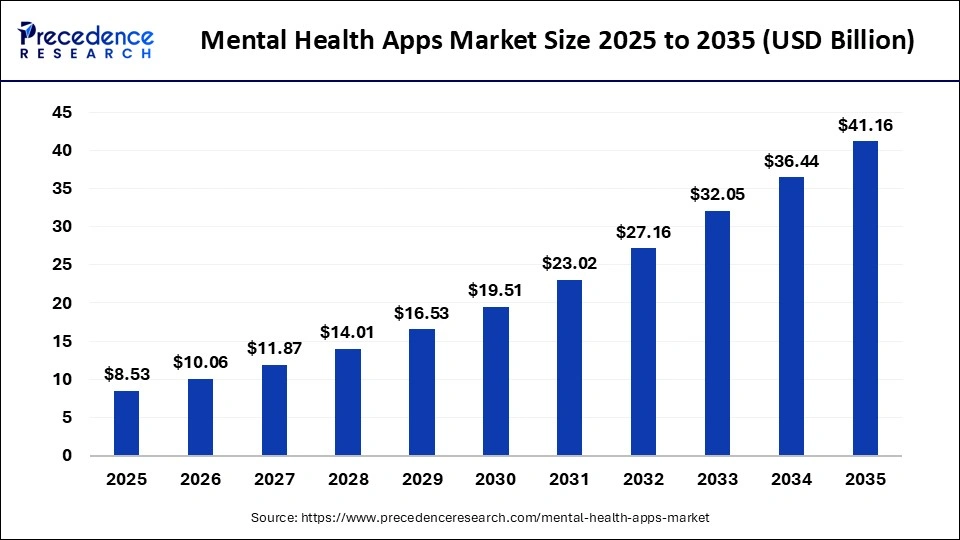
The mental health app industry is a digital revolution rather than a niche, due to its unprecedented growth. According to recent data by Precedence Research, the global mental health app market is predicted to reach up to $10.06 billion in 2026 and $41.16 billion by 2035, which will grow at a CAGR of 17.04% during the forecast periods.
There are many factors that fuel the growth of this industry, including increasing adoption of smartphones, growing awareness around mental wellness, and the willingness among people to get something beyond the traditional clinic.
Let’s explore some other factors that foster this momentum:
Mental health app development is a process to build a software solution that helps users become mentally fit. The process includes various steps like gathering ideas, market research, designing, coding, integrating necessary features, testing, and deployment of the end product.
A mental health software delivers services such as mood tracking, therapy sessions, crisis intervention, guided meditation, and AI-based emotional support. It minimizes the gap between mental healthcare and people who require it but can’t access the same with the use of traditional channels.
It’s pivotal to select the right type of mental health application you want to build before proceeding into the development process. Each type of such app serves a unique user requirement and opens up a different business model.
Let’s explore some of the popular apps you can consider building:
Therapy and coaching apps are one of the most powerful commercial mental health apps. With the use of these apps, users can connect with certified life coaches, psychologists, and licensed therapists. The connection takes place in several modes, such as voice sessions, video calls, asynchronous text-based messaging, etc.
The most popular examples of these apps include Talkspace, BetterHelp, and more. These apps have a major impact on how therapy is accessed and provided.
Cognitive Behavioral Therapy (CBT) and Dialectical Behavior Therapy (DBT) are the two most popular and clinically validated approaches. These help in curing depression, anxiety, and emotional dysregulation.
With AI-driven apps, users get therapeutic frameworks without the necessity of a live therapist for every session. These apps guide users through machine learning and conversational AI. They guide users through journaling prompts, restructuring exercises, behavioral activation techniques, etc.
As the name suggests, mood tracking apps allow users to understand their emotional patterns. They can check their mood regularly, rate, add notes, and get visual insights in various forms such as streaks, trend reports, etc.
These facilitate users to connect their lifestyle choices to their emotional state. These apps are specifically robust when combined with AI-based insights that reflect concerning patterns and also suggest timely coping strategies.
Mediation and mindfulness apps help users overcome stress and get mental clarity, while providing guided meditations, mindfulness practices, and breathing exercises. They are good for users looking for preventative mental wellness solutions.
You Might Also Like:
They are packed with features such as personalized recommendations, audio/video sessions, offline access, progress tracking, and more. These apps mainly focus on user engagement through a smooth user experience and content variety.
Mental wellness is all about creating a daily routine for the prevention of psychological health in the long term. Self-care apps help with this. They enable users to develop habits across journaling, hydration, digital detox, gratitude practices, and physical activity.
The gamification layer of this app makes it unique – it includes streaks, progress milestones, badges, and community challenges. These layers lure users to come back.
These apps are meant to cater to some specific clinical conditions instead of a wide wellness market. These mainly target conditions like bipolar disorder, PTSD, OCD, eating disorders, schizophrenia, or addiction recovery.
They are developed across evidence-based intervention methods and with close coordination with healthcare institutions and clinical researchers. Mental disorder-specific apps require the implementation of strict regular compliance and a thorough clinical validation.
Sleep support apps help users to get rid of sleeping disorders – they can improve their sleep quality. It helps them to know their sleep cycles with guided relaxation techniques, bedtime routine builders, and sleep tracking.
These apps become more powerful when integrated with AI-based sleep analysis and wearable devices. Sleep support apps are not only for individual users but also cater to healthcare providers dealing with patients with sleeping disorders related to anxiety.
We develop a user-first mental health app that prioritizes privacy, empathy, and a seamless experience. Let’s start building your app with expert assistance.
While selecting a mental health application, users not only look for an eye-catching UI but also seek tools that help them with their psychological well-being. So, you need to integrate essential features in your mental health app to make it engaging and successful. The following are some of the features you can consider to integrate:
Mood tracking lets users gather details of their emotional states, triggers, and daily experiences. These data become useful in getting details about their behavioral patterns and mental health journey.
A mood and progress tracking app can improve this feature through analytics dashboards, visual insights, personalized recommendations, etc. These allow users to take proactive steps for improvements.
It’s necessary to provide users with complete access to easy-to-understand and reliable mental health content. It includes videos, articles, and coping strategies, guided exercises based on proven psychological approaches.
A fully structured resource library enables users to understand their emotions and offer them practical tools for various purposes, such as managing anxiety, stress, and many other challenges independently.
A smooth access to certified therapists is highly important for users looking for professional assistance. This feature comes with in-app messaging, video consultations, session scheduling, etc.
Be it user confidentiality, secure communication channels, or compliance with healthcare regulations, these play a crucial role. A healthcare app comes with teletherapy that minimizes the gap between digital convenience and traditional care.
AI chatbots have revolutionized mental health support by providing 24/7 assistance and quick assistance. These chatbots engage users in meaningful conversations, offer coping techniques, and provide them with structured therapy exercises such as CBT. Even though they can’t replace human therapists, they indeed maximize both scalability and accessibility, specifically for users who require fast support.
When it comes to crisis support, it’s one of the must-have mental health applications for ensuring user safety. It includes fast access to crisis intervention resources, emergency helplines, panic buttons, and more.
These apps provide direct connections or geolocation-based assistance for support services. These features are quite necessary for users facing emotional distress.
A consistent engagement is indispensable for obtaining outstanding outcomes in mental health software. Whether it’s reminders or push notifications, these allow users to be on track with their routines.
These include attending therapy sessions, logging moods, completing exercises, and practicing mindfulness. With effective personalization, these reminders maximize positive habits even without overwhelming users.
Developing a mental health application involves the use of advanced tools and technologies for different purposes, including personalization, immersive user experience, etc. We will have a look at some of the most commonly used technologies:
It will not be wrong to say that AI is a core technology for these healthcare apps. This technology serves various purposes, be it personalizing content recommendations, powering empathetic chatbots, or detecting early signs of emotional distress with behavioral pattern analysis.
ML models boost the app’s potential to check higher risk behavioral patterns, predict mood shifts, suggest timely interventions, etc. These make it smart and valuable to encourage users to stay longer.
Whether it’s biosensors, smartwatches, or fitness brands, they are considered to be an effective health data source. When you integrate them with wearable devices with the help of mental health apps or IoT connectivity, they can gather psychological data in real time. The data can be sleep quality, heart rate variability, activity levels, skin conductance, etc.
VR and AR are considered to be the most effective therapeutic media, specifically for PTSD, disorders, stress management, and phobias. With VR exposure, users manage even fear-inducing situations in a safe virtual environment. It’s basically a method that has an impeccable and fast-growing clinical validation behind it.
On the other hand, AR overlays guided exercises or calming visuals to enhance real-world interactions. These technologies maximize engagement and therapeutic outcomes.
With predictive analytics, mental health apps can analyze users’ needs accurately based on behavioral trends and historical data. It can easily recognize early warning signs of mental health issues, including irregular sleep patterns, increased stress, and trigger timely interventions.
This kind of proactive approach works better in preventing severe conditions and fostering early support, which ensures the effectiveness of care.
The way people speak tells much about their mental health. Many factors play a crucial role in this, including the words they pick up, their pitch variation, pace, tone, vocal energy, pauses, etc.
Voice and speech analysis technologies leverage AI-based acoustic modeling to analyze these vocal biomarkers during therapy sessions and in-app check-ins. It adds a new passive data stream to the app’s potential for understanding the psychological state of users.
We convert your unique idea into a high-grade mental health software. Partner with us to allow our developers to create a scalable, secure, and engaging app.
The mental health app development process also involves various unique challenges. Some of them are as follows:
The majority of mental health digital solutions lack clinical validation, which is indeed the case. Developers often face difficulties in validating the content and features of apps by certified clinics or medical professionals.
Solutions: Get in touch with licensed psychiatrists, psychologists, and clinical researchers during the development process.
Data shared by patients while accessing the app is personal and thus highly sensitive. This data includes the patient’s trauma histories, deepest fears, emotional vulnerabilities, etc. Even a single data hack not just damages your reputation but also the trust of patients who use your platform.
Solution: Build the app by implementing high-grade security features such as strict data minimization practices, end-to-end encryption, and more.
Mental health software often struggles to maximize user engagement and customer retention. The major reason for this is that users often download the app when they are stressed. But, soon they abandon using the app when they feel better.
Solution: You need to design your app by including an intuitive user interface, progress milestones, personalized journey, gamification, etc.
Most mental health digital solutions are available with AI-based features. The major issue with these features is that they sometimes offer biased or misleading guidance unintentionally, which indeed impacts users negatively.
Solution: You can train AI models on quality and multiple datasets and analyze their outputs continuously. Make sure you establish clear ethical guidelines and conduct the audit on a regular basis to maintain accuracy, fairness, and responsible usage.
It’s true that the regulatory landscape for a mental health app is fragmented, complex, and emerging rapidly. And it’s also true that maintaining these regulations across multiple regions is tough and takes a lot of time. Any non-compliance causes some legal risks and unnecessary penalties.
Solution: It’s advisable to work closely with legal and compliance experts to know some region-based requirements. Besides, you can develop apps with a compliance-first architecture.
Apart from having the right idea, you need to implement the top practices to make your mental health software successful. The following are some of these practices you can consider implementing:
Trust is something that has great importance for these apps. Therefore, you need to focus on creating a secure architecture for your app – implement security features like anonymized data storage, end-to-end encryption, strict access controls, etc. You need to consider GDPR, HIPAA, and regional compliance frameworks as vital product requirements.
As mentioned above, every piece of content your app includes should be validated with certified medical professionals or genuine clinics. You need to get in touch with certified clinicians throughout your mental health software development, not only during the period of content review. These apps earn trust among users fast.
Patients going through mental distress can’t cope with a confusing interface. So, you need to craft your app with an intuitive and engaging UI/UX design. Make sure every transition, tap, and screen feel intuitive.
You need to implement everything to make the user interface design extraordinary, be it using clear typography, warm color palettes, or minimal cognitive load. Your app should also include accessibility features like adjustable text sizes, reader support, low-stimulation modes, etc.
You need to consider implementing those features that provide tangible value. Some of these features you can consider implementing in your MVP are as follows:
While designing your app, you need to be highly focused on engagement and retention strategies. You need to implement progress streaks, personalized reminders, community peer support, achievement milestones, etc.
These work together to let users return consistently. It’s vital to check the main drop-off points in your user journey and adjust your strategies accordingly.
The most exciting thing about a mental health digital solution is that one can monetize it by using various available options. The following are some of those options you can consider to monetize your app:
It’s one of the most effective monetization strategies you can implement to monetize your app. In this model, users pay a recurring fee either monthly or annually and get unlimited access to therapy sessions, premium content, advanced tracking features, AI coaching, and more.
Annual plans maximize lifetime value while minimizing churn, which makes this model quite attractive and also supports business growth for a long term.
In-app purchase is the best option for users who are ready to pay in return for what they require, instead of opting for a full subscription. It allows users to purchase specific content packs, specialized programs, one-on-one therapy sessions, premium meditation series on demand, etc.
The freemium model offers a free tier that engages users – it comes with limited guided sessions, basic mood tracking, crisis resources, etc. Once patients use basic features, they then convert their free subscription into paid plans through a compelling premium upgrade path. The freemium model minimizes the barrier to the first download while creating a natural funnel towards high-value subscription tiers.
B2B partnerships are a lucrative revenue stream in mental health software rather than for individual users. Whether it’s health insurance providers, corporate wellness programs, employee assistance programs, or hospitals, they pay bulk licensing fees or per-seat to provide your software as a benefit to their workforce or members.
This model offers predictable revenue with lower customer acquisition costs compared to direct-to-consumer channels.
Well, mental health app development requires technical expertise and a development partner who possesses a good understanding of compliance complexity, sensitivity, and human responsibility. We have 16+ years of expertise in healthcare app development solutions with a proven track record of delivering quality mental health app development solutions.
With 350+ team strength, our seasoned developers have vast technical expertise and build clinically informed and HIPAA-compliant digital health solutions. We craft varieties of health solutions that are scalable, secure, and impactful.
So, by now, you have already understood how to perform mental health app development. Well, the entire process requires thorough research work, making a solid plan, implementing the right strategies, defining purposes, goals, etc.
Apart from this, building such an app requires a vast technical expertise as well. So, you can partner with reliable mental health app developers like us to get assistance in every development step and build quality solutions.
01
02
03
04
05

Jayanti Katariya is the CEO of Moon Technolabs, a fast-growing IT solutions provider, with 18+ years of experience in the industry. Passionate about developing creative apps from a young age, he pursued an engineering degree to further this interest. Under his leadership, Moon Technolabs has helped numerous brands establish their online presence and he has also launched an invoicing software that assists businesses to streamline their financial operations.

Submitting the form below will ensure a prompt response from us.
We refine our expertise to deliver innovative business solutions.





205 N Michigan Avenue, #810, Chicago, 60601, Illinois, United States
13500 Long Is Dr, Pflugerville, TX 78660, USA

C/105 Ganesh Meridian, S.G. Highway, Ahmedabad, GJ 380060


Ayse D.
Co-Founder France
“ I highly recommend Moon Technolabs as the quality of service is wonderful. We have hired this company to develop the product based on some complex & technical issues. We get the best quality services as compared with others in the market. Huge Thanks to Moon Technolabs as the team is always ready to give the solution all time.”

Justin G.
Founder & CEO USA
USA“ Moon Technolabs is a pioneer in the WebRTC based project as they have fixed complicated segments of the module by fulfilling different product lines by providing 24X7 customer support. We really recommended Moon Technolabs as they are able to develop products as per the module deadline and project timeline.”

Flavio S.
Founder & Managing Director Germany
“I am happy to recommend Moon Technolabs for their app development services. They successfully developed apps for me, and I am highly satisfied with the overall outcomes. The development team has swiftly addressed the issues with responsive and effective communication to understand the requirement quickly and actively resolve the back-and-forth problems that arose...”

Jay M.
Founder & CEOUSA“Moon Technolabs is the best company that provides advanced apps and websites development services in the USA and Europe. I am a newbie to develop my app with an external team. I am really happy to work with them as I am not that much mobile apps user. Here, the team and specially the CEO of Moon Technolabs helps me to let me know about the benefits of my app to generate revenue....”


Our Offices
India
C/105 Ganesh Meridian,S.G. Highway, Ahmedabad, GJ 380060USA
205 N Michigan Avenue, #810, Chicago, 60601, Illinois, United StatesContact Information


