
Jayanti Katariya
Last Updated: April 07, 2026 Total Views: 89
Table of Content


Blog Summary:
Home services app development is indispensable for businesses seeking to meet the growing demand for convenience and on-demand services. The guide explains everything about home services app development, including development steps, features, tech stacks, monetization trends, and challenges. It also explains a complete cost breakdown and reasons why developing such an app is a smart move.
Table of Content
When users need cleaners, plumbers, or electricians, they often seek instant bookings, a smooth booking experience, and real-time updates. Meanwhile, many service businesses still rely on fragmented communication, manual bookings, and inefficient scheduling. These often cause service delays, missed opportunities, and poor customer satisfaction.
Home Services App Development helps them overcome these issues by offering automated workflows, real-time scheduling, centralizing operations, and more. It fosters customer engagement and improves the booking experience through features such as smart tracking, secure payment, and automated workflows. So, developing a robust home services app is a great choice for a business.
Meanwhile, building these apps requires a lot of planning, research, and strategy building. In this guide, we will cover everything you need to know about developing home service applications. Let’s explore now.
Recent data from Growth Insights shows that the global home services app market is projected to surpass $9.70 billion by 2035. It’s expected to surge at a CAGR of 9.1% during 2025-2035. Dual-income households, urbanization, and related factors drive this growth.
Let’s explore various factors that make the home services market stand out:
The home services market is considered an economic force due to its continued expansion. Straits Research predicts that the global on-demand home services market size is likely to surge at a CAGR of 16.04%. The market is projected to reach up to $19.65 billion by 2033.
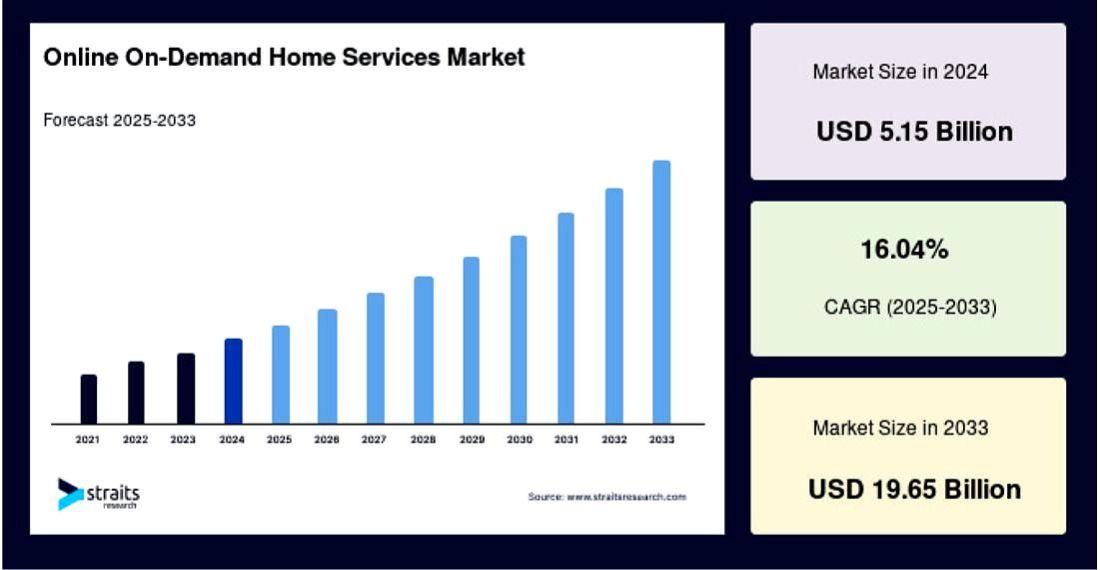
Many factors contribute significantly to driving this growth, including urban lifestyles, increasing smartphone adoption, and more. In the US, approximately 71% of customers (Global Growth Insights) prefer mobile platforms to access home services, while 62% use recurring service plans.
Building a home services app lets you gain benefits like customer loyalty, long-term growth, and operational efficiency. Let’s discuss many other factors that make a home services app development decisive:
With a home services app, consumers have everything at their fingertips, from comparing providers and browsing services to making secure payments and checking availability. All of these can be done in minutes. This experience aligns with most users’ expectations, thereby building immediate trust.
Customers today need home services immediately rather than waiting unnecessarily for a long time. An on-demand home services app can resolve this issue by offering real-time service requests and quick provider matching.
Be it a last-minute house cleaning before guests arrive, or an emergency plumbing leak at midnight, the app connects users with available professionals round the clock.
A home service app removes geographical boundaries, helping businesses target any location. It enables service providers to serve customers across multiple cities, target new customer segments, and onboard hundreds of service professionals.
All these are possible without increasing overhead. Whether it’s tier-2 or tier-3 cities, they offer vast opportunities where demand for home services is increasing, but supply is insufficient to meet it.
Retention matters for the growth of any home services business. The app helps with features such as personalized service recommendations, loyalty programs, easy rebooking, and push notifications.
These features encourage users to return for the next service whenever required. An app creates a perfect ongoing relationship.
It’s not possible to manage a network of service professionals manually, as it causes errors – an app solves this problem. It makes every operational workflow fast, from job assignment and automated scheduling to digital invoicing and real-time status updates.
Data is crucial for business growth, and a home service app generates a lot of data. It helps you gather information on in-demand services, highly rated providers, peak activity times, and more. With these details, you will be able to make the right decision for promotion, pricing, product development, and staffing.
Cost efficiency is one of the great aspects of building a home service app. It includes automated booking that reduces the need for large customer support teams. Digital payments remove cash handling overheads. Besides, route optimization for service professionals minimizes both travel and fuel costs.
Building a home services app is much more than coding and launching a product. It requires smart technology selections, effective planning, and a vast understanding of both business objectives and user behavior. The following are some of the great approaches to developing an app:
The process of building a home services app starts with understanding the project requirements, purposes, goals, and, of course, your target market. You need to understand your target audience better in terms of who they are, the services they require the most, your competitors, etc.
When deciding on features, you need to consider three panels: the service provider app, the customer app, and the admin dashboards. You need to know those service categories you launch with, be it home cleaning, electrical work, plumbing, or a multi-category platform. Focus on features for MVP to go to market fast without sacrificing its important functionality.
When it comes to tech stack selection for your home services app, you need to choose a stack that supports GPS tracking, real-time updates, secure payments, etc. You can consider the following choices for different purposes:
Your selection should be based on your budget, team’s expertise, and long-term scaling roadmap.
You need to focus on crafting your home services app with logical navigation flows, a clean UI design, and accessibility in mind. Make sure the onboarding process is quick, the booking confirmation is instant, and the search and filter functions are effortless. The app’s interface should be equally intuitive for service providers.
Trust is of great importance for a home services app, as users invite unknown persons into their homes for services. So, you need to implement the latest security standards and compliance to build trust among customers. The following are some of those standards:
Make sure your app complies with regional data privacy regulations, such as the CCPA or the GDPR.
You need to develop your app using an agile methodology that includes building in sprints, continuous testing, and feedback-driven iterations. You need to perform a variety of tests, such as performance, functional, and real-device testing, across platforms like iOS and Android.
Apart from this, you need to pay particular attention to edge cases such as payment failures, network connectivity issues, and booking conflicts.
When launching your app, focus on the geographic area and aggressively explore user feedback. You can increase early adoption through app store optimization, referral programs, and targeted digital marketing.
As your platform grows, you need to analyze performance metrics, including customer ratings, provider utilization rates, booking volumes, retention rates, and more.
Build a Scalable and Revenue-Driven Home Services App
We build a powerful home services app to improve bookings, manage providers, and more. Launch your app fast with secure payments, scalable features, and more.
Your app should include essential features to meet users’ growing expectations, latest industry standards, etc. Below are some of those features you can consider to integrate into your app:
Users today expect apps to provide personalized service recommendations based on their location, past booking history, browsing behavior, seasonal patterns, etc. For this, you need to integrate features like AI-based service recommendations into your app. It recommends the right services to users at the right time.
The next feature you can integrate into your home services app is voice-based booking with in-app assistants. It is vital to ensure its compatibility with Google Assistant and Alexa. This helps users to book services hands-free.
Make sure you integrate real-time GPS tracking with accurate ETA predictions to keep users informed and minimize inbound support queries. You need to combine perfect live location data with traffic intelligence to deliver reliable ETAs.
The major advantage of a dynamic pricing feature is that it adjusts service rates based on several factors. These include provider availability, real-time demand, geographic factors, and time of day. This feature enables the system to adjust prices to balance supply when demand surges.
Smart scheduling algorithms automatically match incoming service requests to the availability of the appropriate service provider. The system assigns service requests based on factors like current workflows, proximity, skill set, ratings, etc. It not only minimizes idle time but also ensures a highly efficient task distribution.
Implementing AI-based fraud detection and verification helps you avert security threats such as identity impersonation, fraudulent bookings, payment fraud, and more. This feature allows you to analyze several things, such as flagging suspicious activity in real time, analyzing behavioral patterns, and triggering verification workflows, before issues arise.
Service providers often encounter major difficulties when handling various tasks throughout the day. It not only impacts their earnings but also the app’s throughput. Therefore, it’s essential to implement route optimization in your app to leverage traffic data, location intelligence, job sequencing logic, and more to produce an efficient travel path across multiple assigned jobs.
While building your home services app, you might also be thinking about how to monetize it, right? There are multiple revenue streams you can use to monetize your app. Let’s explore them one by one:
As one of the most widely adopted revenue streams for home services apps, commission-based models help you earn a percentage (10% to 30%) of the transaction value. You can earn commission every time your app is used to book services.
It’s good for predictable, recurring revenue, which most app owners desire. Once you implement this revenue system, you can offer a subscription tier to both service providers and customers.
Customers pay either annual or monthly fees to receive benefits such as discounted rates, priority booking, waived service fees, and more.
With this revenue model, you can charge a fee from service providers to list their services on your platform. It’s a good option that works well during the early stage, especially when transaction volumes are still building.
Advertisement revenue goes well only for your platform when it gains a user base and scales. In this case, in-app advertising acts as an effective revenue channel. You will charge home improvement brands, local businesses, and other service providers for letting them target your vast customer base.
You can implement this revenue stream in your app to cater to users who are willing to pay for premium services. By paying for these services, they can access verified, trusted professionals with fast response times and dedicated support.
Turn Your Ideas into a Robust Home Services App
We convert your unique home services app development idea into a full-fledged app. Let’s build your app fast with an intuitive design and powerful features.
Home services app development also involves various technical and operational challenges. Let’s take a detailed description of all those challenges along with solutions as follows:
Home services app ensures consistent availability of service providers, even in underserved areas or during peak hours. A limited number of service providers causes frustrated users, booking failures, etc.
Solution: Create a dynamic onboarding flow to encourage new service providers to sign up. Use predictive analytics to know demand patterns with time and location.
Manually managing bookings across multiple service providers and categories is a lot of hassle. Double bookings, scheduling conflicts, and delayed assignments can occur without a perfect infrastructure.
Solution: You can integrate the smart auto-dispatch engines into your app. It assigns jobs as per skill set, availability, proximity, etc., in real time.
Since users permit a stranger service provider into their homes for their required services, it necessitates a trust framework. The reason is that any mistrust permanently damages the app’s reputation.
Solution: Implement a strict onboarding process for service providers by mandating background checks, identity verification, and skills assessments.
Improper routing has several repercussions, such as lower job completion rates, late arrivals, and dissatisfied customers. These are neither good for earning nor for service providers nor for platform ratings.
Solution: Integrate a real-time route-optimization engine into your software that factors in job sequencing, live traffic data, and geographic clustering.
An app that handles the load of 500 users may struggle to accommodate 50,000 users. Any backend limitation negatively impacts your app’s user experience, especially as your app grows.
Solution: You need to develop a cloud-native architecture and harness auto-scaling infrastructure from providers such as Google Cloud, AWS, and others.
Whether it’s disputed transactions, payment failures, or refund delays, these are some of the top reasons users often abandon home services platforms. It also erodes trust faster than anything else.
Solution: Integrate reliable payment systems that enable users to pay using multiple options, such as digital wallets and cards. You can also automate the refund workflows with status notifications and clear timelines.
Well, the average cost to build a home services app ranges from $30,000 to $150,000, sometimes more. It depends on the type and complexity of your project – developing a medium-complex app starts at $30,000 and goes up to $70,000. Moreover, developing an enterprise-grade app can cost up to $300,000.
The entire app development cost depends on many other factors as well. The following are some of them:
Now, we will discuss real case studies to understand the true potential of a home service app and how it can be a profitable venture for a business. Let’s discuss some of the most sought-after platforms.
Established in 2014, Urban Company is a popular brand and has become Asia’s largest home services marketplace. With a network of 50,000+ (Urban Company) trained service providers, it operates in more than 63 cities (Urban Company) across countries like Singapore, the UAE, Saudi Arabia, and India. According to Money Control, the company processes 1 million orders per month.
Many factors distinguish Urban Company from its competitors. Some of them are as follows:
As per NewsBytes, Urban Company has reported a 33% year-on-year (YoY) growth to $411.66 million in Q3 FY26.
Launched in 2008, TaskRabbit has a network of 175,000 taskers worldwide (Business Insider). In 2017, it was acquired by IKEA and then integrated into IKEA’s post-purchase ecosystems, which allows users to hire professionals for furniture assembly at checkout.
According to Tracxn, the company expanded its research worldwide, bringing reliable home services to all 50 US states. It’s a great milestone that underscores the continued scale and ambition of this platform.
We have years of experience building custom home services apps tailored to your specific needs. As a mobile app development company, we deliver secure, scalable solutions built to perform. Our commitment to delivering quality home services apps helps us stand apart from our competitors. From discovery to post-launch support, we pay equal attention to every step of the development process.
Here’s what you can expect from us when you opt for our customer home services app development:
It goes without saying that home services app development offers unmatched potential in the growing on-demand market. So, to develop a high-performing home services software, you need to focus on advanced features, user experience, and scalability.
Apart from this, you need to plan strategically and address various development challenges to ensure your app’s long-term success. Partner with an on-demand app development company like ours to strategize effectively and execute your development process hassle-free.
01
02
03
04
05

Jayanti Katariya is the CEO of Moon Technolabs, a fast-growing IT solutions provider, with 18+ years of experience in the industry. Passionate about developing creative apps from a young age, he pursued an engineering degree to further this interest. Under his leadership, Moon Technolabs has helped numerous brands establish their online presence and he has also launched an invoicing software that assists businesses to streamline their financial operations.

Submitting the form below will ensure a prompt response from us.
We refine our expertise to deliver innovative business solutions.





205 N Michigan Avenue, #810, Chicago, 60601, Illinois, United States
13500 Long Is Dr, Pflugerville, TX 78660, USA

C/105 Ganesh Meridian, S.G. Highway, Ahmedabad, GJ 380060


Ayse D.
Co-Founder France
“ I highly recommend Moon Technolabs as the quality of service is wonderful. We have hired this company to develop the product based on some complex & technical issues. We get the best quality services as compared with others in the market. Huge Thanks to Moon Technolabs as the team is always ready to give the solution all time.”

Justin G.
Founder & CEO USA
USA“ Moon Technolabs is a pioneer in the WebRTC based project as they have fixed complicated segments of the module by fulfilling different product lines by providing 24X7 customer support. We really recommended Moon Technolabs as they are able to develop products as per the module deadline and project timeline.”

Flavio S.
Founder & Managing Director Germany
“I am happy to recommend Moon Technolabs for their app development services. They successfully developed apps for me, and I am highly satisfied with the overall outcomes. The development team has swiftly addressed the issues with responsive and effective communication to understand the requirement quickly and actively resolve the back-and-forth problems that arose...”

Jay M.
Founder & CEOUSA“Moon Technolabs is the best company that provides advanced apps and websites development services in the USA and Europe. I am a newbie to develop my app with an external team. I am really happy to work with them as I am not that much mobile apps user. Here, the team and specially the CEO of Moon Technolabs helps me to let me know about the benefits of my app to generate revenue....”


Our Offices
India
C/105 Ganesh Meridian,S.G. Highway, Ahmedabad, GJ 380060USA
205 N Michigan Avenue, #810, Chicago, 60601, Illinois, United StatesContact Information


