
Jayanti Katariya
Last Updated: November 13, 2025 Total Views: 1725
Table of Content


Blog Summary:
This blog is an extensive guide to developing a grocery app for startup owners and food-selling businesses. It will shed light on the key business models, basic and advanced features, ideal tech stack, and app development cost. The blog also provides bonus insights on the top 5 grocery delivery apps and how to overcome challenges on the way to becoming a top grocery business leader.
Table of Content
For a long time, grocery shopping involved navigating crowded market aisles, long checkouts, and even forgetting a few items. However, technology has made picking up household items a convenient shopping experience, thanks to sophisticated algorithms and networks connecting local stores.
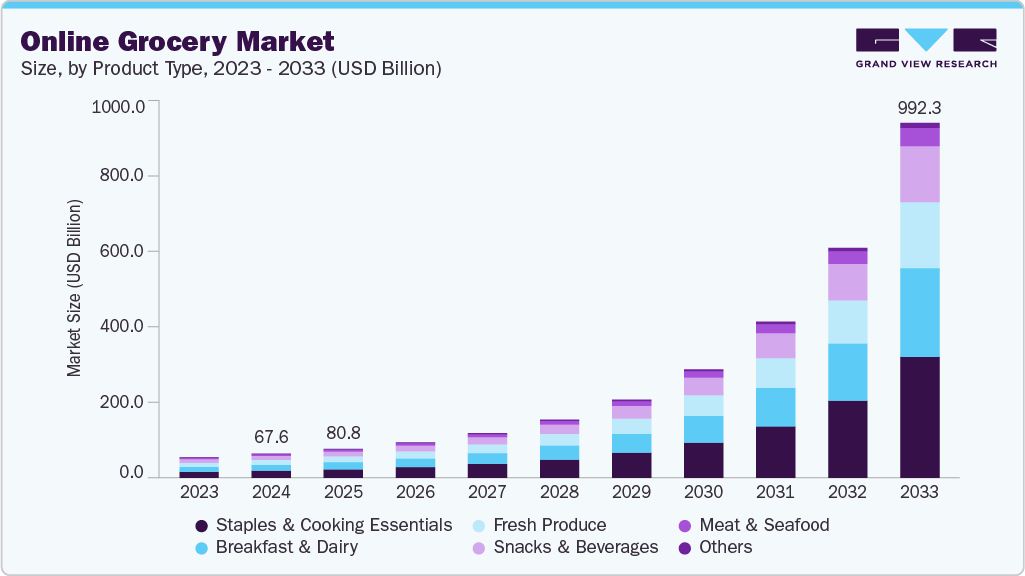
In the USA, the online grocery market reached USD 67.64 billion in 2024 and is expected to grow to USD 992.35 billion by 2033. For many small and large grocery business owners, grocery delivery app development can help address real-world problems.
In this blog, we will help them see these challenges as opportunities to revolutionize this mundane routine into a seamless online shopping experience.
The on-demand delivery app business model provides customers with easy access to shop for products from anywhere. This profitable market works on the following business models:
In this model, an e-commerce store purchases inventory items from various suppliers and stores them in its warehouses. The store manages the inventory, fulfills customer orders, interacts with customers, and ensures timely delivery.
A noteworthy example of this model is the BigBasket grocery app, the leading online grocery delivery app in 25 Indian cities. It stores its bulk-purchased inventory from suppliers like P&G, HUL, and Fresho across 12 warehouses.
The most distinguishing feature of BigBasket is that it sells its own inventory rather than serving as a marketplace for suppliers.
In the Marketplace model, multiple buyers & sellers ship and pay through a website on a common e-commerce platform. The seller handles packaging and distribution, or the seller packages the item, and the marketplace owner dispatches it.
A great example of this model is the Instacart grocery store app, an intermediary platform that connects customers with local grocery stores.
It works on a three-tiered customer strategy involving retail partners, customers, and shoppers (full-service and in-store). It earns revenue from markup prices, delivery fees, membership fees, service fees, pickup fees, and partner payments.
The hybrid business model combines the marketplace and inventory models, enabling businesses to serve a varied customer base. It offers customers an in-store shopping experience with the convenience of online grocery shopping options.
It also combines support from local store vendors with on-demand technology for efficient order fulfillment.
Amazon Fresh is an excellent example of a hybrid grocery shopping app that combines its network of centers. It keeps a stock to manage a vast inventory for reliable deliveries and distributes groceries by partnering with local grocery store owners and vendors to bring unique special items.
Turn grocery delivery challenges into opportunities and navigate the future with a custom app.
Tap Into a Booming Market
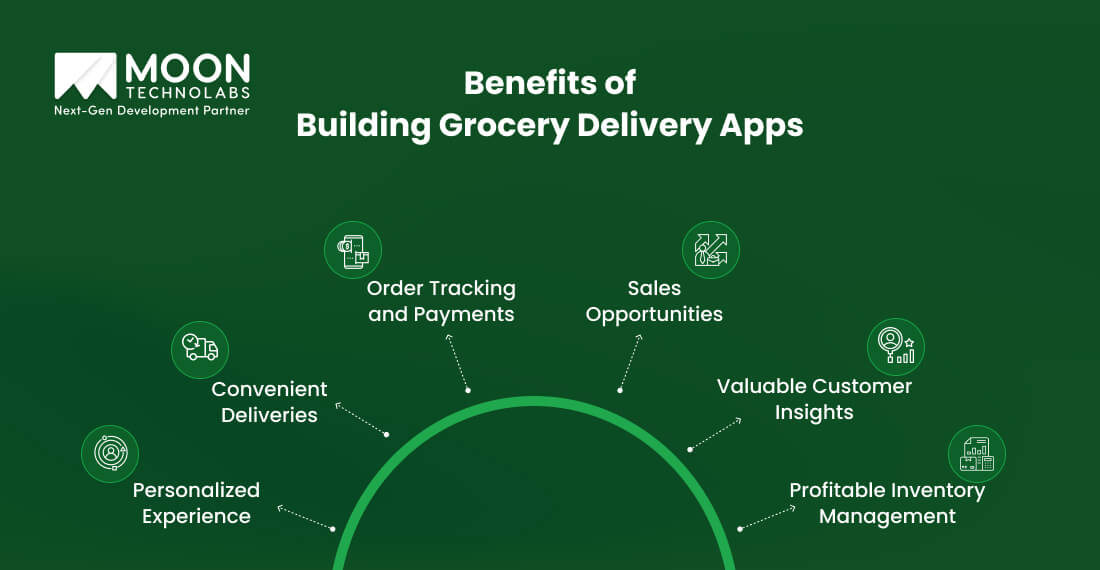
Building an online grocery delivery app will enable your business to earn profits by taking customer orders and purchasing those items at lower costs from local stores and sellers.
Let’s understand how your business will expand its customer base by attracting customers who prefer a personalized online shopping experience:
Grocery apps enable better customer engagement by keeping them in the loop even after they sign out and place an order. They can schedule orders and even get recommendations for further shopping.
More than 60% of customers find online grocery delivery services more convenient. As customers become savvier and seek ways to save money, grocery apps offer a range of discounts, memberships, and cashback options.
Real-time order tracking on grocery apps is the most efficient feature, allowing customers to track their orders on a map. Payments also offer a variety of options that let them choose their preferred payment method.
Let’s have a look at the benefits of grocery apps for grocery stores & restaurants:
Online ordering increases sales opportunities by offering a personalized experience tailored to customers’ previous purchases. Online grocery delivery apps can attract even the busiest customers as they can order from anywhere and choose a delivery slot that suits them.
Using app analytics, a grocery app provides insights into customer preferences, peak purchase times, and demographics. You can categorize customers based on preferred shopping times, best products, and chosen payment methods.
Managing inventory becomes easier with a grocery app, as you can make faster, more informed decisions about unavailable items. By integrating inventory management, you’ll have information at your fingertips about which items need to be restocked or new items to introduce.
Instacart serves more than 10,00,000 users today. Uber Eats is a top Hotel, Restaurant, and Catering (HoReCa) app that offers a subscription that lets customers order unlimited groceries with no delivery fees.
Similarly, Zepto, Dunzo, BigBasket, and Blinkit have been ruling over Indian customers with deliveries of 45 minutes or less, and even 10 minutes.
Instant delivery and the convenience of online store browsing have made these grocery delivery service apps a huge success. Before you start your own business, let’s look at how the top 5 apps in the world today are leveraging top-notch features and generating revenues:
| Grocery App | Availability | Revenue | Key Benefits (USP) |
|---|---|---|---|
| Instacart | Based in the US, it serves 5,500 cities in the US and Canada | 8.04% YoY growth Annual revenue of $3.04B |
Delivery fee ranges from $3.99 to $7.99 A subscription to Instacart+ is $99/month for unlimited deliveries. |
| Zepto | – Based in India, it serves major metros | 14 times growth Rs. 2024 Cr revenue in 2023 |
10-minute grocery delivery in nearby locations Zepto Pass at Rs. 299 / month |
| HelloFresh | Based in Berlin, it is the largest meal-kit provider in the US, Canada, Australia, and New Zealand. | 7.6 billion Euros in FY 2023 2.8% growth from 2022 |
Home-cooked meal subscription boxes between $8.99 and $12.49 per serving weekly subscriptions |
| Buymie | Based in Dublin, expanding to 200 locations in Ireland and Britain | 14.9 million Euro per year | Same-day grocery delivery in under 1 hour Free delivery on orders above 40 Euros |
| Weezy | Based in London, it serves Manchester, Brighton, and Bristol | 161,400 Euros | 15-minute deliveries Electric bikes and cycle couriers Delivery fee of £2.95. |
An online grocery ordering app typically consists of two main apps: a shopping app that users download to shop and a local delivery app. Both enable making those deliveries and are crucial to ensure deliveries and orders take place.
Here’s an approximate estimate of how much each feature would cost for the customer-facing app:
| Features | Estimated Cost (USD) |
|---|---|
| User Registration/Login | $1,000 – $3,000 |
| User Profile Management | $1,000 – $2,500 |
| Product Listing | $2,000 – $5,000 |
| Product Details | $1,000 – $3,000 |
| Shopping Cart | $2,000 – $4,000 |
| Checkout Process | $2,000 – $4,000 |
| Payment Integration | $3,000 – $5,000 |
| Order Tracking | $2,500 – $5,000 |
| Push Notifications | $1,000 – $2,500 |
| Customer Support | $1,500 – $3,000 |
Let’s understand the features of the customer app in detail:
A user-friendly UI ensures a quick registration process. It is designed to be easy to navigate, with intuitive controls and a simple design. You can also add social media integration.
The feature allows users to save time by easily browsing through a wide range of grocery products by category or product name and finding the best deals and discounts on popular items.
This feature enables secure, hassle-free payment options through multiple payment gateway integrations, prioritizing data security and privacy with advanced encryption.
Customers can track their order status and delivery progress in real time, from the warehouse to the doorstep, using a tracking system.
Customers can select a convenient delivery slot and schedule their delivery by choosing the best time, whether it’s early in the morning or late at night.
Here’s an overview of the features for the admin panel with estimated costs:
| Features | Estimated Cost (USD) |
|---|---|
| Admin Panel | $4,000 – $8,000 |
| Inventory Management | $3,000 – $6,000 |
| Delivery Management | $3,000 – $6,000 |
| Reviews and Ratings | $1,000 – $2,500 |
| Loyalty Programs | $2,000 – $4,000 |
| Multi-language Support | $1,500 – $3,500 |
| Analytics and Reporting | $2,000 – $5,000 |
| Security Features | $2,000 – $5,000 |
Let’s understand the must-have features for the admin panel in detail:
Admin can easily manage inventory, track stock levels, monitor sales trends, and automatically restock products to ensure profitable inventory management.
Admin can easily process orders with a user-friendly admin panel that tracks orders in real-time, manages order statuses, and automates delivery notifications.
Admin can optimize delivery routes for maximum efficiency and minimum time using a route-optimization algorithm that calculates the most efficient routes.
This feature enables admins to analyze key performance indicators — such as sales, inventory, and customer satisfaction —to identify trends and make data-driven decisions.
Customer management tools enable admins to track product information, images, and descriptions, generating accurate in-app reports and providing valuable order insights.
Provide wider visibility for your products with powerful features that help you network with local stores.
Start Your App Development Journey
When considering grocery delivery app development, the first question for the owner is whether the app will be profitable.
However, you can also run into challenges when unsold products are left in the store that you expected to sell out. Let’s understand these in detail with possible solutions:
An app’s product catalog contains various types of items – non-perishable and perishable products from nearby grocery stores. Moreover, the comprehensive list can be difficult to navigate without a proper browse-and-search system.
Solution: Categorizing items with tags and advanced search filters will help customers navigate through them. AI-powered product search and recommendations will also enable them to find products faster.
Timely deliveries are important to ensure that customers get their orders on time. However, sometimes orders are late when delivery personnel aren’t able to make on-time deliveries, leading customers to call to find out the location.
Solution: Integrating a GPS navigation system with real-time order tracking and estimated delivery and arrival times will be helpful to customers.
Due to the lack of a scalable database, a vast amount of data can lead to mismanaged logistics. This can also lead to non-coordinated deliveries without proper planning and optimization.
Solution: Consider partnering with a custom logistics software development company to address the challenges of managing logistics and multiple deliveries simultaneously.
Businesses cannot control changes in consumer behavior. Ordering from an app is constantly changing with new features, and a small error in the process can lead to dissatisfaction.
Solution: A personalized shopping experience can increase customer retention. Offering discounts, loyalty programs, tags, and the option to repeat past orders can also help.
Let’s understand how Amazon Fresh functions to help you get insights into the intricacies of creating your grocery store app. Amazon Fresh uses a hybrid model, with fulfillment centers and partnerships with local stores to maintain consistent stock.
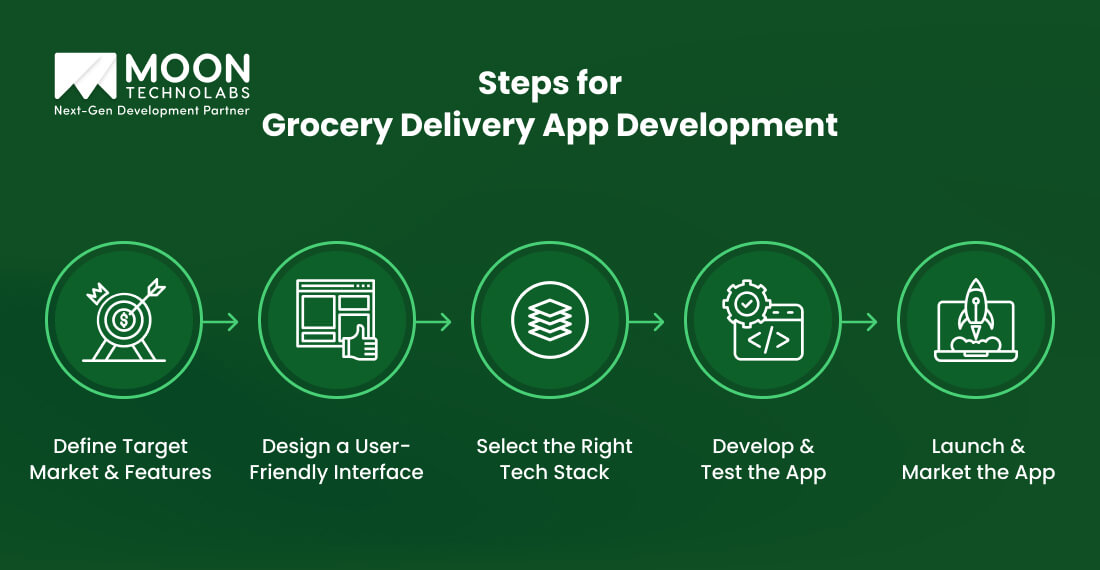
Here are the steps you can follow for developing a grocery delivery app:
The first step in launching your app is to understand the current market. Study competitors’ models and products to understand the demand, threats, weaknesses, and strengths.
Then, attempt to answer the following:
Based on the answers, you can create user personas and establish a roadmap for further development.
To define your interface, understand how competitors approach user experience. Since this is a mobile-first world, your USP should always focus on platform compatibility, easy navigation, more engagement, and security.
At this stage, it’s advisable to partner with an experienced mobile app development company. They can help develop prototypes and define the required features, covering both the visual and user experience.
Once the mockups, style guides, and design specifications are ready, designers can decide on the navigation elements and animations.
To implement the concept, developers write and structure the code for different platforms, ensuring compatibility and optimization. They also define the app architecture for connecting these elements using a set of techniques.
This step puts all the planning into action. It starts by creating a Minimum Viable Product (MVP) with the most basic features, which can be scaled based on user feedback.
It focuses on the core functionality of a customer app and an admin app. Once the MVP is up and running, manual and automated testing ensure that the app functions smoothly in different environments.
With 15 years in the industry, the development team at Moon Technolabs understands the importance of choosing the right app development partner for startups.
The development phase involves business and technical development. In fact, marketing accounts for almost 2/3rd of the total budget, compared to 1/3rd for development.
Simplify the customer shopping experience with a reliable, cost-saving platform.
Get in Touch With An Expert
Choosing the technology stack for a grocery delivery app depends on the type of app you want to build. For example, if the app is based on an aggregator app model, you’ll need features to list out stores and seamlessly connect customers to vendors.
Here’s an overview of common technology stacks used for developing a grocery app:
| Development Stage | Estimated Hours | Estimated Cost (USD) | Suggested Tech-stack |
|---|---|---|---|
| Front-End Development | 200 | $10,000 | React Native/Flutter, JavaScript |
| Back-End Development | 200 | $12,500 | Node.js, Python, |
| Database Design | 50 | $2,500 | MongoDB, Firebase |
| API and Servers | 120 | $4,000 | AWS, Docker, Halla REST API |
| Testing | 60 | $3,000 | Jest, Mocha |
| Deployment | 40 | $2,000 | AWS, Google Play Store, Apple App Store |
| Maintenance and Updates | 60/month | $3,000/month | GitHub, Jenkins, Docker |
| Real-time Analytics and Chat | 150 | $5,000 | Datadog, Prometheus, Kafka, WebSockets, Google Matrix API |
| Third-party Integrations | 200 | $6,500 | Google Maps, MapBox Geocoding API, PayPal, Braintree, |
Let’s understand some common technologies used for the most necessary features of grocery apps:
React Native uses JavaScript, providing native components for a more user-friendly experience. Flutter provides rich, customizable widgets in Dart, enabling a single codebase for both Android and iOS.
Python, Java, and NodeJS ensure that customers don’t experience lag when adding products to their carts. For the same reason, they are called event-driven technologies, as they eliminate blocking of concurrent processes.
A database modifies data sent from the front end to the back end, and it requires maximum security to process requests and return results to users. MySQL and PostgreSQL are ideal choices for users of a grocery app to navigate through the database easily.
Location services and payments are two essential third-party integrations to enhance app functionality. Google Maps is an excellent choice for providing accurate location data for stores and deliveries. PayPal is great for secure, convenient payments.
The grocery app development cost for a simple MVP is around USD 25,000, and a complex MVP can cost up to USD 45,000. To start the discovery phase, we suggest partnering with an Indian software development team for grocery delivery app development.
This will allow you to leverage the skills of development experts and analysts. They conduct comprehensive research and build a prototype based on documentation, which is highly useful for estimating your project’s timeline and cost.
The discovery phase would cost around USD 8,000 to USD 10,000 and take three to five months. Once it’s completed, you can build an app with features your customers want, which would cost between USD 50,000 and USD 1,00,000 and can take up to 6 to 8 months.
The cost of developing a grocery delivery app like Instacart, DoorDash, or Amazon Fresh depends on multiple factors:
Here’s an overview of the app development cost at different stages:
| Development Stage | Estimated Hours | Estimated Costs (USD) |
|---|---|---|
| Market Research | 80 | $4,000 |
| Design and Prototyping | 240 | $12,000 |
| Front-End Development | 200 | $10,000 |
| Back-End Development (Database, API, Setups) | 450 | $24,500 |
| Testing | 240 | $12,000 |
| Deployment and Launch | 80 | $4,000 |
| Maintenance and Updates | 70/month | $3,000/month |
At Moon Technolabs, we are proud knowledge bearers who understand the potential of the on-demand delivery market.
We can turn your concept into an MVP, as we did with Foodaloo—an Italian food marketplace app. Despite the challenges of finding nearby restaurants, our final product continues to attract new customers for the client. With flavourful dashboards and 100+ market products, it’s an innovative way to order food.
With a customer-centric mindset that continuously adapts to changing tastes, your idea can withstand any challenge. Reach out to us for a FREE consultation for your next idea.
01
02
03

Jayanti Katariya is the CEO of Moon Technolabs, a fast-growing IT solutions provider, with 18+ years of experience in the industry. Passionate about developing creative apps from a young age, he pursued an engineering degree to further this interest. Under his leadership, Moon Technolabs has helped numerous brands establish their online presence and he has also launched an invoicing software that assists businesses to streamline their financial operations.


Submitting the form below will ensure a prompt response from us.
We refine our expertise to deliver innovative business solutions.





500 N Michigan Avenue, #600, Chicago IL 60611
13500 Long Is Dr, Pflugerville, TX 78660, USA

C/105 Ganesh Meridian, S.G. Highway, Ahmedabad, GJ 380060


Ayse D.
Co-Founder France
“ I highly recommend Moon Technolabs as the quality of service is wonderful. We have hired this company to develop the product based on some complex & technical issues. We get the best quality services as compared with others in the market. Huge Thanks to Moon Technolabs as the team is always ready to give the solution all time.”

Justin G.
Founder & CEO USA
USA“ Moon Technolabs is a pioneer in the WebRTC based project as they have fixed complicated segments of the module by fulfilling different product lines by providing 24X7 customer support. We really recommended Moon Technolabs as they are able to develop products as per the module deadline and project timeline.”

Flavio S.
Founder & Managing Director Germany
“I am happy to recommend Moon Technolabs for their app development services. They successfully developed apps for me, and I am highly satisfied with the overall outcomes. The development team has swiftly addressed the issues with responsive and effective communication to understand the requirement quickly and actively resolve the back-and-forth problems that arose...”

Jay M.
Founder & CEOUSA“Moon Technolabs is the best company that provides advanced apps and websites development services in the USA and Europe. I am a newbie to develop my app with an external team. I am really happy to work with them as I am not that much mobile apps user. Here, the team and specially the CEO of Moon Technolabs helps me to let me know about the benefits of my app to generate revenue....”


Our Offices
India
C/105 Ganesh Meridian,S.G. Highway, Ahmedabad, GJ 380060USA
500 N Michigan Avenue, #600, Chicago IL 60611Contact Information


