
Jayanti Katariya
Last Updated: November 18, 2025 Total Views: 2213
Table of Content


Blog Summary:
AI has the biggest impact on the construction industry. Do you wish to know how? Read the entire post that covers everything about the impact of AI in the Construction sector including use cases, real-world examples, and benefits. Get ready to delve into it.
Table of Content
Numerous industries have witnessed significant benefits from adopting Artificial Intelligence (AI). One industry that can reap immense benefits from AI adoption is construction.
AI in Construction can revolutionize in several ways by offering innovative solutions that can improve safety, efficiency, and project management. The technology has simplified the planning, execution, and maintenance of projects.
AI proves to be a game-changer for the construction industry, right from automating machinery and streamlining the construction process to predictive issues that can forecast potential issues.
Construction technology minimizes human errors, costs, and other factors. It thus ensures smart decision-making based on data-driven insights. Let’s discuss the impact of AI in construction in more detail.
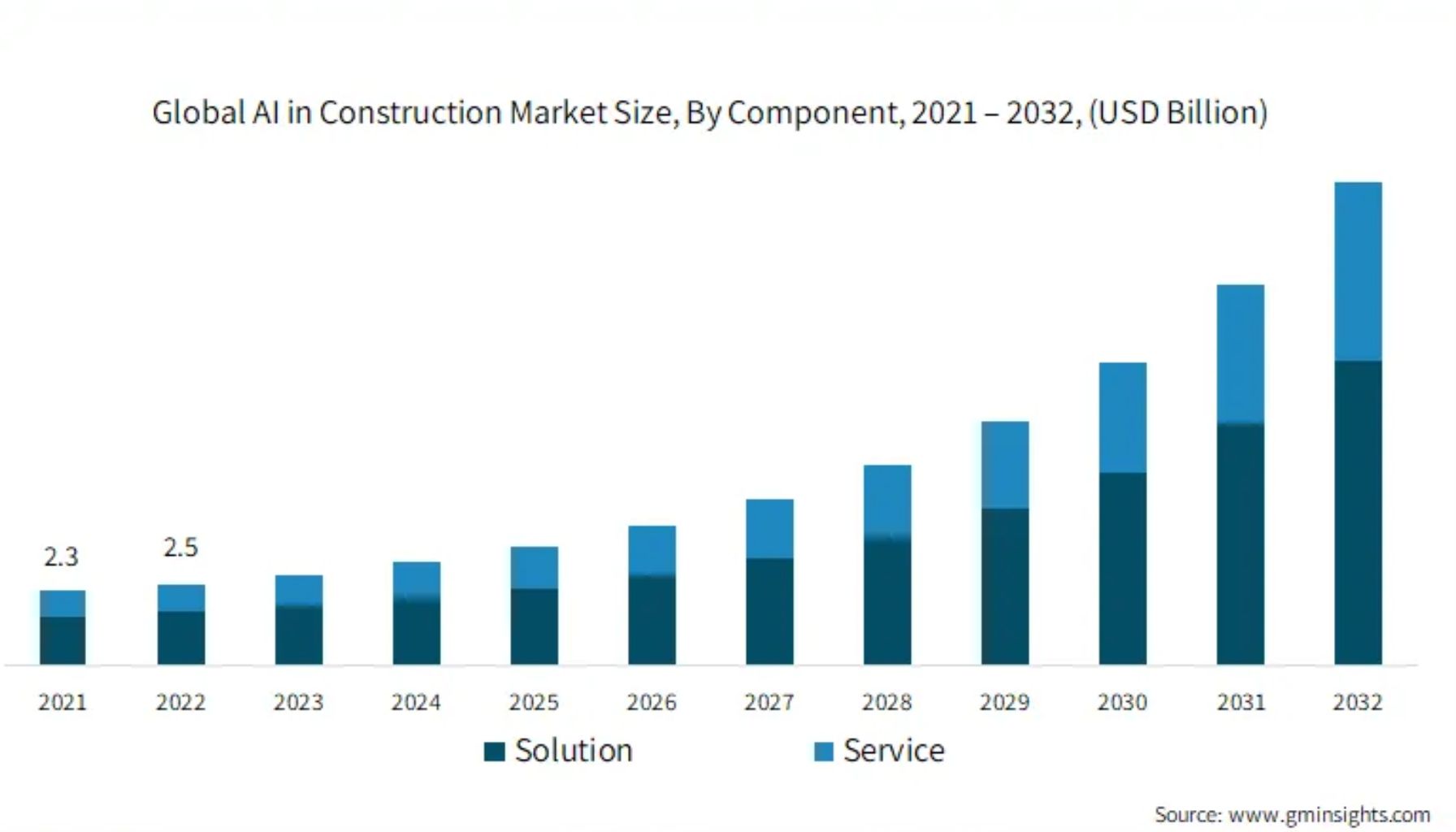
According to a report by Global Market Insights, the market size of AI in construction was valued at over $2.5 billion in 2022 and is expected to grow at a CAGR of 20% by 2032.
AI has transformed the construction industry in several ways, increasing safety, efficiency, and project management. Construction companies use advanced AI algorithms to ensure predictive maintenance and minimize cost and downtime.
Machine learning models can optimize resource allocations and scheduling. They can also use AI-powered drones and robots to perform tasks like surveys and inspections more efficiently. AI-enabled design software can take innovation to the next level while improving sustainability and architectural precision.
Apart from this, using AI in the construction field can improve safety by analyzing site conditions and predicting potential hazards. Since AI continues to emerge, it tends to make construction practices more efficient by increasing productivity.
As we already discussed, AI has a major impact on the construction industry. Let’s explore everything in detail by going through several AI use cases in construction along with real-world examples-
A large number of AI-powered project management tools can transform the way construction projects are planned and executed. These tools leverage machine learning algorithms and data analytics to optimize resource allocation, scheduling, risk management, and more.
For instance, AI for construction management can analyze historical project data to predict potential delays and recommend various schedule adjustments.
Through predictive analysis, construction companies can address issues that tend to become critical in the future. This enhances project efficiency. Several tools, including Procore and PlanRadar, offer these capabilities, providing real-time insights and automated updates.
AI is also useful in smart building design, and most construction companies now use it. They do this using smart simulations and generative design algorithms.
Generative design tools primarily use AI to explore new design possibilities within specific objectives and constraints. Architects can leverage Autodesk’s generative design software to input parameters such as budget, material type, spatial requirements, etc.
Artificial Intelligence then produces a variety of design options. This approach accelerates the overall design process and yields innovative solutions not available through traditional design methods.
Predictive maintenance plays a vital role, especially in the management of construction equipment. AI can analyze sensor data from machinery to predict when equipment will fail or require maintenance. This approach helps reduce costly downtime and breakdowns.
For instance, many companies, including Caterpillar, leverage AI to analyze equipment health in real time.
Once you identify various patterns and anomalies in equipment performance, the entire system can recommend proper maintenance schedules and replacement of different parts. It also ensures the machine functions smoothly and more efficiently throughout the project’s lifecycle.
Safety is a major concern in the construction industry. The most interesting thing about AI is that it plays a leading role in improving overall safety protocols. Many AI-enabled safety monitoring systems use machine learning and computer vision to detect various unsafe behaviors and conditions on construction sites.
Smartvid.io is one of those companies that uses artificial intelligence to analyze videos and images from many construction sites. It identifies many potential hazards, including workers not wearing appropriate safety gear or using unsafe machinery.
These systems can offer various real-time reports and alerts. They help site managers address many safety issues quickly, thereby minimizing the overall risk of accidents.
In the construction field, quality control is essential to ensure projects meet specific standards and regulations. Be it analysis or inspection, artificial intelligence can streamline the entire process.
For instance, drones integrated with AI-enabled imaging systems can conduct high-resolution inspections of construction sites, identifying several defects or deviations from the design.
AI algorithms can analyze collected data to assess the overall quality of work and generate detailed reports. Automation in construction speeds up inspections and improves accuracy, reducing the likelihood of errors that compromise the integrity of the overall project.
In addition to impacting the construction process, artificial intelligence also transforms construction logistics. The technology can optimize the equipment management, materials, labor, and more. AI-powered logistics platforms analyze data related to project timelines, inventory levels, and supply chain performance to streamline operations.
For instance, many companies leverage AI to streamline different construction scenarios and create optimal logistics plans. These platforms help construction managers make data-driven decisions about scheduling and resource allocation, reducing delays and costs.
Artificial intelligence can accurately predict supply chain disruptions and provide alternative solutions. It ensures projects remain on schedule.
Cost estimation and budgeting are issues that most construction companies face. Earlier, the budgeting and cost management process relied primarily on manual calculations and historical data, resulting in errors and cost overruns.
Artificial intelligence can address these issues by using ML algorithms to analyze historical project data, market conditions, and construction trends. These algorithms can predict costs with higher accuracy by identifying multiple patterns and potential cost drivers that may not be obvious to many traditional methods.
Many AI-enabled software can offer real-time cost forecasts and budget adjustments based on current project progress and market fluctuations. This assists the manager in making sound financial decisions and minimizes the risk of budget issues.
Scheduling is one of the most important aspects of construction management, and AI can be effective in it. Most AI-enabled tools can analyze historical data and real-time information to create and adjust different project schedules more efficiently.
ML algorithms can optimize resource allocation, task scheduling, and project timelines by analyzing factors such as labor availability, weather conditions, material supply, and more.
It creates more dynamic and accurate project schedules while minimizing delays and enhancing project efficiency. AI can help construction managers predict potential delays under any circumstances.
Risk management in the construction sector involves identifying and mitigating potential hazards and uncertainties that can impact project success.
AI can also improve risk management by identifying various patterns and predicting risks based on project delays, safety issues, financial issues, etc. For instance, AI can access historical safety incident data to predict potential hazards and suggest preventive measures.
Predictive analytics enables AI to forecast project risk and thus provide the necessary suggestions for mitigation strategies. It encourages project managers to address issues before they become bigger problems.
For monitoring sites, construction companies use AI-driven drones that provide detailed information. It can capture top-quality videos and images, which AI algorithms can analyze to track progress, detect anomalies, and ensure compliance with safety regulations.
For instance, AI-enabled drones can inspect various structural elements and identify potential defects. It can certainly verify that the construction aligns with architectural plans. This real-time monitoring capability improves safety and site management.
Energy efficiency is another major concern in construction. Many AI-powered tools can analyze performance data to recommend energy-saving measures and design highly efficient buildings.
AI algorithms can optimize ventilation, heating, and air conditioning (HVAC) systems by analyzing usage patterns and also external weather conditions.
In addition, AI tends to stimulate diverse energy scenarios even during the design phase to determine highly efficient building configurations, thereby minimizing operational costs and environmental impact.
Another use of AI in the construction field is to optimize the selection of construction materials. The technology can assist in this area by analyzing the material performance data and also recommending top materials for specific applications.
ML models can predict material behavior under different conditions. Construction companies can use this to select materials that offer the ideal balance of cost, performance, and environmental impact.
AI can provide good alternative materials that minimize overall project costs or improve the durability of structures. Thus, this optimization process enhances construction quality and contributes to effective sustainable building practices.
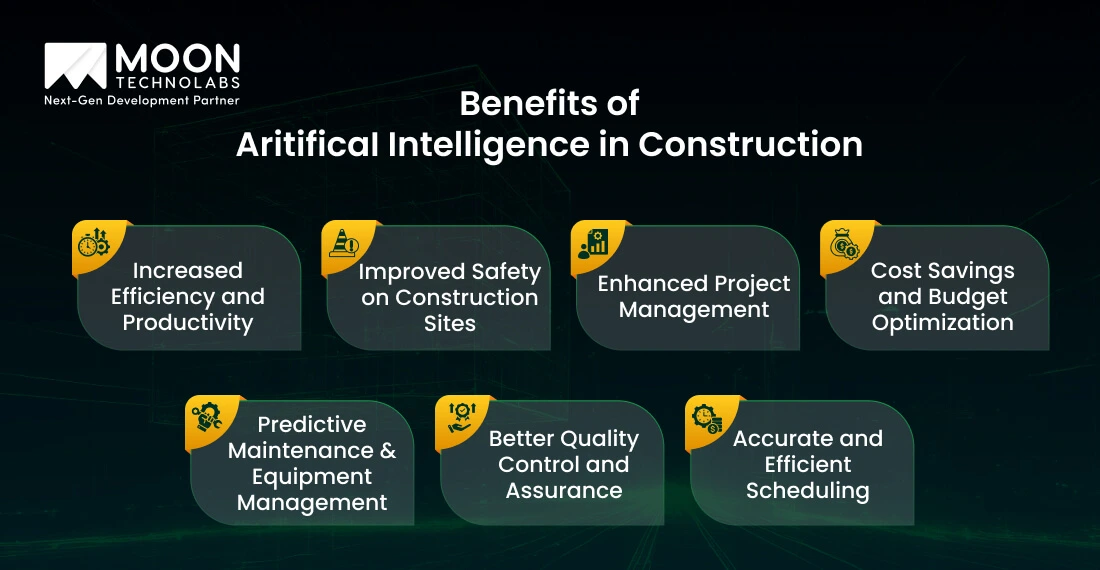
Incorporating AI into construction offers plenty of benefits. Let’s discuss some of the top benefits of AI in construction-
AI in construction industry positively impacts efficiency and productivity by replacing traditional, highly time-consuming construction processes. Meanwhile, using artificial technologies can streamline the entire construction process.
You will encounter a large number of AI-enabled tools that can automate many repetitive tasks, including progress tracking and data entry. ML algorithms can analyze vast amounts of data to allocate resources and schedules.
It improves project timelines and enables human workers to focus on complex, value-added tasks. AI-powered robotics can perform tasks, including welding and bricklaying, with maximum speed, boosting overall productivity.
As we discussed, AI ensures workers’ full safety during construction by preventing hazardous situations. It can improve safety through real-time monitoring and predictive analytics. For instance, AI systems can analyze past accident data to identify patterns and predict potential safety risks.
Many wearable AI devices equipped with sensors can analyze environmental conditions and workers’ vital signs. This helps them be notified about potential dangers, including toxic gases and excessive heat.
Drones and AI-enabled cameras can detect various unsafe conditions and survey construction sites or behaviors. These advanced safety measures are crucial to ensuring full safety and creating a safe environment for workers.
Another top advantage of AI in construction is that it simplifies project management. With AI in construction project management, teams can access robust tools for planning, coordination, and execution. An AI-based project management platform can accurately forecast and identify various potential challenges.
Many project management platforms can leverage ML algorithms to predict project outcomes. They also suggest optimal strategies to minimize overall risk.
AI ensures smooth communication among project stakeholders by providing frequent real-time updates and facilitating data sharing. By analyzing comprehensive data, AI allows project managers to make informed decisions. It yields a highly efficient project execution while ensuring successful outcomes.
AI in construction also effectively works in cost-saving and budget optimization in many ways. Using data analytics and artificial intelligence, many construction companies can forecast expenses with greater accuracy and identify cost-saving opportunities.
For instance, AI algorithms can analyze material usage patterns to help you identify cost-saving opportunities and highlight numerous bulk-purchasing opportunities.
AI-powered tools can reduce waste by optimizing resource allocation. They ensure budgets are followed and financial resources are used more efficiently.
Predictive analytics, on the other hand, also helps construction companies get an accurate idea of potential budget overruns and take the necessary actions before they escalate.
Construction equipment must be in good condition to ensure the project’s success. Artificial intelligence can make construction equipment less expensive. It prevents equipment from unexpected failures or breakdowns, minimizing downtime and enabling efficient, reliable performance.
Artificial intelligence can optimize equipment management by analyzing usage patterns and suggesting the optimal times for replacement and maintenance. Keeping equipment in good condition also helps construction companies avoid any costly repairs and maintenance.
Artificial intelligence improves quality control and ensures top-quality construction work. Many AI-enabled inspection tools can automatically identify defects during different stages of construction. These tools can also identify issues such as inferior workmanship or structural problems by analyzing images and videos of construction.
Artificial intelligence can maintain high-quality standards, thereby minimizing the need for costly rework. AI-powered control systems provide detailed information, helping construction service providers take the necessary measures and thus improve construction practices.
Scheduling is another important aspect of overall construction project management. Artificial intelligence can enhance and improve the scheduling process. AI algorithms can produce project schedules with greater accuracy by accounting for resource availability, timelines, potential risks, and other factors.
AI algorithms can schedule in real time based on project conditions or unforeseen delays. Many AI-enabled tools help construction companies optimize resource allocation and manage dependencies effectively.
It ensures projects get completed on time and within budget. The technology can streamline project workflows and improve overall project performance by enabling precise scheduling and timely adjustments.
At Moon Technolabs, we provide Custom AI development solutions that can improve your efficiency, safety, and accuracy. Whether you seek predictive maintenance, real-time project management, or automated quality control, our solutions cater to your needs in a variety of ways.
We help you integrate data analytics and machine learning to improve workflows, minimize errors, and enhance decision-making. Our solutions are designed to meet your specific project requirements, thereby improving innovation and operational excellence.
By partnering with us, you can leverage these advanced technologies and empower your construction company to achieve a higher level of precision, increase success, and minimize overhead across every phase of the construction process.
Unlock new efficiencies and innovations in construction with our advanced AI solutions. See how our AI in Construction technology can enhance project management, safety, and productivity.
So, as shown above, AI impacts construction. If you run a construction business and have yet to adopt this technology, it’s time to contact a professional AI development company that provides customized solutions.
We at Moon Technolabs are the one-stop destination for harnessing the potential of AI in construction.
01
02
03
04

Jayanti Katariya is the CEO of Moon Technolabs, a fast-growing IT solutions provider, with 18+ years of experience in the industry. Passionate about developing creative apps from a young age, he pursued an engineering degree to further this interest. Under his leadership, Moon Technolabs has helped numerous brands establish their online presence and he has also launched an invoicing software that assists businesses to streamline their financial operations.


Submitting the form below will ensure a prompt response from us.
We refine our expertise to deliver innovative business solutions.





205 N Michigan Avenue, #810, Chicago, 60601, Illinois, United States
13500 Long Is Dr, Pflugerville, TX 78660, USA

C/105 Ganesh Meridian, S.G. Highway, Ahmedabad, GJ 380060


Ayse D.
Co-Founder France
“ I highly recommend Moon Technolabs as the quality of service is wonderful. We have hired this company to develop the product based on some complex & technical issues. We get the best quality services as compared with others in the market. Huge Thanks to Moon Technolabs as the team is always ready to give the solution all time.”

Justin G.
Founder & CEO USA
USA“ Moon Technolabs is a pioneer in the WebRTC based project as they have fixed complicated segments of the module by fulfilling different product lines by providing 24X7 customer support. We really recommended Moon Technolabs as they are able to develop products as per the module deadline and project timeline.”

Flavio S.
Founder & Managing Director Germany
“I am happy to recommend Moon Technolabs for their app development services. They successfully developed apps for me, and I am highly satisfied with the overall outcomes. The development team has swiftly addressed the issues with responsive and effective communication to understand the requirement quickly and actively resolve the back-and-forth problems that arose...”

Jay M.
Founder & CEOUSA“Moon Technolabs is the best company that provides advanced apps and websites development services in the USA and Europe. I am a newbie to develop my app with an external team. I am really happy to work with them as I am not that much mobile apps user. Here, the team and specially the CEO of Moon Technolabs helps me to let me know about the benefits of my app to generate revenue....”


Our Offices
India
C/105 Ganesh Meridian,S.G. Highway, Ahmedabad, GJ 380060USA
205 N Michigan Avenue, #810, Chicago, 60601, Illinois, United StatesContact Information


