
Jayanti Katariya
Last Updated: March 13, 2026 Total Views: 393
Table of Content


Blog Summary:
This guide focuses on Web3 iOS App Development by covering a detailed process that includes multiple steps. It also explains features to integrate, tech stack to use, etc, along with the types of Web3 iOS apps and benefits. Keep reading to develop your project.
Table of Content
With the continuously evolving internet world, users now have the flexibility to gain more control over their data and digital assets. This is indeed the biggest shift driven by Web3 technology, which revolutionizes businesses with decentralized apps. It lets organizations discover new opportunities in the Web3 ecosystem, through NFT marketplaces, DeFi platforms, blockchain games, etc.
Most businesses of late have opt for iOS App Development with Web3 since Apple has a vast base of high-value users. It thus makes a significant impact on the global blockchain market, which is expected to reach up to $393.45 billion by 2030, according to Markets and Markets. The stats reveal the fast adoption of decentralized technologies among businesses.
But developing a successful Web3 iOS app involves a lot of planning, strategy, and skills. In this guide, we will discuss everything related to this. So, get ready to explore more.
The Web3 iOS app is a software solution developed with decentralized technologies. With it, users don’t need centralized intermediaries to interact directly with blockchain networks. It includes a variety of features, which are as follows:
It helps businesses in creating a perfect and user-controlled digital experience while ensuring its security and transparency.
Businesses from across the world use a variety of Web3 iOS apps to provide high-end digital services. The following are some of these apps:
As one of the most widely used Web3 solutions, DeFi brings possibilities for users to access complete financial services like borrowing, lending, trading, staking, etc. And for all these, they don’t need to rely on any financial or traditional banks. These apps are developed on blockchain networks and by leveraging smart contracts.
By using NFT marketplace apps, users find the possibility to buy and sell various non-fungible tokens. These are mainly artwork, collectibles, virtual items, and music. These apps connect the collectors, creators, and investors in a decentralized environment where both authenticity and ownership are verified with the use of blockchain technology.
With crypto wallet apps, users can manage their cryptocurrencies and digital tokens conveniently, whether it’s for storage or transfer. These apps bring possibilities for users to connect smoothly with decentralized apps and sign blockchain transactions. Besides, they can also manage private keys easily.
Blockchain gaming apps include a vast potential for blending traditional experience with decentralized technologies like token economies and NFTs. In these games, players get an option to own in-game assets, earn rewards, trade collectibles, etc., with play-to-earn models. These apps offer fully transparent asset ownership and also various monetization opportunities, be it for players or developers.
With decentralized social media apps, users get complete control over everything, be it their data, content, or identity. These apps work either on decentralized storage systems or blockchain networks and allow censorship resistance and higher transparency. Both startups and businesses leverage social platforms to create user-centric digital communities.
DAO apps enable communities or organizations to work through decentralized governance mechanisms. Members can use blockchain-based voting systems and smart contracts to propose any changes, vote on decisions, and also manage shared resources.
These apps focus mainly on decentralized identity management and secure authentication. It helps users to verify their identity with the use of cryptographic wallets or blockchain credentials. Businesses can harness Web3 identity solutions to improve security, simplify authentication processes, and protect user data across decentralized platforms.
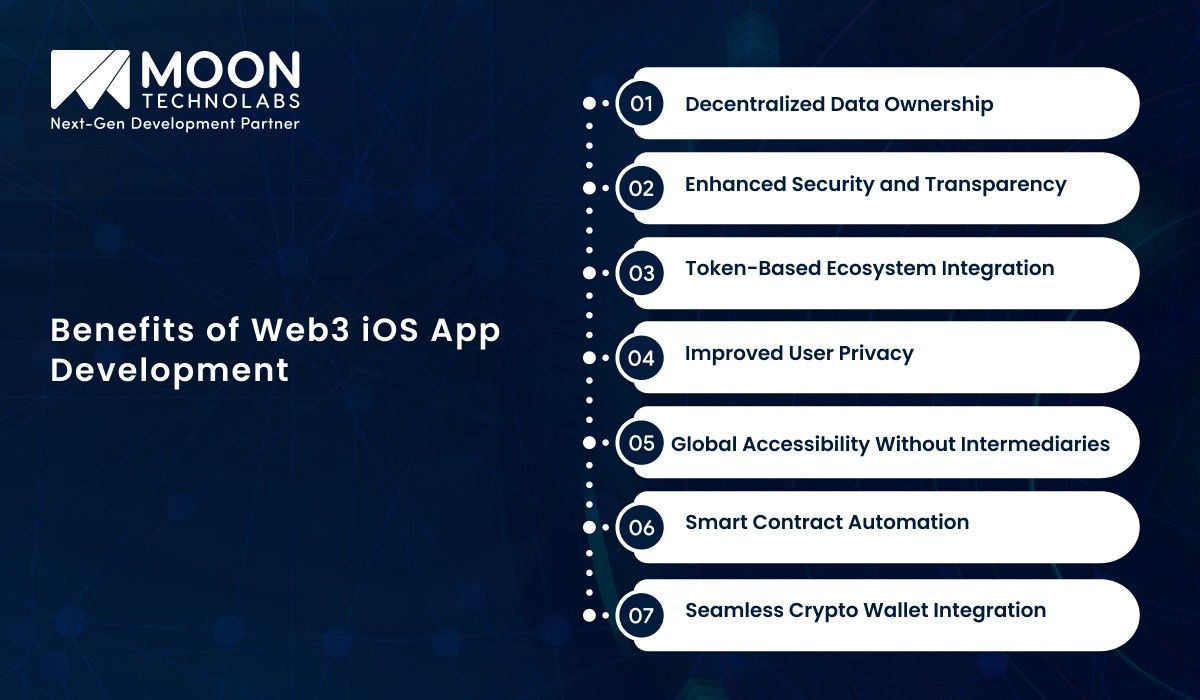
Web3 iOS apps bring numerous advantages to both users and businesses. As mentioned, it allows users to have complete control over data. On the other hand, businesses can use it to discover various strategic advantages:
Decentralized data ownership is one of the major advantages of Web3 iOS apps. Users get the opportunity to maintain their data ownership with cryptographic identities and blockchain-based systems. This shift is indeed great for a higher trust between both users and businesses, minimizing reliance on centralized data management structures.
Web3 iOS apps include a combination of cryptographic protocols and blockchain technology to provide the safety of sensitive data and secure transactions. It ensures verification of all transactions since blockchain records are transparent and immutable. It boosts system reliability and minimizes the overall risks of any fraudulent modifications.
Web3 apps work within an ecosystem developed across digital tokens, where these tokens are important to offer rewards, transactions, governance, or access to any platform features. Businesses can create token-based models to foster user engagement, participate in the community, and generate revenue within apps.
Web3 iOS apps meet the privacy concerns of users by minimizing dependence on centralized identity systems. It allows users to authenticate using either decentralized identity frameworks or blockchain wallets. And they don’t need to reveal their personal identity.
Since Web3 apps work on decentralized networks, they are easy to access from any location across the world. With this app, businesses don’t need to rely on traditional intermediaries such as payment processors, banks, centralized platforms, etc., when it comes to offering their services globally.
When it comes to smart contracts, these are actually self-executing programs. These are stored on blockchain networks and perform actions automatically, especially when predefined conditions are met.
For Web3 iOS apps, smart contracts are pivotal to automate processes such as reward distributions, transactions, governance voting, or transferring digital assets. This reduces the necessity of manual intervention and makes the systems efficient.
Another advantage of Web3 iOS apps is that they are easy to integrate with crypto wallets to help users manage tokens. It also helps them authorize their transactions and access blockchain services directly through their mobile devices. This integration plays a leading role in simplifying user interaction with decentralized platforms.
So, are you all set to develop your app? We help you transform your idea into a secure and robust iOS app. Our experts are ready to deliver the best.
Building a reliable and successful Web3 iOS app requires the integration of many cutting-edge features. Let’s explore some of them as follows:
Cryopto wallet gives users the liberty to send, receive, and store cryptocurrencies and also their digital tokens securely. It also helps users to sign blockchain transactions and discover the possibility to connect with a decentralized app directly by using their smartphones.
A smart contract powers Web3 apps. With Web3 iOS apps, users engage conveniently with smart contracts to execute transactions, access decentralized services, or manage digital assets. The app offers seamless communication between the blockchain network and the mobile interface to maintain reliability and accuracy.
Web3 iOS apps should include highly strong authentication mechanisms such as biometric verification, cryptographic wallet signatures, multi-factor authentication, etc. These are best in protecting user accounts, preventing unauthorized access, and ensuring transactions are approved by only genuine users.
A Web3 iOS app should offer users complete control and visibility over these assets. Be it NFT viewing, token balance tracking, transaction history, or transfer capabilities, many important features help users manage their digital assets with higher efficiency within the app.
A Web3 iOS app integrates smoothly with decentralized storage solutions to improve data security and integrity. It ensures accessibility and tamper resistance of digital assets, user data, and application records, even without relying on centralized infrastructure.
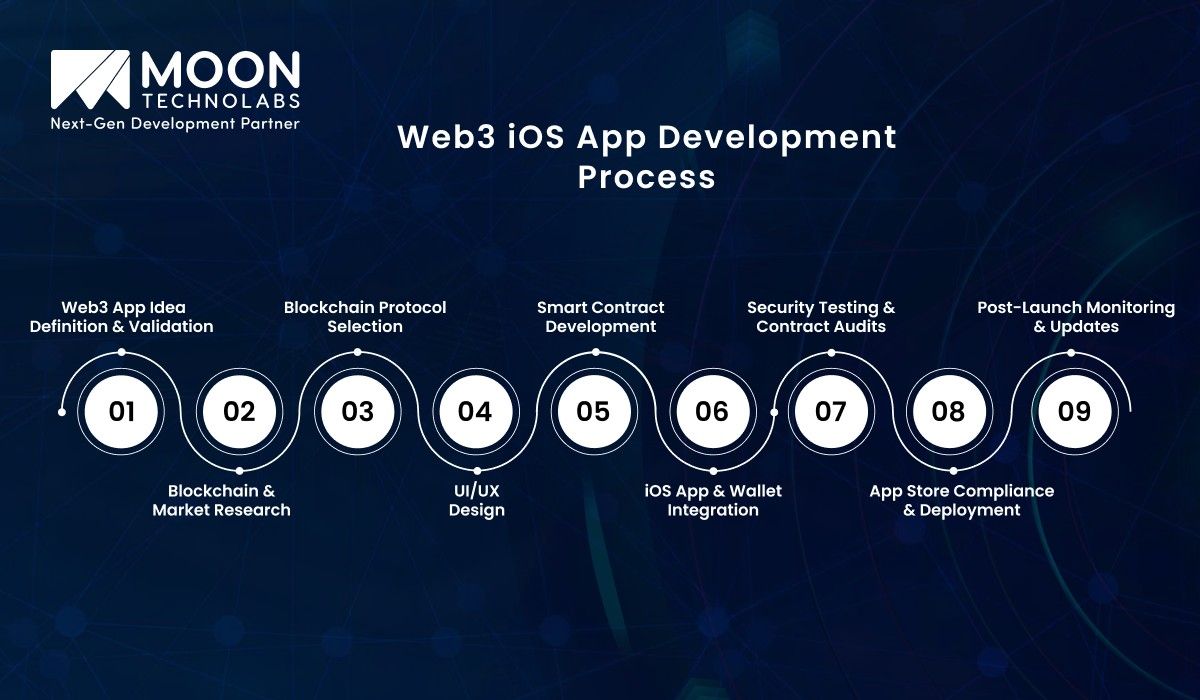
Developing a Web3 iOS app requires businesses to follow a fully structured process that should involve multiple steps. You need to hire iOS developers who follow the steps below:
The web3 app development process starts by determining its actual purpose and functionality. You need to first be familiar with the problem that the app is meant to solve, and also determine how blockchain technology can improve the solution. You can perform it in several ways, like doing user research, competitor analysis, and feasibility assessment.
Once you validate your idea, you need to research blockchain technologies and the ongoing market trends. Thorough market research helps you identify opportunities, know target audiences, and also refine the core features of apps.
Choosing the best blockchain protocol is very important in Web3 iOS app development. It also requires taking into account vital factors like network fees, transaction speed, community support, and scalability. The blockchain network you select impacts how apps handle smart contracts, transactions, and distributed data management.
Create a simple yet appealing UI/UX design that can allow users to navigate applications. The app should offer digital assets management and connect easily with decentralized features. Pay special attention to creating a smooth onboarding process and intuitive transaction flows to boost user adoption.
At this stage, developers code and implement smart contracts that automate processes like token distribution, asset transfers, marketplace transactions, or governance voting.
Developers now create an iOS app that works as a user interface to interact with decentralized systems. They also implement important features, connect the app with blockchain networks, and integrate crypto wallet functionality. Wallet integration lets users sign transactions, manage digital assets, and interact securely with the Web3 ecosystem.
After completing the development process, developers perform a thorough testing to check vulnerabilities in both smart contracts and mobile apps. They conduct a smart contract audit to ensure the code is highly secure and resistant to any potential exploits or also any unauthorized access.
Before submitting an app to the Apple store, developers ensure the app complies with its policies. They also ensure that the app follows Apple’s guidelines related to user privacy, payments, and digital assets. Once they ensure the app meets all requirements, they submit it for final review in the App Store.
Continuous monitoring is essential to check performance, gather user feedback, detect security risks, and more. It’s advisable for businesses to release updates on a regular basis to boost functionality, improve security, and also introduce several new features to make the app relevant.
We help you to launch your decentralized mobile app and unlock the potential of Web3 with user-centered and secure solutions. Let’s turn your idea into a Web3 iOS app.
Web3 apps are completely different from traditional mobile apps in terms of various factors. These mainly include data management, architecture, user control, security, etc. Let’s explore Web3 apps vs traditional apps in-depth:
| Factor | Web3 Apps | Traditional Mobile Apps |
|---|---|---|
| Architecture | Developed on decentralized blockchain networks | It works on centralized servers controlled through an individual service provider. |
| Data ownership & control | Users get control and ownership of data and digital assets. | data is controlled and stored through service providers. |
| Authentication method | In this, authentication is done through cryptographic keys, crypto wallets, and decentralized identity systems. | Users can authenticate with the help of usernames, passwords, social media logins, and email accounts. |
| Payment & monetization model | It supports token-based rewards, cryptocurrency payments, decentralized marketplaces, etc. | It depends mainly on traditional payment systems like in-app purchases, credit cards, etc. |
| Transparency & trust mechanism | Since operations and transactions are recorded on a public blockchain, it ensures higher transparency and trust. | In this, trust relies on policy and reputation of the service provider. |
| Security & privacy structure | It ensures cryptographic security, blockchain immutability, and decentralized networks for the protection of data and transactions. | Security depends mainly on centralized platforms. |
To build Web3 iOS apps, developers need to leverage a variety of technologies. Let’s have a detailed look at some of these technologies:
When it comes to the front-end layer, it focuses mainly on developing the iOS app interface and also delivering a smooth user experience. Developers generally harness native technologies like Swift and Apple’s iOS development frameworks to craft intuitive and responsive interfaces.
The blockchain layer plays a vital role in the decentralized functionality of the app. Developers code smart contracts with the capability of handling important operations like asset ownership, token transfers, transaction verification, governance voting, etc. The development team deploys the smart contracts on blockchain networks.
Backend infrastructure is pivotal, even though Web3 apps rely extensively on decentralized networks. It is required for various purposes such as managing data indexing, off-chain operations, and integration with external services. Besides, the backend API also helps mobile apps communicate with blockchain nodes, handle app-specific processes, and fetch transaction data.
As far as the cost of developing a Web3 iOS app is concerned, it depends mainly on numerous factors. These include blockchain integration, app’s complexity, security requirements, and more. To get a correct estimation of cost, you need to consider the following important factors:
We work as your reliable development partner and provide you with our best possible assistance to create scalable and secure Web3 iOS apps. As a cross-platform app development company, we have a pool of adroit developers who possess unmatched skills in performing iOS app development, blockchain development, and smart contract integration.
We never leave any stone unturned to convert your ideas into fully functional and high-performing decentralized apps. We are committed to providing end-to-end Web3 development services to assist businesses in launching future-ready iOS apps.
By now, you have a complete idea about how to develop a Web3 iOS app, right? You now already have ideas about the features to integrate, the tech stack to leverage, and various steps of the development process. So, it’s the right time to proceed with your app development. To handle it with the best strategy, you can partner with an iOS app development company like us.
01
02
03
04
05

Jayanti Katariya is the CEO of Moon Technolabs, a fast-growing IT solutions provider, with 18+ years of experience in the industry. Passionate about developing creative apps from a young age, he pursued an engineering degree to further this interest. Under his leadership, Moon Technolabs has helped numerous brands establish their online presence and he has also launched an invoicing software that assists businesses to streamline their financial operations.


Submitting the form below will ensure a prompt response from us.
We refine our expertise to deliver innovative business solutions.




500 N Michigan Avenue, #600, Chicago IL 60611
13500 Long Is Dr, Pflugerville, TX 78660, USA

C-105, Ganesh Meridian, S.G. Highway, Ahmedabad, GJ 380060


Ayse D.
Co-Founder France
“ I highly recommend Moon Technolabs as the quality of service is wonderful. We have hired this company to develop the product based on some complex & technical issues. We get the best quality services as compared with others in the market. Huge Thanks to Moon Technolabs as the team is always ready to give the solution all time.”

Justin G.
Founder & CEO USA
USA“ Moon Technolabs is a pioneer in the WebRTC based project as they have fixed complicated segments of the module by fulfilling different product lines by providing 24X7 customer support. We really recommended Moon Technolabs as they are able to develop products as per the module deadline and project timeline.”

Flavio S.
Founder & Managing Director Germany
“I am happy to recommend Moon Technolabs for their app development services. They successfully developed apps for me, and I am highly satisfied with the overall outcomes. The development team has swiftly addressed the issues with responsive and effective communication to understand the requirement quickly and actively resolve the back-and-forth problems that arose...”

Jay M.
Founder & CEOUSA“Moon Technolabs is the best company that provides advanced apps and websites development services in the USA and Europe. I am a newbie to develop my app with an external team. I am really happy to work with them as I am not that much mobile apps user. Here, the team and specially the CEO of Moon Technolabs helps me to let me know about the benefits of my app to generate revenue....”


Our Offices
India
C-105, Ganesh Meridian, S.G. Highway, Ahmedabad, GJ 380060USA
500 N Michigan Avenue, #600, Chicago IL 60611Contact Information


