
 Total Views: 285
Table of Content


Blog Summary:
This blog explores VR Game Development in detail, covering every essential step — from its benefits and features to the tools required, development process, and overall cost. Read the full post to move forward confidently with your next project and build a truly mind-blowing virtual reality experience.
Table of Content
Virtual Reality (VR) is one of the rapidly emerging technologies that has a major impact on the gaming industry. It has redefined how users connect, play, and experience games by immersing themselves in the virtual world.
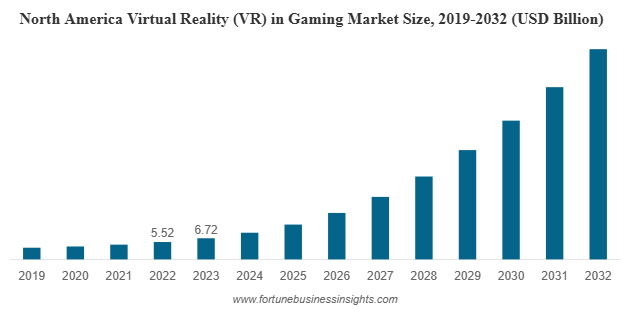
It has driven up demand for VR game development, which is considered a leading force in the evolution of the gaming and entertainment industry. Fortune Business Insights predicts that the VR in the gaming market size is set to reach approximately $189.17 billion by 2032 from $22.63 billion in 2024.
Virtual reality game development helps businesses grab numerous growth opportunities by creating experiences that lure users, boost engagement, and discover untapped revenue streams. Meanwhile, developing a VR game is a highly responsible task that requires proper planning with a strategic approach.
We will provide you with complete information regarding virtual reality game development. You can plan and proceed accordingly. Let’s start.
When developers leverage virtual reality technology to craft an immersive, interactive gaming experience, the process is called VR game development. It also involves crafting realistic physics, 3D environments, and intuitive controls that allow players to explore and interact naturally, even in a virtual world.
In the VR game development process, developers also leverage a range of technologies, such as Unreal Engine and Unity 3D, to create cross-platform games for a variety of devices. These include HTC Vive, Oculus, PlayStation VR, and more.
Their main objective is to deliver a highly engaging experience that allows players to feel their presence in the game. Be it storytelling, creativity, or technology, VR game development combines all of these to transform how players play and enjoy digital entertainment.
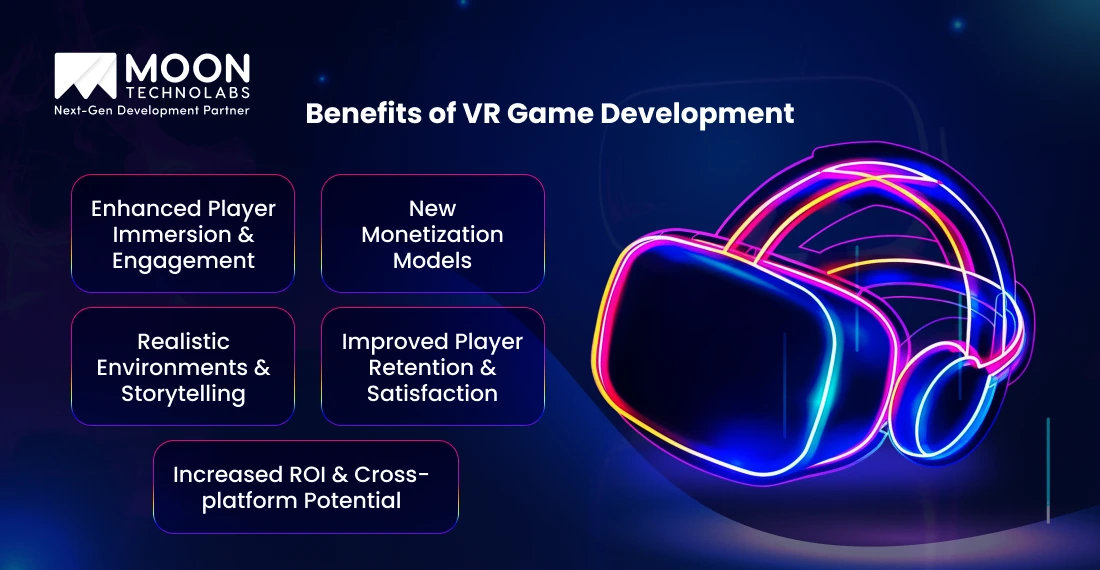
VR game development offers numerous opportunities for businesses, including increased audience reach and revenue generation. We will discuss some of the major advantages in detail.
One of the top benefits of VR games is their capability to deliver highly immersive and interactive experiences. Compared to traditional games, VR provides a 360-degree environment where players can interact, move, and explore naturally. Whether it’s visual realism, haptics, or advanced motion tracking, they create a sense of presence while keeping players physically and emotionally engaged.
Another advantage of VR game development is that it introduces several new monetization models that can even go beyond standard in-app purchases. Developers can easily integrate NFTs, in-game assets, and subscription-based content to produce recurring revenue.
Players can trade, own, or upgrade unique digital assets that add significant value and exclusivity to their gaming experience. Apart from this, battle passes or any subscription models also encourage community participation and long-term engagement. It improves lifetime value per player and also ensures ongoing growth.
With dynamic storytelling and realistic 3D environments, VR lets players become fully active participants in the narrative rather than passive observers. Be it lifelike physics, interactive storylines, or responsive characters, it indeed creates emotionally great journeys that lure audiences. This realism maximizes entertainment value. Besides, it widens VR’s potential across genres such as simulation, adventure, education, and more.
Since VR is immersive, it boosts player retention and provides a high level of satisfaction. This technology enables users to interact with the virtual world in the physical world. It improves powerful emotional connections and also a greater sense of achievement.
Be it community-based content, continuous updates, or multiplayer experience, these play a vital role in keeping players engaged for a long time. It allows developers to create a loyal fan base with a sustainable gaming ecosystem.
With cross-platform compatibility, VR games allow developers to reach a wider audience across many devices. This scalability is necessary to deliver improved ROI, since games tend to be adapted across a range of ecosystems with less rework. Apart from this, the fast-growing popularity of Web3 and metaverse gaming boosts revenue potential through immersive social experiences.
We help you turn your gaming idea into an immersive, stunning reality. Our developers help you build next-gen VR experiences.
Apart from mind-blowing visuals, features are the other most important factors that contribute a lot to making a VR game successful. Let’s discuss some of the top features you can consider implementing in your game.
It’s one of the core features of any VR game, playing a vital role in taking players into virtual worlds. Developers craft it using technologies such as Unreal Engine and Unity 3D.
Whether it’s lightning effects, detailed landscapes, or textures, they create everything that mimics the real world. It boosts players’ interaction while letting them explore and engage naturally with their surroundings.
Whether it’s responsive or smooth motion controls, they are necessary for realistic gameplay. VR games can replicate various physical movements, such as throwing, grabbing, and walking, through motion tracking and gesture recognition.
Apart from this, haptic feedback adds a great dimension by enhancing touch sensations and allowing players to experience resistance or vibrations. It effectively minimizes the overall gap between the virtual and real worlds.
Multiplayer and social experience are other important features that modern VR games majorly focus on. They offer players the opportunity to collaborate and engage in fully shared virtual spaces. Social integration improves replay value and improves community-driven gameplay.
Apart from this, features such as co-op missions, voice chat, shared leaderboards, and more help create a fully dynamic experience. They make VR games a collective experience.
Accurate physics simulations and spatial audio are essential for offering a complete sense of realism in VR. Whether it’s gravity, weight, or collision, realistic object behaviors make interactions more reliable.
On the other hand, 3D spatial audio improves this by adjusting sound based on player movement and distance. It ensures the accuracy of echoes, footsteps, ambient noises, and more.
With this feature, players can personalize various in-game items and avatars to boost their creativity and emotional investment. Be it outfits, customizable skins, or accessories, they make every player’s experience unique. Apart from this, personalization also opens several new monetization streams through asset trading, NFTs, subscription models, and more.
Performance optimization is essential to ensuring smooth frame rates and minimal motion sickness. It’s important for a completely enjoyable VR experience. Developers minimize latency, fine-tune rendering, optimize memory usage, and more to maintain consistency across multiple VR devices. Low latency is particularly important, as any delay between system responses and player actions tends to break immersion.
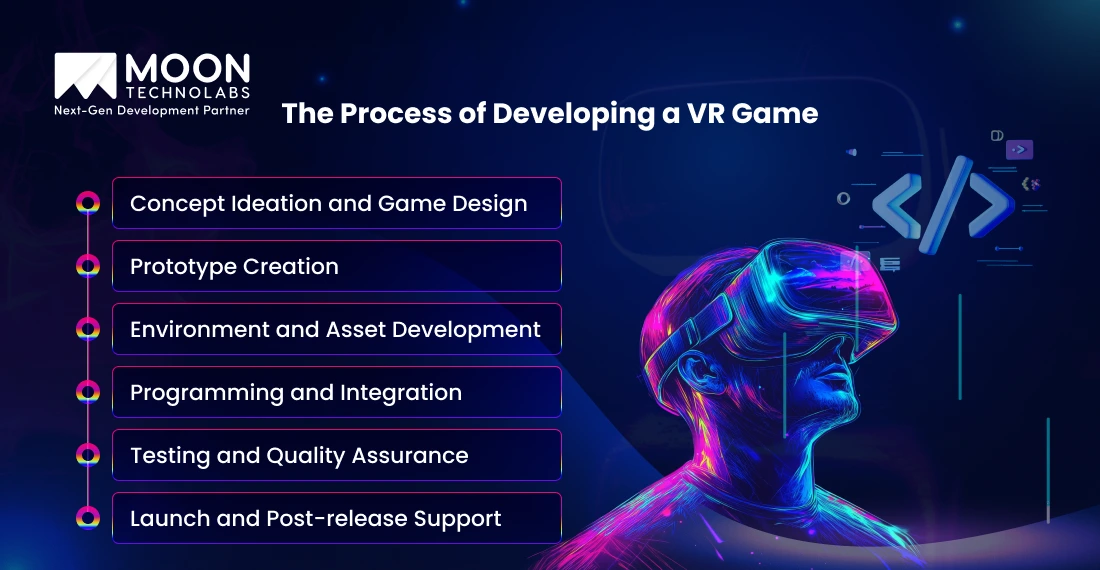
Developing a VR game requires a powerful strategy and is carried out in multiple steps. Let’s discuss each step of the CR game development process in detail.
Every VR game starts with a powerful concept and with a clear vision. In this phase, the development team is responsible for brainstorming their ideas, outlining the storyline, defining gameplay mechanics, and more.
These help to ensure it works well with the target audience. During this important phase, game design documents are crafted to character controls, detail levels, user interactions, and more. A solid design is crucial to delivering a final VR experience that feels balanced, immersive, and engaging.
Prototyping is the next important step, involving creating a basic version of a game to test key mechanics. Developers experiment with multiplayer game ideas, physics, and controls, even without the investment required for full-scale production. They develop and test VR interactions quickly to validate the core concept, even before using cutting-edge tools such as Unreal Engine or Unity 3D.
After approval of the prototype, designers work closely with 3D artists to craft realistic environments and in-game assets. They use tools such as Autodesk Maya and Blender to craft objects, characters, textures, and lighting.
The major objective of this stage is to make the overall virtual world as impressive as possible, including soundscapes, physics, realistic graphics, and more. These maximize player engagement.
This is the core step of developing a VR game. In this, developers code the final game based on the provided design. They use various technologies, such as Unreal’s Blueprint system, Unity’s XR Toolkit, and more, to integrate physics systems, gameplay logic, motion controls, VR interactions, and more. They also optimize for a range of devices, including HTC Vive, Oculus, PlayStation VR, and more, for cross-platform development.
Testing is crucial for minimizing bugs, motion sickness, performance issues, and more. QA teams are responsible for compatibility testing, playtesting, VR-specific usability checks, and more. During this stage, continuous feedback loops are essential for refining performance and interactions before launch.
After successful testing, it’s time to launch the final VR game. The step involves launching the game across a large number of VR platforms.
Meanwhile, the actual process doesn’t end even after launching the final game. Ongoing post-release support is necessary to patch, update, and implement feature enhancements, while also supporting long-term user engagement and satisfaction.
We help you step into the future of immersive gaming. We help you create an immersive experience that drives innovation, engagement, and loyalty.
Developing a powerful, engaging, and successful VR game requires leveraging a range of next-generation tools and technologies. Let’s explore some of them that developers leverage most frequently:
As one of the most widely used engines for developing VR games, Unity 3D is well-known for its cross-platform support and greater flexibility. With this, developers create, test, and implement VR games across a range of devices.
Whether it’s the asset store, the XR interaction toolkit, or real-time rendering capabilities, these are perfect for indie and enterprise VR projects. It also allows them to integrate lighting, physics, and animation systems to craft engaging, realistic virtual environments.
Unreal Engine provides complete photorealistic graphics and a powerful VR development framework. Its Blueprint Visual Scripting Systems enable fast prototyping even without extensive coding, while Lumen and Nanite technologies deliver detailed textures and lifelike lighting.
Unreal Engine always supports a variety of VR platforms. Apart from this, the engine’s scalability is perfect for everything, from storytelling to complex multiplayer VR games.
As open-source animation and 3D modeling software, Blender is essential for crafting environments, characters, in-game assets, and more. It has the potential to support rigging, sculpting, rendering, texturing, and more.
Developers use this tool to build fully optimized 3D assets compatible with Unreal Engine and Unity. It includes a feature like VR scene inspection, which lets developers visualize assets in virtual space while improving immersion and design precision.
It’s another toolkit that eases VR development, especially for those who leverage Unity. It comes with pre-built systems for hand tracking, teleportation, locomotion, and interactions, which minimize overall development time.
Developers can use this tool to focus more on user experience and gameplay rather than coding base-level VR mechanics. It has a modular architecture, making it an important resource for developers seeking cross-platform compatibility.
As an industry-standard tool, Autodesk Maya is useful for creating high-quality 3D animation, visual effects, and environments. It comes with numerous modern-age tools for simulation, modeling, rendering, and more.
These allow developers to craft an immersive world and also lifelike characters. Maya integrates smoothly with game engines, including Unreal and Unity, while ensuring optimized asset import for VR.
You Might Also Like:
Well, the actual cost of developing a VR game ranges from $50,000 to $200,000, and can go higher. Developing a basic VR game with limited features costs less than $60,000, whereas building a complex VR game with advanced features can cost up to $200,000.
Apart from this, the cost of VR game development is also influenced by many other factors. Some of them are as follows:
You Might Also Like:
We are a one-stop destination for anyone looking for VR game development, with unmatched experience in creating high-performing, immersive virtual reality experiences. You can hire game developers with extensive experience in Unreal Engine, Unity 3D, AR/VR Integration, and more.
We develop games optimized for a wide range of devices, including HTC Vive, Oculus, PlayStation VR, and more. Be it 3D modeling, concept design, coding, testing, or deployment, our end-to-end game development solutions include everything. We always focus on intuitive controls, realistic environments, engaging gameplay, and more to develop a highly interactive and successful game.
We let clients stay ahead in the fast-emerging VR market. We work as your reliable development partner, committed to quality and innovation in VR game development.
You may now understand the VR game development process and how it transforms the landscape through interactive storytelling, immersive experiences, etc. With the advancement of technology, it redefines player engagement and monetization opportunities across a range of platforms.
Partner with us to turn your VR gaming idea into a product, leveraging our extensive industry expertise. As a reliable Metaverse development services company, we are committed to helping you stay ahead in the fast-emerging VR market.
01
02
03
04
05

Jayanti Katariya is the CEO of Moon Technolabs, a fast-growing IT solutions provider, with 18+ years of experience in the industry. Passionate about developing creative apps from a young age, he pursued an engineering degree to further this interest. Under his leadership, Moon Technolabs has helped numerous brands establish their online presence and he has also launched an invoicing software that assists businesses to streamline their financial operations.


Submitting the form below will ensure a prompt response from us.
We refine our expertise to deliver innovative business solutions.





500 N Michigan Avenue, #600, Chicago IL 60611
13500 Long Is Dr, Pflugerville, TX 78660, USA

C-105, Ganesh Meridian, S.G. Highway, Ahmedabad, GJ 380060


 France
“ I highly recommend Moon Technolabs as the quality of service is wonderful. We have hired this company to develop the product based on some complex & technical issues. We get the best quality services as compared with others in the market. Huge Thanks to Moon Technolabs as the team is always ready to give the solution all time.”

 USA
USA“ Moon Technolabs is a pioneer in the WebRTC based project as they have fixed complicated segments of the module by fulfilling different product lines by providing 24X7 customer support. We really recommended Moon Technolabs as they are able to develop products as per the module deadline and project timeline.”

 Germany
“I am happy to recommend Moon Technolabs for their app development services. They successfully developed apps for me, and I am highly satisfied with the overall outcomes. The development team has swiftly addressed the issues with responsive and effective communication to understand the requirement quickly and actively resolve the back-and-forth problems that arose...”
 USA
USA“Moon Technolabs is the best company that provides advanced apps and websites development services in the USA and Europe. I am a newbie to develop my app with an external team. I am really happy to work with them as I am not that much mobile apps user. Here, the team and specially the CEO of Moon Technolabs helps me to let me know about the benefits of my app to generate revenue....”


