
Jayanti Katariya
Last Updated: March 05, 2026 Total Views: 85

Table of Content


Blog Summary:
VoIP billing solutions can help businesses track every call, apply the pricing rules effectively and automate invoicing for seamless management. This blog explores key features, top billing platforms, and common challenges. By choosing the right system and a good technology partner, you can build a scalable and future-ready billing infrastructure.
Table of Content
Did you know telecom companies across the globe lose approximately 7% of their total revenue on average each year due to billing errors, reconciliation gaps, and fraud?
This silent leakage will not just impact your margins; it will also restrict your ability to reinvest, scale operations, or stay competitive in a saturated market. Even the minutest miscalculation in call rating or tax configuration can become significant financial losses over time.
Most VoIP startups, IT heads, and even telecom operations find themselves struggling with complex rating rules, manual reconciliations, and disparate systems, leading to blind spots and costly errors.
That’s where a strong VoIP billing solution can help. It automates accurate rating, tax compliance, real-time revenue assurance, and invoicing while eliminating manual inefficiencies.
In this blog, you will discover why VoIP billing matters, what key features to include, and how to choose the right solution to maximize your margins.
Using VoIP billing systems, you can track, price, and bill the voice communication services delivered over the Internet. These systems help you automate CDR collection, apply pre-defined rates, and calculate charges based on factors such as usage, plans, and subscriptions. This way, you can bill accurately and monitor usage in real time without relying on manual processes.
As a VoIP provider or telecom business, these billing solutions also help you manage customers, pricing plans, and payments seamlessly. Moreover, you can reduce billing errors and prevent revenue leakage while maintaining transparency with the customers.
The VoIP billing system also ensures that calls are properly recorded and billed, which is crucial if you want to scale your business without worrying about increasing billing complexity.
The VoIP ecosystem is rapidly evolving, and billing infrastructure has become a strategic growth driver rather than just another backend function. As more enterprises adopt cloud communications, usage complexity increases.
These include hybrid pricing models, rising compliance requirements, and global termination rates, making investments in modern VoIP billing solutions necessary and logical.
Here are some of the key facts and market insights shaping the VoIP billing space:
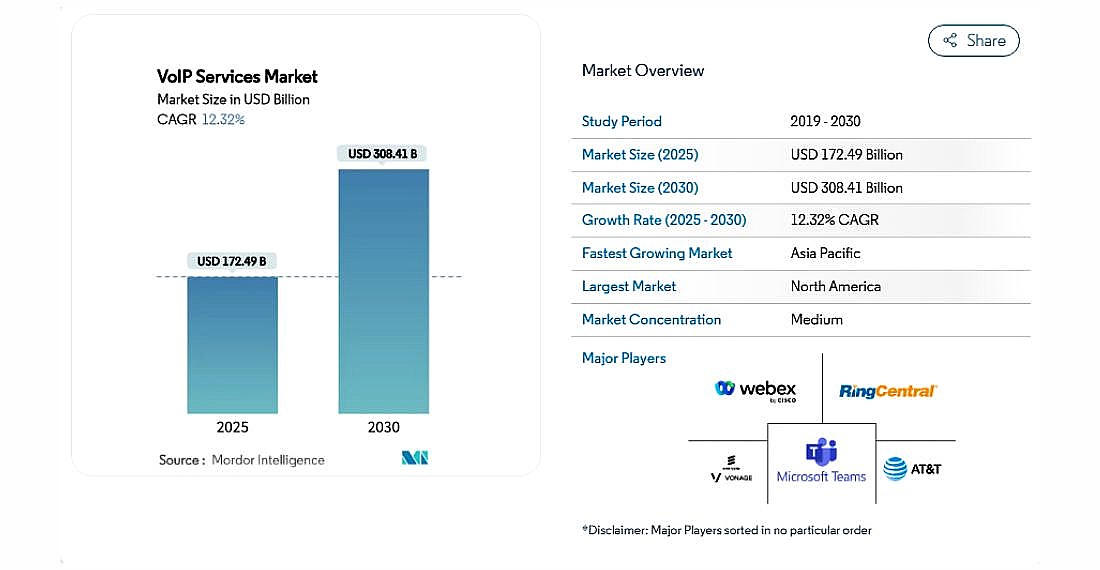
When you look at all these trends together, you will realize the growing need for scalable, automated VoIP solutions to protect revenue and ensure long-term profitability.
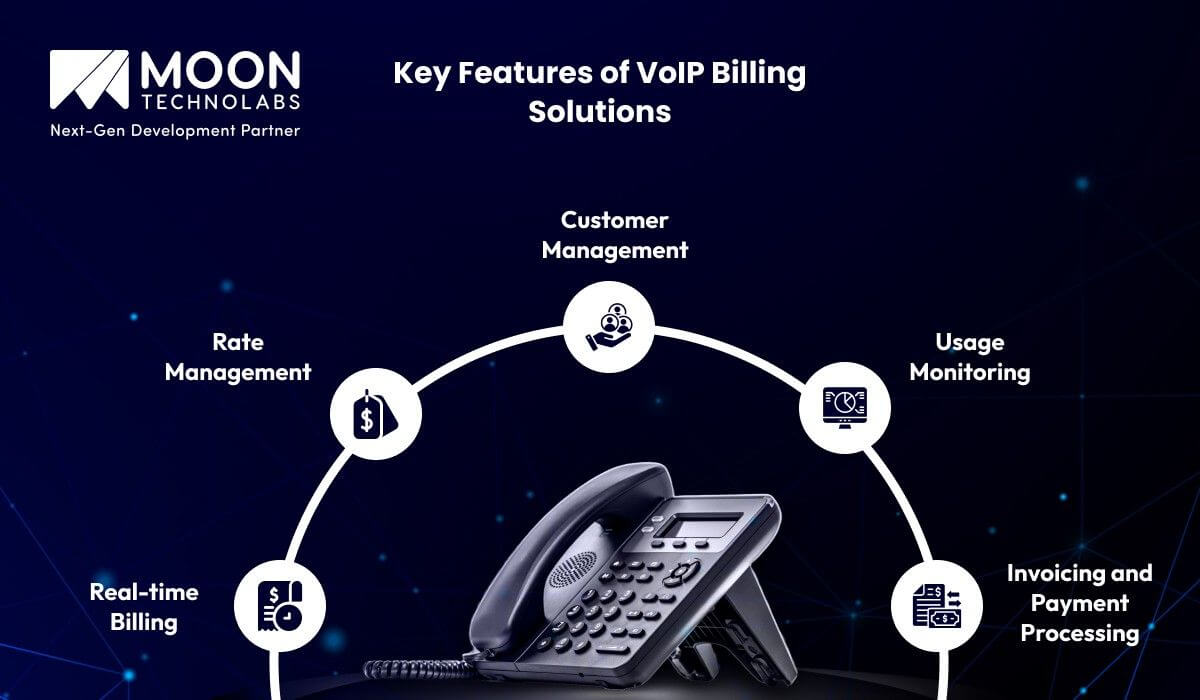
Choosing the right VoIP billing solution is about finding a system that supports your growth, simplifies operations, and eliminates revenue leakage. Here are all the core features that enhance accuracy while helping you scale confidently:
With the real-time billing feature, you can calculate call and service rates in real time. It is crucial for prepaid models and fraud prevention. This way, you don’t need to wait till the end of the month to discover the discrepancies. You will get immediate visibility into the balance, usage limits, and unusual activity, protecting your revenue and customer trust.
Pricing complexities evolve rapidly as you include international routes, peak/off-peak pricing, reseller margins, bundled packages, and custom enterprise contracts. With a strong billing system, you get flexible rate configuration, margin control, and automated updates. This lets you adjust pricing without causing operational complexities.
You need structured account management to handle multiple customer segments like retail, wholesale, resellers, and enterprise clients. The billing platform will centralize customer profiles, contracts, tax rules, service plans, and even credit limits, helping you streamline account management.
Using detailed call detail records (CDRs) and real-time usage monitoring, you can determine the call volumes and identify fraud patterns to forecast your revenue with precision. Clear analytics dashboards help finance and operational teams with actionable insights that fast-track decisions.
Tax calculations, seamless payment gateway integrations, multi-currency support, and automated invoice generation can reduce manual errors and accelerate collections. Owing to this faster and more accurate billing, you can enhance cash flow and customer satisfaction.
Eliminate revenue leakage and automate complex rating rules with a scalable and customized VoIP billing solution that drives growth and profits.
Get Started Now
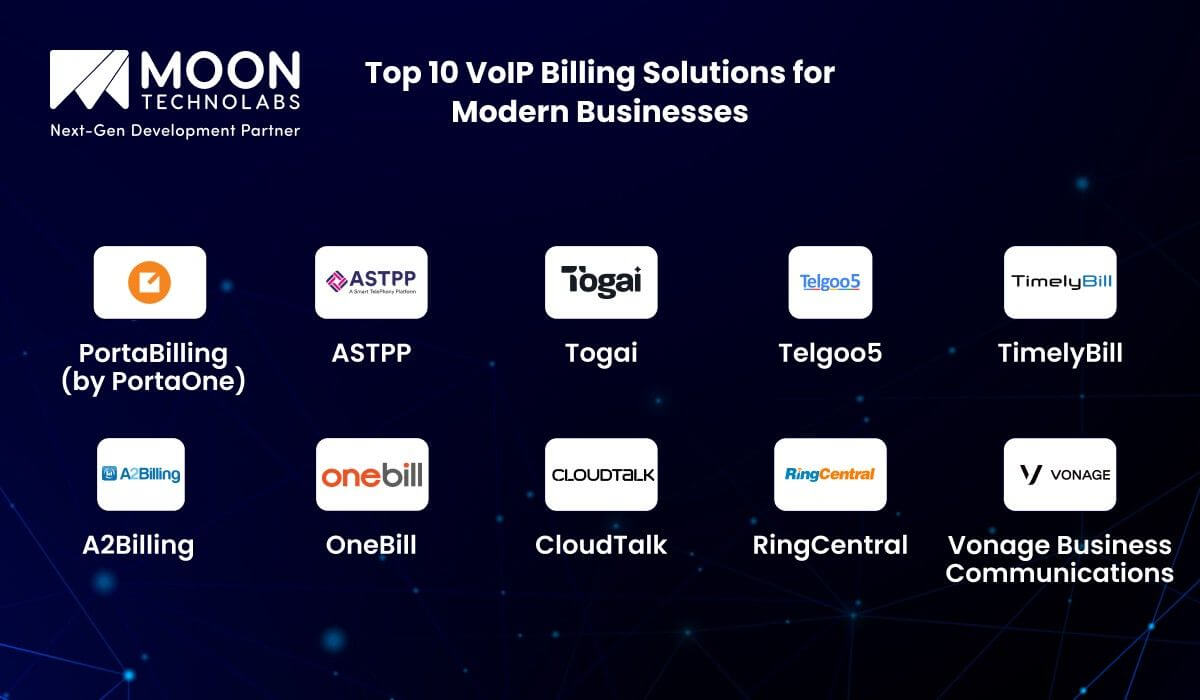
Assessing and implementing the right VoIP billing solution for your business needs can become stressful, especially when automation, scalability, and revenue accuracy are core to your growth.
Here we will walk you through ten proven VoIP billing solutions that most modern telecom providers, communication businesses, and even VoIP startups trust. We will break down to show what makes them a strong choice and how they help in the real-world:
This VoIP billing solution has consistently ranked among the top billing engines in both the telecom and VoIP spaces. It has been specifically built to manage complex carrier requirements.
The platform lets you access mediation, taxation, multi-currency support, invoicing, real-time call rating, and reseller management with a single unified system. Large service providers embrace PortaBilling by PortaOne because it can process thousands of CDRs in a single second without revenue leakage and enhances audit and financial controls for the team.
You can also get robust dashboards and reporting that help you track promotions, churn, and customer profitability. With this solution, you can bring structure and confidence into your billing operations, thus enabling growth with accuracy.
However, the depth and breadth of available features lead to a steep learning curve and a longer implementation timeline. That’s why it may not be suitable for smaller VoIP businesses with simple rate plans. If you anticipate significant scaling or international routing, this platform can be a great investment.
ASTPP is a standout open-source VoIP billing solution. It extends real-time call rating, prepaid/postpaid billing, customer dashboards, tariff configurations, and SIP integrations, everything that core billing needs from a free plan.
For tech-savvy teams and lean startups that need control over their stack, ASTPP can offer great value. The community contributions that have added plugins and modules to the ecosystem help you add functionality without the added costs.
Open-source freedom comes at operational responsibility. You will need in-house developers or third-party support for deployment, updates, and custom configurations. Despite being updated continuously, the user interface and documentation may feel less polished compared to the SaaS competitors, especially if you don’t have the necessary engineering resources.
If you want to enable billing solutions without license fees and have an in-house team that can manage everything, you should go with ASTPP.
Togai has been specifically designed for VoIP providers and telecom agencies requiring a billing solution that blends automation with usability. This tool offers real-time mediation with rating, invoicing, customer management, and OSS/BSS system integrations. Moreover, you don’t need the full support of a telecom engineering team to manage this interface.
Togai’s analytics and revenue-tracking dashboard can reduce leakage and provide actionable insights, making it suitable for mid-sized businesses. It is also appealing for providers that offer hybrid service models or have an evolving user base.
As the ecosystem isn’t very expansive, it cannot handle complex partner settlement needs without assistance. You must invest in the paid version to access advanced custom workflows. This is the best tool if you want strong automation with good reporting without incurring the overhead.
Telgoo5 is best for VoIP carriers and resellers looking for the essential billing features wrapped in a straightforward experience. The advantage of the platform lies in real-time billing, flexible tariff management, and integrated CRM capabilities with separate customer/agent portals.
This system is built for operational transparency and rapid deployment, allowing teams to manage rating and invoicing effortlessly. It also supports reseller hierarchies and multi-tenant billing, useful for tiered services.
However, this platform doesn’t offer all the advanced features that large enterprises need, like intricate mediation logic or reporting templates. In some cases, you may need vendor support as well. If you want to implement billing without complexity, Telgoo5 is a great addition.
TimelyBill offers modern, cloud-native billing capabilities for businesses with a recurring-revenue model. It is best for VoIP and communication service providers. Inherent features such as subscription plans, invoice automation, and CRM/ERP integrations make them best suited for businesses offering bundles, add-ons, and hybrid services.
Automation can help you reduce manual intervention, get detailed analytics, and streamline billing without middleware or other scripts. This cloud-first platform focuses on API extensibility and seamless connections with enterprise systems. While it seems great, it also means the tool leans towards SaaS billing rather than classic telecom carrier mediation.
You may need in-house teams to manage deep network-level integration or specific mediation logic. If you are a business that offers subscription and metered services, this solution will lay a powerful foundation.
A2Billing is an open-source, free billing platform known for prepaid billing and callback service capabilities. It provides features like real-time rating, customer portals, and flexible tariffs. As a small VoIP provider who prioritizes prepaid models, this platform can offer a low-cost, community-backed ecosystem with plugins and enhancements, supporting your need for cost-effective billing solutions.
However, the billing platform’s open-source origins indicate that it offers less refined analytics and user experience than modern commercial platforms. The community support varies, and advanced reporting requires custom development.
It is best suited for teams that prefer control and want to keep the costs down.
OneBill is a comprehensive order-to-cash and billing automation system that combines customer self-service features with subscription management and usage billing.
Owing to its broad scope, it is useful for communication businesses that extend professional services, bundled solutions or have revenue recognition needs. Instead of treating billing as a separate tool, OneBill integrates both sales and finance workflows to eliminate manual handoffs.
The extensive capabilities make deployment more involved. This also means it includes features far beyond the immediate needs of smaller providers.
Pricing is another indicator that the platform may not be suitable for budget-conscious early-stage startups. If you are a business with multiple product lines and evolving contracts, the platform’s end-to-end automation can streamline operations while reducing administrative effort.
CloudTalk combines cloud-based VoIP communication with billing insights and usage tracking. They let you customize billing insights using usage and agent metrics, as needed. It may not be a traditional telecom billing engine designed for carriers. However, the reporting, analytics, and call usage dashboards offer clarity for businesses that translate their calls into bills.
You can use the tool to improve internal cost allocation, pay-per-seat billing, and support organizations for simple chargeback models. As the billing prioritizes usage insights over complex rating, it cannot replace your carrier-grade billing systems. Moreover, the platform doesn’t support multi-currency mediation or external route cost optimization.
However, it extends simplicity and transparency that matters to your operations. You should go with the platform if you want built-in visibility into your usage metrics and cost drivers, driving real business value.
RingCentral is one of the leading VoIP billing platforms, offering built-in billing and usage reporting features to support predictable budgeting and automated invoicing. It may not be a standalone telecom billing engine for carriers; however, it can combine unified communications using clear billing structures, plan management, and usage analytics.
For businesses seeking unified communication with simplified billing, this is a great choice. Because billing is tied to subscription tiers and usage reports, rather than real-time mediation systems, it is not suitable for traditional VoIP billing engines. Moreover, it cannot handle complex CDR mediation or carrier settlements.
Vonage combines cloud VoIP, collaboration, and messaging tools with seat-based billing and usage insights. This would make cost management intuitive for your customers. This is a subscription-centric billing model that automates invoice generation, integrates with CRM systems, and offers usage breakdowns.
If you are offering VoIP as a service instead of a product, Vonage can simplify cost allocation, eliminating billing issues. They don’t offer features like carrier-level billing mediation, wholesale settlement, and tariff configurations, which are crucial for enterprise-grade providers.
However, if you are a small-to-mid-market business looking to unify communications and billing, Vonage is a great addition. It blends predictable pricing with reporting, making it a reliable choice. Each of these billing solutions answers a specific set of requirements. Your choice will depend on business model, scale, and priorities.
Even with the billing system, you may face operational issues that impact profitability and customer trust. As your call volumes grow and pricing models become more complex, even a small inefficiency can become a major financial issue. Here are some of the common challenges you will face with VoIP billing systems:
VoIP billing solutions rely on accurate call detail records (CDRs), configuration rules, and rate tables. If you make mistakes configuring tariffs, peak/off-peak logic, or currency conversion, you will end up overcharging or undercharging the customers.
These errors will not only impact revenue; it will also damage trust and increase the number of support tickets. Using manual reconciliations and spreadsheets can make the problem worse, especially at scale.
Telecom fraud is the biggest threat to the VoIP industry. Aspects such as unauthorized access, SIM box fraud, suspicious traffic spikes, and international revenue-share fraud can generate massive losses within hours. In the absence of real-time monitoring, credit limits, and automated alerts, you may discover fraud when the financial damage is done.
Taxation rules, data retention requirements, and even telecom compliance standards vary by region. If you manage VAT, GST, and international billing manually, you are adding risks. Consequently, you will fail to comply, resulting in penalties, audits, and reputational harm. This is true for providers operating in multiple countries.
Integrating your VoIP billing solution with softswitches, CRMs, and payment gateways requires technical understanding. Moreover, performance bottlenecks, data sync issues, and system downtime can impact invoicing accuracy. Without scalable infrastructure, you may notice strain in billing as your business grows.
VoIP billing platforms are gradually becoming intelligent, automated revenue engines built for scale. As communication technology evolves, billing systems are adapting to manage increasing traffic, new pricing models, and additional compliance requirements.
Here are all the emerging trends that will ensure that the solution won’t become outdated in a few years:
Modern VoIP billing platforms integrate automation with AI-based analytics and predictive revenue insights. As a result, instead of reacting to billing errors or fraud after they occur, your intelligent systems will flag anomalies in real time while forecasting churn.
They can also dynamically optimize pricing models. Cloud-native architecture enables faster deployments, API-backed integrations, and seamless scaling as the user base grows.
Blockchain is definitely the game-changer for telecom billing, especially for inter-carrier settlements and fraud prevention. Using decentralized and tamper-proof transaction records, this technology can foster trust, reduce disputes, and enhance transparency across wholesale VoIP agreements. This emerging technology indicates a future where reconciliation is not just faster, but also smoother and more secure.
The expansion of 5G networks is accelerating data-heavy communication services, ultra-low-latency voice traffic, and IoT connectivity. Current billing solutions must handle micro transactions, high-volume data usage, and dynamic pricing models.
The future-proof VoIP billing platforms can manage complex usage patterns without compromising performance.
While choosing the right VoIP billing solution is important, developing one that aligns with your business model can be transformative.
At Moon Technolabs, we don’t believe a single system can fit all business types. That’s why we work closely with you to understand your pricing structure, compliance needs, long-term growth plans, and customer segments. This helps us design a tailored billing architecture.
If you want features like real-time rating, reseller management, seamless integrations with softswitches, and multi-currency invoicing, our team will build scalable, secure solutions aligned with your operations.
We use a structured, fully transparent approach that begins with requirement analysis, then moves to UI/UX design before proceeding with development, testing, and launch. Our team uses agile, iterative development to build a billing solution that makes you more efficient and scales with you.
Replace your manual billing processes with automated billing, real-time reporting and seamless integrations to reduce operational stress and foster profitability.
Schedule Free Consultation
VoIP billing isn’t restricted to invoice generation alone; it acts as the backbone of revenue accuracy, long-term scalability, and operational efficiency for your business. After understanding the key features, assessing top platforms, and taking a look at future trends, it is clear that billing systems impact business profits.
If billing is inaccurate or outdated, it can cause revenue leakage, compliance risks and even customer dissatisfaction. However, when it is done right, it can become a strategic business advantage, fostering growth.
As VoIP ecosystems grow more complex, businesses need solutions that are reliable and adaptable to the evolving market. That’s where a good technology partner becomes critical. Their knowledge can help you build a system that is customized, scalable, and compliant, not just technically sound.
If you are ready to build a smarter and future-ready VoIP billing solution, partner with our team at Moon Technolabs. We will turn your billing platform into a revenue engine for the business.
01
02
03
04
05

Jayanti Katariya is the CEO of Moon Technolabs, a fast-growing IT solutions provider, with 18+ years of experience in the industry. Passionate about developing creative apps from a young age, he pursued an engineering degree to further this interest. Under his leadership, Moon Technolabs has helped numerous brands establish their online presence and he has also launched an invoicing software that assists businesses to streamline their financial operations.


Submitting the form below will ensure a prompt response from us.
We refine our expertise to deliver innovative business solutions.





500 N Michigan Avenue, #600, Chicago IL 60611
13500 Long Is Dr, Pflugerville, TX 78660, USA

C-105, Ganesh Meridian, S.G. Highway, Ahmedabad, GJ 380060


Ayse D.
Co-Founder France
“ I highly recommend Moon Technolabs as the quality of service is wonderful. We have hired this company to develop the product based on some complex & technical issues. We get the best quality services as compared with others in the market. Huge Thanks to Moon Technolabs as the team is always ready to give the solution all time.”

Justin G.
Founder & CEO USA
USA“ Moon Technolabs is a pioneer in the WebRTC based project as they have fixed complicated segments of the module by fulfilling different product lines by providing 24X7 customer support. We really recommended Moon Technolabs as they are able to develop products as per the module deadline and project timeline.”

Flavio S.
Founder & Managing Director Germany
“I am happy to recommend Moon Technolabs for their app development services. They successfully developed apps for me, and I am highly satisfied with the overall outcomes. The development team has swiftly addressed the issues with responsive and effective communication to understand the requirement quickly and actively resolve the back-and-forth problems that arose...”

Jay M.
Founder & CEOUSA“Moon Technolabs is the best company that provides advanced apps and websites development services in the USA and Europe. I am a newbie to develop my app with an external team. I am really happy to work with them as I am not that much mobile apps user. Here, the team and specially the CEO of Moon Technolabs helps me to let me know about the benefits of my app to generate revenue....”


Our Offices
India
C-105, Ganesh Meridian, S.G. Highway, Ahmedabad, GJ 380060USA
500 N Michigan Avenue, #600, Chicago IL 60611Contact Information


