
 Total Views: 7002
Table of Content


Blog Summary:
This guide explores the purpose, scope, and practical application of internationally recognized standards for software quality assurance (SQA) in a software system. You’ll learn what these standards (such as ISO 9001, ISO/IEC 25010, and IEEE 730) require, how to integrate them into your software development process, and how they enhance software quality, mitigate risk, and streamline audits for regulated industries.
Table of Content
Consider the case of a team racing to launch their new app on time, thereby cutting corners on testing the application, which ultimately fails to meet user expectations. While it seemed like their best move when they started, it gradually led to multiple bugs, expensive app fixes, and unhappy users.
Rework can account for over 30-50% of your project’s effort when your team overlooks software quality. According to IT Pro Today, 40% of companies worldwide are losing over $1 million per year due to poor-quality releases.
You are more likely to experience app abandonment and damage to your reputation due to these bugs. That’s why you must follow popular standards for software quality assurance, such as ISO and IEEE, which help catch bugs effectively to ensure quality. It will also help you incorporate compliance and maintain your loyal users.
This guide will help you understand these top standards, deliver best practices, and outline important quality assurance activities, providing a roadmap to create reliable software solutions.
Software Quality Assurance standards are formalized, repeatable criteria and practices that define how to ensure the high quality of software products. They provide you with a roadmap that comprises clear guidelines. Your engineering teams can use them to plan, design, build, and test the applications with consistency.
These standards prioritize every stage of your software development lifecycle, from requirements gathering to software deployment. These standards also offer a clear distinction between QA and QC.
QA or Quality Assurance is all about introducing the right processes into your lifecycle to prevent issues. Subsequently, QC, or Quality Control, is about identifying defects and ensuring the product meets the defined standards. QA sets the rules, while QC determines if these rules are effective for the team.
You can significantly reduce rework and improve compliance by incorporating automated testing and adhering to software quality assurance standards, ultimately delivering trustworthy and reliable products. It establishes a shared language for developers and testers to help them understand what good software looks like and how to achieve it.
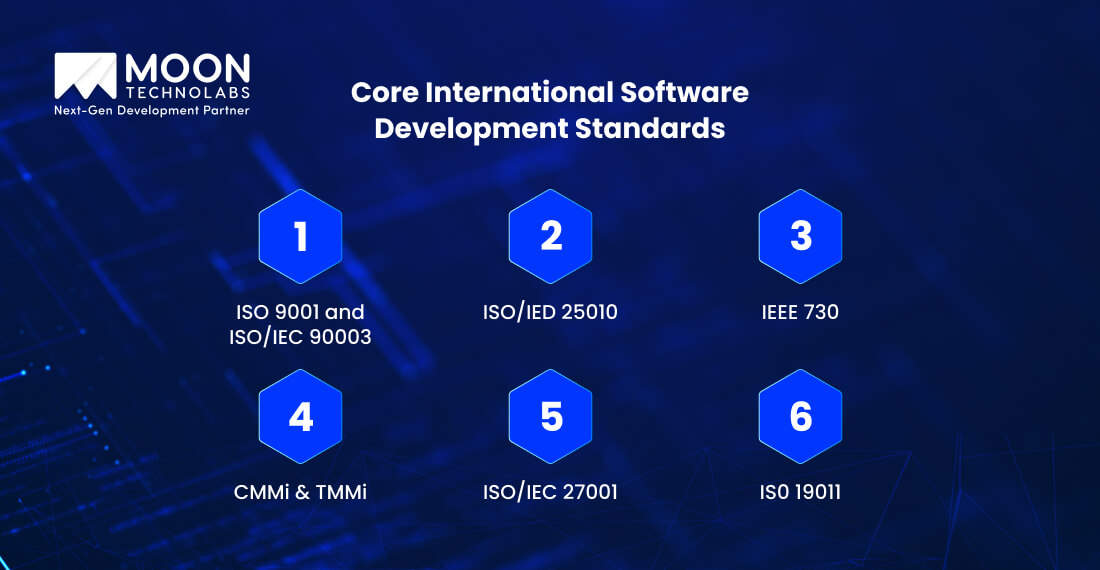
With these core international SQA standards, your team can build a fully compliant and reliable software. Let’s take a look at each of these influential standards in detail.
ISO 9001 is your general quality management system standard. This will help you consistently meet the customer’s needs and improve their satisfaction scores. ISO/IEC 90003, on the other hand, applies the ISO 9001 to software development.
Using this guide, teams can implement a quality management system to enhance their planning, resource management, documentation, and continuous feedback cycles throughout the lifecycle.
When you use them together, you can establish process-backed requirements, such as complete documentation, version control, and risk-based thinking. This means that teams should not only document all phases of the quality assurance process, but also integrate risk management and address potential threats throughout the app development process.
This standard provides a structured model for assessing software quality. The latest version of ISO/IEC 25010 provides important characteristics of product quality to help evaluate your software and ICT products.
The characteristics include performance, efficiency, usability, security, compatibility, functional suitability, and reliability. You can subdivide them into measurable sub-characteristics to provide your team with clear & consistent terminology for comparing quality.
With this standard, your team can understand what “good quality” literally translates to: solutions that work correctly, recover from failure, are efficient, and can be easily updated.
IEEE 730 is your guide to structuring all your quality efforts, including test planning, to release a reliable and standardized software solution. It helps determine how to create and manage the software quality assurance plan. You can begin using this early in the software development lifecycle, and keep updating as you proceed.
The SQAP should include your objectives, planned QA activities, and other relevant metrics. It should also provide a documentation strategy, audit mechanisms, and reviews to facilitate a detailed assessment.
Your document will also outline the roles, responsibilities, and processes. For example, you know which team member is assessing which part of the software. Additionally, you can determine how the issues can be tracked and reported to the clients. It will also cover audit and review checkpoints to keep all stakeholders on the same page.
Ultimately, it is your playbook to keep quality at the forefront of your development processes.
They are the maturity models for the organizations, and not just another product standard. CMMI, Capability Maturity Model Integration, can help organizations evaluate and enhance their development processes using a structured format.
TMMi, Test Maturity Model Integration, helps improve testing processes by providing a structured approach. It guides teams, from initial test phases to optimization, to enable continuous improvement.
If you are handling sensitive data, you must include this standard in your QA process. It sets the benchmark for information security management systems. You can integrate this standard into your software quality assurance, especially for the regulated sectors.
Using this standard, you can institute clear guidelines for audit quality and security management systems. It also helps you plan audits, define the criteria, and select auditors for the purpose. For software projects, documenting QA processes helps ensure they are transparent and compliant.
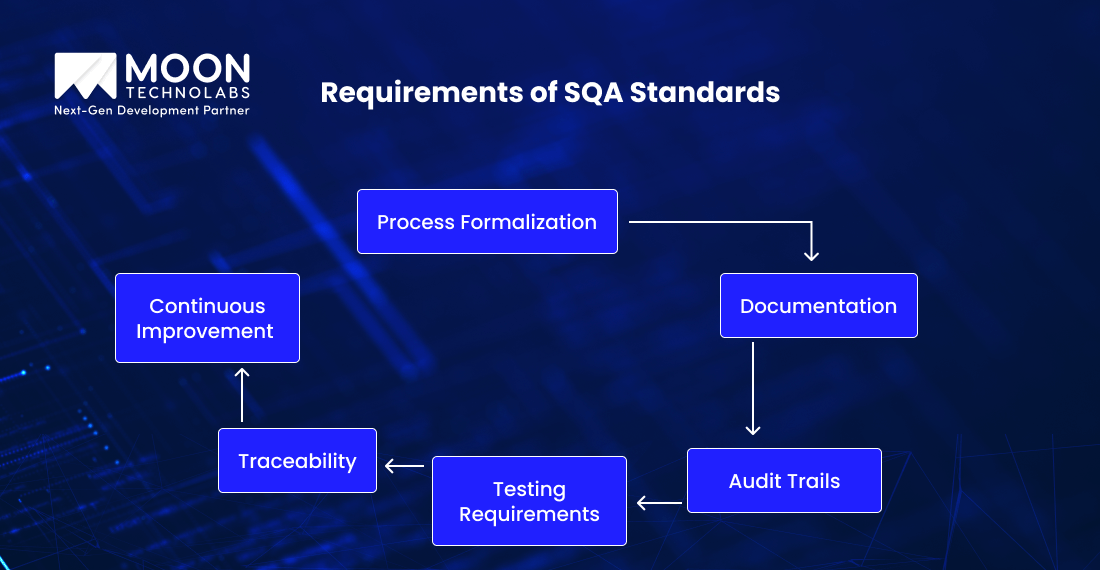
Managing standards while testing your application is more than ticking off a checklist. It is about building habits that keep quality at the core of your custom software and application development. Here is what SQA standards expect from your team members.
Using these quality standards, your team can map out the entire development process and not just write code. It means they can create clear criteria and checkpoints for quality assessment through the planning, design, build, and test stages. Using this roadmap, you can minimize last-minute surprises while keeping all teams aligned.
Nothing should be overlooked while developing or testing the application. The standards help you link your app requirements to the design, test case development, and final release stages. This traceability helps prove that each feature was tested and deployed as planned, thereby supporting audits.
While paperwork is not glamorous, it is essential. SQA expects your team to maintain records of the test plans, risk logs, bug reports, and reviews. Good documentation can help your teams collaborate, identify gaps early, and maintain clarity even as projects become complex.
Testing after completion is a must. However, it is not the only time to test your application. The quality assessment standards want you to conduct structured testing. You should regularly manage functional, integration, regression, performance, and security checks. Using the balanced approach can help you deliver software that works well and scales effortlessly. Here are some best practices that you can follow for the functional testing process.
Whether you are planning for a client or regulatory review, audit checks are crucial. Standards need you to implement clear logs and reports to help stakeholders know what was built, tested, and approved.
The SQA requires you to learn and grow continuously. That’s why you need to introduce metrics, feedback loops, and post-project reviews in your process. It will help your team spot patterns, improve processes, and raise the quality bar after each release.
Partner with our experts to align your development with global quality standards, reducing costly rework.
Schedule a Free Consultation
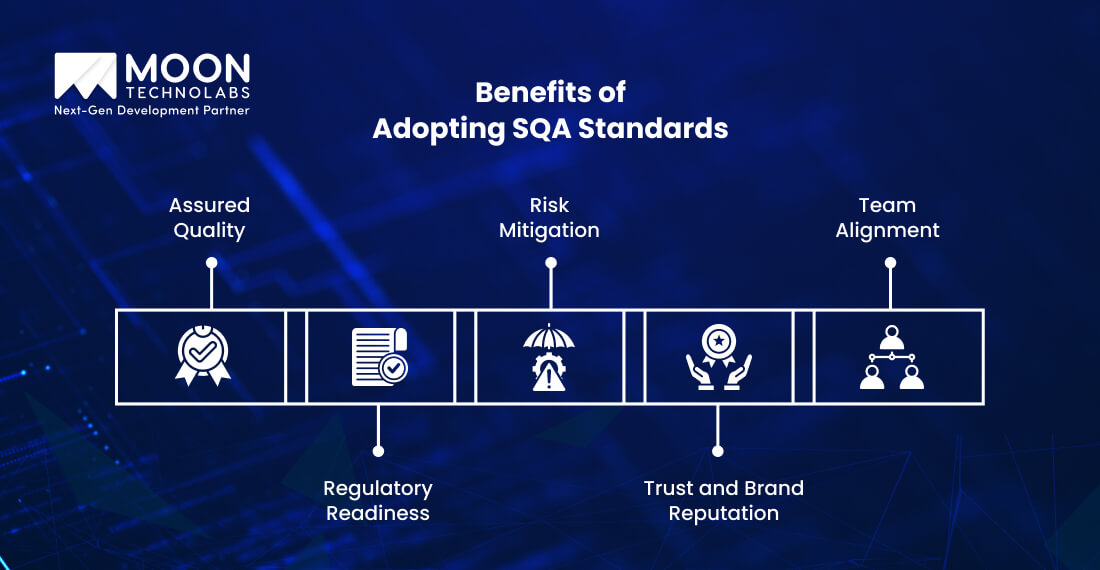
Why do successful teams prioritize SQA standards during software development? They provide a clear structure to deliver better software faster and with fewer hassles. Here is how these SQA standards help.
These standards promote process consistency, thorough reviews, and rigorous testing, resulting in fewer surprises when you launch the app. As your SQA standard helps you meet all requirements and identify defects early through quality assurance testing, you can achieve better product quality. As a result, you get to release a bug-free, stable, and reliable application that satisfies users.
Audits can be intimidating, especially when dealing with banking, healthcare, and other highly regulated industries. SQA simplifies the process by incorporating complete documentation, formal reviews, and traceability into your process. It can reduce stress during audits and accelerate approvals from clients and regulators owing to sound and compliant processes.
If you skip quality checks, you will end up fixing expensive issues later. SQA standards can mitigate this risk by enabling you to identify defects early, enforce security checks, and facilitate structured testing. Using this proactive approach, which includes manual testing, you can reduce critical failures, costly rework, and security incidents that can damage your product and reputation.
You can build high-quality software confidently using SQA. By following these standards, you send a clear message to your customers, partners, and even investors that quality matters most. With consistent releases and rare issues, you can establish yourself as a dependable and professional business, attracting more loyal users.
Standards help everyone on the team, from developers to managers, share a common language and expectations. This will help reduce confusion, improve collaboration, and ensure the projects are on track. This way, everyone knows “what’s done” really means, which speeds up delivery and boosts team efficiency.
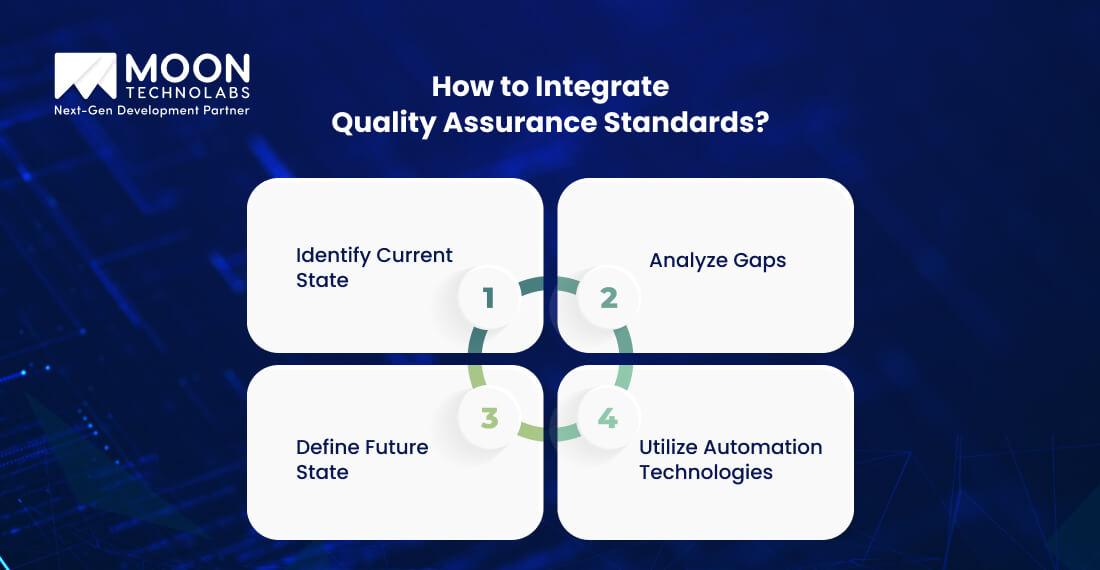
Adopting standard practices can seem demanding. However, it is a way to align your processes with the best practices. Let’s examine some ways to integrate the SQA standards into your process seamlessly.
Start by reviewing your current software quality assurance (SQA) plan and benchmark it against key standards. This would include ISO 9001, ISO/IEC 25010, and IEEE 730. You should look for gaps at the end of the review, such as missing documentation, unclear roles/responsibilities, and weak traceability. These gaps can lead to further problems in the future.
You should introduce the teams to these best practices. Train your developers, testers, and managers on what standards they should incorporate and how they help. Update the QA plans and documentation to add checkpoints, review cycles, and risk assessments. These testing activities, along with the reporting and audit, should sync with the standards.
Incorporating standards doesn’t mean you continue increasing manual work. You can include modern QA automated testing frameworks to improve requirement traceability, enhance test management, and automate the reporting. With these tools, you can ensure properly organized and audit-ready processes that don’t slow down your releases.
Here’s an example of how mapping the QA process to a standard can help. A healthcare startup mapped the key standards, like ISO 9001 and ISO/IEC 25010, into its QA process. This included traceable test cases for all regulatory requirements, automated dashboards for metrics, and strict version control for documentation. As a result, they were able to deliver audit-ready releases with fewer issues at a later stage.
Our experts integrate the ISO and IEEE frameworks into your process to ensure quality, compliance, and reliability with every release.
Work with Us
While applying SQA standards may seem simple, it is easy to get everything wrong. The most common issue you are likely to face is overcomplicating the process. Many teams add layers of paperwork and reviews, claiming it’s necessary for quality. However, it only slows down delivery and loses agility. Standards must guide the process and not create unnecessary bureaucracy.
The second challenge is a lack of training. If the QA team or developers are unable to understand their roles or how standards align with their daily work, they will likely make mistakes. This can also lead to gaps and incomplete documentation that auditors will spot immediately.
Lastly, most teams treat standards as a one-time process. However, the fact is that standards evolve with time. If you fail to refresh your SQA processes as the standards or products evolve, you can expose the process completely. That’s why you must stay current with respect to standards.
Bugs, rework, or even compliance issues don’t happen by chance. If anything, they happen when you don’t include quality in your process. SQA standards can turn all your scattered efforts into a clear and repeatable software development framework to ensure well-aligned teams, structured processes, reliable products, and effective continuous integration.
Whether you are incorporating ISO 9001 for processes or IEEE 730 for planning, standards can help confirm measurable and sustainable quality.
Moon Technolabs is an expert testing and QA services provider, specializing in incorporating user feedback into quality assurance practices. Our team is well-versed in the current standards and implements them into the testing processes.
If you want to raise the standard of your software solution, connect with our experts to plan the next steps.
01
02
03
04

Jayanti Katariya is the CEO of Moon Technolabs, a fast-growing IT solutions provider, with 18+ years of experience in the industry. Passionate about developing creative apps from a young age, he pursued an engineering degree to further this interest. Under his leadership, Moon Technolabs has helped numerous brands establish their online presence and he has also launched an invoicing software that assists businesses to streamline their financial operations.


Submitting the form below will ensure a prompt response from us.
We refine our expertise to deliver innovative business solutions.





500 N Michigan Avenue, #600, Chicago IL 60611
13500 Long Is Dr, Pflugerville, TX 78660, USA

C-105, Ganesh Meridian, S.G. Highway, Ahmedabad, GJ 380060


 France
“ I highly recommend Moon Technolabs as the quality of service is wonderful. We have hired this company to develop the product based on some complex & technical issues. We get the best quality services as compared with others in the market. Huge Thanks to Moon Technolabs as the team is always ready to give the solution all time.”

 USA
USA“ Moon Technolabs is a pioneer in the WebRTC based project as they have fixed complicated segments of the module by fulfilling different product lines by providing 24X7 customer support. We really recommended Moon Technolabs as they are able to develop products as per the module deadline and project timeline.”

 Germany
“I am happy to recommend Moon Technolabs for their app development services. They successfully developed apps for me, and I am highly satisfied with the overall outcomes. The development team has swiftly addressed the issues with responsive and effective communication to understand the requirement quickly and actively resolve the back-and-forth problems that arose...”
 USA
USA“Moon Technolabs is the best company that provides advanced apps and websites development services in the USA and Europe. I am a newbie to develop my app with an external team. I am really happy to work with them as I am not that much mobile apps user. Here, the team and specially the CEO of Moon Technolabs helps me to let me know about the benefits of my app to generate revenue....”


