The Ultimate Software Quality Assurance Plan for Effective Development

Jayanti Katariya
Last Updated: Aug 29, 2025 Total Views: 9016

Table of Content


Blog Summary:
This guide helps you understand the process of creating a robust software quality assurance plan. It is used to weave quality into every stage of the development lifecycle. This blog breaks down essential components, roles, tools, and best practices to help you boost compliance, streamline processes, and deliver software that exceeds customer expectations.
Table of Content
Are you caught in the storm of rapid releases, complex features, and endless compliance checklists? You’re not alone. Many software projects stumble not because of bad code, but because they lack a solid foundation. The truth is that behind every bug-free product lies a comprehensive software quality assurance (SQA) plan.
It’s the master blueprint that aligns your development and QA teams, closes critical documentation gaps, and provides clear visibility into the project. In this guide, we’ll walk you through how to build an SQA plan that not only guarantees a smooth journey to compliance but also delivers the kind of quality your customers expect.
What is a Software Quality Assurance Plan?
A software quality assurance (SQA) plan is basically a formal document that outlines the processes, standards, and responsibilities for ensuring quality in the entire software development lifecycle. In other words, we can say that it’s a proactive roadmap designed to prevent defects. It defines quality goals, metrics, as well as procedures for reviews, audits, and corrective actions.
Moreover, SQA is not just about testing. It’s also a comprehensive approach that covers every stage of development, from requirements gathering to delivery. The primary difference between quality assurance and software testing lies in their respective purposes.
SQA is process-oriented and prevents defects by improving the software development process. It ensures that the right steps are followed to achieve a high-quality outcome. In contrast, software testing is product-oriented, which focuses on detecting and reporting defects that already exist within the code.
Testing is a specific, phase-based activity that evaluates the finished product, whereas SQA is an ongoing activity that governs the entire process.
Core Components of a Robust SQA Plan
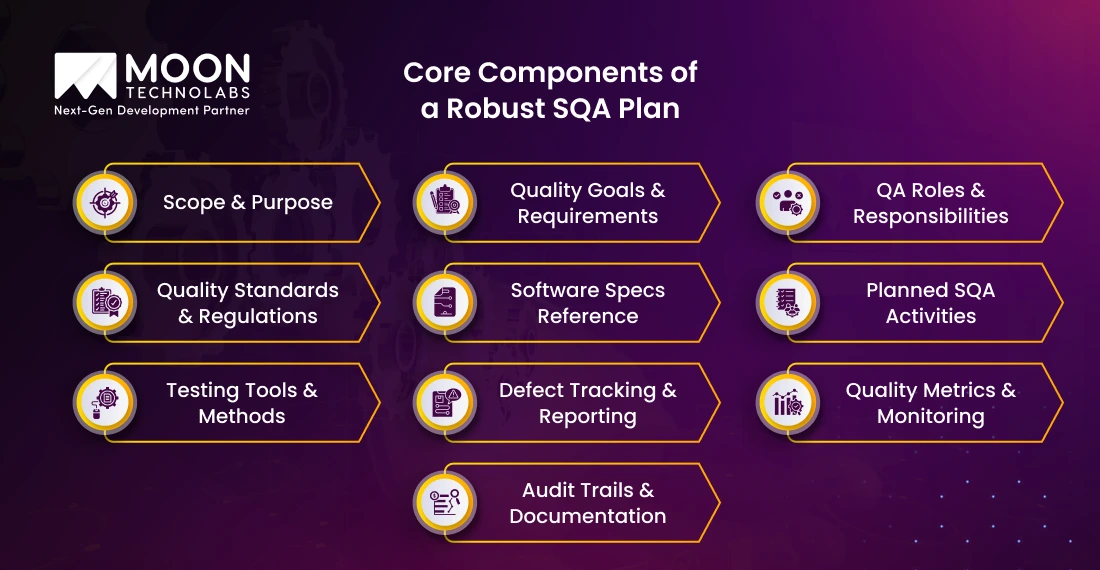
A robust software quality assurance plan outlines the processes and activities to ensure software products meet quality standards. It is a critical guide for the entire development lifecycle:
Scope and Purpose
This section defines the scope of the SQA plan, including the specific projects or product lines to which it applies. It clarifies the plan’s objectives, including preventing defects and ensuring the final product meets both functional and non-functional requirements. It sets the stage for the entire quality effort.
Quality Goals and Requirements
This component sets SMART (Specific, Measurable, Achievable, Relevant, Time-bound) benchmarks for quality. These goals are directly aligned with stakeholder and customer expectations, such as achieving a specific level of performance, reliability, or user-friendliness.
QA Roles and Responsibilities
It defines the SQA team’s structure and responsibilities. Using tools like a RACI (Responsible, Accountable, Consulted, Informed) chart helps to clearly assign roles for each quality-related task, from design reviews to final testing.
Quality Standards & Regulatory References
Here, the plan specifies adherence to relevant industry standards and regulations, such as ISO 9001 for quality management, HIPAA compliance for healthcare data, or FDA guidelines for medical devices. It helps to ensure that the software is compliant with necessary laws.
Software Requirement Specification Reference
This component ensures traceability. It links requirements defined in the software requirement specification (SRS) to specific test cases and implementations, ensuring every requirement is tested and validated before release.
Planned SQA Activities
It outlines the quality assurance activities across each phase of the software development life cycle. This includes static analysis activities, such as design and code reviews, as well as dynamic testing methods. It includes unit testing, integration testing, system testing, regression testing, and stress testing.
Testing Tools & Methodologies
This component lists the specific tools and methodologies to be used. It includes automation tools, configuration management systems, and defect-tracking software. This ensures consistency and efficiency in the testing process.
Defect Tracking & Problem Reporting
It details the formal process for identifying, reporting, and managing defects. It also describes the triage process for prioritizing bugs and defines metrics, such as defect density, to measure the software’s quality.
Quality Metrics & Monitoring
This outlines how quality is measured throughout the project. It includes key metrics such as test coverage, defect trends, and release readiness criteria. These metrics provide objective data to track progress and inform decision-making.
Audit Trails & Regulatory Documentation
This component ensures all quality-related activities are properly documented. It specifies the need for clear audit trails to facilitate internal and external compliance reviews. It is essential to maintain a record of quality and comply with regulatory obligations.
Is Your SQA Plan Missing a Piece?
A great SQA plan has many moving parts. If you’re unsure your plan covers all the critical components for success, let’s review it together.
Get a Free SQA Plan Review
Step-by-Step Process: How to Create a Software Quality Assurance Plan?
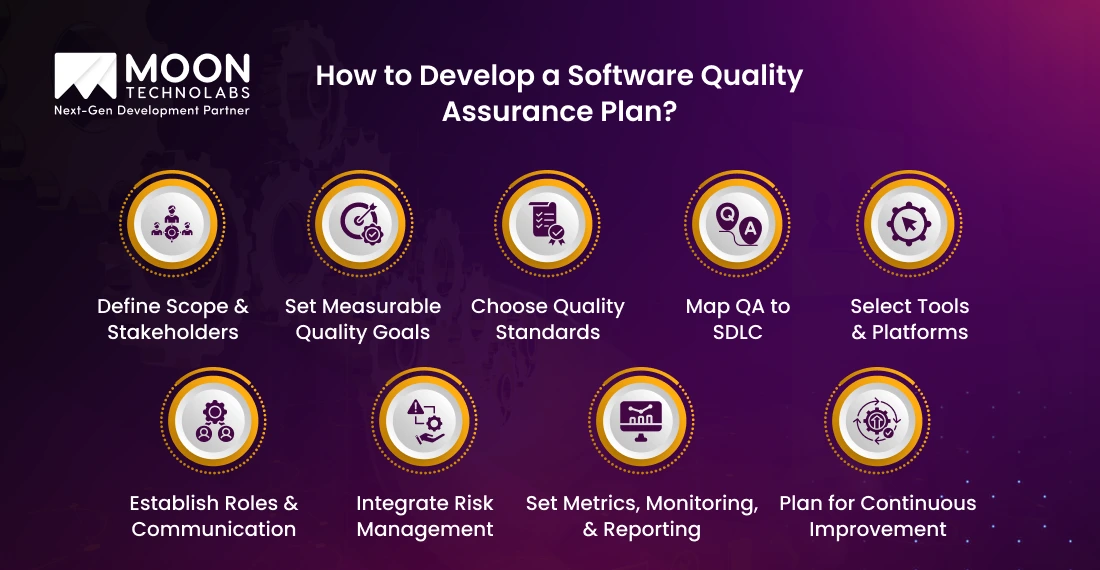
We must follow a nine-step process to develop a software quality assurance plan. It ensures that a software product meets quality standards and business requirements:
Define Scope & Stakeholders
The first step is to clearly define the project’s scope, including its size, complexity, and the specific deliverables. Here, you can identify all stakeholders, such as developers, product managers, and end-users. It helps to understand their expectations and involve them in the planning.
Set Measurable Quality Goals
Then, you can establish specific, measurable, achievable, relevant, and time-bound (SMART) goals for quality. These goals should align with business objectives, such as reducing the number of post-release defects by a certain percentage or achieving a specific customer satisfaction score.
Select Quality Standards
The next step is to choose the appropriate industry and regulatory standards that the software must comply with. This includes international standards, such as ISO 9001, as well as domain-specific regulations, such as those applicable to the healthcare or finance industries.
Map QA Activities to SDLC
Afterwards, you need to integrate QA activities into each phase of the software development life cycle. It involves planning activities such as static code analysis during the design phase and regression testing prior to release.
Select Tools & Platforms
Choose the right set of tools and platforms to support your QA plan. This includes test management tools for planning and tracking, automation frameworks for repeated tests, and CI/CD tools to enable continuous integration and deployment.
Establish Roles and Communication
Clearly define the roles and responsibilities of each team member involved in the QA process. Establish clear communication channels and a protocol for reporting defects and escalating issues to ensure that everyone is aware of their responsibilities.
Integrate Risk Management
Build a risk management strategy into the plan by identifying potential risks and their impact on quality. Develop mitigation plans to address issues, such as the discovery of a critical bug late in the development cycle.
Set Up Metrics, Monitoring, and Reporting
Define the key metrics to be tracked, such as defect density, test coverage, and maintenance costs. Implement dashboards and reporting mechanisms to continuously monitor these metrics and provide transparency into the software’s quality.
Plan for Continuous Improvement
At last, you can use the data and insights gained from monitoring and reporting to create a feedback loop. This allows you to continuously refine processes, improve efficiency, and enhance the overall quality of future software releases.
Benefits of Compliance in the Software Quality Assurance Process
Compliance in the SQA process offers a range of benefits that impact an organization’s operations, finances, and reputation. It ensures that software products meet both internal and external standards. It results in a more reliable, secure, and competitive final product:
Risk Mitigation & Regulatory Protection
Compliance ensures that your company adheres to laws such as GDPR and industry standards, thereby protecting it from costly fines and legal issues. It also reduces the risk of security breaches and data leaks.
Standardization of Quality Assurance Activities
A compliant and standardized process means everyone on the SQA team follows the same steps for testing and documentation. It yields consistent and reliable results, while also making it easier for new team members to get up to speed.
Improved Auditability & Traceability
Compliance requires thorough documentation of every SQA activity. It creates a clear and detailed history of all changes and tests. This is required to prove that a company has met its obligations during audits. Additionally, it helps in quickly tracing the source of any problems.
Customer Trust & Satisfaction
A company produces reliable software consistently when it adheres to quality standards. As a result, the company significantly builds trust with customers by ensuring that their data is protected. Ultimately, it results in increased satisfaction and loyalty.
Efficient Problem Reporting & Corrective Action
A compliant process includes a structured method for reporting bugs and issues. This efficiency ensures that problems are quickly and properly addressed, reducing the time and effort needed to fix defects.
Business Scalability & Adaptability
A robust and compliant SQA framework ensures that a business can easily grow and introduce new products. The standardized processes enable the smooth integration of new projects and teams without compromising quality.
Better Collaboration Across Teams
Compliance provides a common set of guidelines that all teams can understand and follow. It is a shared understanding to reduce miscommunication and ensure everyone is working toward the same goals.
Long-term Cost Savings
Compliance is highly cost-effective in the long run as it identifies and corrects errors early, thereby avoiding fines. The initial investment in a compliant system pays off by reducing expensive rework and enhancing the company’s reputation.
Common Pitfalls in SQA Planning
SQA planning may falter due to several common pitfalls. One significant mistake is overlooking the needs of users and customers, as well as the real-world workflows in which they engage. This leads to testing against a flawed model and missing critical issues that impact actual users.
Another pitfall is incomplete test plan coverage. It often results from skipping essential tasks, such as regression testing for new code changes, or failing to automate repetitive tests. This leaves the system vulnerable to defects.
Third, a weak SQA plan often lacks clear accountability and coordination. If the team responsibilities are unclear and collaboration with development and product teams is inadequate, it’s a major problem.
Lastly, errors in documentation and auditability make it difficult to track changes, review test results, or justify the quality of the software, hindering continuous improvement. These issues prevent the SQA process from being effective and reliable.
Don’t Let These Common Challenges Compromise your Software Quality
Let our experienced team guide you through a flawless SQA planning process and achieve your quality goals.
Talk to an SQA Expert
SQA Plan Checklist: What to Include?
| Section | Checklist Items |
|---|---|
| Scope, Objectives, Roles, Standards |
|
| QA Processes Mapped to SDLC Phases |
|
| Activities, Tools, Metrics, Reporting, and Audit |
|
| Continuous Improvement Steps |
|
Conclusion & Next Steps
Ultimately, a robust SQA plan is the cornerstone of delivering exceptional, bug-free software that delights customers and builds a strong reputation. Instead of the ‘find-and-fix’ mentality, the SQAP integrates a proactive, continuous quality approach throughout the software development lifecycle. This streamlines development, reduces costs, and guarantees a superior end-user experience.
Looking to truly maximize your project’s success and establish a culture of quality? It’s vital to have a clear, customized roadmap in place. Connect with our SQA experts to create a specialized plan or get the customized software testing services.
FAQs
01
What does a software quality assurance plan include?
A software quality assurance plan outlines the procedures, standards, and tools to ensure that a software product meets specified requirements. It details the testing activities, quality metrics, as well as roles and responsibilities to maintain high-quality software throughout the development lifecycle.02
How is an SQA plan different from just a test plan?
An SQA plan is a broader organizational document that details the overall strategy for ensuring quality throughout the entire software development lifecycle. On the other hand, a test plan is a project-level document that details how and when the actual testing will be conducted.03
How often should an SQA plan be reviewed or updated?
An SQA (Software Quality Assurance) plan should be reviewed and updated regularly in your project's lifecycle. It is recommended to review the plan at the beginning of each major development phase. Another good practice is to review it whenever there are significant changes to the project's scope, technology, or requirements.04
What are the most important quality metrics to monitor in an SQA plan?
An SQA plan should prioritize metrics that directly measure software quality, development process efficiency, and user satisfaction. Key metrics include defect density (bugs per line of code), test coverage (percentage of code tested), and escaped defects (bugs found after release). You can monitor quality metrics to identify and resolve issues early. This improves product reliability and reduces post-release costs.




Jayanti Katariya is the CEO of Moon Technolabs, a fast-growing IT solutions provider, with 18+ years of experience in the industry. Passionate about developing creative apps from a young age, he pursued an engineering degree to further this interest. Under his leadership, Moon Technolabs has helped numerous brands establish their online presence and he has also launched an invoicing software that assists businesses to streamline their financial operations.
Submitting the form below will ensure a prompt response from us.
We refine our expertise to deliver innovative business solutions.





205 N Michigan Avenue, #810, Chicago, 60601, Illinois, United States
13500 Long Is Dr, Pflugerville, TX 78660, USA

C/105 Ganesh Meridian, S.G. Highway, Ahmedabad, GJ 380060


Ayse D.
Co-Founder France
“ I highly recommend Moon Technolabs as the quality of service is wonderful. We have hired this company to develop the product based on some complex & technical issues. We get the best quality services as compared with others in the market. Huge Thanks to Moon Technolabs as the team is always ready to give the solution all time.”

Justin G.
Founder & CEO USA
USA“ Moon Technolabs is a pioneer in the WebRTC based project as they have fixed complicated segments of the module by fulfilling different product lines by providing 24X7 customer support. We really recommended Moon Technolabs as they are able to develop products as per the module deadline and project timeline.”

Flavio S.
Founder & Managing Director Germany
“I am happy to recommend Moon Technolabs for their app development services. They successfully developed apps for me, and I am highly satisfied with the overall outcomes. The development team has swiftly addressed the issues with responsive and effective communication to understand the requirement quickly and actively resolve the back-and-forth problems that arose...”

Jay M.
Founder & CEOUSA“Moon Technolabs is the best company that provides advanced apps and websites development services in the USA and Europe. I am a newbie to develop my app with an external team. I am really happy to work with them as I am not that much mobile apps user. Here, the team and specially the CEO of Moon Technolabs helps me to let me know about the benefits of my app to generate revenue....”


Our Offices
India
C/105 Ganesh Meridian,S.G. Highway, Ahmedabad, GJ 380060USA
205 N Michigan Avenue, #810, Chicago, 60601, Illinois, United StatesContact Information