
Jayanti Katariya
Last Updated: February 04, 2026 Total Views: 170
Table of Content


Blog Summary:
As we all know, demand for software developers continues to grow, which is why startups and enterprises are increasingly opting to outsource software development. This model enables companies to expand their teams with external talent, offering flexibility, cost efficiency, and access to specialized skills. In this guide, we’ll cover the benefits, challenges, and costs of team extension, helping you understand how to use this strategy to grow your development team effectively.
Table of Content
With a quick shift in the digital arena, businesses are increasingly relying on technology to drive innovation, streamline processes, and stay ahead of the competition. The ability to scale development teams efficiently has never been more crucial. One strategic solution that has gained significant traction is Software Team Extension.
This dedicated team model allows companies to expand their development capabilities by tapping external talent, enabling them to meet growing demands without compromising quality and productivity.
You’ll be surprised to learn that global IT spending reached $5.61 trillion in 2025, up 9.8% from 2024, according to Gartner. With this massive growth, the pressure on businesses to scale their software development teams has never been greater.
As demand for technology continues to surge, adopting a flexible, scalable approach, such as a development team extension model, can give organizations the edge they need to stay agile and competitive in a changing market.
Software Team Extension is a model in which businesses hire additional professionals (developers, designers, project managers, etc.) to join their in-house team. These external teams work alongside internal staff, integrating seamlessly and using the same workflows, processes, and tools.
In the dedicated team extension model, external team members seamlessly integrate into the in-house team, adopting the same processes, workflows, and tools to ensure smooth collaboration. This IT team extension approach is valuable for quickly addressing skill gaps when internal expertise is scarce.
The extended team model also offers high scalability and flexibility, allowing teams to scale up or down based on project demands without long-term commitments. In addition, it offers significant cost savings by avoiding the expenses of hiring, training, and providing benefits to full-time employees, making it a more adaptable and budget-friendly option.
| Factor | Software Team Extension | In-House Hiring |
|---|---|---|
| Speed | Faster to hire external professionals | Slower due to recruitment, interviews, and onboarding |
| Commitment | Short-term or project-based | Long-term permanent employees |
| Cost | Lower, no recruitment, training, or benefits costs | Higher due to salaries, benefits, and overhead |
| Specialization | Access to specialized skills on demand | Limited to available in-house expertise |
| Control | Higher control over team members’ work | Full control as the development team is internal |
| Factor | Software Team Extension | Project Outsourcing |
|---|---|---|
| Control | High, as the team works directly with in-house staff | Low, as the external vendor manages the project |
| Flexibility | Flexible, as the team can be scaled up and down based on the needs | Less flexible; the project scope and timeline are set |
| Scope | Adds external members to the existing team | The external vendor handles the full project |
| Cost | Typically more affordable, with pay-per-hour/ monthly rates | Can be more expensive with fixed project fees |
| Involvement | Direct involvement in day-to-day project work | Less direct involvement; communication with the vendor |
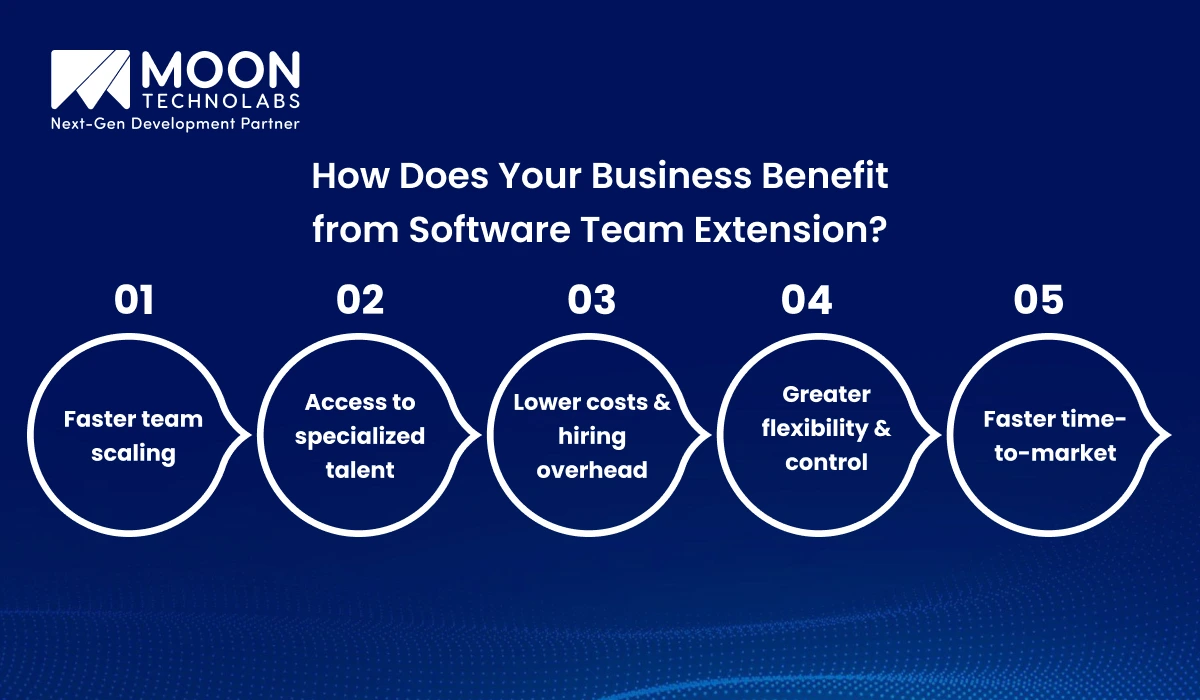
Software team extension provides businesses with the agility, expertise, and cost savings needed to accelerate development and stay competitive in the digital world. Here are the key benefits:
Expanding your team quickly without any delays of the traditional hiring process means you can meet urgent project deadlines and scale resources up or down based on demand. This flexibility is vital for businesses looking to grow fast or handle fluctuating workloads.
With an extended development team, you can tap into a global pool of highly skilled professionals across various technical fields such as cloud computing, AI, and blockchain. This access to niche expertise ensures your team is equipped to handle complex tasks and incorporate the latest technologies without needing to train or recruit an internal team.
Hiring permanent staff is expensive, especially given recruitment, onboarding, benefits, and training costs. IT team extension offers a cost-effective solution, allowing you to bring in the exact skills you need without long-term commitments. You reduce overhead costs and pay only for the expertise and time you need, making it easier to manage budgets.
While outsourcing software development or even a part of it, you remain in control of the project’s direction. You can manage the extended team directly, set priorities, and adjust timelines as needed to ensure the final product meets your vision. This team collaboration helps keep your projects aligned with business goals.
By quickly ramping up your dedicated development team, you can accelerate the delivery of features and new products. This gives you a competitive advantage by enabling you to release updates faster, gather user feedback sooner, and stay ahead of market trends.
Our software team extension model helps you scale faster while staying fully in control.
Let’s Talk
The Software Team Extension Model can be a valuable approach for scaling development efforts and accessing specialized expertise. However, like any collaboration model, it comes with important considerations; see the challenges below to understand better what to expect.
Working across different time zones can slow down collaboration and decision-making. The asynchronous nature of communication may delay feedback, and coordinating meetings for all team members can be challenging, thereby impacting overall efficiency.
Cultural differences and differing work habits between new and existing team members can lead to misunderstandings and inefficiencies. Differences in expectations for task execution, communication styles, and project management tools may hinder smooth coordination and workflow integration.
Sharing confidential information with external teams poses a risk to data security and intellectual property. Different countries have varying data protection laws, increasing the complexity of ensuring compliance and safeguarding proprietary information.
Extended team members may struggle to feel connected to the core team, which can lead to collaboration and alignment issues. Without proper integration, team members may lack context, which can impact productivity and create gaps in communication and understanding of company goals.
Expanding your team through external hires can drive success, but it requires careful management. Here are five key practices to ensure effectiveness:
Ensure both teams fully understand the project’s goals and deliverables. Document requirements, set milestones, and define expected outcomes to keep everyone aligned.
Clearly outline roles and responsibilities to prevent overlap or confusion. Assign ownership for tasks and ensure team members know their duties and timelines.
Use tools like Jira, Slack, and Zoom for task management, daily communication, and voice calls. Centralize documents on platforms such as Google Drive to enable easy sharing and collaboration.
Adopt agile practices with regular stand-ups, sprint planning, and reviews. Keep the progress transparent with weekly reports to ensure alignment and identify blockers early.
Track performance with KPIs and provide regular feedback to keep teams motivated and on track, supporting continuous improvement and improving collaboration and productivity.
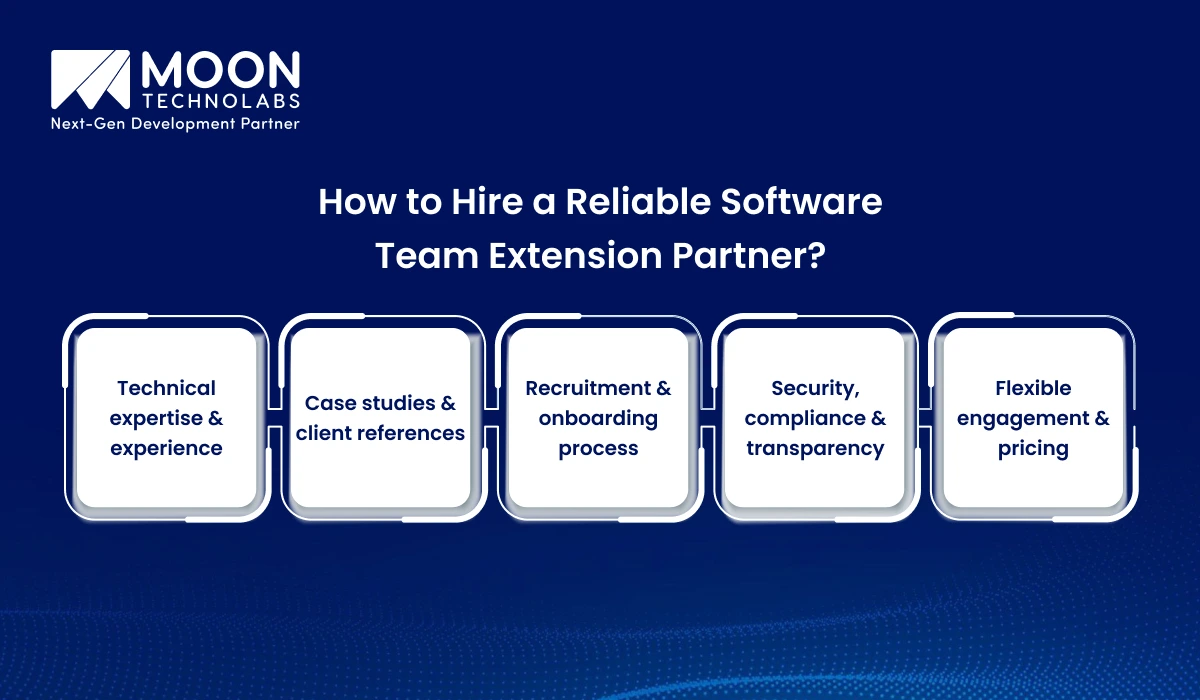
Here are 5 easy steps to help you hire a reliable team extension partner for your project. Have a sneak peek:
The first step in hiring extended team members is to evaluate their technical skills and experience against your project’s requirements. Before you hire, ensure they have the right skills, including proficiency in specific programming languages, tools, and frameworks.
It is essential to check whether they have experience in similar projects or industries, as this helps ensure they can quickly grasp your needs and challenges.
Once you have evaluated their experience and expertise, review recent projects and client references to gain a clear understanding of the types of projects the new team members have worked on. Also, check online reviews and testimonials for independent feedback on their performance.
After reviewing their projects and online reviews, confirm they follow a robust recruitment process to ensure smooth onboarding and quick integration into your project. They must provide team stability, as high turnover can disrupt progress and delay your project.
The dedicated development team you choose should follow the best practices for data security, especially if your project involves confidential information. They should comply with industry standards, such as GDPR or HIPAA, depending on your requirements.
Progress tracking and transparent communication are necessary to avoid unwanted surprises. So, look for clear, open discussion about challenges, deliverables, and timelines.
Choose software team extension services that offer flexible engagement models that align with your budget and project scope. Additionally, they should be able to scale the team up or down as needed to ensure you are neither over- nor understaffed at any point during the software development process.
Software team extension services help organizations scale their existing development teams by adding an external team of professionals. Costs vary based on factors like team size, location, expertise, and project complexity.
Location has a major impact on pricing. Teams in high-cost regions such as the U.S. and Western Europe typically charge $50–$200 per hour or $8,000–$20,000 per month per developer, while teams in Eastern Europe and Latin America charge $30–$100 per hour or $4,500–$12,000 per month. Lower-cost regions such as India offer rates between $15–$50 per hour or $2,500–$6,000 per month per developer.
Costs also rise with team size and expertise. A small team may cost $8,000–$50,000 per month. Senior developers or specialists, such as DevOps engineers, often charge 20–50% higher rates than standard developers.
Project complexity and duration further affect pricing. Simple projects may cost around $15,000–$40,000 per month, while complex, long-term projects can exceed $100,000 per month. Additional expenses, such as project management and coordination tools, may add $2,000–$5,000 per month.
As a leading software development company, we are a top choice for businesses seeking reliable software team extension services, with 17+ years of proven expertise, innovative solutions, and a commitment to quality.
With a strong track record of delivering high-performance applications, we bring the right blend of technical skills and industry knowledge to meet diverse project needs.
Perks of working with us:
We help you extend your development team with vetted talent aligned to your goals.
Schedule a Consultation
Using a development team through a software team extension is a smart and effective way to scale your team without the hassle of hiring full-time developers. It allows you to quickly bring in skilled professionals to support your current team, helping you meet deadlines, improve quality, and tackle complex challenges.
This approach provides the flexibility to expand or reduce your team as needed, making it easier to adapt to changing project requirements and stay competitive in the tech landscape. Whether you’re looking to speed up development or bring in specialized expertise, having the right team extension partner by your side is a powerful way to grow your business efficiently.
01
02
03
04
05

Jayanti Katariya is the CEO of Moon Technolabs, a fast-growing IT solutions provider, with 18+ years of experience in the industry. Passionate about developing creative apps from a young age, he pursued an engineering degree to further this interest. Under his leadership, Moon Technolabs has helped numerous brands establish their online presence and he has also launched an invoicing software that assists businesses to streamline their financial operations.


Submitting the form below will ensure a prompt response from us.
We refine our expertise to deliver innovative business solutions.





500 N Michigan Avenue, #600, Chicago IL 60611
13500 Long Is Dr, Pflugerville, TX 78660, USA

C-105, Ganesh Meridian, S.G. Highway, Ahmedabad, GJ 380060


Ayse D.
Co-Founder France
“ I highly recommend Moon Technolabs as the quality of service is wonderful. We have hired this company to develop the product based on some complex & technical issues. We get the best quality services as compared with others in the market. Huge Thanks to Moon Technolabs as the team is always ready to give the solution all time.”

Justin G.
Founder & CEO USA
USA“ Moon Technolabs is a pioneer in the WebRTC based project as they have fixed complicated segments of the module by fulfilling different product lines by providing 24X7 customer support. We really recommended Moon Technolabs as they are able to develop products as per the module deadline and project timeline.”

Flavio S.
Founder & Managing Director Germany
“I am happy to recommend Moon Technolabs for their app development services. They successfully developed apps for me, and I am highly satisfied with the overall outcomes. The development team has swiftly addressed the issues with responsive and effective communication to understand the requirement quickly and actively resolve the back-and-forth problems that arose...”

Jay M.
Founder & CEOUSA“Moon Technolabs is the best company that provides advanced apps and websites development services in the USA and Europe. I am a newbie to develop my app with an external team. I am really happy to work with them as I am not that much mobile apps user. Here, the team and specially the CEO of Moon Technolabs helps me to let me know about the benefits of my app to generate revenue....”


Our Offices
India
C-105, Ganesh Meridian, S.G. Highway, Ahmedabad, GJ 380060USA
500 N Michigan Avenue, #600, Chicago IL 60611Contact Information


