
Jayanti Katariya
Last Updated: March 05, 2026 Total Views: 86
Table of Content


Blog Summary:
Software Development Time Estimation is a technique for estimating how long a software project will take by considering requirements, scope, and breaking it down into smaller tasks. Instead of guessing how long a project will take, it focuses on planning each step of the project, including design, development, and testing. By considering these factors, a better estimate can be made. This helps in reducing delays and increases trust among stakeholders.
Table of Content
A missed deadline will delay your project and damage your credibility in the industry. Eventually, stakeholders may stop trusting your timelines and future estimates will be constantly questioned.
The truth is that most software development delays aren’t a result of a lack of skills. It occurs because the time estimation process was rushed. Most often, these timelines are either too optimistic or defined using incomplete information.
If you are the one that plans and delivers the software, you know just how much pressure sits behind that number on the roadmap. Don’t mistake accurate estimation for perfection; it is more about predictable milestones with equal understanding of risks involved.
In this guide, we will take you through the structured and practical ways to estimate software timelines realistically, helping you regain confidence in your delivery plans.
Software development time estimation is all about predicting the time it will take for the development team to complete a specific project, feature, or even task. It isn’t about picking a date and assigning it as a milestone. You need to analyze the requirements, see through the complexities, assess the team’s capability, and break down the entire job into manageable tasks. This will then become the roadmap used to convert your idea into a usable product.
The time estimation can be used to plan feature releases, allocate resources, and budget the entire job. When you don’t plan everything, you will end up assigning milestones based on assumptions, thus turning every deadline into another target to be accomplished. This will also deteriorate the quality of your work.
Accurate estimation will not only bring in predictability; it will also reduce stress, foster trust and eliminate last minute surprises that turn into disasters. If done right, time estimation becomes a strategic advantage for your business.
Software time estimation is not defined on a one-time calculation; rather, evolves as you gain clarity. Here, we will discuss how each phase helps define the final timeline for the project.
You will start building the timeline for the software project at this phase. You gain clarity during this phase as stakeholders will define the goals, business rules, constraints, and even user expectations during discussions and surveys.
Diving deeper and having in-depth conversations with every stakeholder will help define clear priorities and scope. It will also help you build a tight timeline that is accurate, well-prioritized, and predictable. With vague requirements, you might create a high-risk timeline that might not be attainable.
Once you have understood the requirements, defining the scope will help set boundaries. At this point, you will be able to determine what is included in the scope and what’s not. Scope creep can lead to timeline issues. To avoid this, you can document features, user flows, exclusions, and tech limitations, ensuring full alignment within teams.
Clarity in scope definition will reduce the risks of project expansion midway that increases your timeline.
Wireframes, prototypes, and interaction flows are designed in the UI/UX planning phase. It may take a few days to design the simple interface, saving several weeks in development.
To deliver a highly customized user experience, you must increase frontend efforts and testing cycles. Making changes or corrections to the interface and experience design at this stage can be cost-efficient than making changes during coding stage. Finalizing the design decisions in this stage can help the developers estimate timelines with confidence.
System architecture will help determine how your software functions behind the scenes. Your decisions regarding databases, hosting, scalability, frameworks and performance needs will impact the development effort needed.
You can automatically reduce technical debt and prevent large refactoring with a well-thought architecture. However, this phase might take more time if you are designing for a complex system.
Avoid rushing through to skipping this phase as it can lead to timeline overruns when integration or scaling challenges appear.
Development is multitude of tasks stitched together, such as backend logic, frontend implementation, database setup and internal testing. By breaking down development into smaller modules or sprints, you can make accurate estimations.
This breakdown will highlight the dependencies existing between components. With structured sprint planning, you can adjust the forecasts seamlessly, instead of facing a massive delay at the end.
Integrations seem simple on paper but, can affect the timelines eventually. When connecting the software with CRM systems payment gateways or existing systems, they can cause dependency risks.
With documentation gaps, version mismatches, and rate limits, you can extend development timelines. That’s why your estimates must include buffer time needed for troubleshooting integrations.
By integrating stable third-party systems, your timelines will stay predictable otherwise adjustments are essential. You should account for these external dependencies to make sure your project timeline is aligned with the real-world complexities.
You Might Also Like:
Testing can validate everything you have built, and it is a crucial phase. Functional and regression testing combined with performance checks and bug fixing require structured timelines. Most teams underestimate this phase, assuming it will be done quickly. But, finding and resolving these issues will increase the timelines.
If the system is complex, you should make time for comprehensive testing. Include multiple QA cycles to enhance reliability while reducing stress before launch.
Security isn’t an option in today’s digital landscape. That’s why this phase is crucial in software development, and you must maintain proper timelines to accomplish the security goals. You have to conduct vulnerability assessments, compliance checks, and data protection validation in this phase.
If you address security late into development, it can increase timeline if you need to adjust architectural design. So, include That’s why security validation should be included in planning phase.
Deployment is more crucial than the actual launch. This phase includes environment setup, CI/CD pipeline validation, server configuration and rollback planning. Poor planning can cause setbacks even when development is complete.
To estimate the timeline for this phase, you should consider everything from the staging environment to production. Include contingency windows as well for post-release issues.
Launch day shouldn’t be treated like the finish line. There’s work after the release as well. This is where the real users will start interacting with the product in an unpredictable environment. After launch, performance tuning, feedback adjustments, minor refinements, and bug patches are crucial.
These tasks are not part of the initial delivery, but they will impact the timelines and resource allocation. You should be prepared for continuous improvement after launch, as it reflects a long-term approach to software delivery.
Translate your idea into a scalable software solution with accurate timelines, expert planning and cost-efficient development, completely tailored to your goals.
Project timelines shift significantly according to the software complexity. As the scope and technical depth increase, the estimation process becomes more layered.
Small scale projects like MVPs, landing pages and simple tools with limited features come with clearly defined requirements and minimal integrations. They are easier to estimate, and timelines range from a few weeks to months. In this case, the main risk is uncontrolled feature addition that can increase the delivery timeline.
These mid-sized applications support core operations like dashboards, management systems, and CRMs. These applications have multiple user roles, moderate integrations and database logic. As these solutions offer diverse functionality, the development and testing should remain coordinated. Timelines span from several months and estimation depends on the various phases/modules.
Enterprise solutions require scalability, compliance, integration, and security validation with their existing software. These projects go on for six months to a year. The complexity may increase risks, which requires detailed planning and a buffer timeline.
SaaS platforms need multi-tenant architecture, frequent updates and subscription model. Initial development takes months, and iterative improvements continue after launch.
Unique requirements with integrations and performance expectations shape custom solutions, directly impacting the timeline.
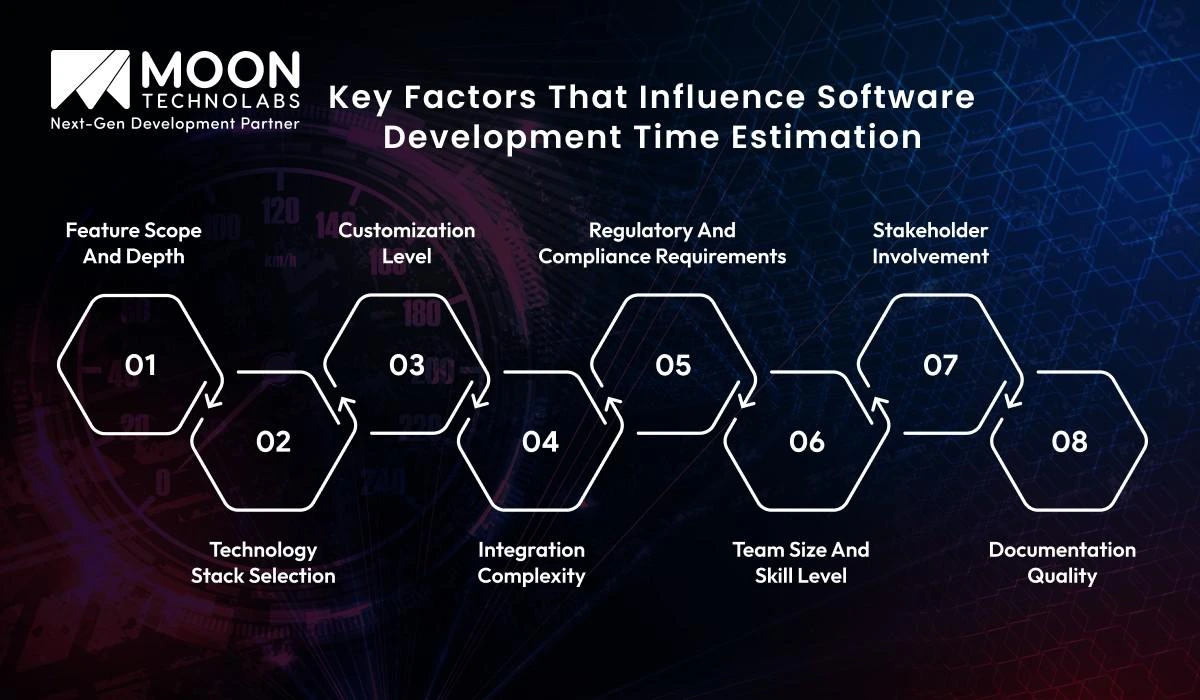
Several factors influence how long it will take to deliver the software project. By understanding these factors, your teams can calculate time estimates under real development conditions.
The total features and their complexity will directly define the development time. You can build a simple login system quickly. However, developing advanced workflows with automation can extend the timelines.
Technologies used for development can also impact estimation. If you use strong frameworks with a robust community backing, it can accelerate development. Subsequently, it will take additional research, setup, and testing time when using specialized technologies.
Using customized software increases design decisions, coding efforts, and testing cycles. On the other hand, off-the-shelf solutions can reduce development time.
Most modern applications rely on APIs, payment gateways, and external services for data flow. With each integration, you will introduce dependencies and compatibility challenges that can increase the development timeline.
Many modern applications rely on APIs, payment gateways, CRM systems, and other external services. Each integration introduces dependencies and potential compatibility challenges that may extend development and testing phases.
Several industries like healthcare, finance, and insurance call for strict compliance with the defined security and data protection standards. To ensure these, you need to spend time in validation, documentation, and audits.
Experienced teams can solve the technical challenges faster, releasing clean code. However, small and less experienced teams require additional time for troubleshooting and revisions.
With frequent feedback and clear decision-making, you can move forward with confidence. Delays occur when stakeholders are not involved in the loop.
A well-documented project scope offers clarity on requirements, workflows and tech expectations, letting the team estimate tasks accurately.
You cannot plan the timelines accurately till you have included the external factors in your estimation. Here are all the factors to consider.
Evolving requirements like new feature addition, shifting priorities or even the need for developers to revisit design and architecture can cause disruptions, extending timelines.
If your stakeholders take longer while to review designs, offer feedback or approve features, it can pause your development for a noticeable period.
If your app is dependent on an API or external system experiencing downtime, or compatibility issues, your development need needs some time to resolve these challenges.
Several technical issues like server limitations, hosting issues, and environment configuration appear late into the development or testing cycle. Your team needs extra time to resolve these issues properly.
Projects integrating with older systems face compatibility issues, outdated documentation, and limited flexibility. Your development team may face unexpected complexities when trying to resolve these issues, increasing the timeline.
If there is misalignment between the stakeholders and developers or project managers, it can cause misunderstandings, requiring revision and rework.
If the internal approvals for features, budgets, and design decisions are slow, it can disrupt your schedules.
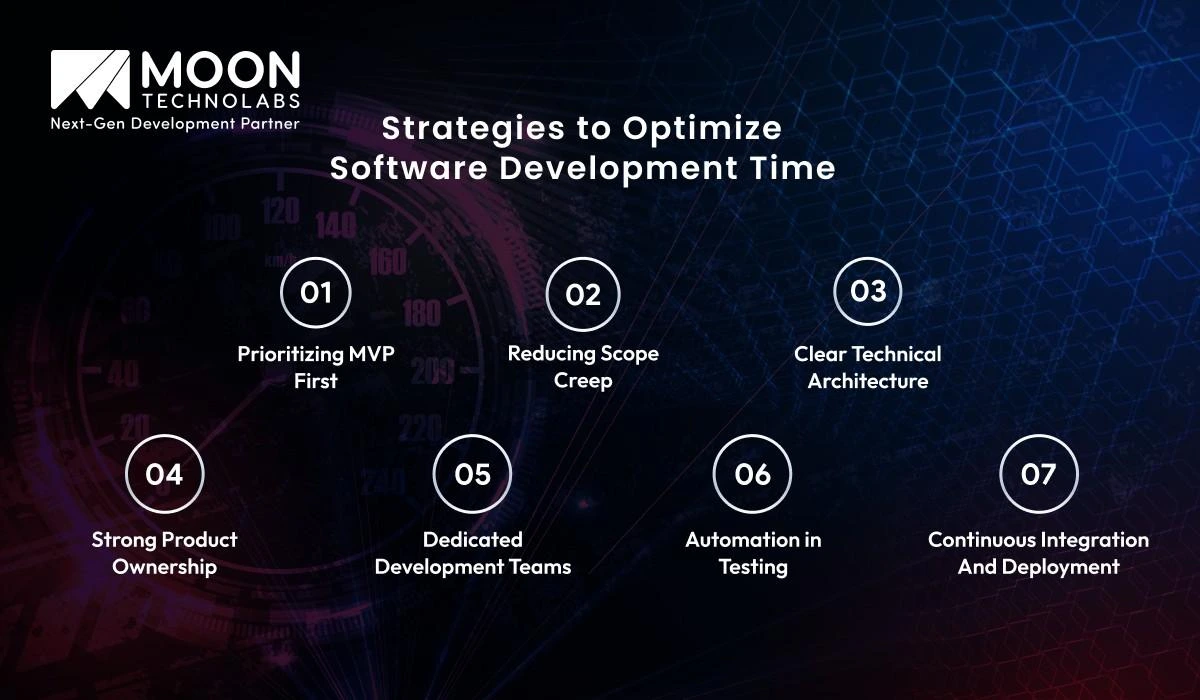
Here are all the strategies that help you build smarter processes that reduce delays and enhance collaboration to deliver real-value.
When you start with MVP, it will help your development team focus on the core functionality needed to launch the product. You can reduce development cycles, making them predictable by developing essential features first.
Timelines expand when you keep adding features to the application. With a stricter change management process, you can evaluate the requests before adding them to the development roadmap.
Using well-defined architecture gives your developers a stable foundation. That’s why you must ensure the system structure, frameworks, and infrastructure decisions are clearly defined in the early stages, to avoid rework.
Having a dedicated product owners will help speed up decision-making, establish clear requirements and maintain continuous collaboration, reducing delays and confusion.
With dedicated teams, you can ensure stronger collaboration between the developers and a better understanding. This reduces onboarding time and accelerates decision-making, enhancing efficiency.
Automating testing allows you to reduce time taken by repetitive validation tasks. It can also help find bugs faster, preventing delays in the QA phase.
CI/CD pipelines can help integrate code frequently while deploying updates efficiently. With this approach, you can minimize integration conflicts and accelerate releases.
| Project Type | Estimated Timeline | Typical Cost Range | Key Cost Drivers |
|---|---|---|---|
| Small Scale Projects | 2-8 weeks | Low | Basic features, minimal integrations |
| Mid-size Business Applications | 2-6 months | Moderate | Multiple modules with database complexity and UI/UX requirements |
| Enterprise Level Systems | 6-12+ months | High | Scalability, security, integrations, and large teams |
| SaaS Platforms | 4-10 months | Moderate-to-high | Multi-tenant architecture, subscription models |
| Custom Software Solutions | Varies widely | Variable | Unique requirements and customization depth |
Time and cost are very closely connected in software development. When the project takes longer while to complete, it can consume more resources like infrastructure, testing cycles, developer hours and even project management effort. However, it is important to note that the relationship isn’t always linear.
If it is a well-planned project with clear requirements, it can move faster compared to one with poorly defined requirements. Complexity can also impact both time and cost. Projects with advanced features and enterprise-grade scalability need more development hours and specialized teams. However, you will note lower timelines with controlled costs for a functionality-first project.
By understanding the balance between time and cost, you can plan your project well, keeping both budget and delivery expectations real.
Artificial intelligence is core to modern application development. Several businesses use AI for automation, personalization, smart decision-making and predictive analytics. Since AI models need data training, validation, and optimization, timelines are more complex than traditional development.
It takes a longer time than standard development to deliver an AI-powered application. It may take a few additional weeks to introduce basic AI features and several months to build advanced learning models. The timeline will depend on data availability, model training and algorithm selection.
With the ongoing improvement cycles, your models can be refined using new data, improving its accuracy and reliability. The AI development timelines include experimentation, validation, and continuous monitoring. That’s why AI projects are more iterative compared to conventional development.
Before you finalize the project timeline, you need a structured checklist that can validate assumptions and reduce estimation risks. This is the detailed estimation checklist founded on realistic conditions.
When your team understands the purpose, target users, and outcomes for the project clearly, they can prioritize the features and avoid unnecessary development work.
By evaluating the technical feasibility of the project, you can determine if the solution is practical with the chosen technologies. This step can help you find potential challenges at the start and prevent delays occurring due to unexpected technical limitations.
You need to consider the availability of your developers, designers, testers, and even project managers to finalize the time estimates. If your resources are limited or you have more priorities, it can increase the timeline even when the technical scope is manageable.
Every software project comes with its integration issues, performance concerns, and risks caused by evolving requirements. Identifying these risks can help you plan buffer time and mitigation strategies.
Consistent communication with stakeholders ensured expectations are fully aligned with business goals. As all teams agree on the scope, priorities, and milestones, projects can move forward without constant revisions.
Final timelines should consider deployment preparation, user training, and post-launch monitoring. Establishing release readiness allows your teams to transition smoothly from development to production without delays.
The accuracy of software time estimation depends on the experience and processes used by your software development partner. If you have a skilled development team, they know how to evaluate the requirements and break down projects into realistic timelines while determining potential risks. Owing to their experience across industries and technologies, they can anticipate challenges that you or a lesser experienced team might overlook.
The right partner brings to the table structured planning methods. They will follow proven frameworks during requirement analysis, sprint planning, and architecture design to refine estimates at every stage. Using this structured approach, you will note precision in timelines.
Moreover, strong communication is core to the experienced teams. This means they will share regular updates, gather feedback in the early stages, and address changes immediately. Consequently, there will be fewer misunderstandings and no delays.
The right development partner will not just help build software; they will create predictable timelines and reduce development risks to enhance efficiency throughout the process.
Work with an experienced team that prioritizes clear planning, realistic timelines, and efficient development to create reliable software solutions.
Software development time estimates are crucial in turning your idea into a successful digital product. Each development phase, from requirement analysis to design and development, influences the final project timeline. The project’s complexity, technology choices, and external variables also impact the actual delivery time. By understanding these elements, you can plan better, allocate resources effectively, and avoid delays that cause budget overruns.
Accurate estimation becomes easier when you work with an experienced development partner. The skilled team will bring forth structured processes, combined with technical expertise and proven planning methods, to improve timeline accuracy and project outcomes.
If you want to build reliable software without unexpected delays, you must partner with Moon Technolabs, a leading software development company. Connect with us to schedule a free consultation and take the first step to translate your idea into a software product.
01
02
03
04
05

Jayanti Katariya is the CEO of Moon Technolabs, a fast-growing IT solutions provider, with 18+ years of experience in the industry. Passionate about developing creative apps from a young age, he pursued an engineering degree to further this interest. Under his leadership, Moon Technolabs has helped numerous brands establish their online presence and he has also launched an invoicing software that assists businesses to streamline their financial operations.


Submitting the form below will ensure a prompt response from us.
We refine our expertise to deliver innovative business solutions.





500 N Michigan Avenue, #600, Chicago IL 60611
13500 Long Is Dr, Pflugerville, TX 78660, USA

C-105, Ganesh Meridian, S.G. Highway, Ahmedabad, GJ 380060


Ayse D.
Co-Founder France
“ I highly recommend Moon Technolabs as the quality of service is wonderful. We have hired this company to develop the product based on some complex & technical issues. We get the best quality services as compared with others in the market. Huge Thanks to Moon Technolabs as the team is always ready to give the solution all time.”

Justin G.
Founder & CEO USA
USA“ Moon Technolabs is a pioneer in the WebRTC based project as they have fixed complicated segments of the module by fulfilling different product lines by providing 24X7 customer support. We really recommended Moon Technolabs as they are able to develop products as per the module deadline and project timeline.”

Flavio S.
Founder & Managing Director Germany
“I am happy to recommend Moon Technolabs for their app development services. They successfully developed apps for me, and I am highly satisfied with the overall outcomes. The development team has swiftly addressed the issues with responsive and effective communication to understand the requirement quickly and actively resolve the back-and-forth problems that arose...”

Jay M.
Founder & CEOUSA“Moon Technolabs is the best company that provides advanced apps and websites development services in the USA and Europe. I am a newbie to develop my app with an external team. I am really happy to work with them as I am not that much mobile apps user. Here, the team and specially the CEO of Moon Technolabs helps me to let me know about the benefits of my app to generate revenue....”


Our Offices
India
C-105, Ganesh Meridian, S.G. Highway, Ahmedabad, GJ 380060USA
500 N Michigan Avenue, #600, Chicago IL 60611Contact Information


