
Jayanti Katariya
Last Updated: March 19, 2026 Total Views: 89
Table of Content


Blog Summary:
The guide highlights the detailed comparison of SAP ECC vs. SAP ERP S/4 HANA based on factors like database, architecture, data processing, user interface, deployment models, etc. It also explains why businesses prefer to move from SAP ECC to S/4 HANA, challenges in migration, etc. Keep reading on to select the best option for your business.
Table of Content
Most organizations struggle, especially when their business systems fail to communicate with each other. It causes data to be scattered across various departments, and employees rely extensively on disconnected spreadsheets. This slows operations and makes it difficult for businesses to obtain accurate, real-time data for decision-making.
An enterprise resource planning (ERP) system helps them overcome these challenges by integrating various processes into a single system. It enables organizations to improve their workflows and, in turn, their operational efficiency. SAP offers two platforms for this purpose – SAP ECC vs. SAP ERP S/4 HANA.
Though both platforms can manage vital business processes, they differ in speed, architecture, and technological capabilities. This makes a comparison between SAP ECC and SAP ERP S/4HANA necessary for businesses.
In this guide, we will gather in-depth comparisons of both platforms to help you make the right decision. Let’s explore further.
SAP ECC is a resource planning system for enterprises that helps integrate and manage their vital business operations. It can be easily linked to supply chain, finance, production, human resources, and procurement within a single platform. Organizations can use SAP ECC to tailor modules to their major operational requirements.
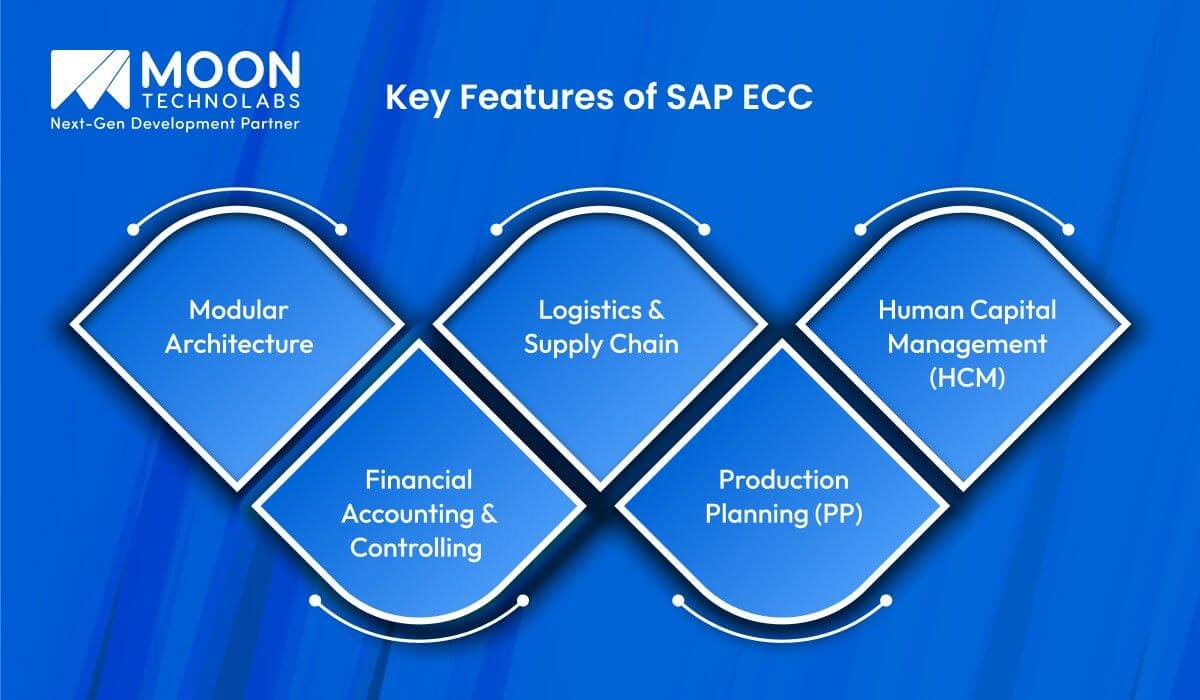
SAP ECC comes with a wide range of features to help organizations manage even complex business operations more efficiently. Let’s explore some of the features:
The major advantage of SAP ECC is that it’s divided into different functional modules. These support a variety of business processes such as supply chain, finance, human resources, and manufacturing. Therefore, it gives businesses the liberty to use only those modules they require.
Businesses can integrate those modules smoothly within a centralized system. The module design offers flexibility and allows organizations to scale their ERP environment as their operational requirements grow.
FI/CO modules are useful for organizations in managing their financial transactions. They can use these modules to maintain accurate accounting records while ensuring regulatory compliance.
These modules include features such as asset accounting, accounts payable/receivable, and general ledger management. These allow businesses to monitor their financial performance and gain real-time insights. It helps them make an informed decision.
SAP ECC includes modules such as materials management (MM) and sales & distribution (SD). These enable organizations to manage inventory control, procurement, distribution, and order processing.
This integration allows supply chain data to move smoothly between departments. It also helps businesses maintain optimal inventory levels, which boosts delivery speed and accuracy.
With the production planning module, manufacturers streamline their production workflows. This module also supports key tasks such as creating detailed production schedules, analyzing resource utilization, managing production orders, and ensuring consistent product quality. SAP ECC gives manufacturers operational control to reduce delays and increase overall productivity.
Human capital management enables businesses to manage processes efficiently when employees are directly involved. It supports various functions, whether it’s personal administration, payroll management, performance tracking, or workforce planning.
The HCM works better for organizations in redefining workforce management. Meanwhile, it also helps in fulfilling compliance with labor regulations and internal policies.
Developed on a SAP HANA in-memory database, SAP S/4HANA is a modern enterprise resource planning platform. It helps businesses by providing real-time data processing, simplified data management, and high-speed analytics.
It’s designed mainly to help businesses manage even complex operations efficiently. It allows organizations to integrate core business functions, including supply chain, finance, and manufacturing, into a unified system. SAP S/4HANA helps organizations to gain deeper insights and improve routine business processes.
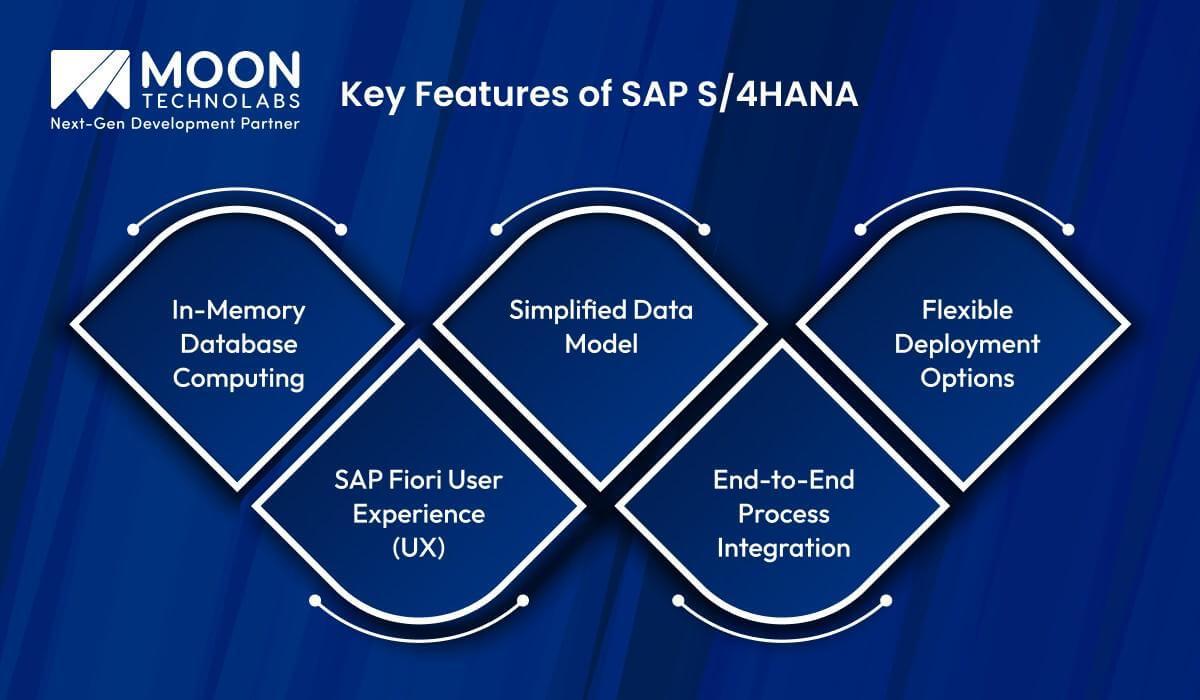
SAP S/4HANA boasts a range of next-generation features that make it a robust choice among businesses. The following are some of these features:
With its potential to process data directly in memory, SAP HANA enables organizations to perform even complex transactions and analytics in real time. It helps them create reports fast and analyze even the vast datasets quickly. It also helps them make decisions based on the data.
The SAP Fiori UX replaces the conventional SAP GUI with a responsive interface tailored to user roles. It can be easily accessed through tablets, desktops, and mobile devices.
SAP Fiori also redefines how users interact with business apps by offering easy navigation, a personalized dashboard, and improved workflows. It enhances the user experience, enables employees to complete routine tasks quickly, and reduces the learning curve.
SAP S/4HANA removes redundant tables and aggregates data into a single source of truth. It not only enhances system performance but also improves data processing.
Organizations get the flexibility to access information fast and accurately with a streamlined database structure. It also minimizes the maintenance effort required to manage enterprise data.
SAP S/4HANA connects the core business processes across supply chain, finance, manufacturing, procurement, and sales. This integration ensures that information flows smoothly across departments, improving teamwork and making operations more transparent.
It helps businesses gain a complete view of their operations and can improve workflows, reduce inefficiencies, etc.
With SAP S/4HANA, businesses have the freedom to implement it in various ways to meet their operational requirements and IT strategy. It supports cloud, on-premises, and hybrid deployment models, helping businesses select the best environment that matches their scalability and infrastructure requirements. This flexibility makes it convenient for organizations to transform their ERP systems.
You Might Also Like:
Understanding the major differences between SAP ECC and SAP S/4HANA helps businesses choose the platform that supports their digital transformation goals. Below is a brief comparison of SAP ECC vs SAP S/4HANA:
| Points of Differences | SAP ECC | SAP S/4HANA |
|---|---|---|
| Database | It works only with traditional databases such as IBM DB2, Oracle, and Microsoft SQL Server. | It’s developed mainly on SAP HANA in-memory database, which ensures fast data processing. |
| Architecture | It has a traditional ERP architecture accompanied by numerous tables and complex data structures | It comes with a simple architecture with a refined data model, with fast processing |
| User Interfaces | It mainly includes the traditional SAP GUI, which tends to be more complex and less intuitive. | It boasts a SAP Fiori that offers a role-based, modern, and responsive user interface. |
| Data Processing | It processes data with a disk-based system. | In this, in-memory computing ensures real-time data processing and faster analytics. |
| Deployment | It mainly depends on on-premises infrastructure, with limited flexibility. | It supports cloud, on-premise, and hybrid deployment. |
| Analytics Capability | For advanced analytics, a separate tool like SAP Business Warehouse is needed. | Embedded analytics ensure real-time insights directly within the ERP system. |
| Customization | It’s customizable but often requires a complex system modification and maintenance. | It fosters the standardized process with extensibility. |
| Security | It depends on traditional security frameworks yet offers enterprise-grade security. | It includes advanced security features, cutting-edge authentication methods, and improved compliance capabilities. |
| Support Lifecycle | It is set to limit mainstream support in the near future. | It’s committed to provide long-term support. |
We assist you in upgrading your current ERP system smoothly to boost operational efficiency and growth. Let’s unlock scalable enterprise performance.
Get Free Consultation Now
Now, we will delve into an in-depth comparison of SAP ECC vs. SAP ERP S/4 HANA. Below are some of the points to understand the actual differences between these two:
SAP ECC
It’s compatible with various traditional relational databases, including IBM DB2, Oracle, Microsoft SQL Server, etc. These systems primarily rely on conventional database processing and disk-based storage.
SAP S/4HANA
It’s developed mainly on SAP HANA, which processes data in memory rather than retrieving it from disk. This architecture effectively minimizes data retrieval time and boosts the efficiency of transactional and analytical operations. It allows businesses to process even a vast amount of data quickly.
SAP ECC
Since SAP ECC is a traditional ERP system, it requires separate processes for both transactions and analytics. These work effectively in slowing down data processing and reporting.
SAP S/4HANA
It reduces most delays by offering real-time data processing and fast system responses. It thus helps organizations produce reports quickly and analyze operational data without delays, improving decision-making with real-time insights.
SAP ECC
It leverages a more complex data structure, with multiple aggregate and index tables, to manage larger volumes of enterprise data. While this design works well in traditional database systems, it also increases system complexity and introduces additional maintenance issues.
SAP S/4HANA
It simplifies the data model by removing duplicate tables and also bringing various data structures into a single framework. This change reduces duplicate data entries, improves system efficiency, and helps businesses manage enterprise data easily.
SAP ECC
It mainly depends on the traditional SAP graphical user interface, which is complicated and not very intuitive for end users. The interface indeed necessitates vast training for employees to navigate multiple processes and modules.
SAP S/4HANA
It includes an advanced, responsive user interface powered by SAP Fiori. This interface indeed provides a role-based dashboard, mobile-friendly access, and personalized workflows. Through this system, employees can handle various business processes more efficiently, access real-time operational data, and interact with the system via a simpler interface.
SAP ECC
In this, a large number of business processes are divided across various systems and modules. These lead to operational inefficiencies.
SAP S/4HANA
It brings business processes together and helps organizations manage day-to-day operations efficiently while reducing manual work. These include supply chain, finance, procurement, manufacturing, and sales processes. As a result, teams can collaborate more across departments and increase overall productivity.
SAP ECC
In this environment, organizations mainly depend on various additional tools like SAP business warehouse for advanced analytics and reporting tasks. This separation between analytical and transactional systems increases complexity and slows the generation of insights.
SAP S/4HANA
SAP S/4HANA can integrate analytics into an ERP platform. It enables you to run real-time reports, quickly check operational data, and gain in-depth insights without requiring any separate analytics systems. Embedded analytics is essential to respond quickly to the changing market conditions.
SAP ECC
SAP ECC is indeed a great option for on-premise deployment. It helps organizations to maintain their IT resources and infrastructure properly.
SAP S/4HANA
It can be deployed in multiple ways, like private cloud, hybrid environments, and public cloud. This flexibility allows businesses to select the deployment option that is the best fit for their operational requirements and future goal plans.
SAP ECC
It includes strong security capabilities, such as data protection controls and role-based access control. At the same time, these features still rely largely on older security architectures that require additional customization to meet modern regulatory standards.
SAP S/4HANA
It strengthens security capability with enhanced data protection mechanisms, authentication methods, and robust compliance support. This aligns with emerging global regulations and security standards, which help you protect sensitive data and maintain regulatory compliance.
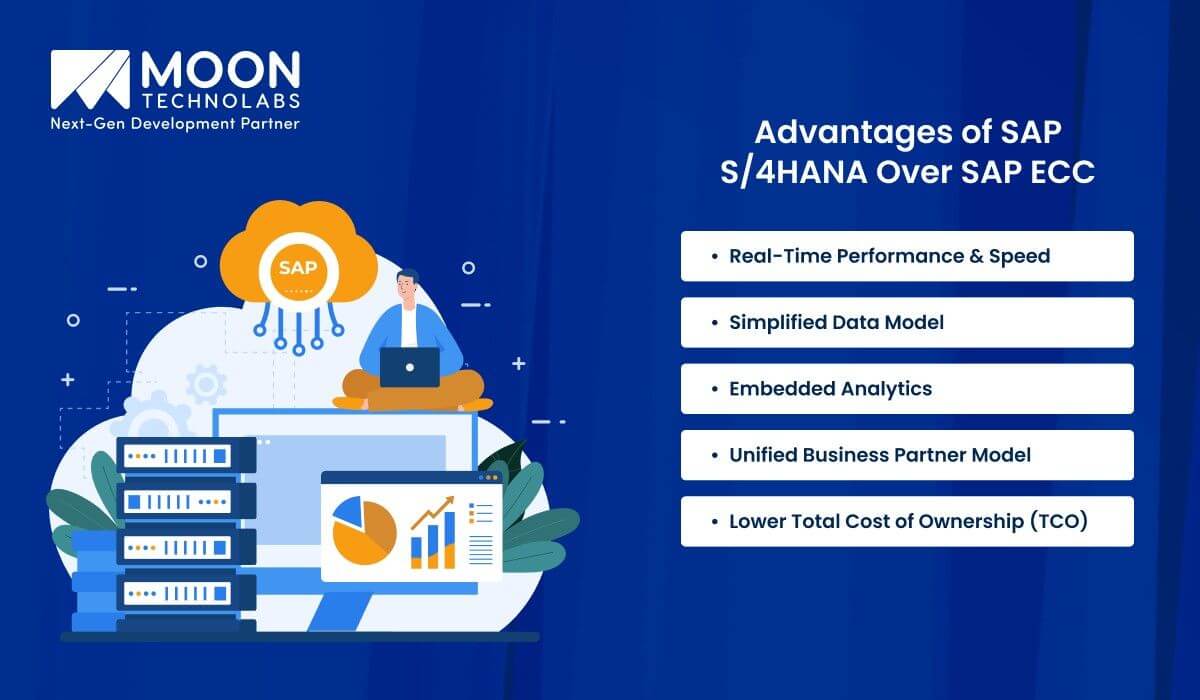
With advanced capabilities, SAP S/4HANA provides a range of benefits over its counterpart. Let’s discuss some of them as follows:
As we already discussed, SAP S/4HANA can process vast amounts of data in real time. So, it allows you to simplify complex analytics and transitions and run them smoothly, avoiding delays. Using this, you can also create fast reports and monitor operations in real time.
Another advantage of SAP S/4HANA is its simpler data structure compared to its predecessor. It minimizes database complexity and maximizes the overall system performance. It also minimizes the effort needed for data management and maintenance.
SAP S/4HANA comes with built-in analytics capabilities. Besides, it includes the capability to integrate analytics directly. By using this platform, you can get an overview of business data quickly and gather real-time insights. It doesn’t rely on any separate analytics environment.
SAP S/4HANA includes a business partner model that consolidates vendor and customer data into a single master record. In SAP ECC, these entities are managed individually, which leads to data duplication and inconsistencies.
On the other hand, SAP S/4HANA unifies this detail. It not only simplifies data management but also boosts data accuracy across business processes.
Thanks to the simple architecture of SAP S/4HANA, which minimizes data footprint and boosts system efficiency. It thus helps the organization to keep the overall cost of ownership to a minimum.
This platform requires minimal hardware and minimizes database maintenance. It also minimizes overall operational complexities. Over time, these kinds of efficiencies enable businesses to optimize IT investments while ensuring scalable enterprise growth.
Organizations nowadays frequently migrate from SAP ECC to SAP S/4HANA due to many reasons. These mainly include technological advancements and more agile, efficient operations. Let’s explore some other reasons:
Since SAP ECC has announced it will stop mainstream support in the coming days, this prompts the majority of businesses to migrate. Doing this helps organizations prepare for a complete transition, ensuring security patches and continued system updates. With migration, businesses can easily maintain a highly secure, well-supported ERP environment.
Since SAP S/4HANA includes in-memory computing capability, it enables fast data processing, real-time analytics, and improved system performance. And as we mentioned, this is crucial in preparing a report without spending too much time.
An improved user experience is another reason why businesses prefer to migrate to SAP S/4HANA. And as we already mentioned, this is possible mainly due to SAP Fiori. With a role-based and intuitive design, it enables staff to access personalized dashboards. Besides, they can do more tasks efficiently across a range of devices, including tablets, desktops, and smartphones.
SAP S/4HANA supports various emerging technologies and future business innovations. This platform integrates easily with modern capabilities, including Machine Learning (ML), Artificial Intelligence (AI), and advanced analytics.
This helps businesses to stay competitive. With a successful migration, they can create a future-ready digital core that supports scalable growth and continuous innovation.
Get our assistance to migrate to SAP S/4HANA with assurance of secure and smooth digital transformation. Start your journey with a proven migration strategy.
Talk to Our Experts
It can’t be denied that migrating to SAP S/4HANA brings numerous advantages. But it also involves many challenges as well. Let’s go through each challenge one by one:
Large enterprises accumulate vast amounts of data in their current SAP ECC systems over several years.
Solution: Before starting the migration process, they need to clean, validate, and organize the data while ensuring both consistency and accuracy. Always remember: poor-quality data slows migration efforts. It causes errors in the new system.
Most organizations customize SAP ECC extensively to match their specific business requirements. So, there’s a higher possibility that these custom programs and modifications may not be compatible with SAP S/4HANA.
Solution: Businesses need to check, modify, and remove outdated custom code before initiating the migration process.
You need to understand that not every SAP ECC functionality and third-party integrations align directly with SAP S/4HANA. Many legacy extensions and modules need a proper replacement or adjustments.
Solution: It’s necessary for you to determine your existing system landscape to check compatibility with advanced architecture.
ERP migration requires a heavy investment for skilled professionals, infrastructure, and system upgrades. So, organizations need to train their staff on the latest interfaces and tools. These factors indeed increase the overall cost and also resource requirements of the migration process.
Solution: You need to plan carefully with professional assistance to minimize costs.
You may struggle with your migration process without proper planning. You may encounter problems such as unexpected technical issues, delays, or operational disruptions.
Solution: All you need is a clear roadmap for a successful migration. Besides, you need to assess risks and collaboration among IT teams, implementation partners, and business stakeholders.
Well, migrating from SAP ECC to SAP S/4HANA is a strategic move. So, you need to make your final decision based on factors such as your business goals, system support timelines, and technical readiness. Let’s explore more situations when you need to decide on migration.
As announced, SAP ECC will be discontinued in 2027. After this deadline, businesses will face higher maintenance costs, potential security risks, and limited updates. So you can avoid all of these by migrating as early as possible.
As a large number of companies adopt SAP S/4HANA, demand for talented professionals such as consultants, developers, and implementation partners is rising. So, businesses that delay migration face significant difficulties in finding skilled professionals, especially during the transition. So, it’s essential to plan for securing the right expertise to ensure a successful migration.
Migration lets businesses take advantage of modern ERP capabilities such as enhanced automation, real-time analytics, a better user experience, and more. Besides, organizations can integrate emerging technologies and optimize operations in the most effective way.
ERP migration is indeed a complex process, as it involves data preparation, system analysis, employee training, and more. So, it’s important to start the transition process before the deadline, giving businesses enough time to manage these steps more effectively. It also reduces various operational risks even during the implementation.
After going through the detailed comparison of SAP ECC vs. SAP ERP S/4 HANA, you may have already decided on the right ERP module for your business, right? Your selection also depends on many factors, including an organization’s long-term digital strategy.
SAP ECC has long supported enterprise operations. On the other hand, SAP S/4HANA offers simplified data management, fast performance, and an outstanding user experience. To make the right decision, you can partner with an experienced provider like us.
01
02
03
04

Jayanti Katariya is the CEO of Moon Technolabs, a fast-growing IT solutions provider, with 18+ years of experience in the industry. Passionate about developing creative apps from a young age, he pursued an engineering degree to further this interest. Under his leadership, Moon Technolabs has helped numerous brands establish their online presence and he has also launched an invoicing software that assists businesses to streamline their financial operations.


Submitting the form below will ensure a prompt response from us.
We refine our expertise to deliver innovative business solutions.





500 N Michigan Avenue, #600, Chicago IL 60611
13500 Long Is Dr, Pflugerville, TX 78660, USA

C/105 Ganesh Meridian, S.G. Highway, Ahmedabad, GJ 380060


Ayse D.
Co-Founder France
“ I highly recommend Moon Technolabs as the quality of service is wonderful. We have hired this company to develop the product based on some complex & technical issues. We get the best quality services as compared with others in the market. Huge Thanks to Moon Technolabs as the team is always ready to give the solution all time.”

Justin G.
Founder & CEO USA
USA“ Moon Technolabs is a pioneer in the WebRTC based project as they have fixed complicated segments of the module by fulfilling different product lines by providing 24X7 customer support. We really recommended Moon Technolabs as they are able to develop products as per the module deadline and project timeline.”

Flavio S.
Founder & Managing Director Germany
“I am happy to recommend Moon Technolabs for their app development services. They successfully developed apps for me, and I am highly satisfied with the overall outcomes. The development team has swiftly addressed the issues with responsive and effective communication to understand the requirement quickly and actively resolve the back-and-forth problems that arose...”

Jay M.
Founder & CEOUSA“Moon Technolabs is the best company that provides advanced apps and websites development services in the USA and Europe. I am a newbie to develop my app with an external team. I am really happy to work with them as I am not that much mobile apps user. Here, the team and specially the CEO of Moon Technolabs helps me to let me know about the benefits of my app to generate revenue....”


Our Offices
India
C/105 Ganesh Meridian,S.G. Highway, Ahmedabad, GJ 380060USA
500 N Michigan Avenue, #600, Chicago IL 60611Contact Information


