
Jayanti Katariya
Last Updated: March 03, 2026 Total Views: 88
Table of Content


Blog Summary:
This blog post discusses restaurant digital transformation and its importance. It also outlines various steps, examples, trends, ideas, and expert tips. Read the entire blog to make the digital transformation of your restaurant successfully.
Table of Content
Imagine a scenario, it’s Saturday evening. Your restaurant is jam-packed with customers, online orders are increasing, your delivery partners are waiting for a long time, and your staff leaves no stone unturned to sync the multiple systems with every order. Every delayed order yields major complaints. And by the end, you are thinking about what went wrong.
Well, this is a common situation for most restaurants. This is where they can think about Restaurant Digital Transformation and redefine their operations to boost efficiency, improve customer experience, and increase ROI. Digital transformation brings vast growth opportunities for restaurants while enabling long-term growth.
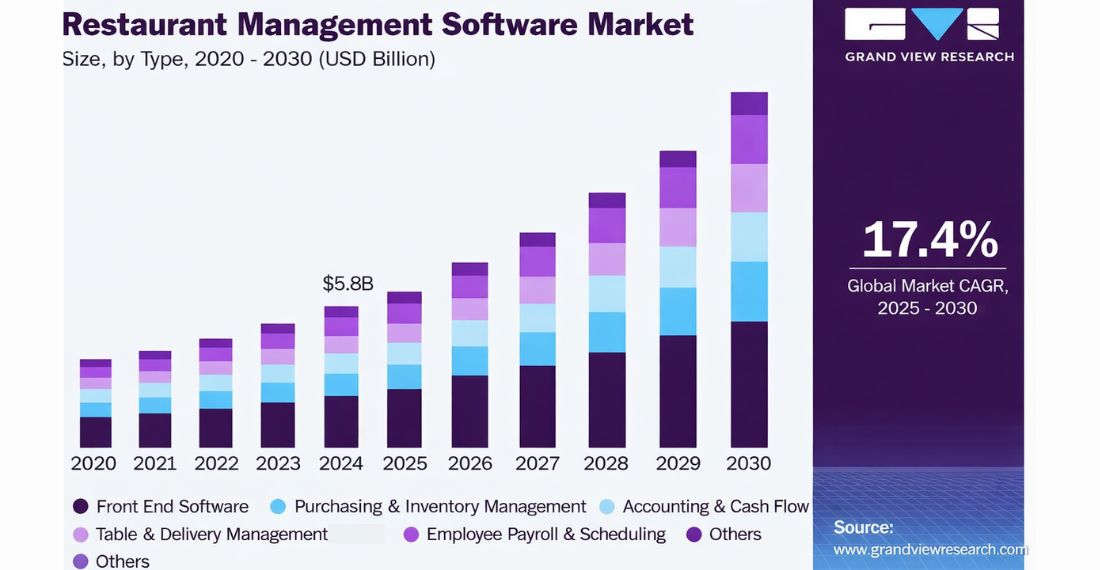
This has encouraged more restaurants to go for digital transformation. It also has a major impact on the restaurant management software market size, which is expected to grow at a CAGR of 17.4% (Grand View Research) from 2025 to 2030.
Meanwhile, the process of digital transformation is not only about adding software. But it’s about enhancing guest experiences, connecting operations, and building scalable & smart businesses. So, it requires a proper strategy and approach. We will discuss everything that helps you do it successfully. Let’s explore.
Restaurant digital transformation is a process of using cutting-edge technologies in its core operations. Its ultimate purpose is to improve customer experience, efficiency, and thus profitability. It’s much more than just adopting the latest tools.
The actual purpose of restaurant digital transformation is to redefine traditional workflows and align them with technologies to match evolving customer expectations. Digital innovation allows restaurants to minimize operational costs, streamline processes, and deliver personalized dining experiences.
Let’s explore various important elements of digital transformation:
With digital transformation, restaurants can enhance guest satisfaction, operational agility and remain competitive in the fast-evolving tech-based hospitality world.
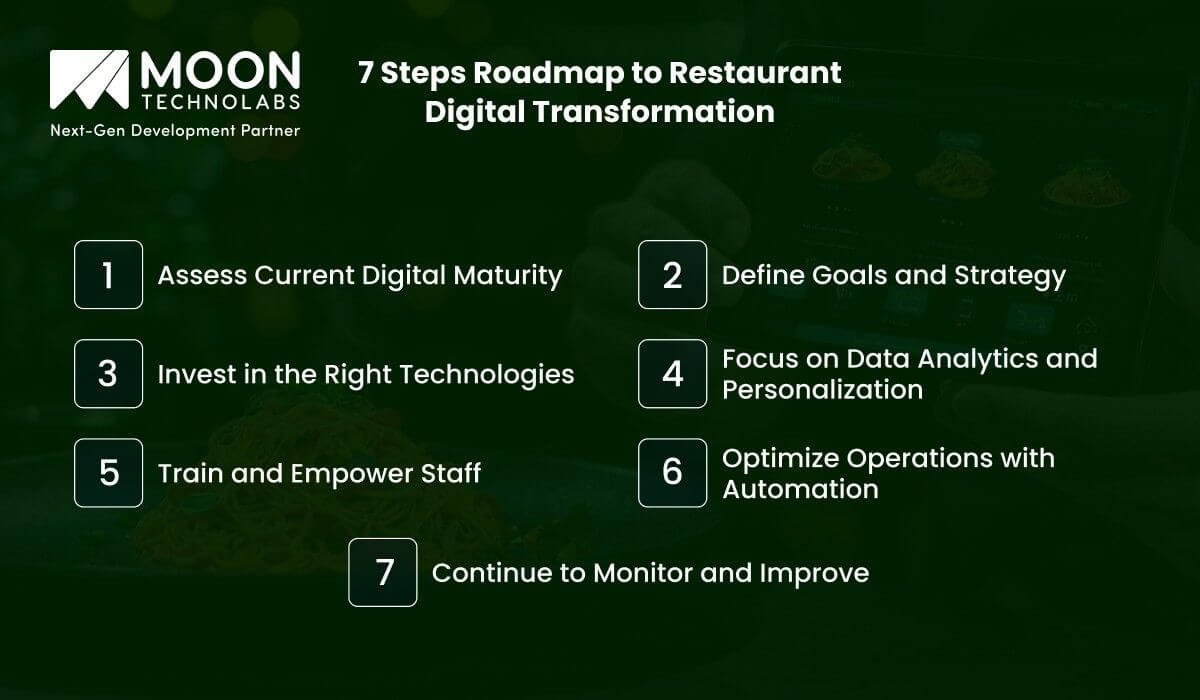
Restaurant digital transformation is a structured process that is carried out in multiple steps. The following are all those steps:
You can start the process by determining your existing technology landscape. You need to gather the system details in use. These can be inventory management, POS, accounting tools, CRM, online ordering, and more. Make sure you complete a thorough assessment of their scalability, integration capabilities, and performance gaps.
At this step, you also need to go through operational issues, customer feedback, etc. With a thorough digital maturity assessment, you get clarity on where you are and details on the areas that need a quick modernization.
You need to understand that digital transformation should be goal-specific. Make sure you have specific goals such as minimizing wait times, enhancing order accuracy, increasing customer retention, increasing online sales, or optimizing food costs.
It’s crucial to align these goals perfectly with a long-term digital strategy that offers complete business growth. Make sure you have a clear roadmap for technology investments to get measurable outcomes.
No matter what, technology selection is important for a successful digital transformation in the restaurant industry. It’s advisable to always go with cloud-based, scalable, and integration-friendly solutions that support emerging business requirements. It includes:
Right from customer preferences to peak-hour trends, restaurants generate vast volumes of data. You can convert this raw data into actionable insights by using analytics transforms.
It helps you analyze various purchasing patterns, loyalty programs, personalized promotions, and more. Besides, predictive analytics lets you forecast demand, optimize staffing schedules, and minimize food wastage.
Data-driven decision-making maximizes operational efficiency and improves customer satisfaction through personalized dining experiences.
Your technology adoption can be successful only when your staff uses new systems confidently. It’s essential to offer a structured training program that enables staff to become familiar with digital tools and their operational benefits.
It’s highly important to foster a softer collaboration between frontline and management teams during implementation. You need to address issues properly through transparent communication and hands-on support.
Employees who undergo proper training contribute significantly to fast service, smooth transitions, and improved customer interactions. It maximizes the actual value of digital investments.
Automation improves consistency and efficiency and minimizes manual errors. Restaurants can automate vendor management, inventory tracking, order processing, kitchen display systems, and staff management.
Smart automation is necessary for QR-based ordering, self-service kiosks, and AI-driven chatbots for reservations. These innovations are necessary to minimize dependence on manual processes while delivering a fast, accurate service experience. Operational automation also helps restaurants scale more efficiently, even without increasing overhead.
You should know that digital transformation is an ongoing process.
It means you have to keep an eye on everything, like what customers are saying, how well things are working, and if systems are running smoothly. Checking things regularly can help you find ways to improve them.
Updating and improving continuously is really important because technology is evolving rapidly. By being flexible and adaptable, you can keep up with market changes, customer wants, and new rules.
To make digital transformation work well, you need a plan and to keep optimizing. This helps you do things better, grow steadily, and stay ahead of others in your area. Digital transformation helps you achieve all this.
We modernize your restaurant operations by implementing advanced technologies. Let’s redefine your workflow, minimize costs, and boost customer experience.
Talk to Our Experts
From AI-based personalization to an outstanding dining experience, restaurants are doing everything to drive digital transformation. It helps them redefine operational efficiency and make their guest journey memorable. Let’s explore some of the important ideas, examples, and emerging trends that boost transformation in this niche:
Restaurants have been investing extensively in unified customer experience platforms of late. These integrate better payments, ordering, feedback systems, and loyalty programs into a single ecosystem. These platforms offer a seamless journey across takeaway, dine-in, third-party delivery, and mobile apps.
Whether it’s real-time table management, digital waitlists, or automated feedback collection, such platforms boost convenience while minimizing service friction. Restaurants find the possibility to maintain consistent brand experiences across various locations and touchpoints.
Artificial Intelligence (AI) contributes a lot to customer engagement. AI-based systems analyze dining frequency, customer purchase history, behavioral patterns, and preferences. These contribute a lot to delivering personalized offers and recommendations. It brings the possibility for restaurants to do the following things:
AI-powered personalization is necessary to maximize customer retention and thus average order value by providing a wonderful experience.
The introduction of smart kitchens has revolutionized back-of-house operations. It increases efficiency, maintains consistency, and minimizes food wastage. Some of the popular examples are as follows:
These technologies minimize manual errors, accelerate order fulfillment, and boost coordination between staff. Centralized monitoring offers standardization across multiple outlets for multi-location chains.
Online ordering is considered a major revenue channel for restaurants. Advanced ordering systems provide real-time menu updates, intuitive interfaces, loyalty rewards, and integrated payment gateways.
Restaurants nowadays also invest in progressive web apps (PWAs) and branded mobile apps to minimize reliance on third-party aggregators. Meanwhile, features such as subscription-based meal plans, scheduled ordering, and one-click reordering boost customer convenience.
While integrating with POS systems, it offers real-time order synchronization, preventing discrepancies and maximizing operational efficiency.
It goes without saying that catering and event services offer vast revenue-generating opportunities for businesses of all sizes, including mid-sized and large brands.
Digital transformation restructures everything, from quotation management to event booking to vendor coordination. A robust catering management software brings the following possibilities for restaurants:
With a centralized dashboard, you get visibility into operational planning, payments, and bookings, minimizing administrative workloads and improving service quality.
Customer relationship management (CRM) systems are quite essential for restaurants. It helps gather customer data from various sources, such as online ordering, POS, reservations, and loyalty programs. It consolidates these data into a unified database. Apart from this, a centralized CRM helps restaurants in the following ways:
The centralized platform also supports franchise models with standardized operations. It also ensures a localized marketing strategy.
The demand for a contactless experience is growing by leaps and bounds these days, as it significantly impacts customer expectations. It encourages restaurants to adopt contactless payments, QR-based menus, digital receipts, and self-order kiosks. These are essential to improve both safety and convenience.
The major advantage of a contactless solution is that it boosts order accuracy, minimizes wait times, and physical interaction, even without compromising service quality. Apart from this, digital payments also simplify accounting processes and minimize cash-handling risks.
To increase profitability, restaurants need to focus on resource optimization. And they can do it conveniently through digital transformation, which helps them in various ways, such as vendor performance, real-time inventory tracking, staff scheduling, and food costs. Advanced analytics tools offer the following important details:
With a comprehensive overview of predictive analytics, restaurants can minimize food waste, maintain healthy profit margins, and optimize procurement cycles. Besides, demand forecasting and automated low-stock alerts also boost operational agility.
Be it Augmented Reality (AR), Virtual Reality (VR), or 3D virtual tours, immersive technologies are nowadays considered to be the best tools for marketing and customer engagement. They provide an interactive experience that distinguishes your restaurant from others. The following are the uses of these technologies:
These technologies improve social media appeal, pre-dining engagement, create memorable brand impressions, etc. Though it’s still evolving rapidly, immersive solutions have gained widespread popularity across restaurants, whether they are experience-focused or premium.
Get our assistance to upgrade your restaurant business with digital transformation to boost customer experiences, improve operations, and increase profitability.
Schedule a Consultation Now
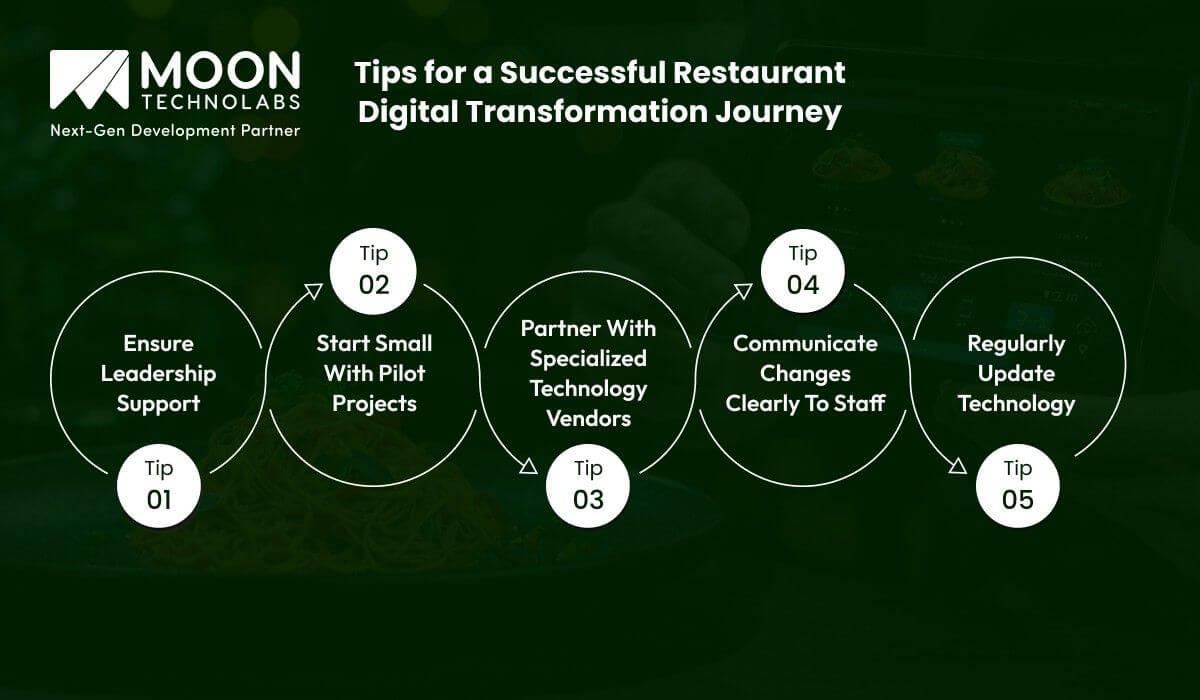
You need to understand that restaurant digital transformation is much more than just implementing technologies. It requires a perfect combination of strategy and technology to succeed. Let’s go through expert tips to make your digital transformation journey successful:
Every restaurant’s digital transformation starts at the leadership level, ensuring perfect alignment across multiple departments. It also helps minimize resistance and improve decision-making.
There’s a greater likelihood that the team will adopt new systems with confidence when management demonstrates a commitment to innovation. Apart from this, leadership is necessary to align digital investments with long-term growth strategies instead of short-term operational fixes.
It’s not a good decision to undertake a large-scale digital transformation of your restaurant at the start. Instead, you can initiate with a small or a controlled pilot project. This is indeed a perfect initiative that reduces the operational risks while offering important insights for optimization.
You can introduce the latest POS system or digital ordering solution in one branch to help refine workflows before an organization-wide deployment. This kind of phased approach provides a smooth transition and also highly predictable outcomes.
Selecting a reliable technology partner is pivotal for a successful transformation. It’s important for you to collaborate with experienced vendors who understand hospitality workflows, scalability challenges, and compliance requirements.
You can expect the following important things from a specialized technology partner:
A strategic partnership minimizes implementation complexity and ensures that digital solutions are better aligned with core business objectives. A trusted vendor is also necessary to make your investment future-proof by providing scalable platforms that scale as your restaurant business grows.
The next important thing you need to do is to communicate with your staff about changes. These include expected benefits, upcoming changes, training schedules, and more. These help minimize resistance and uncertainty.
You can boost your staff’s confidence through hands-on demonstrations, structured onboarding sessions, and ongoing support. It’s a great idea to gather feedback from frontline teams, as they often identify practical improvements even during implementation.
Once your employees are aware of how digital tools simplify workflows and boost customer experience, they can easily adopt innovation and thus contribute actively to making your operation successful.
Rather than a one-time initiative, digital transformation is an ongoing process. The fact is that technology evolves quickly, and outdated systems tend to limit efficiency and competitiveness.
It’s important for restaurants to determine system upgrades, conduct periodic performance reviews, and analyze emerging industry trends. Regular updates are necessary for security compliance, integration compatibility, and improved functionality with emerging platforms.
Restaurants can improve customer satisfaction, sustain operational excellence, and remain competitive through maintaining an agile mindset and optimizing digital infrastructure.
We understand the importance of restaurant digital transformation. Our team has extensive expertise in making it successful through proper planning, smooth integration, and strategic alignment. We have deep industry expertise and extensive engineering capabilities to deliver secure, scalable, and future-ready solutions for your restaurant.
We craft customized digital ecosystems tailored to match your specific restaurant model, right from POS systems to centralized management dashboards. We have a strong focus on data security, performance, and user experience.
Our team offers minimal operational disruption, smooth deployment, and continuous optimization. We promise to improve customer engagement, growth, and make your business digitally empowered.
Digital transformation has become quite essential for every restaurant to achieve sustainable growth. Since it’s a strategic move, you need to plan carefully to integrate the right technologies for the right purposes.
Make sure your restaurant’s digital transformation is properly aligned with your business goals and fosters a strong culture of innovation. Partnering with us makes your task easy and provides proper guidance through a proven strategy, implementation, and optimization.
01
02
03
04
05

Jayanti Katariya is the CEO of Moon Technolabs, a fast-growing IT solutions provider, with 18+ years of experience in the industry. Passionate about developing creative apps from a young age, he pursued an engineering degree to further this interest. Under his leadership, Moon Technolabs has helped numerous brands establish their online presence and he has also launched an invoicing software that assists businesses to streamline their financial operations.


Submitting the form below will ensure a prompt response from us.
We refine our expertise to deliver innovative business solutions.





500 N Michigan Avenue, #600, Chicago IL 60611
13500 Long Is Dr, Pflugerville, TX 78660, USA

C-105, Ganesh Meridian, S.G. Highway, Ahmedabad, GJ 380060


Ayse D.
Co-Founder France
“ I highly recommend Moon Technolabs as the quality of service is wonderful. We have hired this company to develop the product based on some complex & technical issues. We get the best quality services as compared with others in the market. Huge Thanks to Moon Technolabs as the team is always ready to give the solution all time.”

Justin G.
Founder & CEO USA
USA“ Moon Technolabs is a pioneer in the WebRTC based project as they have fixed complicated segments of the module by fulfilling different product lines by providing 24X7 customer support. We really recommended Moon Technolabs as they are able to develop products as per the module deadline and project timeline.”

Flavio S.
Founder & Managing Director Germany
“I am happy to recommend Moon Technolabs for their app development services. They successfully developed apps for me, and I am highly satisfied with the overall outcomes. The development team has swiftly addressed the issues with responsive and effective communication to understand the requirement quickly and actively resolve the back-and-forth problems that arose...”

Jay M.
Founder & CEOUSA“Moon Technolabs is the best company that provides advanced apps and websites development services in the USA and Europe. I am a newbie to develop my app with an external team. I am really happy to work with them as I am not that much mobile apps user. Here, the team and specially the CEO of Moon Technolabs helps me to let me know about the benefits of my app to generate revenue....”


Our Offices
India
C-105, Ganesh Meridian, S.G. Highway, Ahmedabad, GJ 380060USA
500 N Michigan Avenue, #600, Chicago IL 60611Contact Information


