
Jayanti Katariya
Last Updated: March 11, 2026 Total Views: 98

Table of Content


Blog Summary:
Private blockchains offer enterprises scalable and secure solutions, providing greater control over data and processes. These permissioned networks are perfect for businesses that require enhanced privacy and performance. In this blog, we explore the benefits of private blockchains, different types of private blockchain networks, the step-by–step development process, and key considerations for building secure, enterprise-grade Private Blockchain Development solutions that meet specific business needs.
Table of Content
Blockchain technology is a decentralized digital ledger that securely and transparently records transactions across multiple computers. Instead of relying on a central authority, blockchain networks enable participants to verify and store data collectively.
Each transaction is grouped into a block and linked to the previous one using cryptographic techniques, forming a continuous chain of records. This structure makes the data highly secure, transparent, and tamper-resistant. Blockchain is widely used in cryptocurrencies like Bitcoin and Ethereum, but its applications extend far beyond digital currencies.
Blockchain works through a distributed network of nodes that validate and record transactions using consensus mechanisms. When a new transaction occurs, it is verified by network participants and then added to a new block. Once confirmed, the block is permanently stored on the chain, making the information immutable.
Many blockchain platforms also support smart contracts, self-executing programs that automatically enforce agreements when predefined conditions are met. Enterprise frameworks such as Hyperledger Fabric enable businesses to build secure, permissioned blockchain networks for applications such as supply chain management, finance, and healthcare.
A private blockchain is a permissioned network with restricted access, often governed by a central authority or consortium. Unlike public blockchains, where anyone can join and participate, private blockchains restrict access to only authorized entities, who can validate transactions and access the network. This makes private blockchains ideal for organizations that require greater control, security, and privacy over their business operations.
These blockchains are commonly used in industries such as healthcare, finance, and supply chain management, where sensitive data must be protected, and compliance with regulations is crucial. They offer faster transaction speeds and greater scalability than public networks, as the number of participants is limited.
By using more energy-efficient consensus mechanisms, private blockchain solutions can provide a secure, transparent, and efficient environment tailored to meet the needs of enterprises seeking secure, scalable solutions.
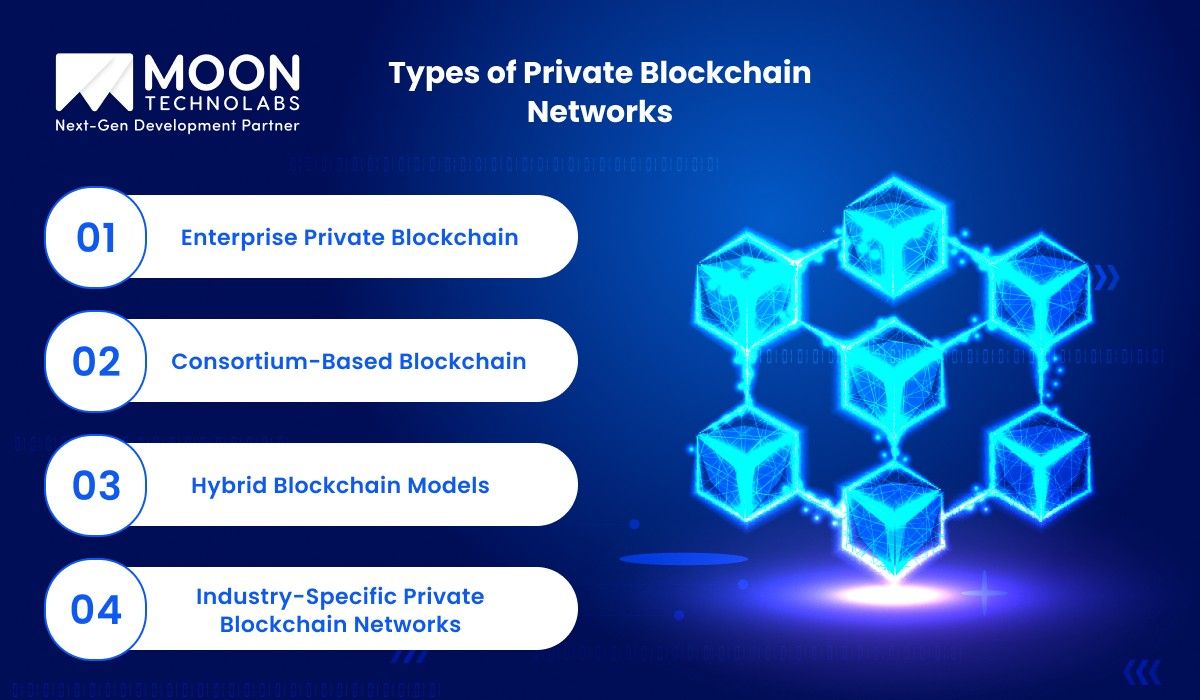
Private blockchain networks are designed to restrict participation to authorized users, ensuring greater control over data and transactions. Depending on organizational needs and levels of collaboration, these networks can be implemented in several forms:
A single organization controls an enterprise private blockchain. Only authorized users can access and validate transactions. Companies mainly use it to improve internal processes, security, and data management.
A group of organizations manages a consortium-based blockchain. Multiple participants share control of the network and validate transactions together. It is commonly used in industries like banking, supply chain, and logistics.
A hybrid blockchain combines features of both public and private blockchains. Sensitive data remains private, while some information can be shared publicly for transparency and verification.
These blockchains are designed for specific industries such as healthcare, finance, or supply chain. They help organizations securely share data, automate business processes, and improve efficiency.
Here are some major application types built on private blockchain technology that support secure data management and efficient collaboration among authorized participants:
Private blockchain helps track products at every stage of the supply chain, from production to delivery. It improves transparency, eliminates the chances of fraud, and enables businesses to monitor the movement of goods in real time. This helps businesses increase efficiency and build trust among suppliers, manufacturers, and customers.
Financial institutions use private blockchains to enable secure, faster transactions. It helps with payment processing, record-keeping, and fraud prevention. Private blockchain also reduces operational costs and improves transparency in banking operations.
A private blockchain enables authorized healthcare providers and hospitals to securely store and share patients’ medical records. It ensures data privacy, accuracy, and easy access for authorized medical professionals. This helps improve patient care and reduces the risk of data breaches.
A private blockchain is used to store and verify digital identities securely. Individuals can control their personal information, while organizations can quickly verify identity details. This reduces identity theft and improves security in online services.
Asset tokenization platforms use a private blockchain to convert real-world assets into digital tokens. Assets such as real estate, art, or commodities can be represented digitally, making them easier to trade, transfer, and manage. This increases liquidity and simplifies ownership management.
Private blockchain platforms are designed for enterprise and organizational use, where access to the network is restricted and controlled. Unlike public blockchains, private blockchains provide higher privacy, better scalability, and controlled participation. These platforms are commonly used in industries such as finance, supply chain, healthcare, and government systems.
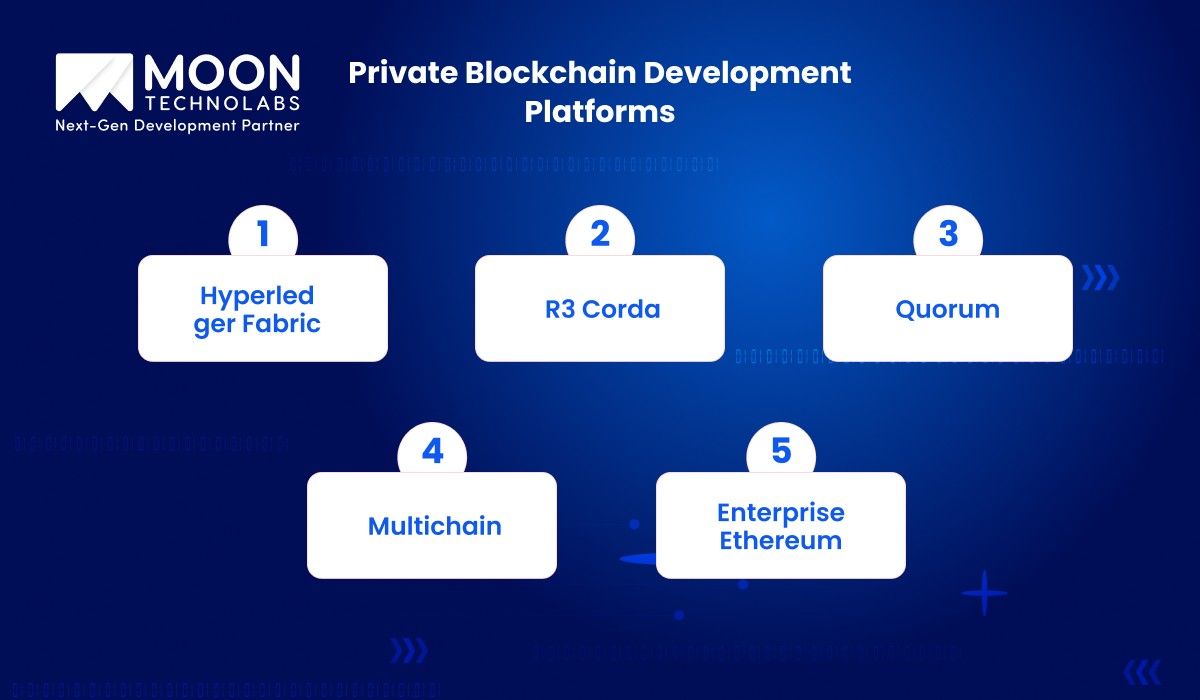
Some of the most widely used private blockchain development platforms are:
It is a permissioned blockchain platform developed by the Linux Foundation as part of the Hyperledger. It is designed for enterprise environments where participants are known and authorized.
The platform has a modular architecture that allows customization of components like consensus and membership services. It supports smart contracts called chaincode written in languages such as Java, Go, and Node.js. This platform also offers private channels for secure transactions, making it well-suited for industries such as healthcare, finance, and the supply chain.
R3 Corda is a distributed ledger platform developed by R3 mainly for financial institutions. It focuses on privacy by sharing transaction data only with the parties involved. The platform uses notary services to verify transactions and prevent double-spending.
Corda supports smart contracts written in Kotlin & Java, and can easily integrate with existing enterprise systems. It is widely used in banking, insurance, and trade finance.
Quorum is an enterprise blockchain platform originally developed by JPMorgan Chase based on the Ethereum protocol. It is designed for private & permissioned networks, and offers enhanced privacy and faster transaction processing compared to public Ethereum.
It also supports Ethereum smart contracts and tools, making it easier for developers to build enterprise blockchain applications, especially in the financial sector.
MultiChain is a platform that enables organizations to create and deploy private blockchain networks easily. It provides robust permission management, allowing administrators to control network activity.
MultiChain also supports the creation and transfer of digital assets & data streams for secure information sharing. It is commonly used for internal data management, asset tracking, and financial auditing.
Enterprise Ethereum refers to blockchain solutions based on the Ethereum protocol but adapted for business use. The Enterprise Ethereum Alliance supports it.
The platform offers permissioned access, improved privacy, and better scalability while remaining compatible with the public Ethereum network. It enables organizations to use smart contracts to automate processes across finance, the supply chain, and enterprise systems.
Our blockchain experts help you design and develop private blockchain solutions that improve transparency, security, and operational efficiency.
The following are some key benefits of private blockchain development that help organizations enhance security, improve efficiency, and maintain better control over their data and transactions:
One of the major benefits of private blockchain networks is that they restrict access to authorized participants, ensuring better control over confidential information. With permission-based access and powerful cryptographic security, organizations can protect data while maintaining transparency and immutability.
Private blockchains operate with a limited set of trusted participants and can use more efficient consensus mechanisms. This leads to faster transaction processing and better scalability for enterprise applications.
Private blockchain technology allows organizations to define roles, governance rules, and permissions within the network. This ensures that only approved participants can perform specific actions, providing both operational control and transparency.
By reducing reliance on intermediaries and automating processes through smart contracts, private blockchains help organizations lower operational costs and improve overall efficiency.
Private blockchain systems provide transparent and tamper-proof transaction records, making it easier for organizations to meet regulatory requirements across industries.
Developing a private blockchain requires careful planning, secure architecture, and continuous monitoring. Unlike public blockchains, private blockchain networks have controlled environments with restricted access to authorized participants.
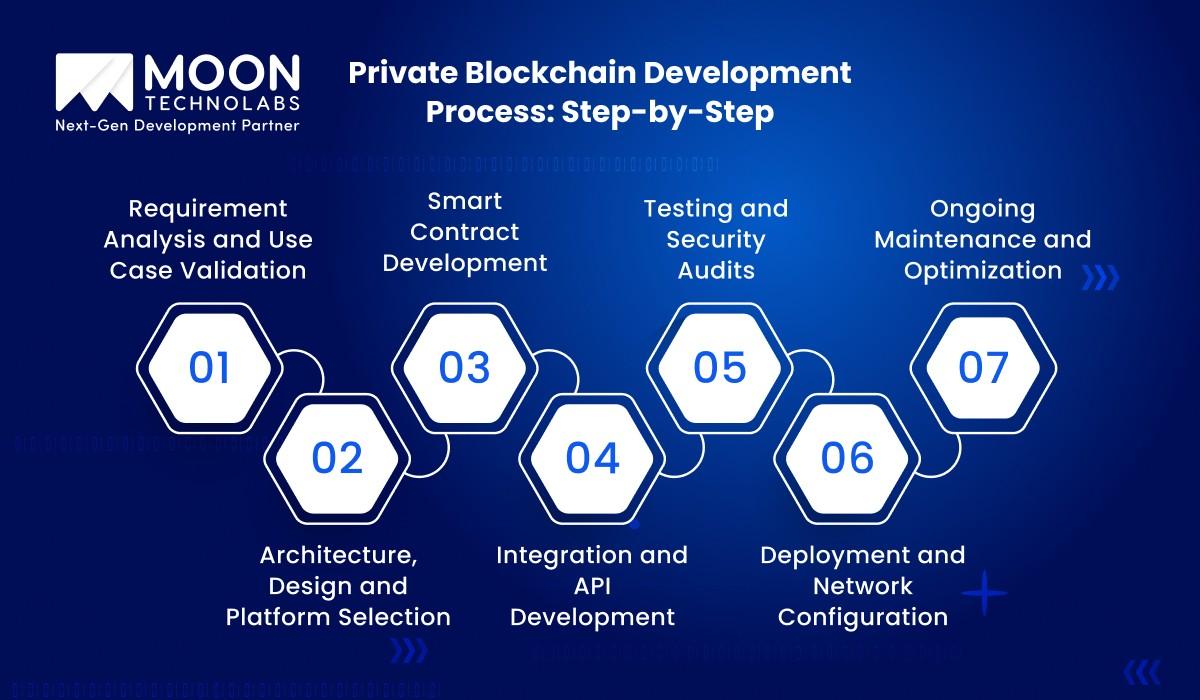
Below is a step-by-step process that most organizations follow when building a private blockchain solution:
The development process starts by identifying business requirements and evaluating whether blockchain is the right solution. Organizations analyze existing challenges, define project objectives, and determine which participants will have access to the private network. This step ensures the blockchain implementation aligns with real business needs.
In this stage, the overall blockchain architecture is designed. Developers choose the appropriate platform, define the network structure, and decide how nodes will communicate. Important factors such as consensus mechanisms, data privacy, and governance rules are also established to ensure visibility and efficiency.
Smart contracts are developed to automate processes within the blockchain network. These self-executing programs enforce predefined rules and agreements between participants. Proper development and optimization ensure the contracts run securely and efficiently.
To make the blockchain network useful in real-world applications, it must integrate with existing enterprise systems. APIs are developed to allow communication between the blockchain and external systems such as databases, ERP platforms, or web applications.
Before launching the system, thorough testing is conducted to ensure functionality, performance, and security. Blockchain developers test smart contracts, network operations, and potential vulnerabilities to ensure the system is reliable and protected from threats.
Once testing is complete, the blockchain network is deployed to production. Nodes are configured, smart contracts are deployed, and user access permissions are defined to ensure the network operates smoothly.
After deployment, continuous monitoring and maintenance are required. Regular updates, performance improvements, and security enhancements help keep the private blockchain network stable, scalable, and secure over time.
Private blockchain development cost and timeline can vary significantly depending on the project’s complexity, security requirements, and level of customization. Unlike public blockchains, private blockchains are designed for controlled access, making them ideal for enterprises that require enhanced privacy, performance, and governance.
Understanding the major cost drivers and development phases helps organizations plan budgets and timelines effectively:
The cost of developing a private blockchain largely depends on the network’s complexity and the features required. A basic private blockchain with limited nodes, simple smart contracts, and minimal integrations may cost between $20,000 and $50,000.
A medium-complexity blockchain network that includes custom smart contracts, role-based permissions, APIs, and enterprise system integration can cost between $50,000 and $120,000.
For highly customized enterprise blockchain solutions with advanced security, custom consensus mechanisms, multiple nodes, and complex integrations, development costs can range from $120,000 to $300,000 or more.
The timeline for developing a private blockchain typically ranges from 3 to 9 months, depending on the project scope. The process begins with requirement analysis and planning, which usually takes a few weeks to define the use case and technical architecture.
Next comes the design and development phase, where the blockchain network is built, smart contracts are created, and integrations are implemented. This stage often takes the majority of the development time.
Finally, testing and deployment ensure that the network runs securely and efficiently before it is launched for enterprise use.
After deployment, organizations must also account for ongoing maintenance and blockchain infrastructure expenses. These costs may include cloud hosting, security monitoring, updates, and technical support
Maintenance typically costs around 15% to 25% of the initial development cost per year, depending on the network size and required updates. Continuous monitoring and upgrades help maintain security, scalability, and long-term performance of the private blockchain network.
Private blockchains are permissioned networks where only authorized participants can access and validate transactions. They are commonly used by enterprises that require high-end security, controlled participation, and regulatory compliance. When developing a private blockchain, several important factors must be carefully planned to ensure performance, trust, and long-term sustainability:
A clear network governance structure is important in private blockchain development because it defines how the network is managed and how decisions are made among participants. It establishes roles, permissions, and rules for joining the network, resolving disputes, and implementing updates. Proper governance helps maintain transparency, accountability, and trust among all stakeholders.
Choosing the right consensus mechanism determines how transactions are validated and how agreement is achieved across the network. Private blockchains typically use efficient consensus protocols such as PBFT, Proof of Authority, or Raft because participants are known and trusted. The right mechanism improves performance, security, and transaction speed.
Smart contract security is essential because vulnerabilities can lead to system failures or financial losses. Developers must follow secure coding practices, conduct code audits, and thoroughly test contracts before deployment. Strong security measures ensure that smart contract capabilities execute reliably and safely.
Scalability and infrastructure planning ensure that the blockchain network can handle growing transaction volumes and user demands. Proper network architecture, node management, and scalable infrastructure help maintain performance and efficiency as the system expands.
Integration with legacy systems allows private blockchain solutions to work with existing enterprise applications such as ERP or CRM systems. Using APIs and middleware helps enable smooth data exchange, allowing organizations to adopt blockchain without replacing their current infrastructure.
Blockchain development costs can vary widely depending on the project’s requirements, technical complexity, and long-term goals. Businesses planning to build blockchain solutions must evaluate several factors that directly influence the total development budget.
Below are the key elements that determine the overall cost of blockchain development:
The more complex the blockchain structure, the higher the development cost. Functionalities such as custom consensus mechanisms, multi-layer networks, and scalability solutions require more time, resources, and expertise.
The platform used, such as Hyperledger or Corda, affects development cost. Each platform has different tools, programming requirements, and infrastructure needs, which influence both development time and hiring costs.
Smart contracts automate transactions on the blockchain. If the project requires complex logic, multiple contracts, or advanced functionality, the costs of development, testing, and auditing increase.
Strong security measures such as encryption, identity verification, and multi-signature authentication increase development costs. Compliance with industry regulations may also require additional development and auditing.
Integrating blockchain with current business systems, databases, and third-party APIs can increase development time and complexity, raising overall costs.
Experienced blockchain developers and longer development timelines increase project costs. Ongoing maintenance, updates, and monitoring also contribute to the total investment.
Partner with experienced blockchain developers to design and deploy secure, scalable private blockchain solutions tailored to your business needs.
Moon Technolabs offers expertise in blockchain development, providing custom solutions to enhance security, privacy, and control for decentralized systems. Our team of skilled developers uses cutting-edge technologies to build blockchain platforms tailored to businesses’ unique needs.
By creating private blockchains, we help clients maintain confidentiality, streamline processes, and reduce fraud risk. These private networks offer a secure and efficient way to manage transactions, making them ideal for various industries.
As a full-service blockchain development company, Moon Technolabs guides businesses through every phase of the blockchain lifecycle. We offer extensive end-to-end blockchain development services from initial concept and design to seamless deployment and ongoing maintenance.
With a strong emphasis on scalability, we ensure that each blockchain system grows alongside the client’s business. Be it integrating blockchain into existing systems or creating tailored smart contracts, we provide the tools businesses need to succeed in an evolving digital landscape.
Private blockchain development provides enterprises with enhanced security, scalability, and control over their data. It allows businesses to improve efficiency and reduce costs while ensuring transparency and trust in operations. To build a successful private blockchain solution, it’s essential to work with skilled professionals.
If you’re looking to implement blockchain technology, consider hiring blockchain developers who can help design, develop, and support a solution tailored to your needs. Our expertise can ensure a smooth and secure blockchain implementation for your business.
01
02
03
04
05

Jayanti Katariya is the CEO of Moon Technolabs, a fast-growing IT solutions provider, with 18+ years of experience in the industry. Passionate about developing creative apps from a young age, he pursued an engineering degree to further this interest. Under his leadership, Moon Technolabs has helped numerous brands establish their online presence and he has also launched an invoicing software that assists businesses to streamline their financial operations.


Submitting the form below will ensure a prompt response from us.
We refine our expertise to deliver innovative business solutions.





500 N Michigan Avenue, #600, Chicago IL 60611
13500 Long Is Dr, Pflugerville, TX 78660, USA

C-105, Ganesh Meridian, S.G. Highway, Ahmedabad, GJ 380060


Ayse D.
Co-Founder France
“ I highly recommend Moon Technolabs as the quality of service is wonderful. We have hired this company to develop the product based on some complex & technical issues. We get the best quality services as compared with others in the market. Huge Thanks to Moon Technolabs as the team is always ready to give the solution all time.”

Justin G.
Founder & CEO USA
USA“ Moon Technolabs is a pioneer in the WebRTC based project as they have fixed complicated segments of the module by fulfilling different product lines by providing 24X7 customer support. We really recommended Moon Technolabs as they are able to develop products as per the module deadline and project timeline.”

Flavio S.
Founder & Managing Director Germany
“I am happy to recommend Moon Technolabs for their app development services. They successfully developed apps for me, and I am highly satisfied with the overall outcomes. The development team has swiftly addressed the issues with responsive and effective communication to understand the requirement quickly and actively resolve the back-and-forth problems that arose...”

Jay M.
Founder & CEOUSA“Moon Technolabs is the best company that provides advanced apps and websites development services in the USA and Europe. I am a newbie to develop my app with an external team. I am really happy to work with them as I am not that much mobile apps user. Here, the team and specially the CEO of Moon Technolabs helps me to let me know about the benefits of my app to generate revenue....”


Our Offices
India
C-105, Ganesh Meridian, S.G. Highway, Ahmedabad, GJ 380060USA
500 N Michigan Avenue, #600, Chicago IL 60611Contact Information


