
Jayanti Katariya
Last Updated: January 23, 2026 Total Views: 529
Table of Content


Blog Summary:
Looking for an Odoo Alternative? Have a look at the best ERP solutions for growing businesses. Each option offers unique advantages, whether it’s scalability, customization, or an industry-specific solution. By exploring these alternatives, businesses can streamline operations, improve efficiency, and scale seamlessly, better equipped to meet the demands of growth and change. Find the perfect ERP fit for your business needs.
Table of Content
Choosing an ERP can seem overwhelming, especially if you must commit immediately despite uncertainty about its long-term value and fit. Months into the commitment, you might realize that the system you implemented is either underpowered or silently consuming budget due to workarounds.
It is equally possible that your teams are still struggling to embrace the ERP while team leaders lack guaranteed visibility. In such cases, even simple processes start to feel complex. ERP regret is a common occurrence.
That’s where the strong, flexible options available across different growth stages and industries come in. Now, you don’t need to force your business to fit into a tool that doesn’t acknowledge your needs.
In this blog, we will explore alternatives to Odoo to help you determine which option best fits your business and how to make the right choice.
Odoo is an open-source ERP platform that allows your business to connect and communicate easily without juggling different disconnected tools. For instance, you would switch between sales, inventory, and HR tools to gain complete visibility into your business. With Odoo, you can access all the functions in one place.
The biggest advantage of this ERP is the modular setup. You don’t need to invest in all modules at once; start with the ones that matter most to you, then add the others as your business needs evolve.
The core modules for Odoo ERP include CRM, sales, advanced accounting, manufacturing, human resources, project management, inventory, and e-commerce. When you begin using Odoo, you realize it offers streamlined order processing, improved visibility across all departments, and fewer manual handoffs.
If you are a growing business, Odoo can provide a flexible foundation rather than a rigid system. However, the flexibility of the ERP depends on its configuration and maintenance. This means you must continually evaluate whether the ERP is a fit for your business and identify your business’s true needs.
Odoo ERP is a popular choice for growing businesses because it offers flexibility without forcing you into an all-or-nothing system. The structure it offers allows you to scale your ERP at your own pace while maintaining connected operations.
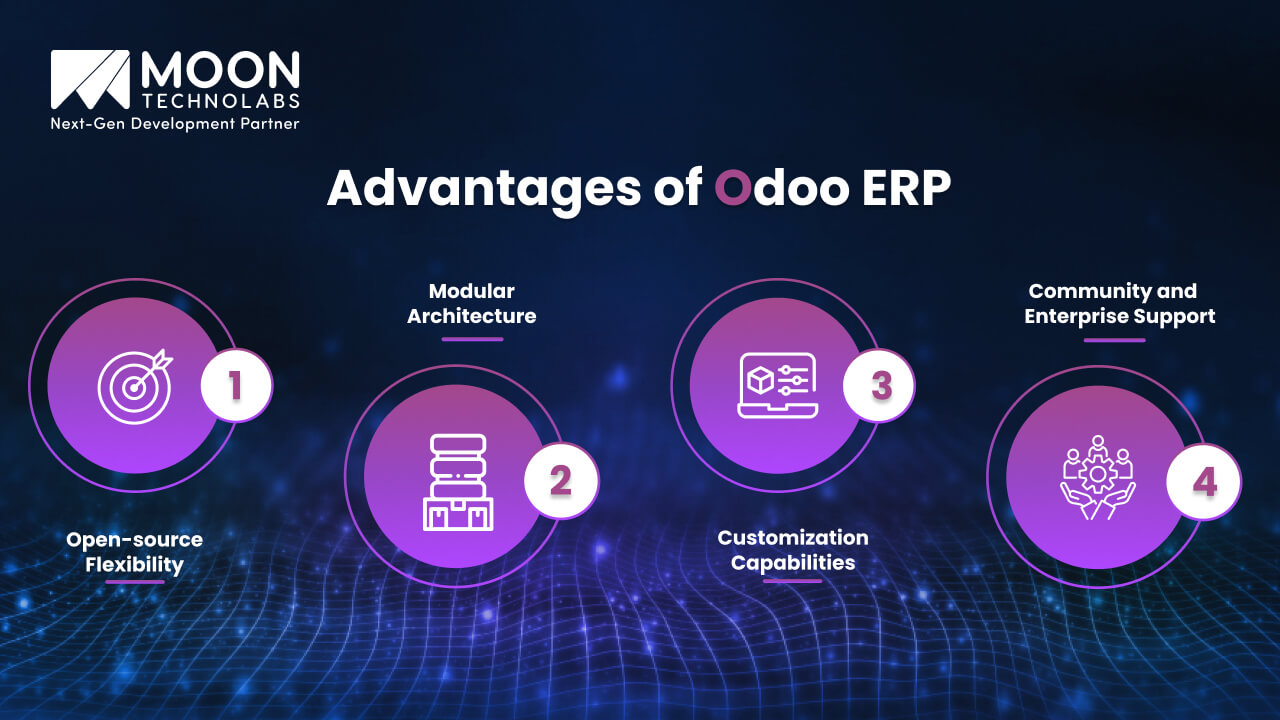
With Odoo’s open-source approach, you get more control compared to traditional ERPs. You aren’t locked into a single vendor’s roadmap, upgrade cycle, or licensing model. Consequently, you can easily customize the model to your evolving needs without building anything from scratch.
The modular architecture is its differentiating factor. This allows you to start small, with one or two core functions, such as CRM or accounting. Once you are comfortable with Odoo, you can gradually add modules such as HR or eCommerce as needed. At the same time, you will pay for and manage what you actually use.
You can create custom workflows, reports, and integrations that align with your business needs, as Odoo is customizable. This makes it ideal for companies that hold unique processes. You should plan the implementation properly in this case.
A large global community and ecosystem support Odoo, enhancing its features and apps. Odoo Enterprise is a strong addition, as it includes security updates and long-term stability, which is important for businesses that require SLAs for reliability.
Compare top ERP platforms, including Odoo alternatives, to find the solution that reduces complexity and boosts efficiency while staying on budget.
If you are evaluating ERP platforms other than Odoo, you should consider these alternatives. They offer numerous advantages, such as focus, deployment flexibility, and ease of use. Let’s look at each of these options individually.
SAP Business One is an excellent Odoo alternative for small and mid-sized businesses. It offers a more structured ERP without added complexity. You can manage all functions, including sales, inventory, purchasing, manufacturing, finance, and compliance reporting, from a single system.
It supports both cloud and on-premises deployment and includes strong analytics and compliance features. If you need process control with long-term stability and data accuracy, rather than customization or rapid change, this is the best option.
This is your cloud-first ERP built for fast-growing, globally distributed businesses. You can consolidate financial management, inventory, order processing, multi-entry consolidation, and CRM solution into a single platform.
It offers real-time visibility across all currencies and subsidiaries. As a cloud-based solution, this Odoo alternative is the best fit for organizations that need scalability, standardized processes, and robust financial governance. With this ERP, you can easily reduce infrastructure management and manual reporting overhead as you expand operations.
This is one of the top Odoo alternatives, combining ERP and customer relationship management capabilities and offering deep integration with Microsoft’s ecosystem. This ERP supports diverse workflows across finance, supply chain, sales, and operations, and provides excellent customer support and service.
The ERP integrates well with Excel, Teams, Outlook, and Power BI, and is available in both cloud and hybrid deployments. As a result, it is a powerful alternative for enterprises and medium sized businesses that already use Microsoft tools and need flexibility while maintaining familiarity.
This open-source ERP is directly compared with Odoo, which is known for its simplicity and transparency. This solution provides all core functions, including accounting, CRM, inventory, manufacturing, payroll, and HR. It is easy to implement and highly cost-effective, supporting both on-premises and cloud deployments.
ERPNext is the best Odoo alternative for small businesses, delivering value to your workflows while reducing ownership costs and minimizing customization. Additionally, it provides full control over the ERP system.
Zoho ERP is a tightly integrated cloud-based business application suite. It covers all aspects of your business, including accounting software, CRM, inventory, analytics, HR, and automation. Zoho delivers fast deployment with minimal technical effort, making it affordable and usable.
As a strong Odoo alternative for SMBs and startups, it offers simplicity, seamless integration, and rapid scalability without the added complexity of traditional enterprise ERP solutions.
This modern ERP, specifically designed for mid-sized businesses, is an excellent Odoo alternative. It supports your business growth by enabling you to manage distribution, financial management, manufacturing, project accounting, and customer relationships in a single system.
The usage-based pricing is the standout feature. It is available to your business through cloud and private-cloud deployments. This ERP system is ideal if you need scalability, flexible access, and predictable costs without increasing licensing needs.
This best Odoo alternative is designed for mid-sized and large businesses with complex operational requirements. It provides robust functionality for the finance, manufacturing, supply chain, and compliance management departments.
You can get both on-premises and cloud deployments, enabling the ERP to support multi-entry and multi-country business operations. It is the best fit for organizations that require operational control, structured workflows, and industry-backed capabilities. Moreover, if you have outgrown entry-level ERPs and need deep control over functions without the full complexity of an enterprise system, choose Sage X3.
Suppose you want an industry-focused ERP designed for enterprises that need systems aligned with their sector’s operations. Infor CloudSuite is for you. It isn’t another generic ERP setup. You get preconfigured solutions for industries including manufacturing, healthcare, retail, and distribution.
It offers core features, including financial management, supply chain planning, and asset management, to streamline operations. As a cloud-first platform, this Odoo alternative reduces the need for extensive customization by embedding industry best practices. No wonder it is the best fit for organizations that have specific operational needs.
This cloud-native enterprise platform prioritizes human capital and financial management over an end-to-end ERP. It includes advanced features such as HR, payroll, talent management, analytics, financial reporting, and workforce planning.
With its intuitive user interface and strong compliance capabilities, Workday is used by large and global organizations. It may lack deep inventory and manufacturing features, but it is a strong alternative to Odoo for businesses that prioritize financial visibility and strategic decision-making over supply chain management.
This is a lightweight, open-source ERP and CRM, designed specifically for small businesses, early-stage startups, and freelancers. It offers essential features, including invoicing, customer management, inventory tracking, and basic accounting. You can easily deploy this ERP on-premise as well as on the cloud.
This ERP system prioritizes simplicity over depth, making it suitable for teams that need a low-cost, no-frills ERP. It ensures quick setup with minimal configuration, without the overhead and complexity of large, traditional ERP systems.
| ERP Platform | Best for | Core Strengths | Deployment | Why Odoo Alternative? |
|---|---|---|---|---|
| SAP Business One | SMBs that need structure | Strong financials, reporting, and compliance | Cloud and On-premise | Prefer standardized processes instead of customization |
| Oracle NetSuite | Fast-growing global firms | Scalability and multi-entity finance | Cloud only | Global consolidation and real-time financial visibility |
| Microsoft Dynamics 365 | Microsoft-centric business | ERP & CRM with Microsoft integrations | Cloud and Hybrid | Seamless integrations with Microsoft tools |
| ERPNext | Small businesses and startups | Open-source and simple | Cloud and on-premise | Simple, low-cost, and open-source ERP |
| Zoho ERP | Service-based SMBs | Ease of use and affordability | Cloud-first | Fast deployment with minimal complexity |
| Acumatica | Growing & mid-sized businesses | Usage-based pricing with flexibility | Cloud or Private Cloud | Scale users without the licensing constraints |
| Sage X3 | Manufacturing and distribution | Deep operational control | Cloud and on-premise | Needs stronger manufacturing and compliance depth |
| Infor CloudSuite | Industry-specific business | Pre-built workflows for industries | Cloud | Prefers industry-backed ERP software |
| Workday | Large enterprises | HR, finance,ce, and analytics | Cloud only | Prioritizes people operations and financial planning |
| Dolibarr | Micro businesses | Lightweight and open source | Cloud and On-premise | Needs a basic ERP without complexity or costs |
Odoo is a flexible and powerful ERP platform, but it may not be a perfect fit for all business types or needs. Several challenges impact adoption, cost, and long-term efficiency.
The ERP’s flexibility can become a double-edged sword. If you want to tailor the ERP to meet your unique business needs, you need extensive tech expertise. In the absence of skilled developers, customizations can become difficult to implement or maintain.
Odoo’s licensing is affordable; however, the total cost of ownership can increase quickly. From implementation through ongoing support to custom development, each step will increase the budget. This is especially true for companies that have complex workflows or large teams.
As your business grows, you will notice an increase in the transaction volume. If you don’t optimize the system properly, Odoo ERP can experience performance slowdowns. If you are incorporating large datasets and multi-user operations, you may need additional infrastructure or technical tuning.
Despite its modern interface, it can be overwhelming, especially for non-technical members. Training is essential to help your users navigate modules and manage workflows efficiently.
Many businesses rely on external modules to extend their functionality. While this is great, it can introduce compatibility issues and inconsistent quality, or pose upgrade risks.
Choosing the best alternative to Odoo isn’t just about picking another popular ERP; it is about finding the system that fits your business needs and processes perfectly. The right choice depends on your company’s size, future growth plans, operational complexity, and budget.
If you are a small or mid-sized business that prioritizes structure and compliance and relies on reliable reporting, SAP Business One is a great option. For fast-growing, multi-entity businesses that need real-time financial visibility, Oracle NetSuite stands out.
As a business already using Microsoft tools, Microsoft Dynamics 365 is an easy choice, as it integrates with Excel, Teams, and Power BI. If you prioritize cost, simplicity, or transparency, you should choose ERPNext or Dolibarr, as they are practical options.
For service-focused SMBs, Zoho ERP delivers fast deployment and ease of use. Infor CloudSuite and SageX 3 are strong options if you have industry-specific needs, such as manufacturing or distribution.
The best alternative to Odoo is the one that best fits your current needs while allowing you to grow without unnecessary complexity.
Partner with our team to access expert advice, compare key features, and get actionable insights to make the right ERP choice.
Choosing the right ERP can be overwhelming, especially when these Odoo alternatives promise flexibility, scalability, and efficiency. You must find a solution that fully aligns with your business processes, growth plans, and team capabilities without increasing the cost or complexity.
While Odoo offers exceptional features, it also entails significant customization requirements, a steep learning curve, and reliance on third-party modules. It may or may not suit your business. That’s why it is essential to explore alternatives that fit your business needs and growth requirements.
At Moon Technolabs, an experienced Odoo development company, we help growing businesses assess, implement, and optimize their ERP systems for smooth operations and measurable results—partner with us to find the right ERP solution that scales with your business.
01
02
03
04
05

Jayanti Katariya is the CEO of Moon Technolabs, a fast-growing IT solutions provider, with 18+ years of experience in the industry. Passionate about developing creative apps from a young age, he pursued an engineering degree to further this interest. Under his leadership, Moon Technolabs has helped numerous brands establish their online presence and he has also launched an invoicing software that assists businesses to streamline their financial operations.


Submitting the form below will ensure a prompt response from us.
We refine our expertise to deliver innovative business solutions.




500 N Michigan Avenue, #600, Chicago IL 60611
13500 Long Is Dr, Pflugerville, TX 78660, USA

C/105 Ganesh Meridian, S.G. Highway, Ahmedabad, GJ 380060


Ayse D.
Co-Founder France
“ I highly recommend Moon Technolabs as the quality of service is wonderful. We have hired this company to develop the product based on some complex & technical issues. We get the best quality services as compared with others in the market. Huge Thanks to Moon Technolabs as the team is always ready to give the solution all time.”

Justin G.
Founder & CEO USA
USA“ Moon Technolabs is a pioneer in the WebRTC based project as they have fixed complicated segments of the module by fulfilling different product lines by providing 24X7 customer support. We really recommended Moon Technolabs as they are able to develop products as per the module deadline and project timeline.”

Flavio S.
Founder & Managing Director Germany
“I am happy to recommend Moon Technolabs for their app development services. They successfully developed apps for me, and I am highly satisfied with the overall outcomes. The development team has swiftly addressed the issues with responsive and effective communication to understand the requirement quickly and actively resolve the back-and-forth problems that arose...”

Jay M.
Founder & CEOUSA“Moon Technolabs is the best company that provides advanced apps and websites development services in the USA and Europe. I am a newbie to develop my app with an external team. I am really happy to work with them as I am not that much mobile apps user. Here, the team and specially the CEO of Moon Technolabs helps me to let me know about the benefits of my app to generate revenue....”


Our Offices
India
C/105 Ganesh Meridian,S.G. Highway, Ahmedabad, GJ 380060USA
500 N Michigan Avenue, #600, Chicago IL 60611Contact Information


