
Jayanti Katariya
Last Updated: January 02, 2026 Total Views: 1238
Table of Content


Blog Summary:
Mexico is known for its thriving ecosystems for world-class mobile app development, which ensures great collaboration with experienced and adroit professionals. This is the reason why businesses prefer Mexico when it comes to nearshore mobile app development. Let’s explore more about nearshore mobile app development in Mexico.
Table of Content
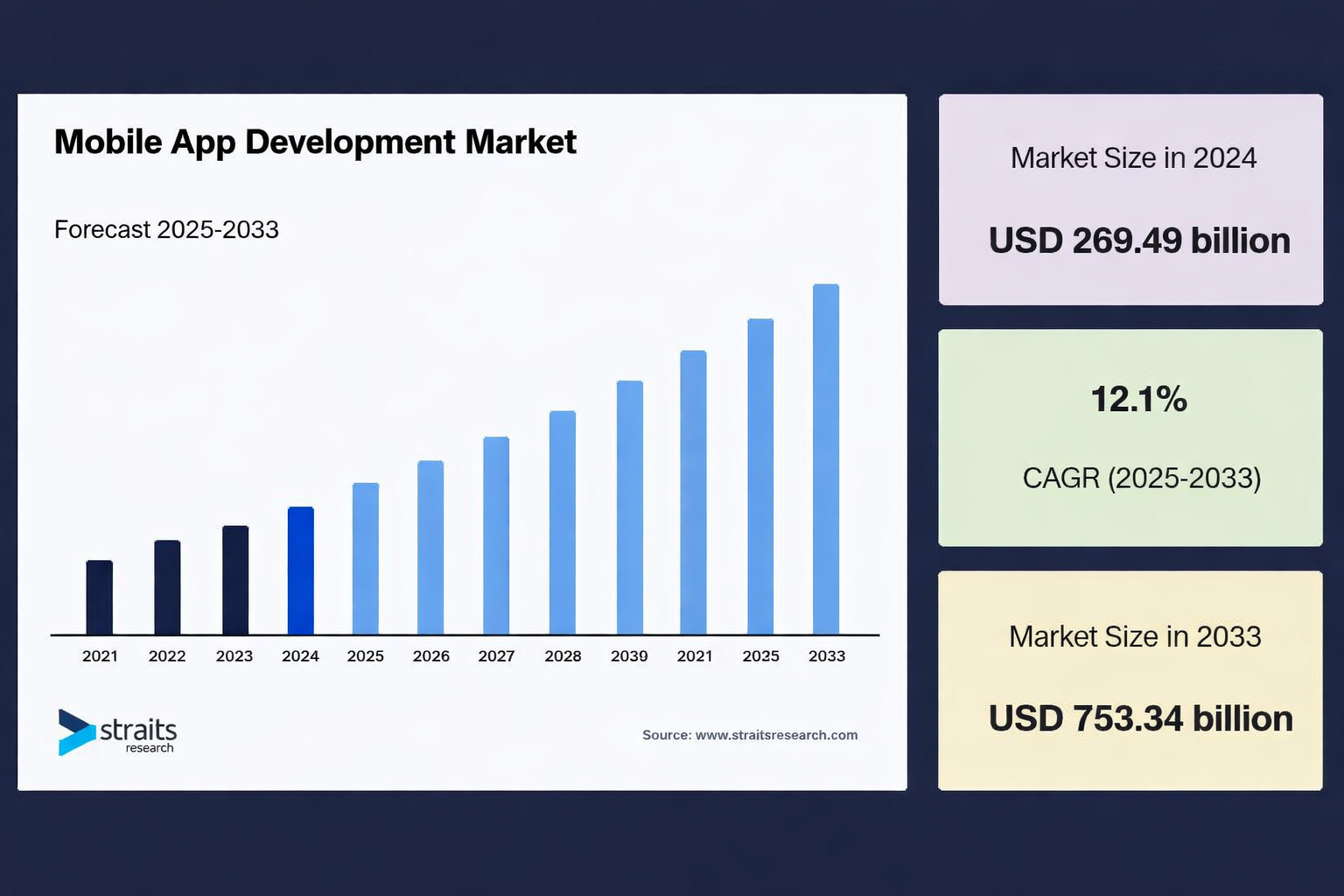
A mobile app helps businesses grow in various ways, including building a powerful brand, acquiring new customers, and improving customer engagement. It has driven demand for apps among businesses, thereby expanding the mobile app development market, which is expected to reach USD 753.34 billion by 2033.
Meanwhile, rising app development costs are the biggest challenge for businesses seeking to build mobile apps. Nearshore mobile app development in Mexico emerges as the right option for them.
Mexico has become the preferred destination for businesses seeking to hire a dedicated mobile app development team to handle a variety of apps at a cost-effective rate. Let’s explore more about nearshore app development.
Nearshore mobile app development involves outsourcing software development to companies based in nearby locations or neighboring countries. As an emerging approach to software development, it offers various advantages, including ease of communication, shared time zones, and cultural affinity, which boost collaboration between the app development team and clients.
The major benefit of nearshore mobile App Development in Mexico is that it lets businesses access talented app developers at cost-effective rates while minimizing language barriers. Proximity to the location also enables real-time interactions.
Nearshore mobile app development is the right option for businesses seeking high-quality solutions at affordable costs while maintaining effective project management.
Nearshore development is a relatively recent concept that has significantly impacted the modern business landscape, offering a compelling alternative to traditional onshore and offshore models. Because nearshore development fosters close collaboration between clients and the development team, it makes the development process more transparent and effective.
The proximity of the nearshore software development team also fosters development cycles and improves project management and real-time response.
Additionally, nearshore development enables cultural alignment, encouraging teams to share a common understanding and work honestly toward shared goals. Nearshore development is a strong option for businesses seeking a collaborative app development team to build their apps.
Nearshore, offshore, and onshore refer to the locations where businesses outsource app development services. Nearshore refers to outsourcing services to neighboring countries, while offshore refers to outsourcing to countries beyond the immediate region. Onshore refers to outsourcing services within the same country.
Let’s understand the differences between these three services.
As mentioned, nearshoring is the best option for businesses that want to capitalize on cost savings while maintaining cultural proximity. It’s a popular model in regions where nearby countries offer the best services while striking a balance between cost and the quality of end products.
Nearshore enables businesses to benefit from lower app development costs while leveraging cultural affinity and a shared time zone. It ensures smoother operations than offshore operations by eliminating language barriers and time zone differences.
Offshore is another option for businesses seeking affordable application development. Offshore regions ensure access to affordable professionals, thereby lowering operational costs.
By outsourcing to these regions, businesses can access high-quality solutions at lower costs. Common offshore destinations include the Philippines and India, which host large numbers of professionals who provide services at affordable rates.
While offshore offers advantages, it also presents challenges, including cultural and time zone differences, potential communication issues, and more. You need careful planning and robust communication channels to manage cross-border projects and ensure the success of offshore operations.
Onshore offers businesses proximity to the domestic market, regulatory compliance, and cultural alignment. It’s the best option for businesses that want to focus on proximity to customers and have specific legal requirements in their home country. Moreover, it’s also a good option for a business that needs local stakeholders and constant collaboration.
The primary benefit of an onshore operation is the ease of communication. With this model, businesses can benefit from additional advantages, including the ability to respond quickly to market changes, manage projects more closely, and strengthen cultural unity among professionals.
Meanwhile, the biggest drawback of onshore operations is higher operating costs with infrastructure and labor.
| Pros and Cons |
|---|
|
In addition to the numerous advantages, businesses also face challenges when opting for nearshore mobile app development. We have covered each challenge in detail to help you better understand them.
One of the major challenges businesses face in nearshore app development is navigating legal and contractual issues. Navigating different legal frameworks across many countries poses a serious challenge for protecting intellectual property rights, data, and ensuring compliance. You should always establish a clear contract that addresses these concerns to avoid legal complications.
In nearshore operations, time zone differences are a common challenge due to cross-regional collaboration. If working hours are misaligned, it leads to issues such as reduced collaboration, delayed communication, and longer development cycles.
To address time zone differences, distributed teams should implement effective communication strategies. They can also adopt an agile approach to address it.
Technology and infrastructure gaps are another challenge that can hinder project development. Other factors affecting the project’s progress include varying hardware specifications, inconsistent network connectivity, different development environments, and more.
It’s necessary to conduct a thorough assessment of the team’s technical capabilities and ensure alignment with the client’s needs.
To make nearshore mobile app development successful, it’s necessary to manage resources most effectively. Meanwhile, it’s certainly not an easy task. Clients collaborate with the team remotely, making it difficult to assign skilled professionals to specific tasks.
To overcome these challenges, businesses need to conduct regular, thorough assessments of teams, align them with project requirements, and adopt a flexible resource-allocation strategy.
When it comes to managing client expectations, it’s more difficult in nearshore operations. Whether it’s cultural nuances, communication styles, or understanding client expectations, many factors can lead to misunderstandings.
To avoid it and build trust, it’s recommended to receive regular project updates, establish a clear communication channel, and set realistic expectations.
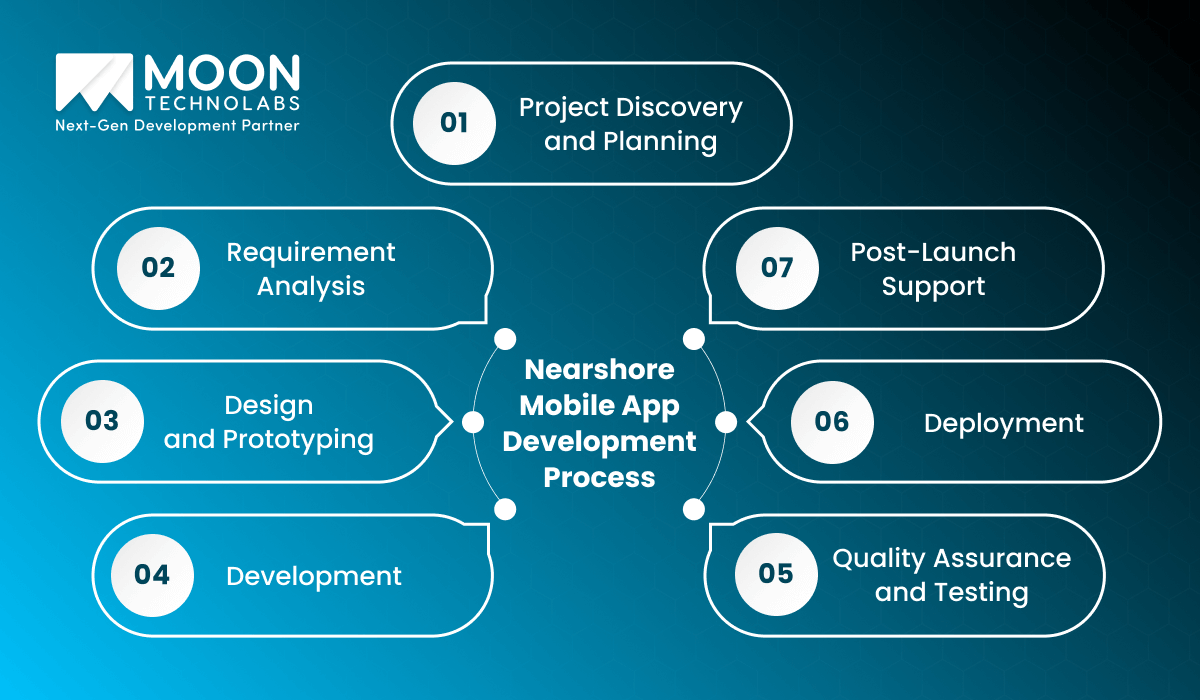
The nearshore mobile app development process consists of several stages. Each stage is equally important to ensure a smooth and successful development process. Let’s discuss all stages of the nearshore mobile app development process in detail:
The first step in nearshore development is to gather the client’s requirements, business details, target audience, goals, and a complete vision for the mobile application. It also involves defining the project scope, creating realistic timelines, and defining the budget. It’s the foundational step of any project development.
After defining the project scope, the development team conducts a comprehensive requirements analysis. They break down projects into different specific features, functionalities, and user stories.
The primary objective is to compile a comprehensive set of specifications that serve as a roadmap for the development team. In this phase, clear communication between the development team and the client is essential to avoid misunderstandings.
The design phase involves transforming ideas into visuals. Designers craft prototypes and wireframes to represent the app’s flow and structure visually. This step involves finding design flaws and also ensures a final product aligns with the expectations of clients. Designers collect user feedback and incorporate it into the design.
Development is the core step of nearshore mobile app development. It involves coding the finalized application. This model ensures real-time collaboration between the development team and clients, fostering transparent communication.
Developers follow an agile methodology to leverage adaptability and flexibility as requirements change throughout development.
Quality assurance is critical in nearshore mobile app development. QA professionals conduct thorough testing of mobile apps in different scenarios and under rigorous conditions. It helps them identify and resolve bugs, performance concerns, and various usability issues.
Collaboration between the QA and development teams ensures the app is error-free and performs well.
After thorough app testing and client approval, the app is ready to deploy. The nearshore team handles app deployment. They also perform other tasks, including server configuration, database setup, and preparing applications for user access.
The nearshore app development team also provides necessary maintenance and support to keep apps up to date with the latest changes and ensure smooth performance. They provide the required ongoing support, analyze app performance, and tackle various issues.
Regular maintenance and support are also necessary to keep the application fully secure, up to date, and compatible with evolving technologies.
The average app development cost in Mexico ranges from $7000 to $20000 (for basic apps). For complex ones, the cost ranges from $30,000 to $50,000 or more. Mexico is known for offering highly competitive rates compared to other countries, making it a favorite destination for app development.
The cost of application development varies based on numerous factors, including features, complexity, developer rates, selected platform, functionality, design, and more. Hourly rates are lower in Mexico than in other countries, including the United States.
So, are you looking for a nearshore app development company in Mexico for your project? Moon Technolabs can be the right option for you. With a commitment to delivering excellence, it works with a customer-centric approach as your reliable nearshore app development partner.
To meet clients’ diverse needs, they offer a range of app development services in Mexico, including mobile, web, custom, AR/VR, AI/ML, blockchain, and IoT development, among others.
The company has a skilled app development team comprising designers, developers, project managers, and other specialists who collaborate closely to bring your ideas to life. It implements the latest industry practices to deliver next-generation solutions.
01
02
03
04

Jayanti Katariya is the CEO of Moon Technolabs, a fast-growing IT solutions provider, with 18+ years of experience in the industry. Passionate about developing creative apps from a young age, he pursued an engineering degree to further this interest. Under his leadership, Moon Technolabs has helped numerous brands establish their online presence and he has also launched an invoicing software that assists businesses to streamline their financial operations.


Submitting the form below will ensure a prompt response from us.
We refine our expertise to deliver innovative business solutions.





500 N Michigan Avenue, #600, Chicago IL 60611
13500 Long Is Dr, Pflugerville, TX 78660, USA

C/105 Ganesh Meridian, S.G. Highway, Ahmedabad, GJ 380060


Ayse D.
Co-Founder France
“ I highly recommend Moon Technolabs as the quality of service is wonderful. We have hired this company to develop the product based on some complex & technical issues. We get the best quality services as compared with others in the market. Huge Thanks to Moon Technolabs as the team is always ready to give the solution all time.”

Justin G.
Founder & CEO USA
USA“ Moon Technolabs is a pioneer in the WebRTC based project as they have fixed complicated segments of the module by fulfilling different product lines by providing 24X7 customer support. We really recommended Moon Technolabs as they are able to develop products as per the module deadline and project timeline.”

Flavio S.
Founder & Managing Director Germany
“I am happy to recommend Moon Technolabs for their app development services. They successfully developed apps for me, and I am highly satisfied with the overall outcomes. The development team has swiftly addressed the issues with responsive and effective communication to understand the requirement quickly and actively resolve the back-and-forth problems that arose...”

Jay M.
Founder & CEOUSA“Moon Technolabs is the best company that provides advanced apps and websites development services in the USA and Europe. I am a newbie to develop my app with an external team. I am really happy to work with them as I am not that much mobile apps user. Here, the team and specially the CEO of Moon Technolabs helps me to let me know about the benefits of my app to generate revenue....”


Our Offices
India
C/105 Ganesh Meridian,S.G. Highway, Ahmedabad, GJ 380060USA
500 N Michigan Avenue, #600, Chicago IL 60611Contact Information


