
 Total Views: 5765
Table of Content


Blog Summary:
This blog will break down the world of managed platforms and server solutions—what they are, how they work, their effects on business processes, and why enterprises rely on them. It will compare managed services platforms, managed server solutions, and data center managed service providers, explore top use cases across various industries, highlight key benefits, and provide a vendor evaluation framework.
Table of Content
Imagine a scenario where your core systems fail during peak hours. For every second your software is offline, your revenue bleeds and customers churn, which emphasizes the need to reduce risk. According to Atlassian, in 2025 alone, organizations lost approximately $56,000 per minute of IT downtime.
Enterprise IT isn’t getting simpler. With multi-cloud environments, compliance mandates, and evolving cyber threats, an in-house DIY infrastructure can become a maze. Moreover, DIY setups are not even feasible financially without the necessary expertise.
That’s why managed services platforms have become essential. It serves as a backbone for your enterprise’s scalability, security, and compliance. In this guide, you will learn why moving to managed services is no longer optional but mission-critical. We will also discuss why it is crucial for your IT operations in 2025, along with the server solutions that will help you further your infrastructure and unlock its full potential.
If downtime is expensive for your business, then who is keeping your systems running at full speed? The managed platforms and server solutions are the obvious answer to this question. They are your IT pit crew, handling the heavy lifting while your team focuses on growth and overall success.
It is the foundation for your enterprise infrastructure. It provides you with a complete environment, including hardware, software, networking, and security, that are monitored and optimized by experts. The provider keeps your infrastructure up-to-date and resilient. The all-new OpenStack Business private cloud by Rackspace delivers a fully API accessible, proactively managed, and secure infrastructure for performance and compliance.
It provides you with the necessary infrastructure along with the ongoing services like backup, compliance checks, incident response, and resource scaling. A single dashboard supports your team in maintaining a healthy tech ecosystem 24/7, especially for cloud-based software and app development. Shield Technology Partners is an excellent example of this management. They provide an AI-backed managed IT services platform that effortlessly blends humans with automation.
They are purpose-built physical, virtual, or hybrid server environments that help you enable reliability and security. It delivers provisioning, monitoring, and troubleshooting services. This means the provider manages all tasks to ensure uptime and maximum performance without increasing your work or resources.
Data centre managed services can help deliver enterprise-grade reliability. They provide comprehensive services, including co-location, storage, disaster recovery, and security controls, all of which are handled by certified professionals.
Traditional hosting gives you spaces, while cloud solutions give you access. Managed services can combine the best of both worlds to deliver active management. Instead of renting the hardware or bandwidth, you get experts who proactively manage issues, enforce security, and align your infrastructure with business needs.
It’s time to explore why most enterprises are turning to managed services as their best bet in 2025.
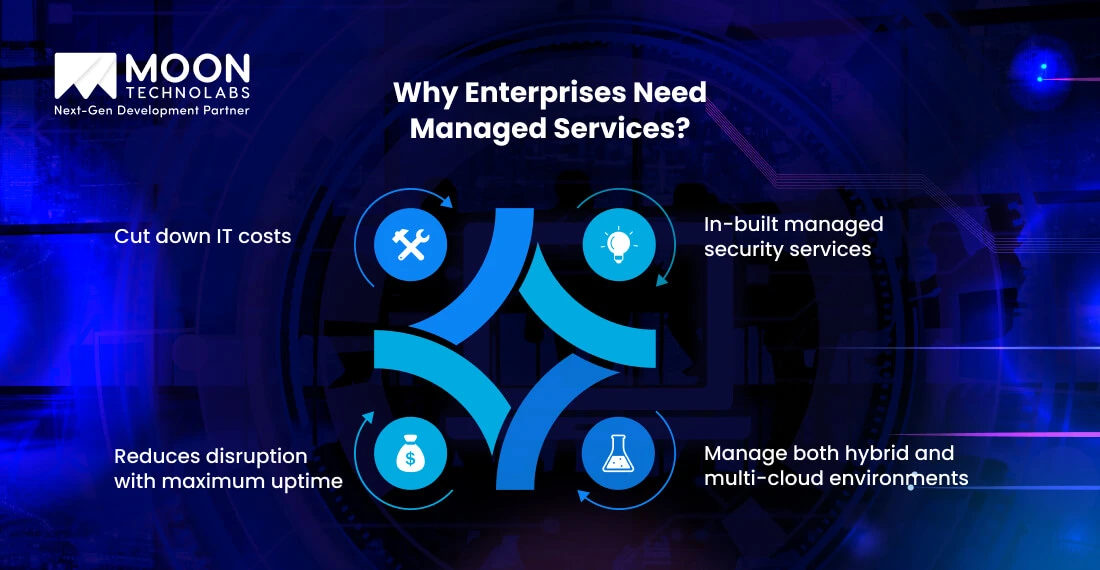
With managed service providers (MSPs), you can cut down your IT costs by about 15-45%. At the same time, it boosts your operational efficiency by 45-65%. It will also help consolidate the vendors through MSPs, reduce the vendor management overhead by 70% and streamline billing. All this ensures high savings for your business.
As regulations are growing stricter, you must remain compliant. MSPs can help with in-built managed security services that include 24/7 monitoring, patching, audits, and policy enforcement. Eventually, compliance becomes an integral part of your service, rather than an afterthought, especially when you track relevant metrics. When you add managed detection and response, you will notice that enterprises can stay ahead of cyberthreats. That’s another reason why managed services platforms are gaining popularity.
When the tech uptime is directly connected to the 24/7 SLAs, downtime is not possible. It also helps with proactive monitoring and rapid response, which delivers seamless reliability. As uptime and availability reduce disruption, you will notice more enterprises embracing managed services.
Modern infrastructure is available on the premise, in the cloud, and even on the edge. MSPs can help you manage hybrid as well as multi-cloud environments effortlessly. That helps you optimize costs, performance, and security while simplifying data flows.
Do you feel that the IT landscape has become an alphabet soup owing to the numerous terminologies like platforms, servers, cloud, and data centres? If you are still unable to determine what suits your enterprise best, you are not alone. Each model in the landscape solves a definitive issue. That’s why you need to choose the right one that helps you control costs while proactively resolving issues.
| Parameters | Managed Platform | Managed Server Solutions | Data Centre Services |
|---|---|---|---|
| Cost | Predictable monthly fees. It is cost-efficient for growth. For example, AWS managed services can simplify spending | The cost is mid-range and slightly higher than the platform’s due to the dedicated resources. Rackspace Managed hosting is an example | It is expensive. They provide facilities, cooling, and staff. An example would be IBM Data Services Centre |
| Security & Compliance | Very strong security and managed by the provider. It is ideal for meeting standard industry compliance requirements. Azure Managed Security is an example. | Very high security and compliance. It can be customized to meet stricter requirements, such as SOC2 and HIPAA. Example: Liquid Web HIPAA-ready servers | Enterprise-grade security with advanced physical and cyber layers. Example: Equinix secure colocation. |
| Scalability | It is flexible. Best suited for SaaS and cloud-native applications | Scales perfectly, but is limited by server capacity. Example: InMotion Managed Dedicated Servers | Best suited for high volume and mission-critical needs |
| Management Scope | Full stack that includes OS, apps, and network monitored | Focuses on server and workload management | End-to-end scope that includes facilities, redundancy, and disaster recovery. |
| Support | 24/7 remote support and ticketing, along with proactive monitoring. Offers shared managers and teams | 24/7 specialized support with dedicated account managers. Provides faster paths for escalations | 24/7 on-site and remote teams that include engineers and custom SLAs. |
Managed services are that quiet engine that keeps your business available all the time. You may not see it every day, but you’ll feel its impact in the form of enhanced security, a reliable technology environment, lower costs, and an improved quality of life for your employees. That’s why enterprises are slowly moving towards managed services in 2025.
Hiring, training, and retaining skilled IT talent can be expensive and time-consuming. With managed services, you can reduce the burden on your team as they come with a ready team of specialists. They will handle everything from patching to performance tuning, allowing developers to focus on innovation.
You will not experience surprise invoices or unpredictable capital spend with these services. With subscription-based or pay-as-you-grow models, your CFOs get complete visibility and clear control over IT budgets.
The newer cyber threats are more complex than their predecessors. A managed services platform can build security into the core to deliver firewalls, encryption, identity management, and continuous compliance checks. This will keep you ahead of the evolving threats. Most platforms are HIPAA, SOC2, and GDPR ready, thus removing these hassles.
Managed services can help you expand into newer markets while aligning with the local rules and standards. Whether you want to adhere to data residency requirements in Germany or privacy rules in the Middle East, these compliances are built into the platform.
With round-the-clock monitoring, you can catch issues even before they cause damage. When you incorporate disaster recovery into the model, you will find that systems recover quickly, even after unexpected outages or cyberattacks.
Ultimately, managed services give you the agility and confidence to focus on business growth.
From enterprise software to managed data centres, our experts align technology with your business outcomes, enabling a resilient, compliant, and cost-effective infrastructure.
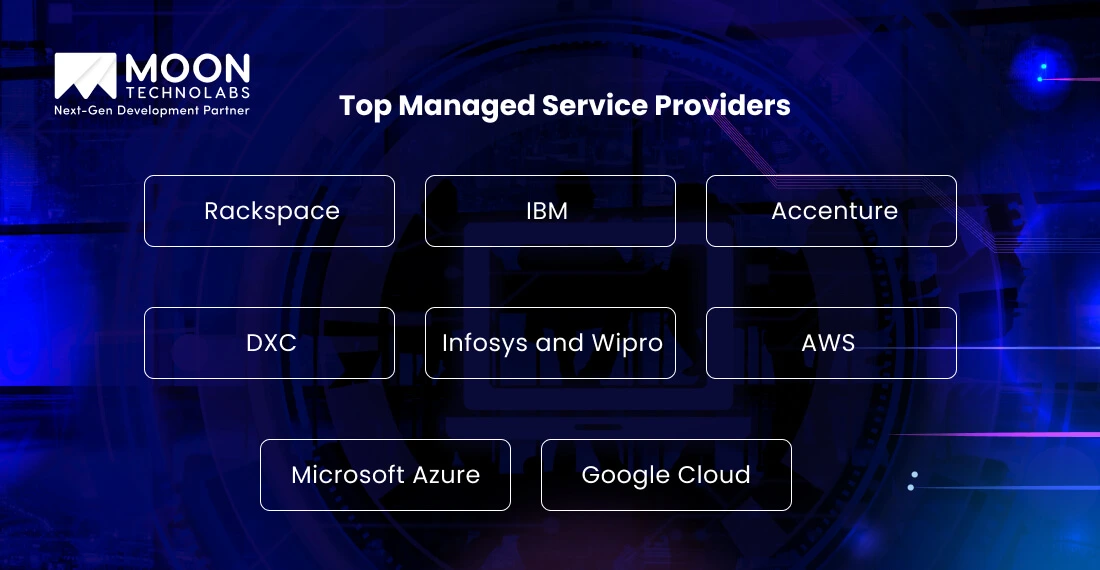
Are you seeking a reliable partner to manage your IT services? Let’s look at the top eight providers and learn a bit more about them.
This US-based cloud services pioneer, founded in 1988, is renowned for offering fanatical support. It focuses on hybrid and multi-cloud environments, offering proactive monitoring with a customer-first service. They are a strong fit for mid-sized businesses and enterprises that need personalized support for AWS, Azure, Google, and private clouds.
This platform combines years of experience with strong hybrid cloud and compliance tools. They are suited for industries like finance and healthcare that require strict adherence. IBM provides you with robust governance and security frameworks, like IBM Cloud.
This is a global consulting powerhouse that offers more than managed services to its enterprise clients. Along with infrastructure and cloud services, they provide you with strategy, innovation, and AI solutions. You can choose this provider if you want to modernize, innovate at scale, or transform your organization while aligning technology to your goals.
They prioritize large-scale enterprise IT needs. The provider offers deep integration with your legacy systems and modernization programs. It is proficient in complex migrations as well as handling hybrid infrastructures. This is the best fit for enterprises that require closing the gaps between the old and new technologies without disruptions.
The two bring strong offshore delivery capabilities to the table. US organizations consider them for their cost-efficient services and 24/7 coverage. These organizations combine global talent pools with local governance and industry-specific accelerators to deliver solutions tailored to your needs. If scalability and cost-effectiveness are top of your requirement checklist, you can consider these providers.
Backed by Amazon, these services are designed to help your enterprise run secure and scalable workloads on AWS. It helps automate operations such as patching, monitoring, and compliance that are integrated with AWS tools. If you are using AWS development services, this is the best managed services platform choice for you.
This extends into the Microsoft ecosystem to provide fully managed Azure environments tailored to your business needs. These environments come with complete governance, security, and performance tuning. It is best suited for companies that use Microsoft 365, Dynamics, or Windows-based workloads. These services can ensure smooth integration and enterprise-grade scalability.
Google Cloud development stands out for delivering AI-backed operations, high-performance computing, and strong security. These services are well-suited for analytics-intensive workloads, SaaS platforms, and innovative data-driven businesses. You should consider them if speed, automation, and cutting-edge tools are your priorities.
Choosing the right managed services partner isn’t just about comparing the price tag; it’s also about considering the overall value. It is about finding the team that becomes an extension of your business. Here is how you can make that decision with confidence, focusing on the right configuration.
Start your journey to finding the right partner with a comprehensive evaluation checklist. Evaluate the SLAs to determine the uptime they guarantee. Check if there are penalties for missing targets. Review the provider’s compliance capabilities. They should be able to adhere to compliance standards such as HIPAA, GDPR, and SOC2.
Evaluate their tech stack to know if they support tools and platforms you prefer. Lastly, determine their global presence to assess whether they can deliver consistent service across regions.
You should thoroughly investigate the provider’s capabilities before signing them up for your infrastructure needs. Ask them these questions as part of your decision-making process.
These answers will help you gain more clarity regarding your provider.
A good partner will not just showcase the cost savings, but also take a look at the bigger picture. They will help you achieve your business goals, such as speed-to-market, regulatory confidence, and innovation, with the perfect infrastructure to support an amazing product. Before collaborating, you should discuss the JPS that matter and see how their services align with your goals.
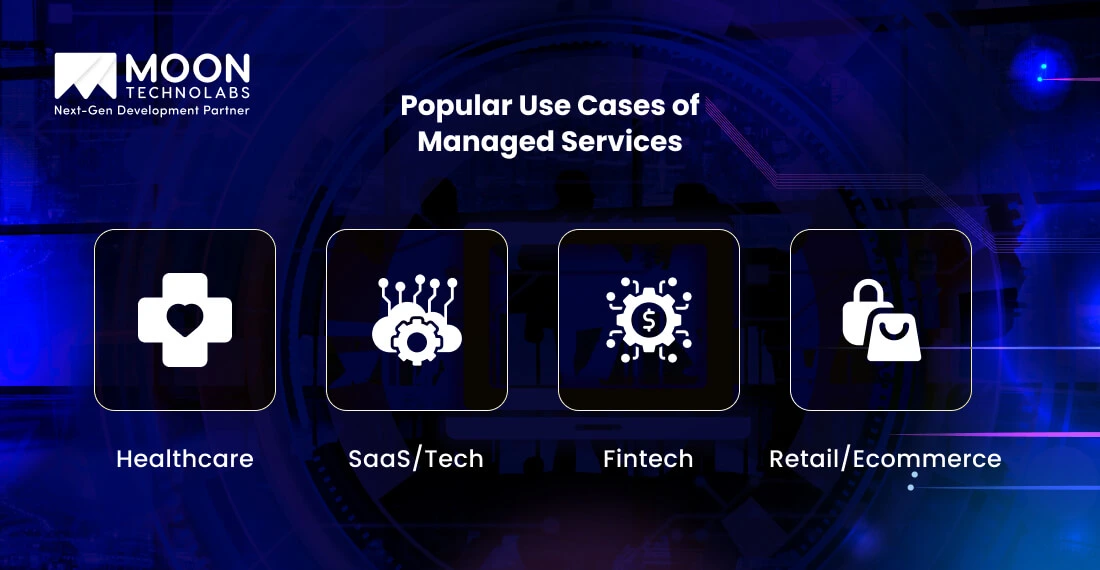
There is no one-size-fits-all for managed services. There are specific reasons why different industries lean on them. Here’s how managed services can make a difference across the key sectors.
Security and compliance are non-negotiable for the healthcare software modernization industry. Every touchpoint, like HIPAA or GDPR, has specific rules. Managed services can deliver enterprise-grade security, encrypted backups, and proactive monitoring to hospitals and clinics to ensure patient data safety. It is akin to a multi-location hospital system with managed data centres that help unify patient records for an audit-ready system.
Agility is crucial for SaaS or tech companies. Managed services can help both startups and enterprises prioritize product innovation while managing their infrastructure. Whether it is creating environments for testing or supporting DevOps development with CI/CD pipelines, managed platforms can keep your business running smoothly.
A second’s downtime can cost the financial services industry revenue as well as user trust. With managed services, they can ensure high availability of architectures, redundant systems, and continuous monitoring that keeps the transactions flowing 24/7, thereby enhancing overall productivity. It also helps ensure strict adherence to SOC 2, PCI DSS, and other financial regulations.
Retailers tend to manage unpredictable spikes, such as holiday sales, flash deals, and viral moments. Managed services give them a flexible infrastructure that scales up and down as needed to save costs. It can also unify their online and in-store systems to deliver omnichannel experiences.
Managed services can adapt to the unique pressures of each industry, allowing businesses to prioritize innovation and customer satisfaction.
Our experts will reduce IT overhead, boost security, and scale multi-cloud setups to boost uptime and support your team with 24/7 coverage.
What if you had an IT infrastructure that fixed problems even before they occurred? That’s the future of managed services. AI-backed monitoring is the new norm, and the stage for it has already been set. AI tools continuously scan systems to identify anomalies and predict potential failures. They even self-correct these issues without human interference. This will help with continuous improvement in the future.
Enterprises may no longer track uptime; they will begin predicting it. By analyzing usage patterns, service providers can predict traffic spikes and allocate their budget accordingly. It can also help optimize costs effectively.
Lastly, new-age intelligent automation platforms are replacing the managed hosting solutions. They are strategic partners that utilize automation and AI to manage complex, hybrid, or multi-cloud environments seamlessly.
Downtime, breaches, and scale challenges can put even the best business a few years behind. In 2025, managed services will serve as a safety net for enterprises, offering security, cost efficiency, and scalability with minimal hassle, allowing them to operate effectively in a competitive landscape.
Moon Technolabs, a software development company, helps organizations build, manage, and scale their enterprise platforms. We prioritize security, compliance, and automation across the process. Whether you want to modernize a legacy app or manage a multi-cloud environment, our team delivers effective solutions.
To assess your IT maturity, please connect with our team today. We offer a free IT readiness assessment to help determine your enterprise’s current state and requirements.
01
02
03
04
05

Jayanti Katariya is the CEO of Moon Technolabs, a fast-growing IT solutions provider, with 18+ years of experience in the industry. Passionate about developing creative apps from a young age, he pursued an engineering degree to further this interest. Under his leadership, Moon Technolabs has helped numerous brands establish their online presence and he has also launched an invoicing software that assists businesses to streamline their financial operations.


Submitting the form below will ensure a prompt response from us.
We refine our expertise to deliver innovative business solutions.





500 N Michigan Avenue, #600, Chicago IL 60611
13500 Long Is Dr, Pflugerville, TX 78660, USA

C-105, Ganesh Meridian, S.G. Highway, Ahmedabad, GJ 380060


 France
“ I highly recommend Moon Technolabs as the quality of service is wonderful. We have hired this company to develop the product based on some complex & technical issues. We get the best quality services as compared with others in the market. Huge Thanks to Moon Technolabs as the team is always ready to give the solution all time.”

 USA
USA“ Moon Technolabs is a pioneer in the WebRTC based project as they have fixed complicated segments of the module by fulfilling different product lines by providing 24X7 customer support. We really recommended Moon Technolabs as they are able to develop products as per the module deadline and project timeline.”

 Germany
“I am happy to recommend Moon Technolabs for their app development services. They successfully developed apps for me, and I am highly satisfied with the overall outcomes. The development team has swiftly addressed the issues with responsive and effective communication to understand the requirement quickly and actively resolve the back-and-forth problems that arose...”
 USA
USA“Moon Technolabs is the best company that provides advanced apps and websites development services in the USA and Europe. I am a newbie to develop my app with an external team. I am really happy to work with them as I am not that much mobile apps user. Here, the team and specially the CEO of Moon Technolabs helps me to let me know about the benefits of my app to generate revenue....”


