
Jayanti Katariya
Last Updated: November 27, 2025 Total Views: 699
Table of Content


Blog Summary:
Planning to develop an ML app but not sure how to proceed? You have landed at the right place. We explain the different stages of ML app development, followed by features to integrate, benefits, reasons to invest, how ML apps work, development costs, and more. Let’s read the entire blog to explore more.
Table of Content
You may have already come across instances where banking apps send you an alert for any suspicious account-related activities. And also, how do e-commerce apps recommend products you desire to purchase?
Have you ever wondered how they accomplish all this? It’s becoming possible due to machine learning technologies. Apps developed with this technology can read your mind. This is the reason why Machine Learning App Development has gained significant demand across businesses from multiple industries.
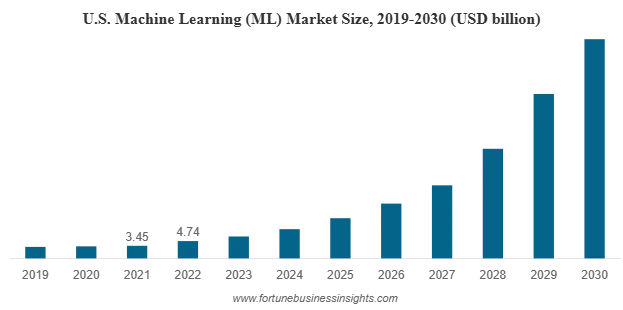
According to Fortune Business Insights, the market size of ML in the USA is projected to grow from approximately $6.49 billion in 2023 to $59.30 billion by 2030. It’s expected to surge at a CAGR of 37.2% during the forecast period.
ML apps enable businesses to achieve a range of benefits. These include creating personalized customer experiences to boost engagement, performing predictive maintenance to reduce downtime, and detecting fraud to enhance security.
So, how to proceed with ML app development? It requires proper planning and a solid strategy. In this guide, we will take you through the entire process of ML app development.
The worldwide ML market is growing rapidly, with fast-paced adoption across various industries, including finance, healthcare, retail, manufacturing, and others.
Fortune Business Insights predicts that the global machine learning market size will likely reach approximately $309.68 billion by 2032, up from $47.99 billion in 2025, surging at a CAGR of 30.5% during the forecast period.
Apart from this, numerous popular trends also play a significant role in shaping the market. The following are some of the key trends:
On the other hand, the adoption of enterprise AI, open-source frameworks, cloud-based ML platforms, and other technologies also fosters innovation. They make ML pivotal for digital transformation worldwide.
Machine learning app development involves creating apps with the adequate potential to learn from data and improve over time. It should also be able to make the right decision even without any explicit programming.
ML apps harness models and algorithms to analyze patterns, automate several tasks, predict outcomes, and more. The entire development process is a combination of the following activities:
ML apps have gained widespread adoption across multiple industries, including finance, healthcare, manufacturing, and e-commerce. These industries utilize apps for various tasks, including fraud detection, recommendation systems, predictive analytics, and more.
ML apps work on the core principle of imitating human intelligence. They learn from data directly, find patterns, and also make decisions or predictions accordingly.
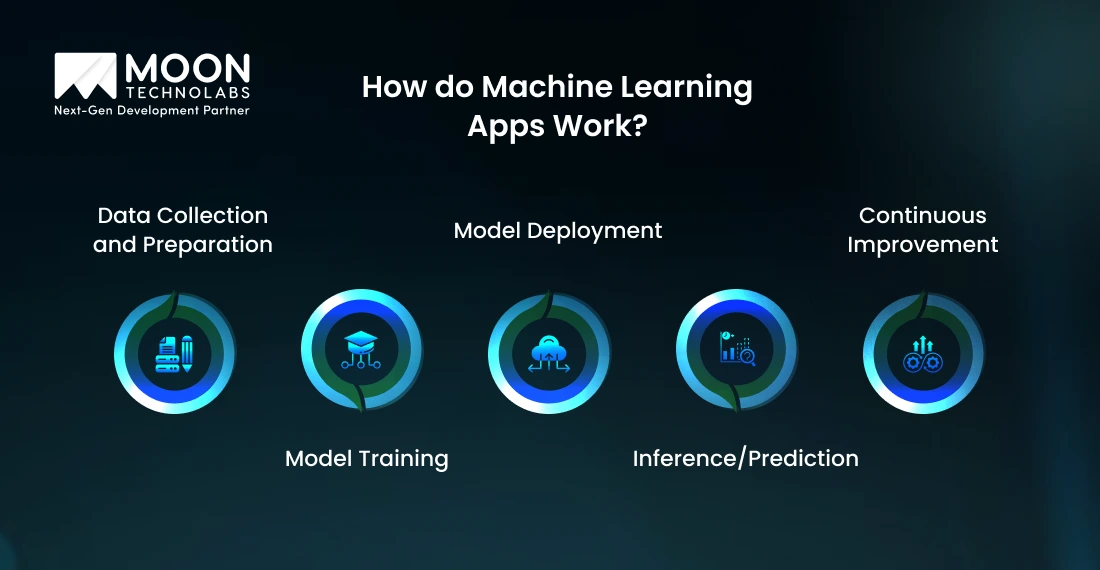
The actual functioning and development of these apps follow completely structured pipelines, which ensure scalability, accuracy, and continuous improvements. Let’s understand the different stages of how these apps work:
This is the first and most crucial stage, which involves gathering a substantial volume of high-quality data from various sources, including sensors, interactions, images, logs, and other relevant data. The collected data comes with duplicacy, inconsistencies, or missing values.
This is where data preparation becomes highly necessary. It includes multiple activities, such as normalizing, cleaning, and labeling, to prepare the data for use with ML algorithms.
ML model training is the next step, which involves feeding a cleaned dataset into algorithms, including neural networks, decision trees, support vector machines, and other machine learning models. The model training process involves identifying the relationships within the data and making necessary adjustments to internal parameters to minimize errors.
Whether it’s supervised, unsupervised, or reinforcement learning, they are implemented based on the exact type of problem. For example, a healthcare app utilizes supervised learning when training a model to project disease risks based on patient records.
After proper validation and training, the ML model is deployed into the application for real-world use. Model deployment also ensures the model can be interacted with through user queries and live data streams.
Be it PyTorch, TensorFlow, or cloud platforms, developers can leverage a variety of frameworks to scale models most effectively.
In this stage, apps deliver the core value. Inference is the entire process of implementing the trained model on completely unseen or new data to produce classifications or predictions.
Meanwhile, the major challenge is to obtain low-latency predictions, which ensure outcomes are delivered quickly, without compromising accuracy. With efficient inference, ML apps offer real-time decision-making capabilities that enhance user experience and drive business results.
Even after deploying ML apps successfully, your job doesn’t end. You need to keep an eye on them consistently and introduce major improvements to keep them relevant. With continuous monitoring, you can detect several issues.
Developers retain models with the updated datasets to ensure both relevance and accuracy. Additionally, techniques such as feedback loops and A/B testing are crucial for refining algorithms more effectively.
You can invest in ML app development to stay ahead in the competitive race. It ensures automation, decision-making, personalized experiences, and more.
As the majority of industries today shift towards data-driven operations, ML apps enable organizations to identify and capitalize on new growth opportunities while optimizing efficiencies.
The following are some other genuine reasons why you should invest in ML app development:
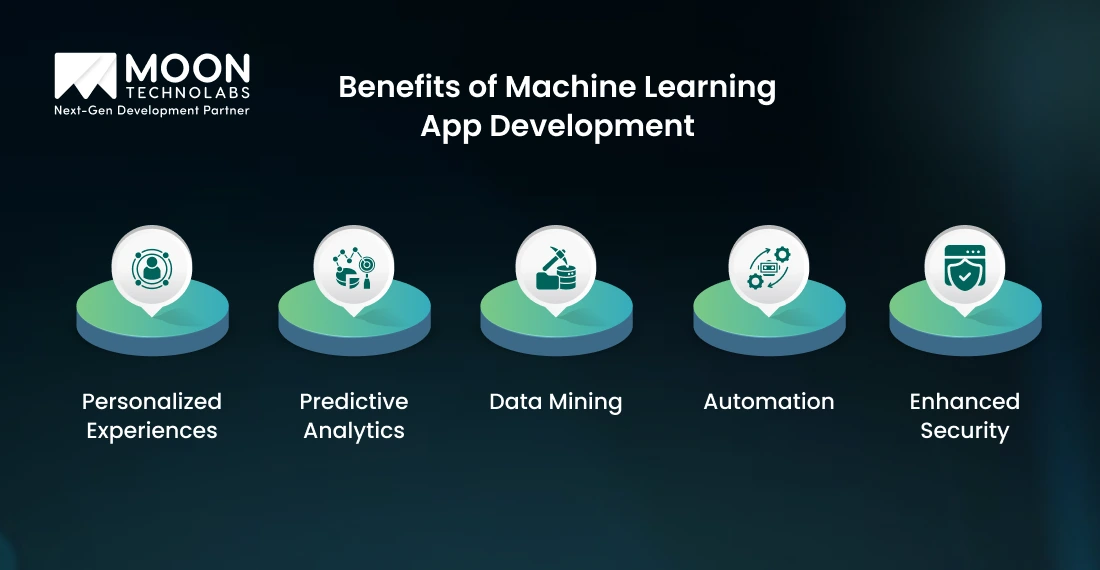
Machine learning app development offers a range of benefits for businesses, delivering efficient, smarter, and customer-driven solutions. Let’s understand some of its top benefits as follows:
One of the major advantages of ML apps is their capability to create personalized user experiences. ML models have the potential to recommend content, products, or services tailored to match individual requirements by analyzing preferences, behavior, and interactions.
Streaming platforms suggest playlists and movies based on past viewing habits, whereas eCommerce apps recommend products that are perfectly aligned with customers’ purchasing histories. This kind of personalization improves loyalty, user satisfaction, and engagement.
ML apps can predict trends and outcomes using real-time and historical data. With predictive analytics, businesses get the potential to predict market demands, customer behavior, potential risks, and more. For instance, financial businesses use ML apps to predict credit defaults or stock movements.
Businesses are often in search of the best ways of extracting important insights from vast datasets produced on a daily basis. ML algorithms have the capability of identifying correlations, hidden patterns, anomalies, and more, even within complex data sets.
Retail businesses utilize ML for data mining to get details of seasonal purchasing trends, which ensures improved inventory planning. This capability has transformed raw data into comprehensive strategic business intelligence.
ML apps automate resource-intensive and repetitive tasks to boost efficiency while minimizing operational costs. Machine learning minimizes the overall dependency on manual intervention, right from chatbots handling customer service queries to automating fraud detection.
In the manufacturing industry, predictive maintenance is beneficial for preventing extensive downtime by automating the process of detecting equipment failures before they occur.
ML apps ensure the safety of systems. ML algorithms analyze user activity and network traffic to detect suspicious behavior, anomalies, and potential threats in real-time. We can take examples of banking apps that harness the power of machine learning to quickly identify unusual transactions, which minimizes the overall risk of fraud.
Features are one of those essential factors that make a Machine Learning app successful. The following are some of the must-have features you need to consider to implement while developing these apps:
When it comes to unsupervised learning, it’s a highly important feature that lets ML apps analyze datasets even without any predefined labels. It enables apps to detect hidden patterns, groupings, or clusters within the data.
For instance, an e-commerce app can utilize unsupervised learning for segmenting customers based on their purchasing behaviors. This approach remains highly relevant for various activities, including anomaly detection, market research, fraud detection, and more.
An ML app integrated with Reinforcement Learning (RL) has the potential to learn through trial and error. It is different from supervised or unsupervised learning and offers the possibility of decision-making in dynamic environments.
We can again use the example of a ride-hailing app to understand it better. These apps ensure continuous learning through rider demand and real-time traffic data, optimizing driver allocations.
Any ML app without a feature like personalized recommendations is incomplete. It analyzes contextual data, browsing history, and user behavior to suggest any relevant services or products.
Whether it’s Netflix, Amazon, or Spotify, these companies leverage this feature to boost sales, engagement, and customer satisfaction. A well-designed recommendation engine maximizes revenue while increasing user loyalty by providing personalized suggestions tailored to each individual’s specific needs.
With image recognition, ML apps gain the ability to scan, verify, and classify images with enhanced accuracy. In the healthcare sector, image recognition models also work effectively to detect diseases from MRIs and X-rays.
Many retail apps utilize it for visual search, allowing users to upload images to find similar products. On the other hand, security systems also utilize it for surveillance, as well as facial recognition.
As a mathematical model, algorithms enable an ML app to fulfill its intended purpose. They bring possibilities for everything, whether it be pattern detection, classification, or power prediction.
Therefore, it’s highly important to select the right algorithm that ensures the app’s higher performance and accuracy. Some of the most popular algorithms are as follows;
Being a subset of ML, deep learning is another must-have feature of robust ML apps. It has an immense capability of simulating human brain functioning and can also process even a larger dataset by using artificial neural networks.
It provides a complete breakthrough in computer vision, natural language processing (NLP), speech recognition, and other related fields. Whether it’s Alexa or Siri, virtual assistants harness deep learning to recognize voice commands and respond accordingly.
Model evaluation enables ML apps to deliver reliable and accurate outcomes. The most important evaluation metrics include recall, precision, accuracy, ROC-AUC, F1-score, and others.
For instance, high recall rates in the healthcare diagnosis app prevent missing potential cases of disease. Continuous evaluation is highly important for validating model performance more effectively.
We already discussed product recommendations. But a border recommendation system suggests songs, movies, courses, or even social media connections. They depend extensively on content-based filtering, collaborative filtering, hybrid models, etc.
The best example is LinkedIn in this case. It implements recommendation systems for providing potential professional connections.
Building a machine learning app is a process that involves multiple stages, each serving a specific purpose. Let’s understand the important stages of ML app development:
This step involves analyzing the issues that the future ML apps will solve. You can get in touch with your development partner to define core objectives, target audience, outcomes, and other key details. When you have clear requirements, these ensure your app aligns perfectly with your main business objectives.
We are all aware that data is pivotal for ML apps. This phase involves collecting relevant data from multiple sources, including IoT devices, customer interactions, third-party APIs, and other relevant data sources.
Meanwhile, raw data often includes errors, inconsistencies, and missing values. To ensure top-quality input from model training, you need to perform data cleaning and preprocessing.
Your development partner will assist you in choosing the right algorithm based on the type and purpose of your ML apps. They will suggest supervised, unsupervised, or reinforcement learning algorithms based on the types of issues your app will solve.
Whether it’s PyTorch, TensorFlow, or Scikit-learn, they provide a fully scalable environment for implementation. The actual choice depends on factors such as performance, dataset size, and business requirements.
This phase involves splitting datasets into training, validation, and test sets. Your selected algorithm will be trained on the data to recognize patterns and make the correct predictions accordingly.
To boost accuracy, the development team implements cross-validation and hyperparameter tuning. The major objective is to develop a model that can generalize perfectly to unseen data.
UI/UX design is one of the factors that make ML apps successful, as it makes the app user-friendly. An app crafted with an intuitive UI/UX design delivers smooth interactions.
Additionally, developers incorporate the trained model into the app, which is crucial for making predictions accessible through backend systems or APIs.
Regardless of the circumstances, thorough quality assurance and testing are essential to ensure the performance, accuracy, and reliability of apps. Whether it’s integration testing, unit testing, or user acceptance testing, QA professionals conduct a variety of tests to ensure your app meets expectations.
Apart from this, they use various evaluation metrics, such as recall, precision, F1-score, and others, to determine effectiveness.
Once you have successfully tested your app, it’s time to deploy it to production environments using the proper deployment strategy. Besides, you need to continually monitor your app’s success to ensure the model can handle real-time data with higher efficiency.
Apart from this, monitoring helps you easily identify any performance issues with your app.
Continuous maintenance and updates are essential for ML apps to meet emerging business requirements and accommodate new data. It includes applying patches, retraining the model, and other measures to achieve long-term success.
The average cost to develop an ML app ranges from $40,000 to $ 250,000 or more. Apart from this, it depends on numerous other factors such as industry, complexity, features, and more. Let’s explore the complete details of the cost to develop different types of ML apps.
| Type of App | Features | Cost Ranges | Development Timeline |
|---|---|---|---|
| Basic App | It includes only necessary features like basic data handling, simple algorithms, and limited predictions | $30,000 to $50,000 | 3 months |
| Mid-Level App | It includes features like recommendation systems, predictive analytics, and API integrations | $40,000 to $150,000 | 3 to 6 months |
| Advanced Apps | It includes features like NLP, Deep Learning, real-time processing, image recognition, and IoT integration | $120,000 to $250,000 | 6 to 12 months |
With over 16 years of experience in this field, we serve as a trusted partner for businesses in ML app development. We are committed to delivering scalable, innovative, business-focused, and custom machine learning development services.
To develop smart ML apps tailored to various industries, our developers harness the potential of cutting-edge frameworks, including PyTorch, TensorFlow, and others.
With a team comprising professionals such as data scientists, ML engineers, developers, and others, we provide comprehensive end-to-end support for all aspects, including data preparation, model training, deployment, maintenance, and more.
Being a leading machine learning app development company, we have expertise in blending next-generation technologies with agile practices. We help your business harness the full potential of ML, boost automation, and achieve measurable digital transformation.
Rather than being an option, machine learning software development nowadays has become necessary for businesses desiring to stay competitive in today’s digital economy. ML apps can unlock numerous opportunities across various industries, ranging from personalized user experiences and advanced analytics to automation and process optimization.
You can develop secure, scalable, and intelligent solutions with the right technology, proven strategy, and holistic approach. Partner with Moon Technolabs to steer your business on the right path to achieving sustainable growth.
01
02
03
04
05

Jayanti Katariya is the CEO of Moon Technolabs, a fast-growing IT solutions provider, with 18+ years of experience in the industry. Passionate about developing creative apps from a young age, he pursued an engineering degree to further this interest. Under his leadership, Moon Technolabs has helped numerous brands establish their online presence and he has also launched an invoicing software that assists businesses to streamline their financial operations.


Submitting the form below will ensure a prompt response from us.
We refine our expertise to deliver innovative business solutions.





500 N Michigan Avenue, #600, Chicago IL 60611
13500 Long Is Dr, Pflugerville, TX 78660, USA

C/105 Ganesh Meridian, S.G. Highway, Ahmedabad, GJ 380060


Ayse D.
Co-Founder France
“ I highly recommend Moon Technolabs as the quality of service is wonderful. We have hired this company to develop the product based on some complex & technical issues. We get the best quality services as compared with others in the market. Huge Thanks to Moon Technolabs as the team is always ready to give the solution all time.”

Justin G.
Founder & CEO USA
USA“ Moon Technolabs is a pioneer in the WebRTC based project as they have fixed complicated segments of the module by fulfilling different product lines by providing 24X7 customer support. We really recommended Moon Technolabs as they are able to develop products as per the module deadline and project timeline.”

Flavio S.
Founder & Managing Director Germany
“I am happy to recommend Moon Technolabs for their app development services. They successfully developed apps for me, and I am highly satisfied with the overall outcomes. The development team has swiftly addressed the issues with responsive and effective communication to understand the requirement quickly and actively resolve the back-and-forth problems that arose...”

Jay M.
Founder & CEOUSA“Moon Technolabs is the best company that provides advanced apps and websites development services in the USA and Europe. I am a newbie to develop my app with an external team. I am really happy to work with them as I am not that much mobile apps user. Here, the team and specially the CEO of Moon Technolabs helps me to let me know about the benefits of my app to generate revenue....”


Our Offices
India
C/105 Ganesh Meridian,S.G. Highway, Ahmedabad, GJ 380060USA
500 N Michigan Avenue, #600, Chicago IL 60611Contact Information


