
 Total Views: 224
Table of Content


Blog Summary:
This blog provides comprehensive details on Ludo Game Development and how it will shape the future of the gaming industry. We let you explore the development steps, tools and technologies, costs, future trends, and important tips. Read the entire blog to explore everything in detail.
Table of Content
The mobile gaming industry received a major boost from the evolution of several games—Ludo is one of them. Rather than just a casual board or family pastime game, it has a thriving market expected to surpass $31.99 billion by 2032, according to Fortune Business Insights. This growth is fostered by real-time social interaction, mobile gaming adoption, and more.
The growing market size has driven demand for Ludo Game Development. Developers combine innovation with nostalgia and perfection to create gameplay that is more rewarding and dynamic. They do it by using technologies like AR/VR, immersive graphics, Blockchain rewards, and more.
The major evolution of Ludo offers a clearer glimpse into the future of interactive gaming, as it continues to minimize physical distance and unite generations.
We will discuss in more detail how this game is shaping the future, accompanied by tech innovation, and is also set to become the forefront of the entertainment industry. Let’s explore now.
Ludo game development is a process that includes multiple steps to create a game app. These steps include gathering information, designing, coding, and implementing digital versions of the classic board game loved worldwide.
It requires a proper combination of intuitive UI/UX design, engaging gameplay mechanics, powerful backend infrastructure, etc. These are necessary to provide smooth, real-time multiplayer experiences.
For ludo game development, developers need to focus on several important tasks, including animation, game logic, secure payment systems, cross-platform compatibility, and more. Use next-generation tools such as Unreal Engine, Unity, Firebase, and more to improve the process.
With the increasing demand for casual mobile gaming, ludo game development is a great venture. To boost user engagement, developers also harness the benefits of technologies like artificial intelligence (AI), augmented reality (AR), Blockchain, and more. These are also beneficial for improving long-term user retention tools.
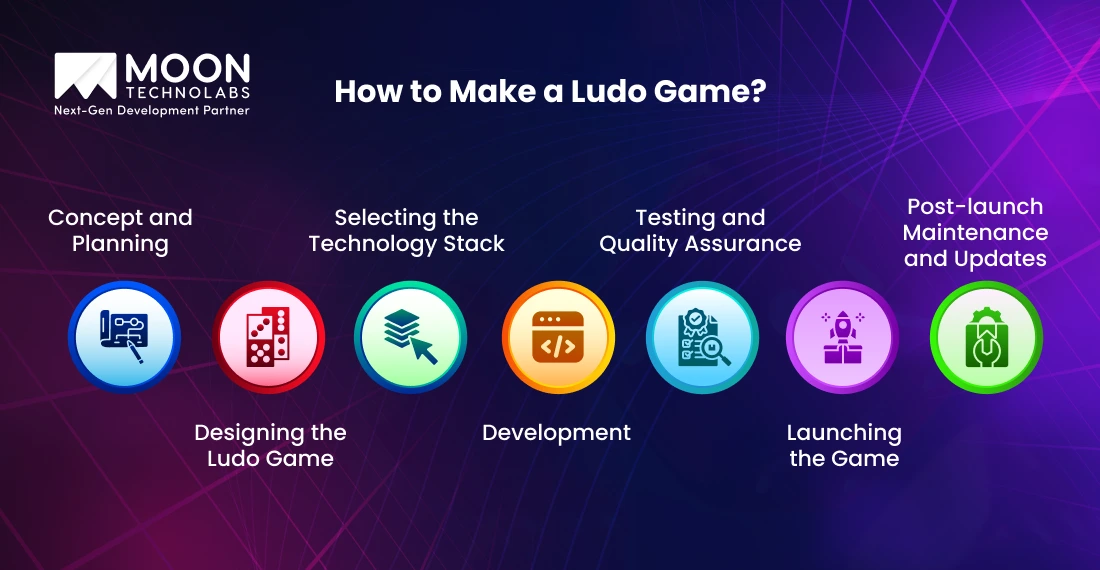
As we mentioned earlier, ludo game development involves several steps, from planning to coding and continuous optimization. The following is a detailed overview of all these steps:
The process of ludo game development starts with a thorough conceptualization and planning. This involves several steps, such as defining the vision, features, and target audience of the ludo game.
You need to decide whether it will be a simple 2D board game or also a 3D multiplayer version with tournaments and chat. During this phase, you need to consider the following important things:
The step involves crafting the game’s visuals and interactive elements. It includes the following crucial activities that designers perform to craft the final design:
Selecting an appropriate technology stack is necessary to determine a game’s actual performance, cross-platform compatibility, and scalability. Developers select varieties of technologies for different purposes:
It’s the major step of developing a Ludo app, which involves converting your ideas into a full-fledged Ludo game. In this stage, developers perform coding by implementing the following important things:
In this phase, QA professionals test the developed game thoroughly to ensure it performs well, is bug-free, and is stable. They conduct a variety of tests that are as follows:
After successfully conducting the testing, the development team launches the newly developed game. To do it successfully, they prepare marketing campaigns effectively while crafting a highly engaging app store listing. And they submit the game to various platforms such as the Apple App Store and Google Play Store.
The development team then promotes your newly developed game through influencer collaborations, social media, gaming communities, and more. These are indeed useful to boost visibility. Early user feedback is indeed helpful in making rapid improvements post-launch.
The game development process doesn’t end even after launching the newly developed game. It emerges with the help of continuous improvement, including multiple steps:
You Might Also Like:
Everything You Need to Know About Game Development Outsourcing
Ludo game development is a process to leverage a variety of technologies for various purposes. The following are the most common tools and technologies developers use frequently:
Being one of the most widely used programming languages, C# is especially popular for game development, especially with the Unity Engine. Be it object-oriented structure, clean syntax, or a robust library, it includes everything to build a robust ludo game.
This programming language is ideal for creating game mechanics, movement logic, dice-roll algorithms, and more. By using C#, the developers craft responsive gameplay experiences across a range of platforms.
Developers integrate this programming language with Unity, ensuring highly efficient debugging, quick prototyping, real-time rendering, and more. These are necessary for multiplayer board games, including Ludo.
As a Google-supported platform, Firebase plays an indispensable role in ludo game development. The development team uses it to handle user authentication, real-time database management, cloud messaging, and more.
Firebase is the perfect option for a game that relies extensively on real-time interaction between different players. It ensures fast data updates—player moves, dice outcomes, leaderboard changes —without delays.
It also supports push notifications, cloud storage, crash reporting, and more. These allow developers to maintain smooth gameplay and improve user retention.
With a powerful backend infrastructure for hosting, Amazon Web Services (AWS) plays a vital role in scaling and managing ludo games. Developers leverage it to deploy game servers, store vast amounts of game data, and manage concurrent player counts.
Whether it’s AWS Lambda or Amazon EC2, these services are necessary to ensure reliable performance while ensuring cost-efficiency. On the other hand, AWS GameLift enables session management and multiplayer matchmaking. It makes AWS a highly important tool to ensure the scalability and stability of larger-scale ludo games.
Highly regarded for its cutting-edge 3D rendering, Unreal Engine is a top choice for developers seeking to craft visually rich, interactive ludo games. It provides a powerful visual scripting system that allows fast game design even without in-depth expertise.
Unreal Engine supports quality graphics and cross-platform deployment. It thus improves the overall gameplay experience, especially for AR or 3D-based ludo game versions.
Kotlin is the perfect choice for creating Android games. It’s considered to be a well-known programming language. It integrates perfectly with Android Studio and lets developers write safer, cleaner, and more concise code.
This programming language simplifies UP design, improves performance, enhances app stability, and more across various Android devices. These ensure players have a bug-free, responsive experience.
Our developers help you build viral and custom ludo games based on your vision. We implement multiplayer mode, engaging design, revenue-ready features, etc.
Let’s Build Your App Now
Well, the average cost of creating a ludo game ranges $20,000 to $50,000 or even more. It also depends on many important factors, such as features, complexity, the team’s location, platforms, and more. Let’s have a complete breakdown of the Ludo game development cost:
Apart from the above, additional costs may arise when integrating NFTs, AR/VR, AI-based matchmaking, and more. The reason is that it maximizes development time and thus your overall budget.
You need to understand that your total investment depends on your actual goals, whether you’re creating a scalable, simple, or revenue-generating ludo platform.
The gaming industry evolves continuously. Let’s discuss some of the upcoming trends that have a major impact on building a ludo game app:
As emerging, top-rated technologies, AR & VR have revolutionized traditional board games by crafting interactive experiences and creating immersive ones.
In Ludo, AR projects the board and pieces into a real-world environment, letting players experience the gameplay fully on any device.
Apart from this, VR offers a 3D environment that allows users to interact with opponents and the board as if sitting together in the same room. This trend redefines how players interact and engage socially in digital spaces.
Blockchain brings complete ownership and transparency to a ludo game ecosystem. Players get the ability to buy, earn, and trade in-game assets, including NFTs, like boards, custom tokens, avatars, and more.
Blockchain offers the potential for secure transactions, prevents fraud, and enables developers to craft a complete decentralized reward system. This model works perfectly to improve reliability but also promotes long-term engagement by letting players get true ownership of their complete digital assets.
When it comes to cross-platform compatibility, it has become a great expectation among players. Whether on iOS, Android, or in web browsers, players want to compete smoothly with friends.
Developers now seek cloud-based multiplayer systems that sync data in real time, offering a completely unified experience across devices. This trend tends to expand reach, thereby improving a more diverse, larger player base.
AI is revolutionizing ludo game development in several ways, including adaptive gameplay, smart matchmaking, and more. AI algorithms can analyze players’ behavior to ensure perfectly balanced matchups and a completely fair competition.
Apart from this, AI-driven bots offer an engaging solo experience, especially when opponents are unavailable. It makes gameplay more personalized and dynamic.
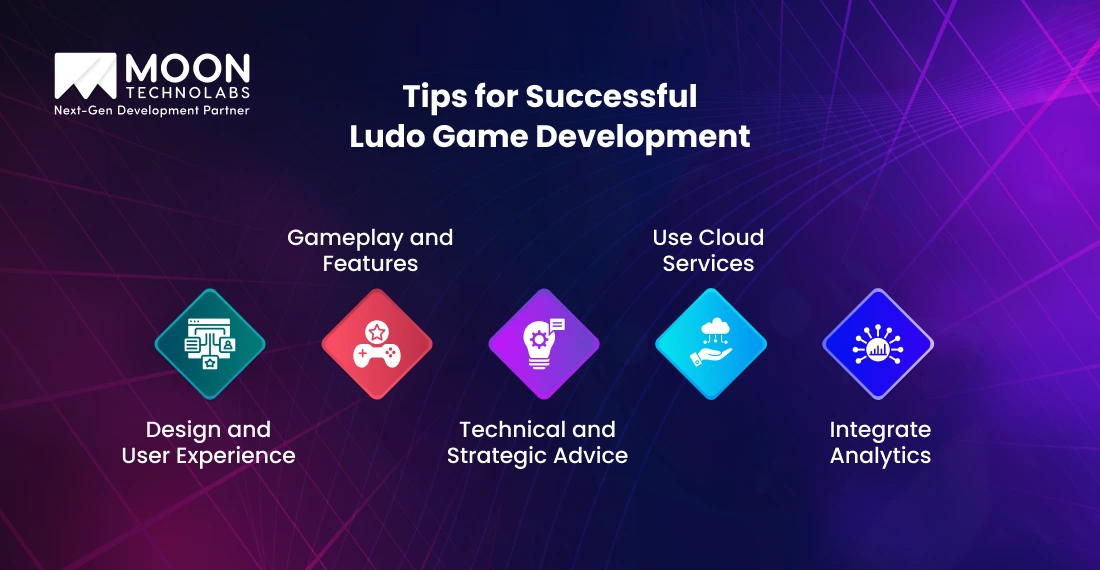
Building a successful Ludo game requires a proven strategy. It’s a highly responsible task that must be carried out properly. Let’s explore tips and tricks to perform the task properly:
The UI/UX serves as a foundation of any engaging ludo game. A highly intuitive and clean interface enables users to keep playing. Meanwhile, poor design causes significant frustration and, as a result, complete drop-offs.
To craft the best design and user experience, you need to implement the following important practices:
A powerful gameplay mechanic is crucial for retaining users. Many modern players often expect much more than only rolling dice. They also look for entertainment, social connection, and more. To do it effectively, you need to consider the following important things:
Your game needs to be technically solid to become highly stable, scalable, and fast. It’s important to take into account a well-crafted technical approach to ensure smooth performance and a highly sustainable development lifecycle.
To make your game technically sound, you need to implement the following important tips:
Cloud-based services are indeed necessary for advanced multiplayer games, including Ludo. Whether it’s Firebase or AWS, these platforms can handle data storage, authentication, leaderboards, real-time communication, and more with greater efficiency.
Cloud integration is useful in the following important ways:
Analytics provide you with a clear insight into how users engage with your game. Many popular analytics tools can track several metrics, including churn rate, session duration, in-app purchases, and more.
By using the analytics tools, you will be able to gather the following details:
We specialize in creating a ludo game that attracts players and keeps them engaged longer. Our developers implement smooth gameplay, interactive design, etc.
Share your Project Details
As the most sought-after game development company, we specialize in creating powerful ludo games. We have the expertise to build scalable, feature-rich, and visually appealing games.
Our developers harness the full potential of technologies like Unreal Engine, Unity, AWS, Firebase, and others to deliver real-time multiplayer functionality, seamless gameplay, secure backend integration, and more. We provide end-to-end services, from conceptualization to final deployment and post-launch support.
If you’re looking to hire game developers with proven expertise in building engaging ludo games, our team offers the right blend of creativity and technical skills.
Apart from this, our developers also possess expertise in leveraging robust technologies such as Blockchain, AR/VR, AI, and others to craft a next-generation gaming experience. We help businesses launch attractive, revenue-driven ludo games.
Rather than just a simple board game, ludo game development has evolved into an interactive, tech-driven experience. It has also redefined social gaming through innovations like AI matchmaking, AR/VR, and Blockchain.
To develop a scalable and engaging game, developers need to combine a perfect strategy, creativity, and the right tech stacks. Partner with us to create a ludo game that can engage a global audience.
01
02
03
04
05

Jayanti Katariya is the CEO of Moon Technolabs, a fast-growing IT solutions provider, with 18+ years of experience in the industry. Passionate about developing creative apps from a young age, he pursued an engineering degree to further this interest. Under his leadership, Moon Technolabs has helped numerous brands establish their online presence and he has also launched an invoicing software that assists businesses to streamline their financial operations.


Submitting the form below will ensure a prompt response from us.
We refine our expertise to deliver innovative business solutions.





500 N Michigan Avenue, #600, Chicago IL 60611
13500 Long Is Dr, Pflugerville, TX 78660, USA

C-105, Ganesh Meridian, S.G. Highway, Ahmedabad, GJ 380060


 France
“ I highly recommend Moon Technolabs as the quality of service is wonderful. We have hired this company to develop the product based on some complex & technical issues. We get the best quality services as compared with others in the market. Huge Thanks to Moon Technolabs as the team is always ready to give the solution all time.”

 USA
USA“ Moon Technolabs is a pioneer in the WebRTC based project as they have fixed complicated segments of the module by fulfilling different product lines by providing 24X7 customer support. We really recommended Moon Technolabs as they are able to develop products as per the module deadline and project timeline.”

 Germany
“I am happy to recommend Moon Technolabs for their app development services. They successfully developed apps for me, and I am highly satisfied with the overall outcomes. The development team has swiftly addressed the issues with responsive and effective communication to understand the requirement quickly and actively resolve the back-and-forth problems that arose...”
 USA
USA“Moon Technolabs is the best company that provides advanced apps and websites development services in the USA and Europe. I am a newbie to develop my app with an external team. I am really happy to work with them as I am not that much mobile apps user. Here, the team and specially the CEO of Moon Technolabs helps me to let me know about the benefits of my app to generate revenue....”


