
Jayanti Katariya
Last Updated: March 19, 2026 Total Views: 384
Table of Content


Blog Summary:
This guide explains the entire IoT development process by covering its various important steps. From basics to the development cost, it discusses everything with clarity. Keep reading the entire post to successfully carry out your project development.
Table of Content
Rather than only being passive tools, machines are now active participants in how businesses operate. Since industries nowadays frequently go for automation, the demand for connected devices is growing tremendously. Statista predicts that the number of connected IoT devices worldwide is likely to exceed 40.56 billion by 2034, reflecting how organizations leverage this technology.
Meanwhile, developing a connected ecosystem is much more than just connecting devices to the internet. It requires a complete IoT Development process to ensure security, scalability, and smooth data flow. It involves several stages that play an important role in defining use cases, integrating cloud platforms, etc.
In this guide, we will discuss the entire IoT development process in detail. Let’s get ready to explore.
The IoT is a network of physical devices connected to the internet. They use sensors for various purposes, such as gathering and exchanging data, without constant human intervention.
In addition to sensors, IoT devices use software and various connectivity technologies to communicate with one another smoothly, often through a centralized system.
IoT solutions are nowadays common among many industries, including smart homes, manufacturing, and logistics. They are useful for organizations seeking to automate the entire process and make data-driven decisions. The following are some of the most common types of IoT ecosystems:
IoT enables businesses to boost efficiency, reduce operational costs, and create scalable, smart digital solutions.
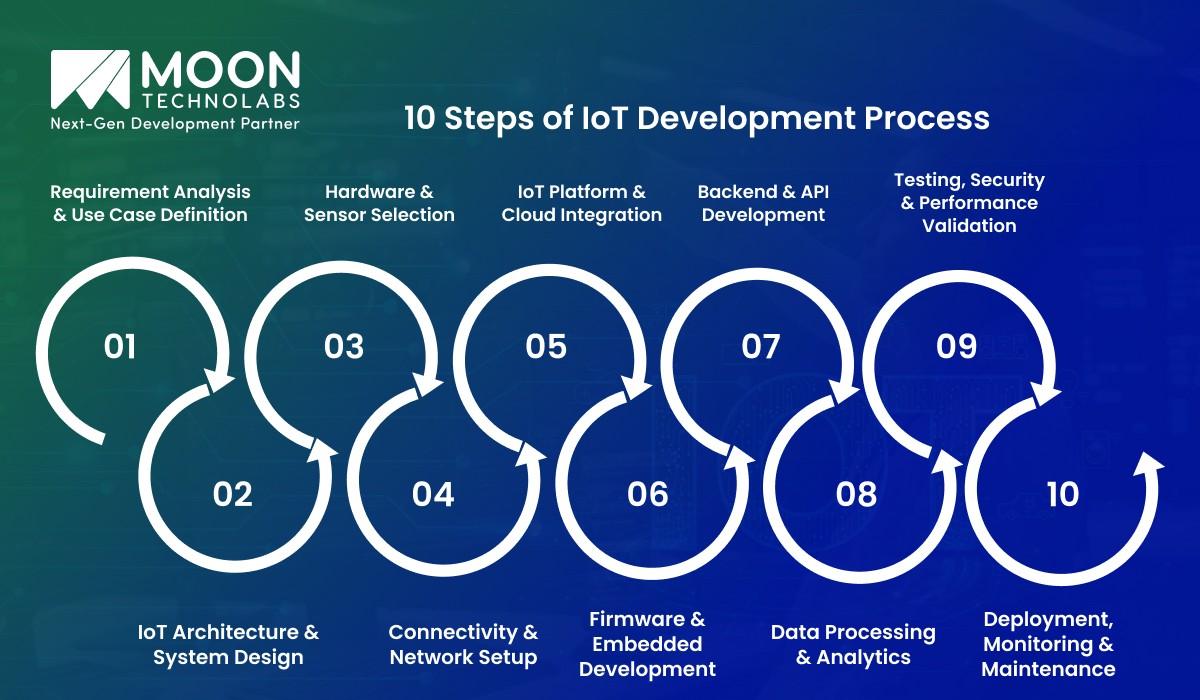
An IoT development process consists of myriad steps, each serving a distinct purpose. Let’s have a look at each step to understand the entire development process:
The IoT development process starts with defining problems that your app can solve. This stage is crucial and involves gathering details of business requirements, identifying operational challenges, and determining clear objectives for the IoT system. During this step, you need to focus on the following things:
You can start by identifying practical use cases. For instance,, IoT sensors detect unusual patterns, monitor equipment performance, and trigger early maintenance alerts in a smart manufacturing environment. When these use cases are clearly outlined, they help you guide technical decisions in the later stages of the development process.
Once you finalize your app project requirements, designers can create the entire IoT architecture. This step serves its core purposes of defining how networks, devices, apps, and cloud platforms interact.
An IoT architecture includes the following layers:
Architects are responsible for making a final decision whether to use edge computing, cloud computing, or a hybrid model for the system. When it comes to edge computing, it’s used mainly for real-time processing, including healthcare monitoring or industrial automation. It’s wise to build an architecture that supports efficiency, scalability, data flow, and easy future system upgrades.
Needless to say, hardware is the foundation for an IoT solution. So, you should spend enough time with your development team to select the right sensors and devices necessary for data collection.
Besides, hardware is also necessary for long-term system reliability. During the process of its selection, you need to focus on the following things:
We can take the example of a smart agriculture solution that uses weather sensors, soil moisture sensors, and GPS modules to monitor crop conditions and irrigation levels.
So, it’s advisable to choose hardware that comes with energy efficiency and durability. Make sure it allows your IoT system to work continuously in real-world environments.
A successful IoT device communicates smoothly. And for this, a connectivity layer is required. So, you should select communication technologies according to bandwidth, range, and power consumption. The following are some of the common connectivity options:
As far as network design is concerned, it’s all about choosing the perfect communication protocols such as HTTP, MQTT, or CoApp. These ensure an efficient data transmission between servers and devices. A perfect network setup is important for maintaining stable connectivity, even when devices are used across vast geographical distances.
An IoT platform offers the necessary infrastructure to store data, manage connected devices, and ensure real-time communication. Developers do integration of devices with cloud platforms that provide the following crucial services:
Cloud platforms make it easy to scale the IoT system as the number of connected devices grows. It allows businesses to process large volumes of data without affecting system performance. Cloud integration also ensures access to IoT data from mobile apps, dashboards, and enterprise systems.
Firmware is software that runs on IoT devices. It determines how devices communicate with networks, how sensors collect data, and how they respond to commands.
At this step, developers create an embedded software with the potential to handle the following important tasks:
It’s essential to optimize firmware for stability, low power consumption, and security. The reason is that most IoT devices have limited processing resources. Firmware updates enable remote upgrades while ensuring devices remain highly secure and compatible with increasing system requirements.
In an IoT app, the backend is critical, managing user interactions, device communication, and data. Developers build server-side systems that gather data from IoT devices and then process it for apps. They include the components as follows:
APIs enable various components of the IoT ecosystem to communicate effectively with one another. For example, a mobile app typically retrieves real-time device data via backend APIs.
A powerful backend architecture is necessary to enable IoT systems to support a large number of connected devices.
The major benefit of an IoT solution is its ability to convert raw sensor data into meaningful insights. This is, of course, an important step that focuses mainly on processing incoming data and also implementing analytics techniques. IoT analytics include the following important things:
We can take an example of a smart logistics system. In this, analytics provide details on fuel usage and vehicle locations, and predict maintenance needs. Effective data processing enables businesses to make decisions fast while optimizing operational performance.
Thorough and rigorous testing is necessary for the newly developed IoT system. The main reason is that an IoT solution includes both software and hardware components. In this, testing is carried out across multiple layers. The following are some of the vital testing activities:
Security is of great importance in an IoT environment. Developers implement security measures such as encryption, device authentication, access control, and secure boot mechanisms. These measures help protect sensitive data while keeping unauthorized users out.
After passing all tests successfully, the system is ready for production deployment. Your team installs the IoT devices on-site, connects them to the necessary infrastructure, and configures them to communicate seamlessly with the cloud platform.
But the IoT development process doesn’t stop after the end solution is deployed. The team continuously monitors and maintains the system to ensure a reliable performance. Let’s have a look at the important post-deployment activities:
Proper maintenance ensures that the IoT ecosystem is reliable, secure, and adaptable to evolving requirements over time.
We extend our best possible assistance to create a smart IoT. Our solution connects multiple devices, gathers real-time data, and enhances operational efficiency.
Well, the cost of IoT development isn’t fixed for every solution. It varies based on several factors, such as hardware requirements, complexity, and deployment scale. You are advised to keep in mind both development expenses and long-term operational costs when planning to develop an IoT solution.
Let’s have a look at many other factors that have a direct impact on the IoT development cost:
If you wish to develop a basic IoT solution, its cost ranges from $30,000 to $60,000. On the other hand, developing a complex or enterprise-grade IoT solution can cost up to $200,000.
Meanwhile, you can optimize development costs through proper planning and architectural design while ensuring long-term scalability.
We make your IoT app development project successful. Our developers launch your tailored IoT app, turning connected devices into robust business solutions.
With decades of experience building IoT solutions, we turn your ideas into scalable, secure solutions. We have vast expertise in cloud integration, embedded systems, and data analytics. Our developers build end-to-end IoT apps tailored to match any specific industry requirements.
Whether you’re building a connected product or upgrading your current infrastructure, our team is ready to support you throughout the process. We help you with our development expertise, technical guidance, and long-term support to build and maintain a world-class IoT ecosystem.
We serve our clients with a variety of IoT software development solutions as follows:
Developing the right IoT solution requires a planned development process. It should align connectivity, devices, data intelligence, and software. You need to spend enough time selecting the appropriate hardware, implementing analytics, and integrating cloud platforms.
Meanwhile, doing all these requires professional assistance. Partner with an IoT app development company like ours to successfully manage your project and develop the desired solution.
01
02
03
04
05

Jayanti Katariya is the CEO of Moon Technolabs, a fast-growing IT solutions provider, with 18+ years of experience in the industry. Passionate about developing creative apps from a young age, he pursued an engineering degree to further this interest. Under his leadership, Moon Technolabs has helped numerous brands establish their online presence and he has also launched an invoicing software that assists businesses to streamline their financial operations.


Submitting the form below will ensure a prompt response from us.
We refine our expertise to deliver innovative business solutions.





500 N Michigan Avenue, #600, Chicago IL 60611
13500 Long Is Dr, Pflugerville, TX 78660, USA

C/105 Ganesh Meridian, S.G. Highway, Ahmedabad, GJ 380060


Ayse D.
Co-Founder France
“ I highly recommend Moon Technolabs as the quality of service is wonderful. We have hired this company to develop the product based on some complex & technical issues. We get the best quality services as compared with others in the market. Huge Thanks to Moon Technolabs as the team is always ready to give the solution all time.”

Justin G.
Founder & CEO USA
USA“ Moon Technolabs is a pioneer in the WebRTC based project as they have fixed complicated segments of the module by fulfilling different product lines by providing 24X7 customer support. We really recommended Moon Technolabs as they are able to develop products as per the module deadline and project timeline.”

Flavio S.
Founder & Managing Director Germany
“I am happy to recommend Moon Technolabs for their app development services. They successfully developed apps for me, and I am highly satisfied with the overall outcomes. The development team has swiftly addressed the issues with responsive and effective communication to understand the requirement quickly and actively resolve the back-and-forth problems that arose...”

Jay M.
Founder & CEOUSA“Moon Technolabs is the best company that provides advanced apps and websites development services in the USA and Europe. I am a newbie to develop my app with an external team. I am really happy to work with them as I am not that much mobile apps user. Here, the team and specially the CEO of Moon Technolabs helps me to let me know about the benefits of my app to generate revenue....”


Our Offices
India
C/105 Ganesh Meridian,S.G. Highway, Ahmedabad, GJ 380060USA
500 N Michigan Avenue, #600, Chicago IL 60611Contact Information


