
Jayanti Katariya
Last Updated: February 10, 2026 Total Views: 714
Table of Content


Blog Summary:
This blog provides comprehensive details on how iOS game development catalyzes innovation through robust technologies and lucrative monetization models. We discuss iOS game development technologies, game types, development steps, key features, and more. Keep reading to explore.
Table of Content
Mobile gaming is much more than just a game and has become a multi-billion-dollar innovation hub. And when it comes to the right mobile development platform, iOS stays at the top. According to Business of Apps, iOS has claimed $47.7 billion of overall game revenue.
iOS Game Development uses technologies like ARKit for AR, Metal for graphics, Core ML for AI, and more. These tools let developers create highly immersive, realistic games.
Whether it’s user engagement metrics or stability performance, the iOS ecosystem makes it a perfect fit for innovation in monetization and design. Let’s discuss more about how iOS game development accelerates innovation.
iOS is one of the most widely used platforms for game development, thanks to its ability to provide a high-performance environment for creating high-performing games. Let’s understand some other reasons why this platform emerged as a good choice:
Apple has not only a vast but also a loyal user community. They are always ready to pay for premium experiences as well. Those who use devices like the iPad and iPhone often seek quality-based and highly engaging games.
They don’t mind spending on premium content and in-app purchases. It creates a reliable, highly lucrative audience for developers of value-driven iOS gaming apps.
When it comes to revenue potential, iOS has an edge over Android. The main reason is that Apple attracts most of those users with high purchasing power. And they are from all across the world. This makes iOS game app development a strategic move for business.
One of iOS’s unmatched strengths lies in its highly integrated ecosystem. Whether it’s hardware or software, Apple has good control over everything. It ensures great performance across a range of devices, reducing compatibility issues.
With this platform, developers can get advantages from smooth frame rates, optimized graphics, responsive touch controls, and more. And they develop a game that provides an outstanding experience.
Since Apple maintains a stringent security standard, iOS games are protected against data breaches, malware, unauthorized access, and more. Developers can leverage security APIs and powerful encryption to develop trust among players who value both data protection and privacy.
Apple’s developer ecosystem includes major tools such as TestFlight, Xcode, Metal, and more. With these tools, developers can streamline the entire game development process, from coding to testing to optimization.
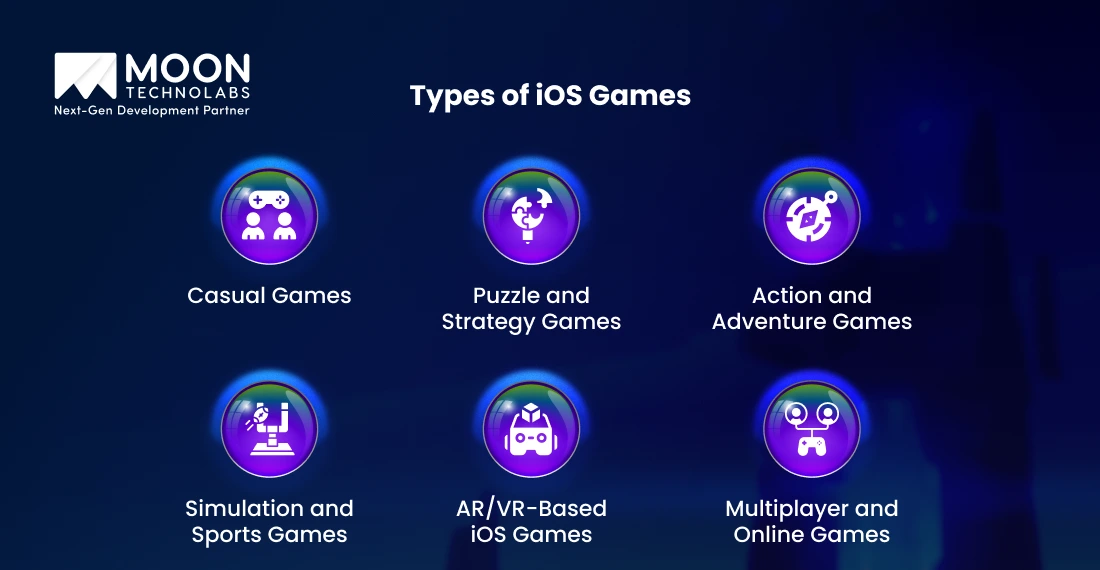
The iOS platform caters to a wide range of audiences, including people of different ages and interests. Developers build a variety of games, including immersive AR experiences, simple casual titles, and more. Let’s explore some of the popular iOS games:
When it comes to casual games, these are among the most downloaded games on the iOS platform. They are the most-played games among players for their quick, highly accessible nature.
Casual games are a good choice for users looking for light entertainment. These game categories feature minimal learning curves, simple controls, engaging loops, and more.
Puzzle and strategy games are another popular genre of games that the iOS platform allows developers to build. They are best for those who use planning, logic, creativity, and related skills. On iOS, this genre of game flourishes mainly because of the platform’s attributes, such as high-resolution displays and touch responsiveness. It also improves user experience.
With these games, players can explore complete missions and expansive worlds and engage in dynamic combat. This genre of game enables developers to experiment with character customization, complex mechanics, cross-platform play, and more.
When it comes to simulation and support games, these indeed bring both interactivity and realism together. With these games, players can have diverse experiences, from managing virtual farms and cities to experiencing real-life sports. These include cricket, football, racing, and more.
On iOS, developers leverage ARKit to craft a complete, lifelike experience that combines the physical and digital worlds. Pokémon Go is the best example of an AR game.
It has revolutionized mobile gaming by fostering interaction and exploration with real-world locations. This genre of game boosts engagement while improving creativity.
iOS offers a smooth network integration by enabling social interactions, co-op missions, and real-time matches. It allows players to join global leaderboards, challenge friends, and participate in live events that maximize community engagement. Many top-notch game genres under this important category include card games, battle royales, online RPGs, and more.
We help you create top-performing games that attract users and maximize engagement. Let’s empower your brand with smooth gameplay and high performance.
Developing a powerful iOS game requires a powerful combination of tools, frameworks, and technologies. We will discuss some of the most popular ones:
iOS developers have a variety of programming languages at their disposal when creating a game that players love to play. Some of the top programming languages are as follows:
Swift is the most sought-after programming language for iOS game development. Developers use it to create games that work on diverse Apple platforms. This programming language is well-known for its range of safety features and clean syntax.
Developers use it to write highly effective, expressive code. They can use this programming language with frameworks such as SceneKit, SpriteKit, and more to create 2D and 3D games that perform outstandingly.
It’s one of the oldest programming languages for iOS game development. For game developers, this programming language has become a trustworthy choice, especially those who wish to access Apple’s API.
This is possible mainly due to its mature ecosystem and dynamic runtime. The majority of iOS developers blend this programming language with Swift to harness both modern coding benefits and performance.
Developers use C# to create reusable scripts that work better across a range of platforms. These include consoles, Windows, Android, and more. Due to this flexibility, C# is specifically highly important for businesses seeking to release games on iOS and other platforms. And they can do it even without rewriting code from scratch.
Game engines are highly important for enabling developers to perform multiple activities, such as creating interactive environments, rendering graphics, and handling animation, physics, and sound. The following are the best choices for game engines:
As a versatile iOS game engine, Unity primarily supports 2D and 3D game development. It integrates perfectly with Xcode or any final implementation.
It’s perfect for iOS developers who want to craft visually rich games with less complexity, thanks to features like a built-in physics engine, a powerful asset store, and C# scripting. Besides, it also supports ARKit and enables developers to craft augmented reality experiences for a range of iOS devices.
Powered by Blueprint Visual Scripting and C++, Unreal Engine is a good option for world-class, graphically intensive games. It includes rendering capabilities that enable developers to generate console-level visuals on both iPads and iPhones. Whether it’s particle effects, advanced lighting, or cinematic tools, Unreal Engine is ideal for adventure games for numerous reasons.
Being Apple’s native 2D game development framework, SpriteKit offers animation, built-in physics, and rendering, several features optimized mainly for iOS hardware. It can be integrated better with Objective-C and Swift.
This ensures a smooth gameplay with minimal lag. It’s a good option for puzzle- and casual-style games that require responsive graphics and fast loading times.
SceneKit provides an Apple-native alternative to popular engines such as Unreal and Unity for 3D games. It simplifies animation and 3D rendering with a declarative SPI and supports both programming languages, Objective-C and Swift.
Developers can integrate this programming language with ARKit, making it a perfect choice for building AR-based iOS games without relying on external frameworks.
Being a cross-platform, open-source framework, Cocos2d-x harnesses the power of C++ to develop 2D games. It’s lightweight yet highly effective with higher performance and flexibility.
The framework supports a wider range of scripting languages, such as JavaScript and Lua. These make it a perfect option for developers looking for profitability across a range of platforms.
Whether it’s an integrated development environment (IDE) or development tools, both are equally important for coding, integration, and debugging. Let’s understand some of the most popular development tools:
As Apple’s official IDE, Xcode serves as a central hub for developing iOS games. It supports a range of programming languages, including Objective-C, Swift, C++, and more, with a full suite of code development, debugging, and testing tools.
Developers can integrate it with Metal, Interface Builder, Simulator, and more. These enable developers to test performance on virtual devices before real implementation.
Developed by JetBrains, AppCode is a robust IDE alternative. It supports a range of programming languages, including Objective-C, Swift, and more. It also offers refactoring tools, intelligent code analysis, and seamless integration, especially with Xcode projects.
CocaPods serves as a dependency manager for Objective-C and Swift projects, simplifying the integration of frameworks and third-party libraries into iOS games. It offers the potential to streamline dependency management while keeping your project structure fully organized, whether you need analytics, networking, or animation libraries.
When testing iOS, QA professionals have a variety of tools at their disposal. Some of these are as follows:
With TestFlight, developers can easily share a pre-release version of their game with QA professionals. And get valuable feedback before the game’s final launch. This tool streamlines crash reporting, user management, performance tracking, and more. These are indeed necessary tools for QA.
As Apple’s built-in testing framework, XCTest enables developers to test for performance issues. It also helps them discover even logic errors early during the development cycle. Developers can easily integrate this tool with Xcode, enabling continuous integration and automated test runs.
Developed by Google, Firebase offers crash reporting, real-time analytics, performance monitoring, and more. It’s primarily used in iOS games to monitor engagement, track user behavior, and manage in-app purchases. Apart from this, its cross-platform nature makes it ideal for developers who need to manage both Android and iOS versions simultaneously.
Fastlane works better when you wish to automate repetitive development tasks, such as creating, testing, and releasing applications. It also removes complications in screenshot generation, code signing, App Store uploads, and more.
These help developers save their valuable time even during deployment. One can integrate it more effectively with CI/CD pipelines and Xocode, which enable smooth, fast delivery cycles.
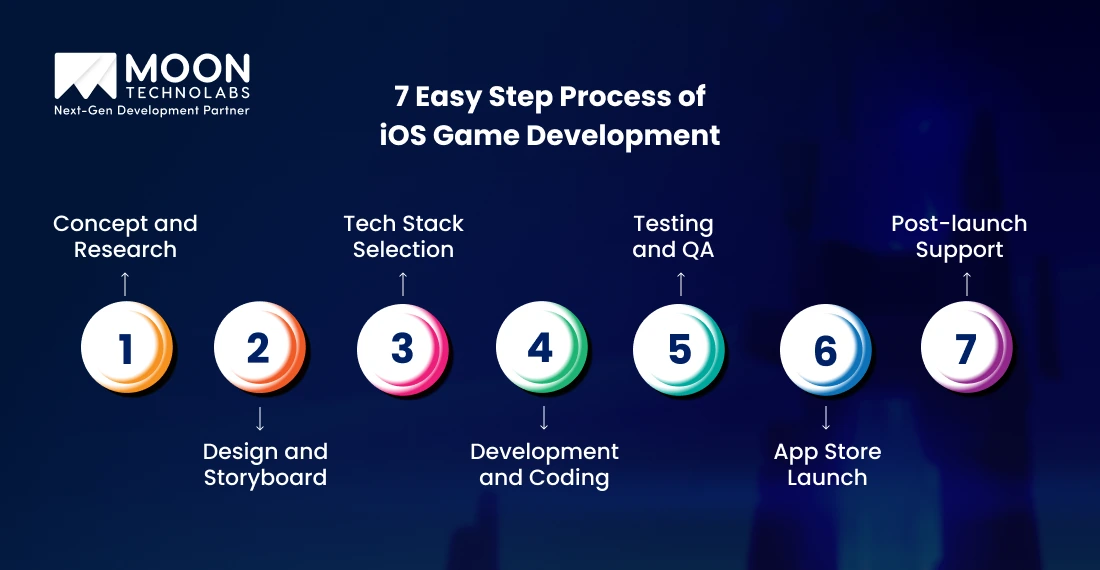
Developing iOS games involves multiple steps to create a high-performing, engaging final product. We will discuss each step in detail:
The conceptualization stage involves discussing game development ideas, core mechanics, genre, target audience, unique selling points, and more. It also involves extensive market research, including audience preferences, competitor games, current trends, and more. Using these details, developers can easily find gaps and opportunities to make their game mindblowing.
After finalization of the game development concept, designers craft characters, storyboards, user interfaces, environments, and more. This is an important stage that determines the game’s overall appearance and experience.
Designers create wireframes and mockups to visualize level designs, user flows, interactions, etc. The major objective is to provide visual consistency and intuitive gameplay across a range of iOS devices.
Choosing cutting-edge technologies is essential for determining a game’s overall performance and scalability. In this stage, developers choose the right programming languages and game engines based on the project requirements. In addition, developers select a range of supporting tools for physics, animation, and sound design.
In this step, developers convert your game development idea into reality. They write core game logic, implement gameplay mechanics, integrate visual assets, and more. Besides, a perfect collaboration among designers, developers, and testers ensures that every feature aligns better with performance objectives and the original design.
This phase serves its core purpose: ensuring the final product is bug-free. QA professionals leverage XCTest and TestFlight to test performance, gameplay, and compatibility across a range of iOS devices. Getting user feedback from beta testing helps refine the overall game before launch.
After the testing process is complete, the development team prepares for the game’s final launch. They submit the app to the Apple App Store in accordance with its criteria. And they prepare screenshots, metadata, descriptions, etc., accordingly.
In this stage, developers monitor the app’s performance. They also check a variety of issues in analyzing performance, releasing updates, resolving issues, and more. They do daily content updates to keep the app engaging among players while ensuring its long-term success.
We help you turn your innovative idea into compelling games with our expertise in iOS game development. Stay in touch to discuss your projects.
One thing you need to understand is that any game delivers a smooth, immersive experience only when it includes the necessary features. The following are some of the features you can consider to integrate into your game:
You need to understand that intuitive, responsive controls are essential for an outstanding gaming experience. The reason is that players often expect fluidity and precision in every move, whether it’s a simple tap-based buzzle or a complex action game. iOS devices provide motion sensors, touch responsiveness, and haptic feedback that developers use to make controls more dynamic.
Immersive sound design and top-quality visuals are essential for an amazing experience. Whether it’s the Metal graphics API or the powerful GPUs on iOS, developers can deliver realistic animations, console-level graphics, stunning effects, and more on mobile devices.
Audio is another important element that can make your game more attention-grabbing. Whether it’s ambient noise, soundtracks, or effects, ensure they align with your game’s mood and tone.
When it comes to flexibility, it’s highly important in gameplay modes. It improves both user retention and accessibility. Offline mode is necessary to allow players to enjoy the game anywhere, anytime, even without internet connectivity. On the other hand, online mode ensures co-op missions, multiplayer battles, and live events. These develop competition and community.
Social integration is highly significant for adding a community-driven, competitive edge to iOS games. Whether it’s friend challenges, Game Center leaderboards, or achievement sharing, these features often encourage players to stay active. Implementing social media sharing options improves organic reach and, in turn, increases Game’s visibility through word of mouth.
A powerful monetization model is essential to sustain developer profitability and, in turn, the game’s growth. Its major strategies include subscriptions, ads, in-app purchases, hybrid models, and more. The most important thing is that monetization should be rewarding rather than intrusive.
You need to ensure that advanced iOS games always support smooth progress syncing across a range of devices. Cloud works perfectly, saving synchronization and ensuring players can continue their journey, especially when they switch from iPhone to iPad.
iOS provides a range of revenue models that developers implement to increase profitability while maintaining an outstanding user experience. Let’s explore some of the top monetization strategies for games developed on this platform:
In-app purchases are indeed the most famous and highly profitable model for many iOS games. Players can purchase skins, power-ups, virtual items, additional levels, and more to improve their overall experience. The most important thing is to design purchases that seem optional yet quite valuable, so users can spend without feeling stressed.
The major advantage of advertising is a steady income stream, which is especially beneficial for free-to-play games. Rewarded video ads are effective since they improve engagement rather than disrupting it.
Other formats, such as banner ads or interstitials, should be used effectively to avoid interrupting gameplay. Your ads can maximize revenue even without compromising the user experience when implemented better.
Subscription-based models provide players with completely exclusive content, premium access, or ad-free experiences for a recurring fee. This approach offers consistent revenue and long-term engagement. For developers, it creates a fully predictable income stream, while players enjoy added value through ongoing content perks or updates.
Even though it’s not used as commonly nowadays, paid downloads can indeed be successful for story-driven, top-quality niche games and more. Players often pay upfront for a premium experience with no advertisement or any in-app purchases. It encourages users to look for one-time investments.
A large number of successful iOS games combine a range of strategies, including offering free gameplay supported through optional IAPs and ads. This kind of hybrid approach works better to diversify revenue and audience reach while offering flexibility across player preferences.
The future of iOS game development is more promising, backed by changing player expectations and technological innovation. Let’s discuss some of the future trends in detail:
AI and ML have redefined how games adapt to players. Developers harness the potential of AI to craft smarter NPCs, dynamic storytelling, personalized difficulty levels, and more. ML enhances player analytics, enabling developers to enhance engagement and refine gameplay experiences with data-driven insights.
The major evolution of cloud technology and 5G networks has transformed the performance of mobile gaming. Players can enjoy smooth multiplayer experiences with low latency and ultra-fast connectivity.
It also ensures real-time streaming of quality-based graphics. In addition, cloud gaming platforms allow users to play console-grade games on iPads and iPhones, even without any hardware requirements.
Cross-platform development is essential, especially as the gaming ecosystem continues to expand. Whether using Unreal Engine or Unity, these tools help developers build games that run smoothly on desktops and iOS and Android devices. It works well in widening audiences while simplifying updates.
When you work with us, we ensure your projects benefit from creative design, expert technical skills, and more. We specialize in using Unity, Swift, Unreal Engine, and more to ensure a fully optimized performance across a range of Apple devices.
From conceptualization to coding and launch, we can handle everything. We help you turn your game ideas into high-quality, engaging experiences that attract players and boost long-term success.
iOS game development remains a driving force of innovation in the mobile gaming industry. With Apple’s powerful ecosystem, cutting-edge tools like ARKit, Metal, and Core ML, and an audience willing to pay for quality experiences, developers have the perfect foundation to create groundbreaking games. From stunning visuals and seamless performance to advanced monetization opportunities, iOS empowers developers to push creative boundaries and deliver next-level gaming experiences.
As the future unfolds with technologies like AI, 5G, and cross-platform development, iOS games will only become more immersive, intelligent, and interconnected. Partnering with an experienced iOS game development company like Moon Technolabs ensures your gaming idea evolves into a captivating, high-performing product that stands out in the App Store and beyond.
01
02
03
04

Jayanti Katariya is the CEO of Moon Technolabs, a fast-growing IT solutions provider, with 18+ years of experience in the industry. Passionate about developing creative apps from a young age, he pursued an engineering degree to further this interest. Under his leadership, Moon Technolabs has helped numerous brands establish their online presence and he has also launched an invoicing software that assists businesses to streamline their financial operations.


Submitting the form below will ensure a prompt response from us.
We refine our expertise to deliver innovative business solutions.





500 N Michigan Avenue, #600, Chicago IL 60611
13500 Long Is Dr, Pflugerville, TX 78660, USA

C/105 Ganesh Meridian, S.G. Highway, Ahmedabad, GJ 380060


Ayse D.
Co-Founder France
“ I highly recommend Moon Technolabs as the quality of service is wonderful. We have hired this company to develop the product based on some complex & technical issues. We get the best quality services as compared with others in the market. Huge Thanks to Moon Technolabs as the team is always ready to give the solution all time.”

Justin G.
Founder & CEO USA
USA“ Moon Technolabs is a pioneer in the WebRTC based project as they have fixed complicated segments of the module by fulfilling different product lines by providing 24X7 customer support. We really recommended Moon Technolabs as they are able to develop products as per the module deadline and project timeline.”

Flavio S.
Founder & Managing Director Germany
“I am happy to recommend Moon Technolabs for their app development services. They successfully developed apps for me, and I am highly satisfied with the overall outcomes. The development team has swiftly addressed the issues with responsive and effective communication to understand the requirement quickly and actively resolve the back-and-forth problems that arose...”

Jay M.
Founder & CEOUSA“Moon Technolabs is the best company that provides advanced apps and websites development services in the USA and Europe. I am a newbie to develop my app with an external team. I am really happy to work with them as I am not that much mobile apps user. Here, the team and specially the CEO of Moon Technolabs helps me to let me know about the benefits of my app to generate revenue....”


Our Offices
India
C/105 Ganesh Meridian,S.G. Highway, Ahmedabad, GJ 380060USA
500 N Michigan Avenue, #600, Chicago IL 60611Contact Information


