
Jayanti Katariya
Last Updated: November 27, 2025 Total Views: 374
Table of Content


Blog Summary:
HMI Software Development drives industrial transformation, enabling seamless integration between humans and machines through the use of AI and real-time analytics. Industry leaders showcase how HMIs streamline operations, elevate safety, and deliver user-centric innovation. This blog will explore how and why modern HMIs are crucial for organizations seeking to enhance efficiency and succeed in a digital, automated future.
Table of Content
When the mechanical typewriter revolutionized human interaction with machines, it established the first tangible connection between humans and machines.
By transforming raw data into intuitive visual representations, HMI (Human-Machine Interface) becomes a digital bridge between humans and complex industrial machines & systems. It enables operators to monitor, optimize, and control the manufacturing processes.
Compared to traditional software, which primarily focuses on data processing, HMI software development prioritizes operator safety and real-time data visualization. It seamlessly integrates with other industrial hardware and software, which makes it fundamentally different from conventional business applications.
In this blog, we’ll explore how organizations in the industrial manufacturing sector can transition from hardware to software-centric technology with custom HMIs and increase productivity.
In industrial technology, traditional machinery hardware required extensive training but had limited operational flexibility. Earlier, the industrial control was dominated by process flow diagrams pasted on large walls.
With HMIs, the manufacturing industry underwent a transition from hardware to software-centric technology, giving rise to Graphical User Interfaces (GUIs). HMIs enabled operators to control machinery with human-machine interactions through touch screens.
The primary focus of HMI software is on exercising real-time industrial control and monitoring. The importance of developing HMI software cannot be overstated, as traditional software often focuses solely on managing business processes and data processing.
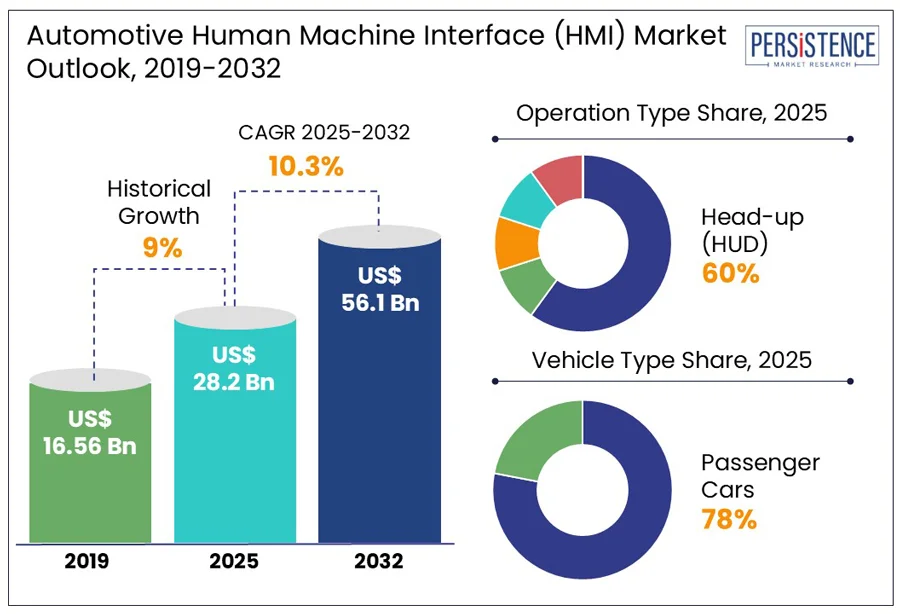
Moreover, the current market statistics of HMIs tell a compelling story of their impact across various industries. There are three segments where the market valuation reflects transformative growth.
In an industrial setting, multiple manufacturing processes are conducted simultaneously. HMI revolutionizes this interaction with its GUIs, which are more visual and intuitive, helping even operators with limited knowledge to create customized interfaces.
The input data received from the PLCs is displayed through HMI interfaces. Since HMIs are connected to PLCs (Programmable Logic Controllers), it’s easier for HMIs to integrate and interact with them.
PLCs and HMIs provide the automation and control necessary for managing complex processes, with response times measured in milliseconds. Together, they create a balance between executing control logic and managing inputs and outputs using the HMI user interface to interact in real-time.
Developing modern HMI solutions can be based on different architectural approaches. Each of those approaches addresses specific operational requirements. Based on different HMI architectures, your organization can invest in different types of custom software development.
As the world entered the digital age in the mid-1990s with the introduction of Windows OS, operators were able to control machinery using Operator Interface Terminals. It also enabled the migration of Distributed Control Systems to PCs, while creating the connectivity era through touch and network integrations.
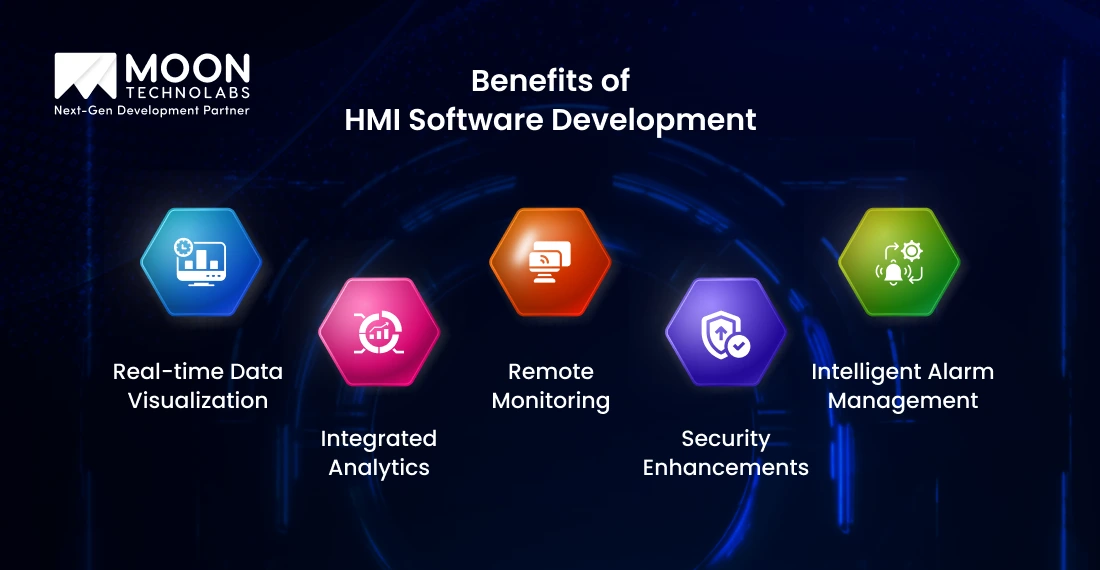
Industry-leading platforms have incorporated the sophisticated capabilities of HMI systems, enabling them to address pain points specific to each organization. Let’s explore in detail how expert software development consulting services for HMIs benefit them by solving their problems:
Organizations worldwide face challenges related to information overload and the effective interpretation of data. With an HMI solution, they can implement advanced data visualization tools and present complex information in an intuitive manner. Operators can also quickly identify trends and anomalies.
In manufacturing industries, it’s quite common to face unexpected equipment failures leading to costly downtime. With HMI, they can avail the benefit of integrated analytics, which can help them anticipate the wear and tear of equipment. Ultimately, it helps prevent costly downtime and also optimizes production schedules.
Manufacturing organizations often have limited operational visibility, making it challenging to manage machines remotely. Integrating HMI software enables digital transformation for manufacturing organizations, providing cloud and mobile capabilities that allow for remote monitoring and control of machines from any location.
They can access real-time data, receive alerts, and obtain information related to equipment performance, all of which can be easily accessed via smartphones.
Industrial systems are often interconnected, which can lead to cybersecurity vulnerabilities if proper safeguards are not in place. HMI solutions offer secure boot, robust network security protocols, and data encryption, protecting against unauthorized access.
Operators can implement multiple security measures, such as multifactor authentication and a VPN (Virtual Private Network), to enhance the security of remote access.
Since manufacturing facilities are crowded with numerous machines, operators can often miss critical warnings, leading to alert fatigue.
With an intelligent alarm management system, an HMI solution provides precise alarm notifications that include contextual data, ensuring timely and accurate responses. Operators can prioritize which responses they need to see based on the critical situations while also minimizing disruptions.
Stop wasting hours on manual monitoring. Integrate real-time monitoring to reduce downtime, boost team productivity, and eliminate repetitive manual tasks.
With HMIs, complicated control panels transformed from controlling a single machine into an enhanced user interface. It helps enhance operations and brings greater efficiency to industrial processes. Let’s understand its applications in detail:
HMIs transform industrial manufacturing processes into smart factories by enhancing safety and enabling the collection, analysis, and utilization of data. With manufacturing automation solutions, operators can easily monitor and control all the processes, which eventually increases productivity.
Apart from offering real-time monitoring for machines and optimizing schedules, HMIs also help reduce scrap and waste production.
In healthcare, HMIs provide support for medical device interfaces, transforming the landscape of patient care. In such life-critical sectors, automated HMI solutions have been reported to offer a 12% reduction in operating downtime. Medical device manufacturers can save up to 14000 operational hours by integrating HMIs with healthcare IoT solutions.
HMIs also enhance automotive productivity by combining traditional physical features with digital capabilities. They are packed with touchscreens, swipe and gesture recognition, speech recognition, along with rotary controllers and push buttons.
For example, BMW implements HMIs with gesture control operations to enhance safety and control through hands-free operations.
Another sector that has been transformed by HMIs is the energy and utilities sector, offering more granular system control. With real-time monitoring of energy consumption, operators gain valuable insights that help them reduce energy consumption and lower operating costs.
The traditional software, which typically relied on cumbersome manual panels with gauges, indicators, switches, and push buttons, was replaced by intuitive screens. HMIs were developed keeping in mind that they had to operate in hazardous industrial manufacturing areas.
With reduced reliance on keyboards and mice, this era introduced modern HMIs with enhanced safety features and user interfaces. As modern systems started integrating cloud computing servers to access multitouch video technologies, tablets, and smartphones, it became easier to access, monitor, and control them from any global location.
Let’s explore the future innovations across different technologies that are used in HMI software:
The future of HMIs is unprecedented, driven by AI and ML algorithms. Together, they will enable prediction and optimization of processes, thereby reducing downtime and boosting efficiency. By utilizing AI for machine monitoring through predictive maintenance systems, organizations can expect to reduce their maintenance costs by 30%.
Another impactful innovation is multimodal HMIs, which combine voice/speech recognition, touch and gesture input, and intelligent context-aware agent support. Next-gen voice assistants with haptic feedback integration are one of the key developments in this area.
Augmented and Virtual Reality enable operators to overlay digital information onto the physical environment. They can obtain real-time data with clear, concise instructions directly on physical architectures.
The AR interface designs allow workers to operate tasks autonomously using industrial-grade tablets or goggles. Key applications include step-by-step visual guidance on maintenance, shared visual feeds for remote assistance, and hazard identification through warning systems.
Edge computing architectures allow organizations to deploy HMIs for local data processing. By reducing dependency on centralized servers, this innovative technology helps build responsive and resilient systems. They facilitate better control, minimize latency, and also enhance real-time performance.
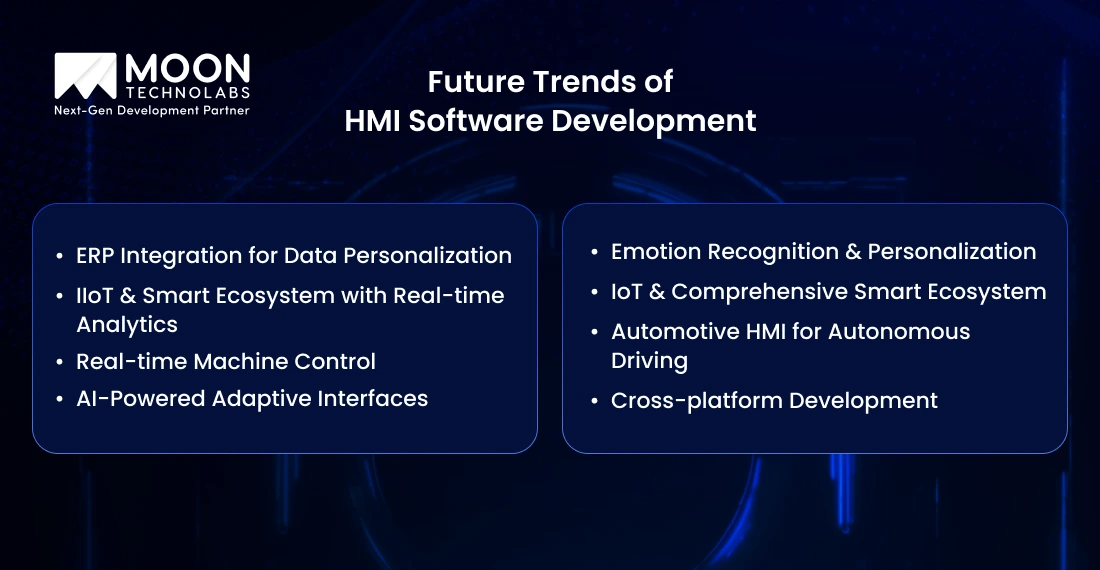
When developing different types of HMIs, it’s essential to ensure that they can be easily integrated with industrial infrastructure. Integration is no longer a discrete step, but an inseparable thread that connects every significant trend shaping the HMI landscape:
You can develop HMI solutions that seamlessly integrate with ERP platforms for robust workforce management. It automatically shares equipment operator activity logs, optimizes human resource allocation, and tracks performance for data-driven decision-making.
The next wave of efficiency comes from integrating HMIs with specialized IIoT development services across devices and sensor networks. By connecting HMIs with IIoT dashboard software, organizations can leverage real-time machine data, automate diagnostics, and remotely monitor assets for seamless machine communication across ecosystems.
A unified integration of HMIs with SCADA (Supervisory Control and Data Acquisition) systems is vital for centralized management of multiple HMIs across facility networks.
It enhances operational visibility and control, allowing for scalable analytics and performance optimization. You can also directly integrate HMIs with PLCs for machinery monitoring and control.
HMIs deliver smart interfaces with AI that adapt to gather, learn, and respond with data from every corner. Integrating with IIoT and MES (Manufacturing Execution Systems) enables personalized interactions by adjusting dashboards, automating alerts, and optimizing workflows to enhance efficiency.
Emotion-aware HMIs can be integrated with operator biometric sensors, camera feeds, and user profiles to enhance the user experience. The rich data gathered from connected platforms helps fine-tune the operator interface by adjusting complexity, suggesting a quick break, and improving both safety and engagement.
HMIs can be integrated with the IoT ecosystem to generate a mesh of actionable insights from smart tools and environmental sensors. The combination allows seamless machine-to-machine and human-to-machine communication, utilizing intelligence to optimize resources. Businesses can orchestrate and monitor entire facilities from the shop floor to the cloud through predictive maintenance.
Connected vehicles are the future of autonomy, demonstrating the need to integrate HMIs with Edge AI, voice assistants, IoT, and OTA (over-the-air) update systems. Smart integration enables vehicles to learn from user behaviors and update features in real-time. Personalized and voice-activated vehicles also enhance driver safety.
HMIs must perform seamlessly across various devices to monitor, control, and diagnose processes from anywhere, thereby breaking down silos. With cross-platform app development, businesses can create interoperable APIs, middleware, and secure data exchange solutions that facilitate seamless integration across multiple platforms. They can build a digital enterprise across desktops, apps, backend systems, and cloud services.
Access and operate machinery from anywhere with cloud-integrated HMI dashboards. Receive predictive alerts and monitor metrics from any device.
For organizations building HMI solutions, each success story of HMI software development projects by industry leaders can offer valuable lessons. From Tesla and Apple, they can understand how to build a user-centric context-aware interface. From Siemens and Samsung, they can grasp how to accelerate deployment.
Let’s understand these four leading case studies of successful HMI projects in detail:
Tesla’s vehicles have replaced traditional dashboard controls with a digital-only experience. The Model S Plaid’s 17-inch touchscreen is a disruptive approach to automotive HMI. Notable features include:
Context-aware interactions can replace physical controls to enhance the automotive user experience. Touch-initiated turn signals must be balanced with intuitive usability to avoid confusion or distraction.
Siemens’ industrial HMI for factory automation has set the industry benchmark for unified control across devices. Their TIA Portal software provides a unified environment for visualization:
Develop integrated HMI-PLC/SCADA platforms for development speed, operational flexibility, and reduced downtime.
Apple CarPlay revolutionized the in-car HMI by bringing smartphone familiarity and connectivity into vehicles. Practical aspects include:
Develop smarter vehicles without complicating the driving experience with third-party integrations such as rapid connect, voice interfaces, and context-aware features.
Samsung’s smart appliances showcase the future of home vision HMI software development. Its refrigerators, air conditioners, and purifiers possess signature innovations:
Organizations can develop systems with multi-device integration powered by AI automation for centralized HMI control. They can build a centralized hub with an app to boost efficiency and customer satisfaction by meeting users on any device they use.
Organizations that adopt advanced HMI technologies have the potential to position themselves as leaders in achieving operational excellence in manufacturing automation. Developing strategic custom HMI software enables them to interact with other connected networks of systems in the vicinity.
At Moon Technolabs, we believe that the future belongs to organizations that recognize the power of HMI software to redefine human-machine interactions. We are a leading custom software development company that utilizes automation solutions with HMI to help our clients reduce operational downtime.
With predictive capabilities, they can minimize their maintenance costs and reduce energy consumption by adopting smart manufacturing solutions. Schedule a consultation with our experts today.
HMI software development is an innovative approach to enhancing human-machine interaction. By integrating these adaptive user interfaces with cloud, AI, IoT, and AR/VR technologies, organizations can develop successful HMIs that drive efficiency, safety, and personalization across various industries.
As automation accelerates and smart ecosystems become standard, next-generation HMIs empower businesses to future-proof operations and deliver superior experiences. Start investing in advanced HMI solutions to provide not only a technical but also a strategic upgrade, transforming your organization digitally.
01
02
03
04
05

Jayanti Katariya is the CEO of Moon Technolabs, a fast-growing IT solutions provider, with 18+ years of experience in the industry. Passionate about developing creative apps from a young age, he pursued an engineering degree to further this interest. Under his leadership, Moon Technolabs has helped numerous brands establish their online presence and he has also launched an invoicing software that assists businesses to streamline their financial operations.


Submitting the form below will ensure a prompt response from us.
We refine our expertise to deliver innovative business solutions.



500 N Michigan Avenue, #600, Chicago IL 60611
13500 Long Is Dr, Pflugerville, TX 78660, USA

C-105, Ganesh Meridian, S.G. Highway, Ahmedabad, GJ 380060


Ayse D.
Co-Founder France
“ I highly recommend Moon Technolabs as the quality of service is wonderful. We have hired this company to develop the product based on some complex & technical issues. We get the best quality services as compared with others in the market. Huge Thanks to Moon Technolabs as the team is always ready to give the solution all time.”

Justin G.
Founder & CEO USA
USA“ Moon Technolabs is a pioneer in the WebRTC based project as they have fixed complicated segments of the module by fulfilling different product lines by providing 24X7 customer support. We really recommended Moon Technolabs as they are able to develop products as per the module deadline and project timeline.”

Flavio S.
Founder & Managing Director Germany
“I am happy to recommend Moon Technolabs for their app development services. They successfully developed apps for me, and I am highly satisfied with the overall outcomes. The development team has swiftly addressed the issues with responsive and effective communication to understand the requirement quickly and actively resolve the back-and-forth problems that arose...”

Jay M.
Founder & CEOUSA“Moon Technolabs is the best company that provides advanced apps and websites development services in the USA and Europe. I am a newbie to develop my app with an external team. I am really happy to work with them as I am not that much mobile apps user. Here, the team and specially the CEO of Moon Technolabs helps me to let me know about the benefits of my app to generate revenue....”


Our Offices
India
C-105, Ganesh Meridian, S.G. Highway, Ahmedabad, GJ 380060USA
500 N Michigan Avenue, #600, Chicago IL 60611Contact Information


