
Jayanti Katariya
Last Updated: February 23, 2026 Total Views: 13
Table of Content


Blog Summary:
This blog offers a complete breakdown of grocery delivery app development costs. It covers all those factors that directly impact cost, including app types, features, third-party integration, tech stack selection, and more. It also explains how to minimize the cost of grocery app development. Let’s uncover more details.
Table of Content
Online grocery shopping is in vogue today for offering much convenience in buying products and ensuring quick delivery at doorsteps. It also offers personalized recommendations, real-time tracking, and smooth payments. And thus, it prompts people to even buy small grocery items online rather than visiting a grocery store and standing in a long queue.
So, the growing trend of online shopping presents the biggest opportunity for startups and retail chains seeking to launch a grocery delivery app to generate strong revenue. Meanwhile, they often wish to obtain details on the cost of grocery delivery app development before proceeding with development.
The development cost for grocery apps varies based on factors such as the tech stack, scalability, features, and business models. In this post, we will discuss the costs of building such apps.
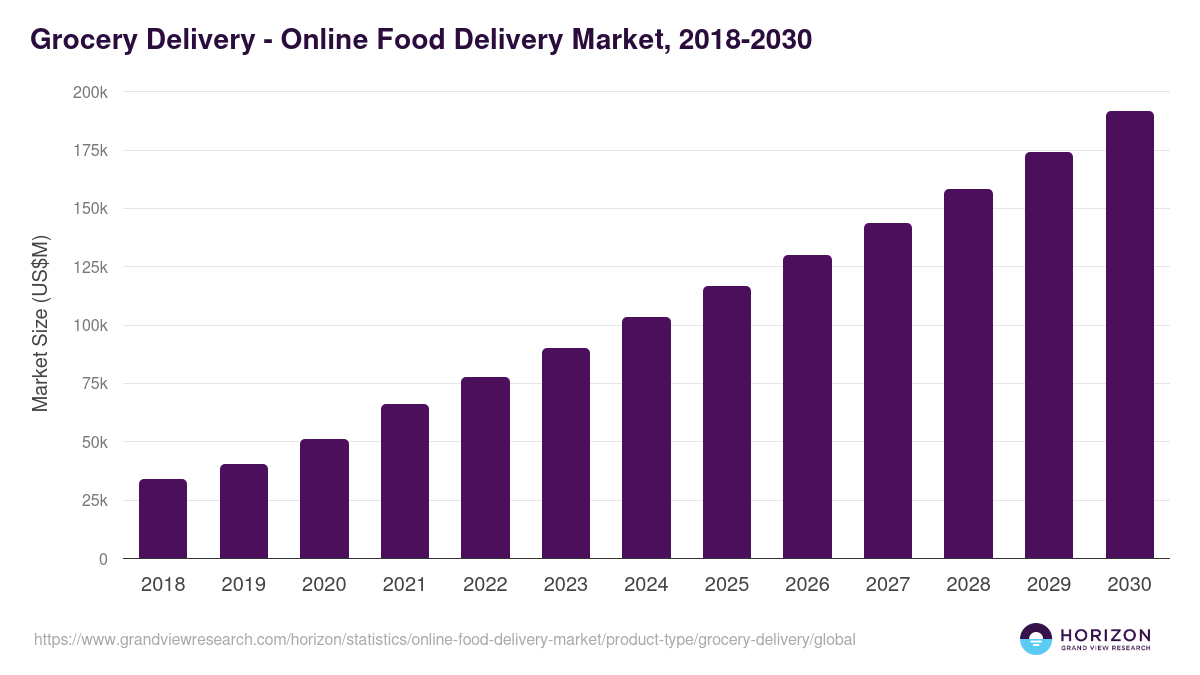
When it comes to the grocery delivery app market, it’s growing at a fast pace. According to the latest stats by Grand View Research, the worldwide online grocery delivery online food delivery market size is projected to grow at a CAGR of 10.4% between 2024 to 2030.
The cost of grocery delivery app development depends on the type of app you wish to develop, the features you plan to integrate, your business model, and more. Let’s get details about the cost based on the following factors:
When developing a basic grocery app, you only need to integrate essential features. These include payment gateway, checkout, cart, product listings, user registration, order tracking, etc. Its cost ranges from $20,000 to $50,000. This is a good option for startups seeking to launch an MVP for validating demand.
While developing a mid-level grocery app, you need to integrate certain advanced features such as multiple payment options, real-time inventory sync, push notifications, delivery scheduling, vendor dashboards, and loyalty programs. The cost of developing any such app ranges from $30,000 to $80,000. This is indeed common for regional marketplaces or multi-store platforms.
Developing an advanced AI-driven grocery app requires integrating predictive analytics, AI-based recommendations, dynamic pricing, route optimization, dark-store management, and more. These indeed increase complexity and thus have a direct impact on development costs, which range from $70,000 to $200,000+. It also depends on scalability and integration requirements.
When you opt to develop native apps for iOS and Android separately, it further increases the overall development cost by 30 to 40%. Additionally, adding a customer web app or a web admin panel further impacts your development budget.
Cost varies based on the location of your development team as well. Hiring the US-based team is expensive as they charge $100 to $250/hour. On the other hand, experienced Indian firms charge $30 to $70/hour.
As far as post-launch maintenance is concerned, it accounts for 15 to even 20% of the development cost. It includes server costs, updates, feature enhancements, and security patches.
Apart from app type and third-party integration, many other factors also directly affect the cost of online grocery app development. Let’s explore each factor one by one as follows:
Developing a single-store order app costs less than a multi-vendor marketplace, including live tracking, real-time inventory sync, admin dashboards, delivery partner modules, analytics, etc.
The cost increases further when integrating promo engines, subscription models, warehouse management logic, and more. It reflects the complexity that directly costs.
Functionality is not enough for a modern grocery app; it should also deliver the finest user experience to be successful. It should include one-tap reordering, smooth navigation, personalized product displays, microinteractions, custom animations, accessibility, and more. Integration of these features requires more time and thus increases cost.
Selecting the right tech stack is necessary for higher scalability, performance, etc. Meanwhile, it also influences long-term maintenance expenses. Developing a native app with Swift or Kotlin indeed costs more. But, good from a performance point of view.
Developing a cross-platform framework minimizes development costs but often compromises performance. For the backend, your choice between Django, Node.js, or a microservices architecture also significantly impacts complexity. You can opt for a scalable cloud infrastructure to avoid costly rebuilding later.
Grocery apps leverage many third-party APIs. These include payment gateways, analytics tools, real-time tracking maps, inventory software, etc. And you need to keep in mind that each integration follows a systematic process – it includes development, testing, etc. It envisages that the more third-party systems you integrate into your grocery app, the more time it takes, thereby increasing costs.
Handling financial translation is highly risky and requires PCI-DSS compliance, secure payment processing, encrypted data storage, fraud detection, and secure authentication. It also requires multi-layer security, which builds customer trust, maximizes development effort, and thus increases costs.
If you desire to expand your business globally, your backend should be able to handle sudden increases in traffic, delivery tracking without lag, and real-time order volume. And for this, you also need to ensure CDN setup, cloud hosting, load balancing, and database optimization. These all maximize infrastructure cost.
We develop a next-gen grocery delivery app with scalability, speed, and a smooth customer experience. We help you stay ahead in the continuously evolving market.
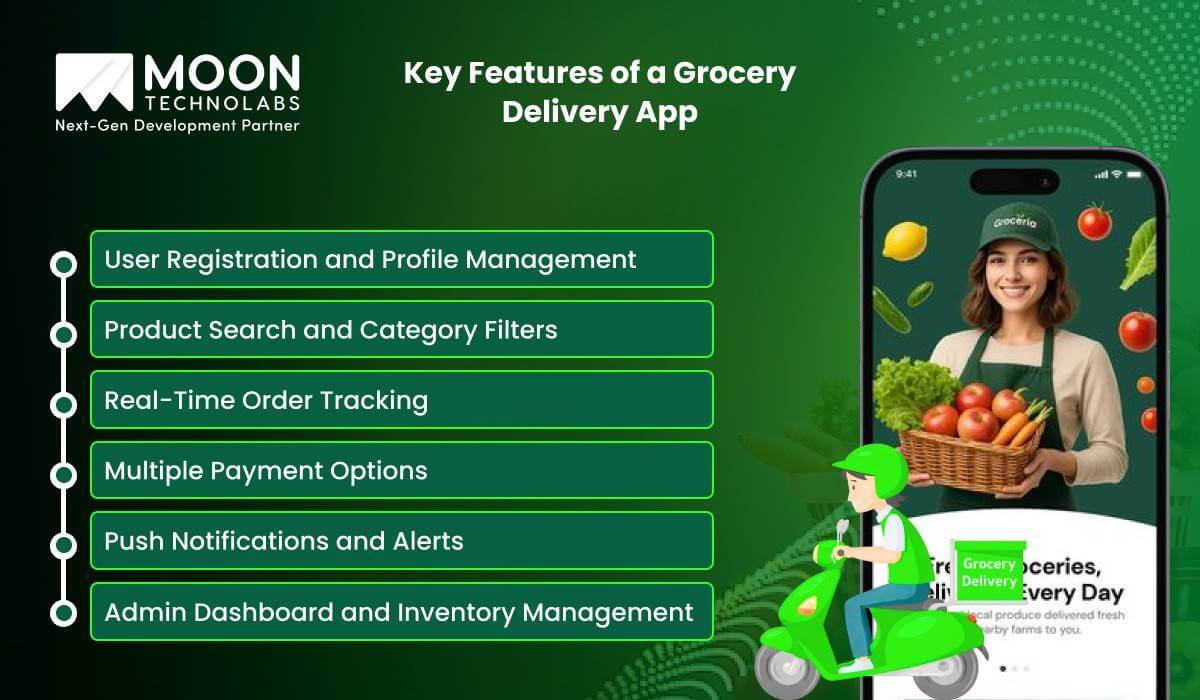
From ensuring user retention to offering operational efficiency, features play a vital role in making a grocery delivery app successful. Let’s go through important features you can consider implementing in your app:
Make sure your app has a smooth onboarding process. It should allow users to sign up with a phone number, email, or social login, in seconds. Profile management allows saving addresses, payment methods, multiple delivery locations, and tracking order history. Personalized dashboards increase repeat purchases and simplify reordering.
A grocery app should include a robust search engine to let users find products quickly. The search engine should be accompanied by voice search, auto-suggestions, and typo tolerance. Whether it’s price range, brand, discounts, dietary preferences, or availability, they help users find products quickly.
Real-time order tracking is a vital feature of grocery apps, fostering transparency and building trust. Customers often expect live order tracking, with exact status updates, from packing to doorstep delivery. GPS-based tracking integrated with map services maximizes reliability. It minimizes support queries.
Your app should include multiple payment options to offer convenience to users, such as net banking, UPI, or cash on delivery. It increases conversion rates. Secure payment processing with quick confirmation minimizes cart abandonment. It also builds confidence in the platform.
Push notifications contribute a lot only when you use them with a proper strategy. It offers restock alerts, order updates, abandoned-cart reminders, personalized offers, and more. These maximize repeat orders.
A robust admin panel is necessary behind every powerful grocery app. It allows store owners to manage orders, track inventory in real time, configure discounts, set pricing controls, and access analytics dashboards. The fact is that automated stock updates boost operational efficiency and prevent overselling.
You can, of course, control the cost of grocery delivery application development with smart planning and a proven strategy. You can go through the following ways to do it successfully:
Developing an MVP first and then building a full-fledged grocery app is the best option for those who have a limited budget. Initially, you can focus on integrating only necessary features such as checkout, cart, product listing, order tracking, and payments.
By developing an MVP, you can test logistics, gather user feedback, and validate demand before investing in advanced modules, such as subscription models or AI recommendations.
Creating a separate native app on platforms like iOS or Android incurs both time and cost. Cross-platform frameworks let you develop a single codebase that works across both platforms, minimizing development time and costs. For startups, it optimizes the initial budget.
Rather than developing everything from scratch, you need to integrate reliable third-party APIs for SMS notifications, payments, analytics, and maps. When it comes to pre-developed solutions, it minimizes timelines, development complexity, and testing overhead.
Integrating unnecessary features in your grocery delivery app drains your budget. Therefore, it’s advisable to focus on implementing top features that have a major role in influencing order and customer retention. Once you notice the revenue flow stabilizes, you can integrate loyalty engines, advanced automation, and AI modules.
As we already mentioned, development costs tend to vary by geography. So, outsourcing to any experienced teams in regions such as Eastern Europe and India minimizes hourly rates even without sacrificing quality.
The major advantage of a cloud platform is that it eliminates the need for large upfront server investments. With pay-as-you-scale infrastructure, you can manage traffic surges more efficiently by controlling hosting experiences early.
Let’s quickly develop your grocery delivery app with feature-rich, scalable solutions. We help you go live and start getting orders quickly.
We understand that creating and launching a grocery app is much more than just coding. It’s about developing a system that can handle payments, logistics, user demand, and inventory smoothly. Here’s what you can expect from us:
Our team has expertise in providing tailored grocery delivery app development solutions. We deliver the end solution aligned with your operational workflow, revenue models, target market, etc., rather than a generic solution for everyone. We design everything around performance and scalability.
We specialize in creating an architecture capable of inventory synchronization, handling real-time order spikes, and supporting simultaneous user traffic, without affecting performance. We understand that quick commerce requires both reliability and speed. Our team crafts backend infrastructure for your grocery apps that offer long-term growth.
To ensure greater safety, we implement encrypted user data handling, payment gateways, real-time tracking, and route-optimization systems. We ensure a smooth operation from checkout to your doorstep.
We never leave any stone unturned to provide ongoing support and make your grocery app relevant, even amid technological advancements, changing user behavior, and industry trends. Our team monitors performance and implements UI improvements, feature upgrades, security updates, etc. These keep your grocery app competitive.
We serve clients by keeping our pricing transparent. With us, you can choose a flexible engagement option, milestone-based delivery, and a clear cost breakdown. We also offer various engagement models, including dedicated team, fixed cost, and hybrid. You can select any of them based on your preference.
By now, it’s clear that the cost of grocery app development varies based on several factors rather than being fixed for every project. Before you proceed with your grocery app idea, define your vision, scalability goals, features, and implementation strategy.
It helps you get a clear idea of how to build your app. Partner with an online grocery delivery app development company to proceed in the right way and develop a profitable and scalable grocery delivery app.
01
02
03
04

Jayanti Katariya is the CEO of Moon Technolabs, a fast-growing IT solutions provider, with 18+ years of experience in the industry. Passionate about developing creative apps from a young age, he pursued an engineering degree to further this interest. Under his leadership, Moon Technolabs has helped numerous brands establish their online presence and he has also launched an invoicing software that assists businesses to streamline their financial operations.


Submitting the form below will ensure a prompt response from us.
We refine our expertise to deliver innovative business solutions.





500 N Michigan Avenue, #600, Chicago IL 60611
13500 Long Is Dr, Pflugerville, TX 78660, USA

C-105, Ganesh Meridian, S.G. Highway, Ahmedabad, GJ 380060


Ayse D.
Co-Founder France
“ I highly recommend Moon Technolabs as the quality of service is wonderful. We have hired this company to develop the product based on some complex & technical issues. We get the best quality services as compared with others in the market. Huge Thanks to Moon Technolabs as the team is always ready to give the solution all time.”

Justin G.
Founder & CEO USA
USA“ Moon Technolabs is a pioneer in the WebRTC based project as they have fixed complicated segments of the module by fulfilling different product lines by providing 24X7 customer support. We really recommended Moon Technolabs as they are able to develop products as per the module deadline and project timeline.”

Flavio S.
Founder & Managing Director Germany
“I am happy to recommend Moon Technolabs for their app development services. They successfully developed apps for me, and I am highly satisfied with the overall outcomes. The development team has swiftly addressed the issues with responsive and effective communication to understand the requirement quickly and actively resolve the back-and-forth problems that arose...”

Jay M.
Founder & CEOUSA“Moon Technolabs is the best company that provides advanced apps and websites development services in the USA and Europe. I am a newbie to develop my app with an external team. I am really happy to work with them as I am not that much mobile apps user. Here, the team and specially the CEO of Moon Technolabs helps me to let me know about the benefits of my app to generate revenue....”


Our Offices
India
C-105, Ganesh Meridian, S.G. Highway, Ahmedabad, GJ 380060USA
500 N Michigan Avenue, #600, Chicago IL 60611Contact Information


