
 Total Views: 4775
Table of Content


Blog Summary:
This blog will provide an actionable, up-to-date guide to functional testing best practices needed to meet the unique demands of mental health software. It will help product managers, healthcare IT managers, and compliance risk officers at digital health/mental health startups, as well as telehealth organizations, avoid common pitfalls and deliver impactful mental health solutions.
Table of Content
Think about this: someone battling acute anxiety opens their mental health app in the middle of a panic attack, only to find the chatbot feature has crashed. A bug in their message flow has led to a system freeze.
In the mental health realm, a faulty app doesn’t only cause inconvenience; it can prove to be dangerous for your end users. Without grounding tips, breathing exercise prompts, or human connection, they often end up spiraling alone, especially when help seems just out of reach.
However, choosing the right software testing partner can help guide you in selecting the right software functional testing tools, which can become a life-saving step for your app and its users.
With this single step, you can confirm that features such as session logs, emergency contact buttons, and mood trackers are functioning as designed. In this blog, we will explore functional testing best practices, along with how functional testing in software development can help mental health apps live up to their promise and responsibility.
Mental health applications carry unique pressure as people turn to them when they are at their lowest point. Users expect privacy, support, and consistent care from their digital support systems. A small glitch, such as a failed mood entry or broken chat, can disrupt their emotional progress and cause distress.
For the users, these aren’t just features; they are emotional lifelines. In this case, the margin for error is almost nil.
Beyond the user experience, you must focus on building apps that adhere to standards like HIPAA and GDPR. With functional testing, you will create a secure application that respects privacy protocols in practice.
Functional testing in software testing can help determine if permissions work correctly, whether sensitive data is encrypted, and whether error-handling is compliant with standards.
Ultimately, the testing will validate whether your app can meet the high standards of legal and ethical requirements set for mental health applications.
Functional testing is not just about squashing bugs; it is about building something safe, legal, and ready to support the end users. It gives you confidence that your app will meet the user’s needs and industry benchmarks.
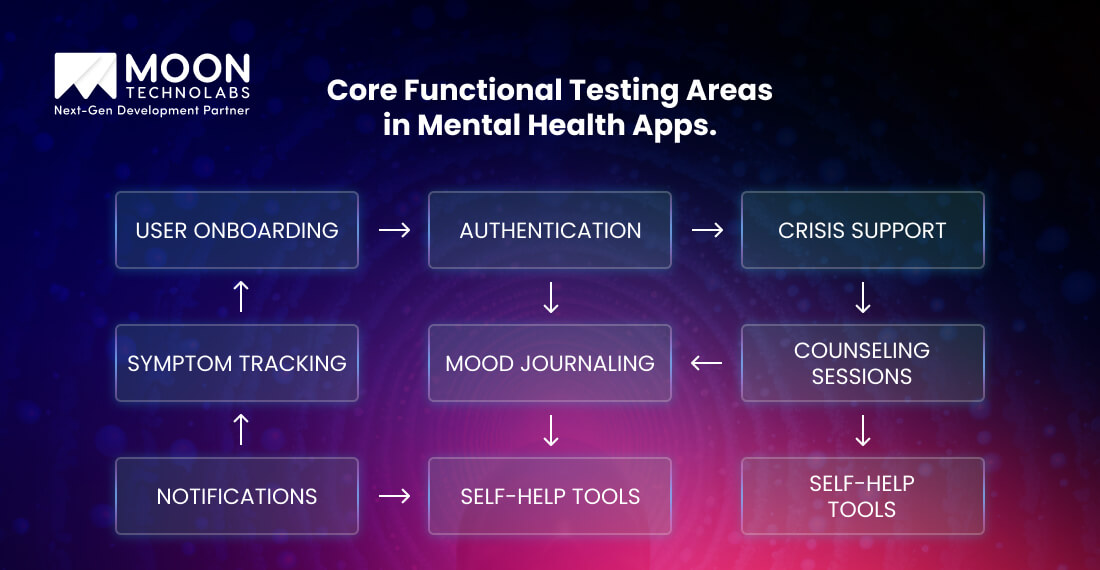
When testing a mental health app, functional testing should go beyond the surface-level features. That’s why you must rigorously test all core features before releasing them. Here is a list of all the crucial areas to test.
Here’s how we developed and tested our most successful mental health app, Inner Journey.
What happens when a user is unable to complete the onboarding flow only because the “Next” button is broken? They will abandon your app and move on. You should test everything, from cover form handling and device compatibility to saved progress and proper error messages, for a warm and seamless first experience.
Consider a scenario where the user is trying to log in at their vulnerable moment and gets stuck in a failed two-factor authentication loop. Utilize functional testing to ensure a seamless login/logout experience, along with secure authentication and effective session timeout handling.
An incorrect score on the mental health assessment can lead to a wrong diagnosis and care recommendation. That’s why you must ensure this feature is fully tested. You should ideally evaluate the scoring logic, form completion, conditional flows, and data submission across devices and inputs.
Users can feel unheard or disconnected when the therapy session freezes in the middle of a conversation. With functional testing, you can verify the message delivery, ensure therapist matching, focus on connection stability, and offer chat history loading without any delay.
When the user’s symptoms don’t save or sync across devices, they lose all the health patterns they had been tracking. You must test all the data entries made by the user. Also, test calendar views and data sync across devices to prevent data loss.
A user who wrote a detailed journey lost it because the app crashed. This becomes a personal setback in their healing journey. Functional tests can confirm autosave, editing, offline access, and recovery options so that these issues don’t occur.
When the crisis button on your mental health app is broken, it can prevent users from accessing help when needed. You should test for tap responsiveness on the app as well as redirection to emergency numbers.
If the app doesn’t send out timely session and medication reminders, it can disrupt care routines. You should test for accurate timings, repeat rules, and user settings. It is also a great idea to test for compatibility at the OS level for permissions.
The breathing exercise fails to load when the user has a panic attack. It can disrupt the entire moment, making them feel more vulnerable. Ensure that all tools load properly, progress tracking works correctly, and the app is accessible in offline mode.
Let our experts ensure that every critical user journey step, from crisis support to privacy flows and accessibility, delivers reliability.
Request a Functional QA Audit
When testing a mental health app, it is essential to go beyond simply validating the buttons and forms. Verify if the app can offer support to users when they need it most.
This step-by-step guide on functional testing for software testing introduces the best practices to help design this solution. These steps take into account the emotional, clinical, and technical aspects of mental health platforms.
Begin this step by identifying how each user type would interact with the application for user story mapping. This would begin with their first-time app use and continue through to continuous interaction with the application, especially during crises. You should identify the mission-critical flows and prioritize them in your test plan.
Follow this up with risk-based testing to determine the areas that will have the highest impact on your users when they fail. For instance, if the “talk to your therapist” button fails during a crisis, it can prove to be dangerous. You can determine the risk hierarchies with proper testing plans.
You should also include positive, negative, and path testing to verify the expected and unexpected behaviours. You should also test for simultaneous logins, poor network connections, and spikes in app usage.
While automation tools for functional testing can speed up your results, they may not help validate all aspects, especially related to mental well-being. If you have several high-volume and repetitive tasks, such as verifying form inputs and notification logic, you should consider using automation testing.
Automation tools can also aid in regression testing, particularly when rolling out updates for mental health apps.
However, in most cases, you will need to work with a human intuitive. Manual testing is crucial in areas where empathy and nuance are essential. When testing a chatbot’s response to an emotionally charged message, you might need human insight. The automation tool can check whether the response is working, but humans will be able to determine if it sounds cold and dismissive or empathetic.
A well-defined balance between manual and automated testing is crucial in setting the stage for accessibility, emotional tone, and structured flow.
In the mental health space, frequent updates, such as new therapy modules and policy changes, make regression testing non-negotiable. Every new feature you add can break something you have created earlier. That’s why you must include regression testing in every sprint and release cycle.
You should use a regression test suite that evolves with your product. Go beyond the login and homepage to test key journeys, including chats, assessments, and data exports.
You should utilize functional testing tools, such as version control, test data management, and a clear release readiness checklist, to make the QA process scalable and repeatable.
You should not conduct functional testing in isolation for mental health applications. Features such as symptom assessment, journaling prompts, and chatbot responses demonstrate clinical sensitivity and technical accuracy.
Consult with mental health professionals to assist you in the testing and validation process, ensuring that you incorporate appropriate language and clinically sound features.
For example, when you send out an “all better now?” prompt at the end of the session, it may sound dismissive. Professionals can suggest better triage flows by utilizing symptom patterns.
Functional testing is not a QA exercise for mental health apps; it is a matter of user safety. From creating a thoughtful test case design to involving clinical experts, you will incorporate best practices to build something users can trust.
Your mental health apps won’t operate in silos; they integrate with electronic health records (EHRs), mobile sensors, wearables, APIs, and emergency contact systems. These integrations enable you to offer more personalized and real-time care, introducing complexities to functional testing.
For example, if your application retrieves heart rate data from a wearable device or sends mood logs to the EHR system, you must ensure that the data transfer flow is secure. You must test the API integrations for accuracy, reliability, and correct handling of downtime and delayed responses.
You should test what happens when the third-party API is slow or returns unexpected data. The test should confirm that the app doesn’t crash or misinterpret this information.
If you’re looking for a wearable app development partner to help you build on your next wearable app idea,
Similarly, it should help validate third-party authorization flows, such as OAuth, when connecting with Google Fit or Apple Health. Test the flows for functionality and edge cases, such as revoked permissions and expired tokens. If there is even a small break here, the user data will stop syncing, impacting the experience.
You must also verify the integration of the emergency contact. If the user chooses to share their status or location with a trusted person, the triggers should work correctly, messages should be sent, and privacy preferences should be respected.
Test for failsafe, i.e., what will happen when the wearable disconnects. With functional testing, you can include fallback scenarios and clear messaging to maintain trust and usability.
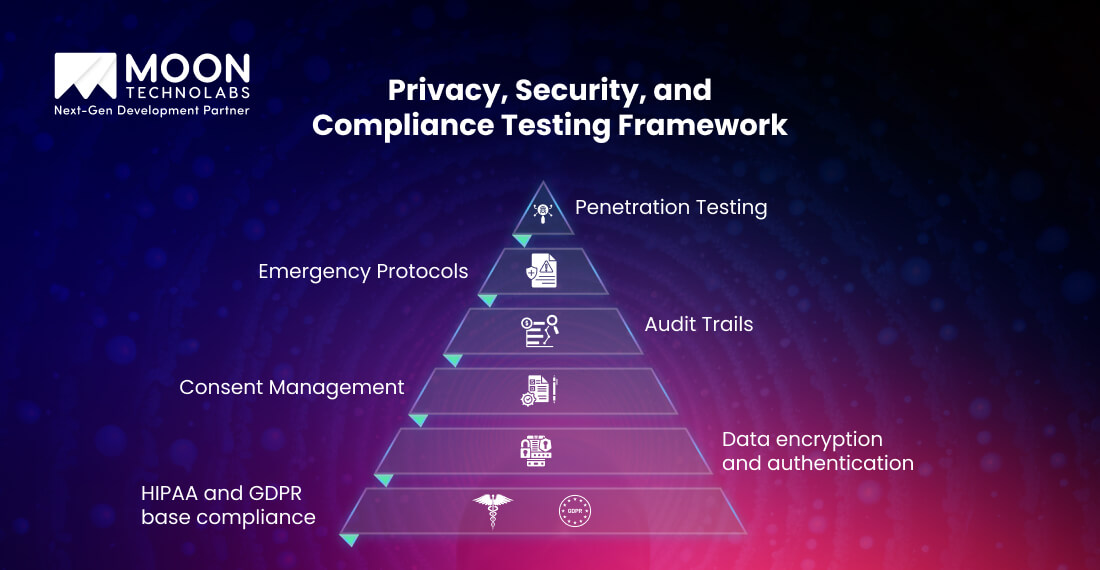
For mental health applications, privacy and compliance are not just a technical checkbox; they help shape the trust and safety of the solution. Here’s how functional tests can create a more secure and regulation-driven experience.
You should test all the consent flows to check if users can opt in/out of data sharing, enable third-party connections, or sync wearable devices. The functional QA ensures that the permission toggles and checkboxes function correctly.
Users must have control over who can see their data. QA will validate the role-based access and visibility settings for journals and therapy logs. It will allow users to manage and delete their accounts with ease.
It will help validate the encrypted data to understand what happens when encrypted reports are downloaded or synced to the provider’s system. It will allow for safe handling of data in real-world workflows.
Your app must respond quickly and legally whenever someone flags an unusual activity or proceeds with account deletion. With functional QA, you can ensure that the incident protocols, deletion flows, and audit trails work as intended.
Your teams should map every test to the key requirements posed under HIPAA and GDPR. This will confirm that every interaction, whether it is a storage, consent, or access, is verified against compliance.
Everyone should be able to use your mental health application, irrespective of their ability. You should use functional testing tools to verify screen reader compatibility, text-to-speech support, keyboard navigation, and alternative input options. This will enhance accessibility for users with visual, motor, or cognitive challenges.
Get ahead of integration issues before launch. Leverage our core compliance testing scenarios for all major APIs, EHRs, and device connections.
Book an Integration QA Review
Functional testing for software used in mental health apps requires verifying the emotional context, validating user sensitivity, and ensuring real-world awareness. Here are some common mistakes that testing teams make, which can compromise usability and user safety.
To avoid these mistakes, opt for a user-first QA process.
Mental health applications aren’t just another software solution for users; they are a support system built for individuals who experience vulnerable moments and issues. That’s precisely why functional testing should go beyond regular QA practices.
Your testing process should account for diverse emotional states, data sensitivity, regulatory pressures, and the real-life consequences of bugs. From verifying the crisis response flows to validating consent, there are several layers to your functional testing approach.
At Moon Technolabs, our experts specialize in developing and testing secure, accessible, and emotionally intelligent mental health applications with AI-powered chatbots for support.. Partner with us to build digital solutions your users can trust and gain support from.
01
02
03
04

Jayanti Katariya is the CEO of Moon Technolabs, a fast-growing IT solutions provider, with 18+ years of experience in the industry. Passionate about developing creative apps from a young age, he pursued an engineering degree to further this interest. Under his leadership, Moon Technolabs has helped numerous brands establish their online presence and he has also launched an invoicing software that assists businesses to streamline their financial operations.


Submitting the form below will ensure a prompt response from us.
We refine our expertise to deliver innovative business solutions.





500 N Michigan Avenue, #600, Chicago IL 60611
13500 Long Is Dr, Pflugerville, TX 78660, USA

C-105, Ganesh Meridian, S.G. Highway, Ahmedabad, GJ 380060


 France
“ I highly recommend Moon Technolabs as the quality of service is wonderful. We have hired this company to develop the product based on some complex & technical issues. We get the best quality services as compared with others in the market. Huge Thanks to Moon Technolabs as the team is always ready to give the solution all time.”

 USA
USA“ Moon Technolabs is a pioneer in the WebRTC based project as they have fixed complicated segments of the module by fulfilling different product lines by providing 24X7 customer support. We really recommended Moon Technolabs as they are able to develop products as per the module deadline and project timeline.”

 Germany
“I am happy to recommend Moon Technolabs for their app development services. They successfully developed apps for me, and I am highly satisfied with the overall outcomes. The development team has swiftly addressed the issues with responsive and effective communication to understand the requirement quickly and actively resolve the back-and-forth problems that arose...”
 USA
USA“Moon Technolabs is the best company that provides advanced apps and websites development services in the USA and Europe. I am a newbie to develop my app with an external team. I am really happy to work with them as I am not that much mobile apps user. Here, the team and specially the CEO of Moon Technolabs helps me to let me know about the benefits of my app to generate revenue....”


