
Jayanti Katariya
Last Updated: December 29, 2025 Total Views: 2265
Table of Content


Blog Summary:
This blog will give you insights on planning your organizational projects by implementing the agile approach of DevOps project management. The decision-makers will gain hands-on knowledge about applying the best tools and practices and the benefits of switching to DevOps over traditional project management culture.
Table of Content
The annual growth rate of the project management software market is expected to grow at a CAGR of 10.68% through 2030. In 2023 and beyond, more than 30% of the business’s revenue will come from project management software.
However, there are some highly concerning numbers regarding the success and failure of IT projects. Wellingtone reports that at least 57% of companies exceed their estimated project budgets, and 56% find investing in new software expensive.
These numbers can worry decision-makers when planning to start their projects because of the following reasons:
In this blog, we’ll answer the questions above for tech decision-makers and explain how they can apply DevOps methodologies to project management to streamline and complete their projects.
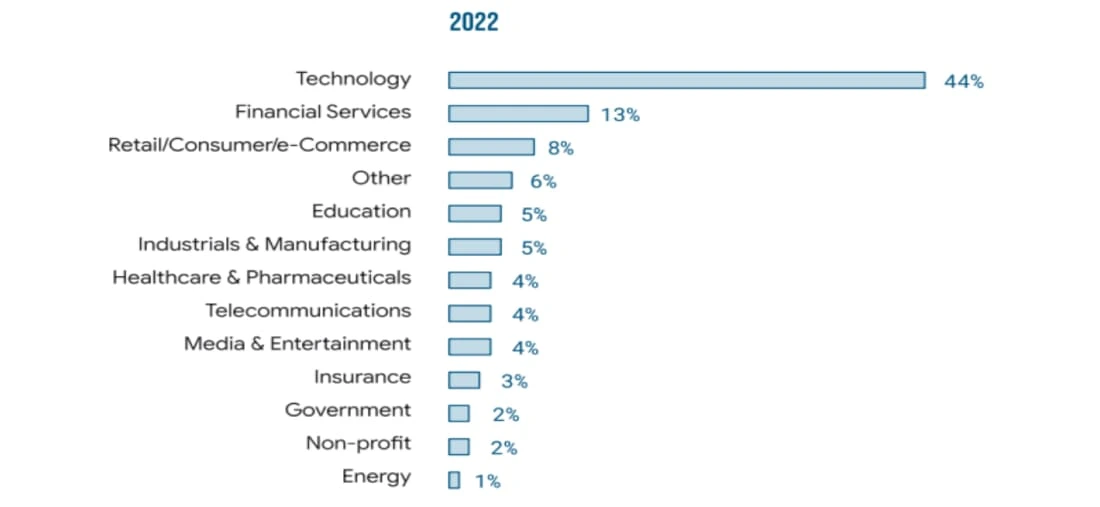
DevOps project management shifts focus from the final product and restructures the timeline to deliver a product with incremental changes in each phase. In 2022, 44% of organizations in the technology sector preferred to implement DevOps to manage their projects, either by outsourcing to a DevOps team or by recruiting an in-house team.
Let’s look at Etsy, a leading name in the retail market, which increased its website deployment by implementing the DevOps lifecycle after earlier setbacks.
For years, Etsy struggled with slow updates that caused frequent crashes. It frustrated visitors, and downtime impacted their sales. When they switched to an agile approach to team management, their deployments increased to at least 50 per day, supported by a fully automated CD pipeline.
CI/CD automated pipelines can save at least 5 hours per day for 54% of organizations by leveraging tools such as calendars, dashboards, and data entry to manage projects. Yet 25% of them lack access to the right collaboration tools.
The traditional waterfall approach doesn’t focus on implementing incremental changes in each project phase as needed to improve deliverables. A recent RGPM report finds that, for most project managers, resource constraints (44%), unrealistic deadlines (31%), and poor scheduling (11%) are the three biggest challenges to adopting project management software.
In the IT sector, this could be a significant blow to project managers, as at least 17% of IT projects fail so severely that they threaten an organization’s existence. Things could soon take a wrong turn if they don’t understand the reasons behind the project going off-track:
However, DevOps project managers work on the technical side, with a more detail-oriented approach rather than focusing solely on numbers. DevOps principles provide an in-depth view of a project’s progress. All tasks are predefined before launch, with a defined scope, objectives, timeframe, and budget.
When combined, DevOps management can streamline an organization’s workflows. They improve team visibility, provide a competitive advantage, reduce downtime, and enable rapid recovery from security breaches.
Measure in-depth project performance at each stage with DevOps project management.
Take The Right Call
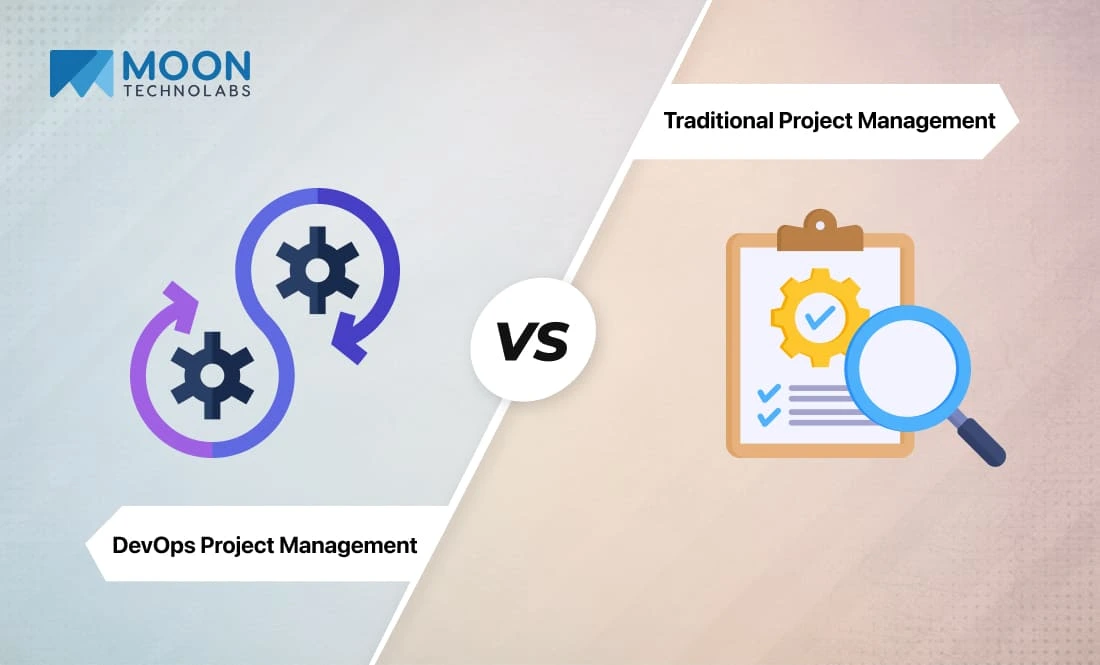
Let us explain the difference between the two approaches using the following example: the leading luxury department store chain, Nordstrom. Here’s how they realized the importance of implementing DevOps and switched from the traditional waterfall approach.
Nordstrom, a famous luxury department store chain in the US, still used the waterfall methodology to launch its app in 2011. When they launched, they became irrelevant and realized they had to change their processes.
By adopting a DevOps culture, they identified the root causes of the delayed lead time and migrated to continuous planning. The integrated collaboration between the Dev and Ops teams reduced bugs, increased throughput, and accelerated release cadence from yearly to bi-monthly.
The above example illustrates the effectiveness of adopting a DevOps agile approach for project management compared with the traditional waterfall approach.
Let’s take a comparative look at both approaches:
The traditional approach creates significant issues with scheduling and planning. Since this approach has many moving parts, scheduling them is challenging. In DevOps automation, scheduling is easier because it’s built on continuous, incremental releases and automation by a dedicated team.
Instead of planning for a few months, organizations can plan for a few weeks ahead. This approach provides better visibility of your team and makes coordination easier.
The traditional approach typically requires significant effort to launch a project. It indicates that projects managed using the traditional approach carry significantly higher stakes and risks. The project team works for months before pushing the launch button or addressing last-minute changes.
In the DevOps development process, teams have frequent, short-cycle launches. Hence, these projects also carry lower risk and stake. Each subsequent cycle requires minimal effort because the previous cycle included a minor update or a version release.
With automated testing, teams can be confident that team members are synchronized. DevOps promotes from one cycle to the next only if they are confident the release version is ready.
Under traditional project management, organizations typically use a waterfall approach, creating silos across the project lifecycle. The work involved in the traditional waterfall approach makes it difficult to focus on planning big releases. Longer development cycles often result in infrequent releases of new-feature versions, making it harder to meet deadlines.
In DevOps solutions, there are more minor releases than the bigger ones. It focuses on making testing more accessible and prioritizes a deep understanding of the releases. When new version releases are minor, it is easier to incorporate changes and fix issues because errors are fewer.
DevOps culture fundamentally changes how IT teams approach their projects. It helps them shift away from the legacy approach that can take months or even years. While DevOps aims to bring agility and better speed, it’s not enough to know only the tools.
DevOps project management requires the teams involved to understand how they will implement and use those tools. To keep projects on schedule, they need to understand the details of the development and release progress.
Here’s how they can drop the old habits of traditional project management to adapt better to DevOps:
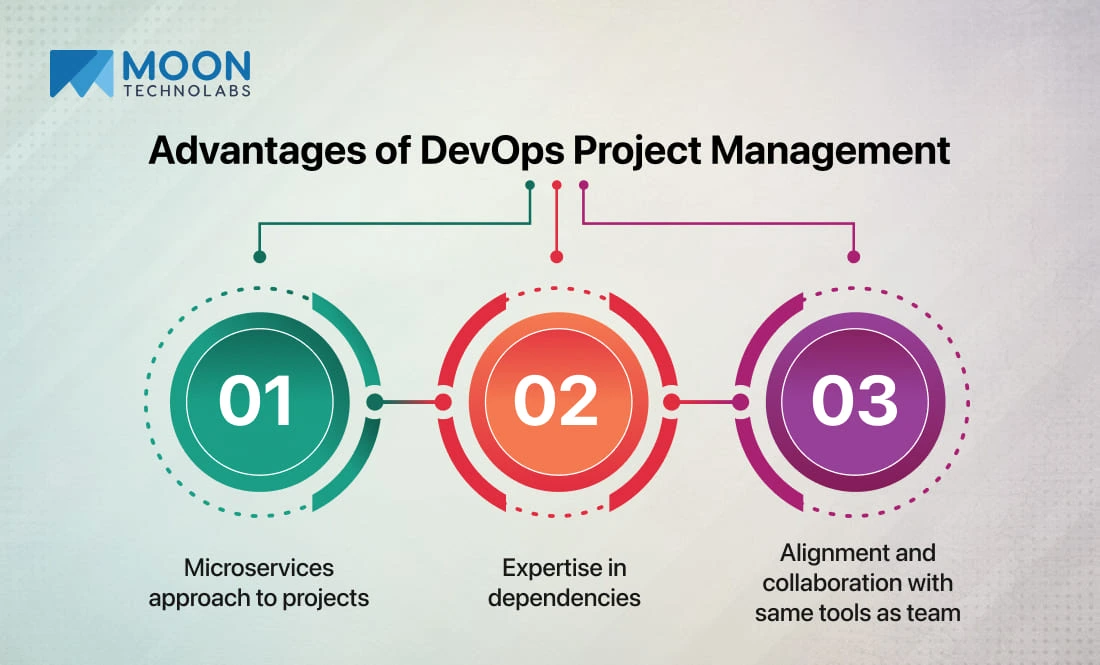
The microservices approach of DevOps breaks a monolithic architecture into smaller pieces. The same approach applies to project management: instead of working on an entire project, teams can break it into smaller parts to work more efficiently.
Interdependent components of a project outperform the traditional approach, where agile replaces the waterfall methodology. This approach to project management enables organizations to divide their workload rather than reduce a project’s timeline. It also allows updating it as needed while maintaining the scope and objectives.
Another benefit of DevOps automation for project management is that it helps build expertise in working with interdependent project components. Even though individual project components can work in isolation, DevOps helps teams understand how well they work together.
Since DevOps focuses on accelerating project velocity, it places even greater emphasis on cross-functional collaboration.
Even when organizations have limited time to integrate deployments, DevOps helps them understand the briefs clearly before moving on to the next phase. It supports the view that rushing the phases won’t provide proper direction.
Integration of tools and practices is essential to completing a project and managing individual tasks. This has been a common practice in earlier methodologies, including Scrum. However, the biggest challenge in tracking project progress is measuring the performance of individual tasks.
However, DevOps services focus on standardizing the toolchain across all teams. It helps organizations recognize that tracking metrics is more important than simply knowing whether a project is on schedule. The DevOps agile process uses a burndown chart.
The advantage of using a burndown chart is that it helps track progress against planned tasks. Hence, it enables them to track metrics like velocity and sprint burn-down – the most insightful trackers for DevOps success.
Track individual tasks and increase team productivity with DevOps project management.
Hire Us For Your Success
DevOps is an agile approach that uses methodologies such as Scrum, Kanban, Iterative, and Hybrid. According to a report by Allied Market Research, the agile software development market is projected to grow at a 19.50% CAGR by the end of 2026. Additionally, 42% of enterprises reported improved software quality, and 47% reported increased team productivity.
These numbers set the roadmap for organizations using DevOps project management best practices to deliver projects successfully.
Here are some practices:
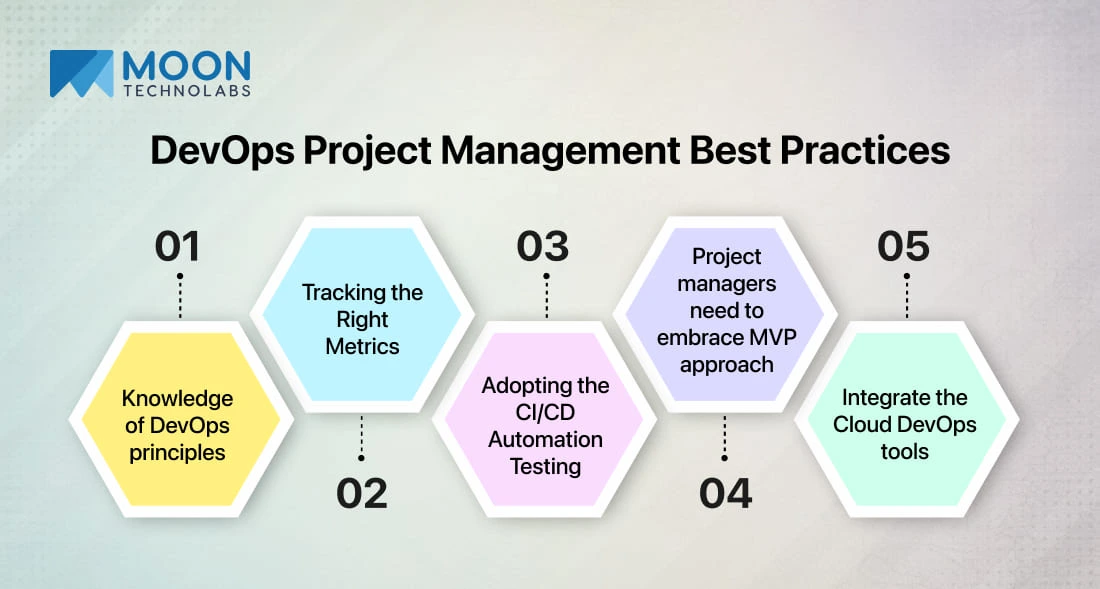
DevOps principles focus on increasing flexibility and efficiency through fundamental practices. Hence, the teams working on DevOps projects need to understand the cultural shift in management processes. The core principles of DevOps are continuous integration and continuous delivery.
CI integrates code updates from multiple sources into a central repository. It enables the teams to achieve the highest accuracy by integrating code changes and using automated tools. The basis of CI is that it is easier to find errors in smaller parts of the code than to find quality issues in the vast codebase.
As the CI concludes, CD takes over. CD keeps the cycle running by delivering improved versions of the project to the next stage. It eliminates the high risks of quality issues and simplifies deployment. In on-demand processes and even complex projects, this approach makes predictions easier.
While developing a software project, your organization’s goals and standards must align with the metrics. DevOps solutions enable continuous performance tracking through project management tools. These tools enable organizations to track essential metrics like lead time, mean time to detect, unit costs, and issue severity.
With built-in analytics reports, teams can gain valuable insights into a project’s performance and progress. These tools include dashboards that everyone can view, showing key indicators and individual task progress. It is an essential practice to adopt because it identifies problems early, takes corrective action swiftly, plans initiatives, and takes a proactive approach.
A software project is incomplete without the critical role of automated tests in CI/CD and other DevOps practices. Automation goes beyond presenting and knowing how to use it. It should assist the teams by helping them know the techniques and solutions to tackle the following essential aspects:
DevOps project management leverages automation to reduce workload and errors, accelerate processes, and allocate resources more effectively. Automation helps optimize the entire process by delivering high-quality results. Organizations experience a steep reduction in project timelines and an increase in software quality.
The simplest version released with the minimum required features is a minimum viable product (MVP). Development teams must embrace the MVP approach, as it keeps them on track to consistently deliver at the end of each sprint.
Compared to the traditional methodology, which focuses on the final monolithic product, this approach emphasizes start and end dates and continuous improvement.
The MVP mindset enables organizations to deliver products to customers faster by receiving feedback more quickly. It sets the team on the right path early in the development cycle. Otherwise, the team will discover that it has delivered a product that hasn’t fully met users’ needs.
DevOps projects focus on automation, providing organizations with greater flexibility to automate their software development, release processes, and agile testing. They are easy to integrate and self-contained across major platforms, including Amazon Web Services (AWS) and Google Cloud Platform (GCP), simplifying cloud migration.
These are also extensible via plugins and easy to deploy across machines to accelerate builds, deployments, and tests. Organizations can add new features, implement fixes, automate updates, and address errors as they arise.
Adopting a DevOps management toolset requires organizations to select tools that enhance team collaboration, improve team performance and visibility, accelerate software velocity, and enable effective monitoring to release software faster.
They have two options in front of them to choose from:
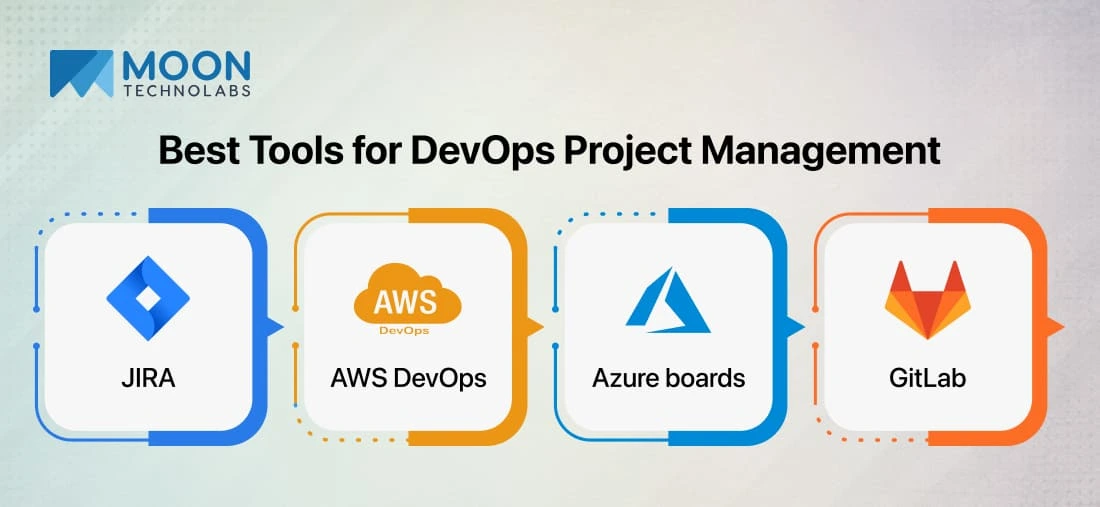
Here are the top tools that they can integrate:
JIRA can be used across multiple stages of the DevOps lifecycle. It’s an issue-tracking platform that can be customized to meet team needs. It enables managers and team members to plan, track, and release software versions by collaborating on sprint results.
JIRA can be integrated with other Atlassian tools, such as Miro and Mural, to capture ideas and research data. It enables teams to organize research findings into actionable items and prioritize their tasks. It can also be applied at other stages, including planning, deployment, operation, and continuous feedback.
AWS DevOps solutions are a toolset under Infrastructure as a Code (IaC) for cloud computing. Organizational teams utilize it to manage the software delivery pipelines with its built-in plugins. These include CodePipeline, CodeDeploy, CodeStar, and CodeBuild. It supports the entire lifecycle and can be deployed on the cloud or local machines.
With AWS, organizations can reprovision infrastructure with similar configurations for tools and code to consistently spin up development variations. With CI as its foundation, it enables automatic error detection and timely remediation. Ultimately, it helps roll out new features without compromising speed and testing processes.
Azure Boards helps teams plan, track, and manage their tasks. Azure Boards enables integration with the entire Azure DevOps project management suite for end-to-end software development. It includes Azure Pipelines, Test Plans and Repositories, item tracking, sprint planning, and customizable Kanban and Scrum boards.
Teams can create and prioritize tasks, assign them to team members, set due dates, and track progress. It also offers advanced analytics to stay on track, providing real-time insights that foster collaboration, transparency, and efficiency in software projects.
GitLab is designed to manage team assignments and organize projects. It uses issues to track tasks and labels, milestones, and iterations for better coordination. Organizations can also visualize the progress toward project goals and integration with code merge requests.
The transition to DevOps is not an overnight task; organizations need a steady, progressive, and smooth approach to implement it. Team members may find it unsettling to adopt a new methodology. However, they can start with baby steps by replicating a small portion of existing software and see the difference.
As everyone becomes accustomed to better communication, visibility, and tracking, they will be less averse to trying themselves. With Moon Technolabs, you will streamline your software development process with our DevOps consulting services with AWS DevOps and Microsoft Azure.
Our services can be easily integrated with tools like Terraform, Kubernetes, Grafana, and Prometheus. If your organization ensures every Dev and Ops team member is on the same page, achieving the overall goals becomes much easier.
01
02
03
04

Jayanti Katariya is the CEO of Moon Technolabs, a fast-growing IT solutions provider, with 18+ years of experience in the industry. Passionate about developing creative apps from a young age, he pursued an engineering degree to further this interest. Under his leadership, Moon Technolabs has helped numerous brands establish their online presence and he has also launched an invoicing software that assists businesses to streamline their financial operations.


Submitting the form below will ensure a prompt response from us.
We refine our expertise to deliver innovative business solutions.





500 N Michigan Avenue, #600, Chicago IL 60611
13500 Long Is Dr, Pflugerville, TX 78660, USA

C-105, Ganesh Meridian, S.G. Highway, Ahmedabad, GJ 380060


Ayse D.
Co-Founder France
“ I highly recommend Moon Technolabs as the quality of service is wonderful. We have hired this company to develop the product based on some complex & technical issues. We get the best quality services as compared with others in the market. Huge Thanks to Moon Technolabs as the team is always ready to give the solution all time.”

Justin G.
Founder & CEO USA
USA“ Moon Technolabs is a pioneer in the WebRTC based project as they have fixed complicated segments of the module by fulfilling different product lines by providing 24X7 customer support. We really recommended Moon Technolabs as they are able to develop products as per the module deadline and project timeline.”

Flavio S.
Founder & Managing Director Germany
“I am happy to recommend Moon Technolabs for their app development services. They successfully developed apps for me, and I am highly satisfied with the overall outcomes. The development team has swiftly addressed the issues with responsive and effective communication to understand the requirement quickly and actively resolve the back-and-forth problems that arose...”

Jay M.
Founder & CEOUSA“Moon Technolabs is the best company that provides advanced apps and websites development services in the USA and Europe. I am a newbie to develop my app with an external team. I am really happy to work with them as I am not that much mobile apps user. Here, the team and specially the CEO of Moon Technolabs helps me to let me know about the benefits of my app to generate revenue....”


Our Offices
India
C-105, Ganesh Meridian, S.G. Highway, Ahmedabad, GJ 380060USA
500 N Michigan Avenue, #600, Chicago IL 60611Contact Information


