
Jayanti Katariya
Last Updated: March 23, 2026 Total Views: 298
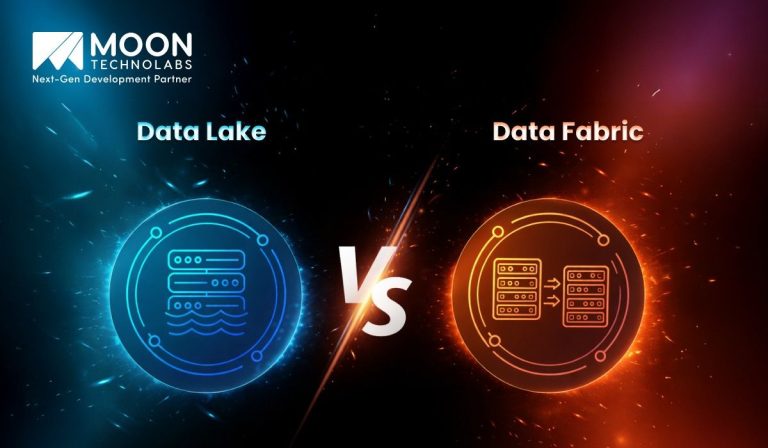
Table of Content


Blog Summary:
Choosing the right data architecture is indispensable for businesses for various reasons, such as gaining real-time insights, increasing scalability, and making informed decisions quickly. The blog offers a comprehensive overview of data fabric vs data lake, examining various factors such as use cases, benefits, features, challenges, and more. Keep reading the entire post to select the right data architecture for your business.
Table of Content
The fast growth of data has redefined how businesses store, use, and manage it. According to the latest data from Statista, the global data volume is likely to reach 182 zettabytes by 2025. It prompts most businesses to modernize their data architectures to support AI, analytics, and better decision-making.
This raises a major concern: data fabric vs. data lake, as these are the two popular options for businesses when it comes to data architectures. Of course, both have certain advantages and limitations.
Data lakes provide scalable yet cost-effective storage solutions for diverse datasets, whereas data fabrics offer an intelligent layer for seamless integration and access across environments. In this post, we will delve into a detailed comparison of data lakes and data fabrics to help you determine the right option for your business.
When it comes to choosing between data fabric and data lakes, it starts with defining your business objectives. You need to be clear about what your business tries to achieve.
Though both architectures facilitate data-based decision-making, they differ in your business scalability requirements, operational goals, and digital transformation goals. Let’s understand how these architectures align better with your core business goals:
As an advanced data architecture, data fabric connects and integrates data across different environments, systems, and platforms. Creating a unified layer ensures smooth data access and sharing. Data fabric leverages automation to help companies boost data visibility and make better decisions.
A data fabric offers features that help organizations access and manage their data more conveniently, enabling them to make better decisions. We will discuss each feature one by one below:
As mentioned, data fabric enables the integration of data from various sources without physical movement. Whether it’s cloud platforms, databases, enterprise apps, or APIs, it connects everything into a single virtual layer. It minimizes data duplication and complexity and ensures data availability with consistency across different systems and teams.
Data fabric uses metadata for various purposes, like organizing, classifying, and managing data assets. It also offers a higher visibility into lineage, data sources, usage, etc. This makes it convenient for businesses to improve governance policies and maintain data quality while ensuring compliance with the latest industry regulations.
With a data fabric, businesses can gain real-time access to data, enabling them to analyze and retrieve it more effectively. It also ensures quick insights and responsive decision-making. It’s particularly beneficial in scenarios where timing is critical, such as dynamic pricing or fraud detection.
Data fabric redefines the data management processes by using the power of Artificial Intelligence. The major advantage of intelligent automation is that it minimizes manual efforts and boosts efficiency, whether it’s data discovery, integration, or monitoring. It improves data operations and enables businesses to scale their data strategy with greater accuracy and control.
The main purpose of using a data fabric for business is to simplify data access and unify data across complex ecosystems, while managing diverse platforms and distributed systems. Let’s find out some of the top examples of implementing data fabric:
Businesses use data fabric to connect data across platforms such as Azure, AWS, and on-premises systems. It provides smooth data access and consistent visualization without physically moving data.
Enterprises use data visualization tools within a data fabric for creating a unified data view. It enables users to check data from various sources in real time.
A data fabric offers an advanced approach to managing distributed data. It also helps organizations unlock value fast while maintaining consistency and control across multiple systems.
As mentioned above, data fabric includes a unified layer that makes data accessible across various platforms and departments. Users can easily retrieve important data without worrying about storage, boost collaboration, and minimize reliance on IT teams.
With a data fabric, businesses gain the benefits of intelligent integration and real-time data access. It helps them analyze details fast and act on important insights without any unnecessary delays. This speed makes it very important to stay competitive in today’s fast-moving markets.
Data fabric helps businesses gain full control over data usage, security, and compliance. It allows businesses to monitor data lineage, implement policies, and maintain quality standards.
Data fabric has the potential to break down traditional data silos by connecting disparate systems into cohesive ecosystems. This unified approach is more effective at boosting data consistency, minimizing duplication, and ensuring a holistic view of business operations.
Though data fabric offers various advantages to businesses, its implementation also presents certain challenges. We will discuss some challenges as follows to make its implementation successful:
When you start setting up a data fabric, you need to integrate different systems, data sources, and platforms into a single layer. For this, you need to perform various tasks such as proper planning, architectural design, and alignment with your existing IT infrastructure.
It goes without saying that data fabric provides long-term value. But it can be more expensive in terms of the initial investment, which includes integration tools, infrastructure upgrades, and implementation services. For some businesses, especially small organizations, upfront expenses can be a barrier.
Managing a data fabric requires extensive expertise in metadata management, data integration, governance frameworks, and related areas. Businesses require training programs or skilled professionals to better handle these responsibilities. Inadequate in-house expertise slows adoption, which impacts overall efficiency.
A data fabric is ideal for businesses operating in distributed, complex data environments that require seamless, real-time data access. Let’s explore some of its popular use cases:
A data fabric unifies disparate systems, such as ERP, CRM, and other third-party apps, through smart integration. It ensures a consistent data view even without complex data migration. It fosters collaboration across multiple departments while minimizing dependency on manual data handling.
Data fabric is important for businesses that rely on the latest insights. These businesses include e-commerce, finance, healthcare, and others. Data fabric enables decision-makers in these businesses to access the latest data and make the right decisions for their businesses. They can respond based on customer behavior, market changes, operational risk, etc.
Today, most businesses function across various cloud platforms and on-premise systems. A data fabric includes a unified layer that connects these different environments to smooth data flow. This flexibility is vital for businesses that manage geographically distributed operations and are undergoing cloud transformation.
Data fabric harnesses the actual power of Artificial Intelligence (AI) and automation to ensure data discovery and classification. It thus minimizes manual effort and boosts data accuracy, making it easier for businesses to improve analytics initiatives while ensuring data quality standards and compliance.
We assist you in upgrading your existing data architectures to improve scalability and performance. Transform your outdated systems into future-ready data ecosystems.
A data lake is a centralized repository that stores large volumes of semi-structured, structured, or unstructured data in raw format.
It enables organizations to gather data from different sources without any predefined schemas. Due to this flexibility, it’s perfect for machine learning, advanced analytics, and long-term data storage. It allows teams to explore and process data as required.
A data lake offers several features that make it the best choice for advanced data-driven initiatives. We will discuss each feature in detail as follows:
Since a data lake can store different types of data, it reduces the need for multiple storage systems. Therefore, it allows businesses to gather data from a wide range of sources, including devices, apps, and external platforms.
A data lake is based on a schema-on-read approach, which distinguishes it from traditional databases. It indicates that the data is stored in raw format and is structured only when it’s accessed. It provides the data team with flexibility in defining schemas for specific use cases, making analysis and experimentation easier.
Data lakes include the ability to scale easily with increasing data volumes. It can handle terabytes or petabytes of data and support high-performance processing without any infrastructure changes. That’s why it’s considered perfect for big data environments.
Data lakes can be easily integrated with business intelligence, analytics, and machine learning tools. It allows businesses to build models and generate reports using the same centralized data source.
Businesses mainly use data lakes to manage large volumes of data effectively. Go through some of the top examples of data lake implementation as follows.
A large number of businesses use data lakes on cloud platforms such as Azure Data Lake Storage, AWS S3, and Google Cloud Storage. These solutions provide them with cost-efficient, scalable storage and built-in tools for purposes such as data security, processing, and analytics, making them a good choice for growing data requirements.
Businesses, especially large organizations, develop data lakes using big data frameworks such as Spark or Hadoop. These platforms offer data ingestion, processing, analysis, and more. It supports various use cases such as predictive analytics and reporting.
A data lake offers a plethora of benefits, enabling businesses to manage data more efficiently while reducing costs. Take a look at some of the most promising advantages below:
The major benefit of data lakes is that they make it possible to store the largest volume of data at the lowest cost. Businesses can retain raw data without investing heavily in infrastructure.
Organizations using data lakes can run advanced analytics, whether it’s machine learning or predictive modeling. It also allows data scientists to perform tasks such as experimenting with, transforming, and analyzing datasets.
Data lakes enable teams to process data for their specific use cases. This kind of flexibility makes it easier to adapt to changing business requirements and to seize new analytical opportunities.
Data lakes consolidate data from a range of sources into a single location. This centralization boosts data accessibility and supports cross-functional analysis. It allows organizations to get a complete view of their operations.
A data lake also comes with certain challenges, though it offers scalability and flexibility. The following are some of those challenges that impact heavily on data reliability and governance:
One of the major issues with a data lake is that it complicates data governance. As we mentioned already, it stores data in a raw format. This creates difficulties with data lineage, ownership tracking, and usage tracking.
Since data lakes support data in native format, it causes duplication, inconsistencies, and inaccuracies over time. It ensures that data quality needs additional processes for cleaning and validation. Poor data quality adversely impacts analytics outcomes and decision-making.
Storing the largest volume of sensitive data in a centralized repository raises many security concerns. Organizations should implement strong encryption, access controls, and monitoring to protect data from breaches.
We make your data architecture future-proof with scalable solutions for emerging business requirements. Empower smooth integration with long-term growth.
A data lake is best for companies that manage large volumes of diverse, raw data and seek to extract meaningful analytical value from it. Businesses can leverage it to store data in various structures in native formats, whether structured, semi-structured, or unstructured. We will discuss some of its more important use cases below:
Data lakes can handle large-scale data ingestion from diverse sources such as IoT devices, apps, and external systems. They include a centralized repository where data can be stored and processed using big data tools. It allows companies to scale even without caring about storage limitations.
A data lake also helps data scientists build models and conduct experiments. Since it enables raw data storage, it allows teams to transform the data for any specific use case. That’s why it’s considered to be a perfect option for predictive analytics, machine learning, and various AI initiatives.
A data lake is quite useful for companies that generate a continuous stream of log and event data, such as digital platforms or IT systems. They can easily store and access this information using a data lake, which also helps detect anomalies and identify patterns. Thus, it helps enhance the system’s performance over time.
A data lake provides a cost-effective way to store historical data that may not be actively used but is crucial for auditing, compliance, and future analysis. It ensures that businesses get vital data without incurring excessive infrastructure costs.
Both architectures cater to distinct purposes, but one has a greater impact according to organizational requirements. Selecting the right one among these requires a comprehensive look at how each performs across various technical and business factors. Let’s have a detailed comparison of data fabric vs. data lake.
A data lake serves as an effective centralized repository for storing large volumes of raw data. On the other hand, data fabric operates better across distributed environments. This makes it a perfect voice for organizations with multi-system architectures.
Data lakes focus mainly on storage, which requires additional tools for transformation and integration. Quite the contrary, data fabric offers built-in integration capabilities that connect a range of data sources through a unified layer and simplify data management.
A data lake requires technical expertise to access and prepare data. Data fabric enhances accessibility by providing a user-friendly approach. It allows companies to access data in real time without any technical involvement.
Data lakes are indeed fast to implement and also more affordable at an earlier stage. Data fabric requires a higher upfront investment and longer implementation time, mainly due to its integration requirements.
Both data fabric and data lake are scalable. Meanwhile, data lakes can be tough to manage as data volumes increase without proper governance. Data fabric includes automated and metadata-based approaches. It offers long-term maintainability.
Data lakes pose several security risks, especially when security measures are not implemented properly. Data fabric boosts both security and compliance by offering improved visibility, policy enforcement, and data lineage tracking across various systems.
Selecting the right data structure is about more than just choosing tools and technologies. You need to focus clearly on domain expertise, a clear strategy, and smooth implementation.
So, partnering with a professional technology provider helps you assess your requirements and craft scalable solutions. They also ensure smooth implementation and guidance to help you improve data value and minimize risks.
Both data fabric and data lake have a set of advantages and disadvantages. So, your final choice should be based on how your businesses extract, integrate, manage, and utilize data. It should also depend on your data complexity and business objectives. Partner with us to design, scale, and implement the most suitable architecture for your business, ensuring long-term success.
01
02
03
04
05

Jayanti Katariya is the CEO of Moon Technolabs, a fast-growing IT solutions provider, with 18+ years of experience in the industry. Passionate about developing creative apps from a young age, he pursued an engineering degree to further this interest. Under his leadership, Moon Technolabs has helped numerous brands establish their online presence and he has also launched an invoicing software that assists businesses to streamline their financial operations.


Submitting the form below will ensure a prompt response from us.
We refine our expertise to deliver innovative business solutions.




205 N Michigan Avenue, #810, Chicago, 60601, Illinois, United States
13500 Long Is Dr, Pflugerville, TX 78660, USA

C/105 Ganesh Meridian, S.G. Highway, Ahmedabad, GJ 380060


Ayse D.
Co-Founder France
“ I highly recommend Moon Technolabs as the quality of service is wonderful. We have hired this company to develop the product based on some complex & technical issues. We get the best quality services as compared with others in the market. Huge Thanks to Moon Technolabs as the team is always ready to give the solution all time.”

Justin G.
Founder & CEO USA
USA“ Moon Technolabs is a pioneer in the WebRTC based project as they have fixed complicated segments of the module by fulfilling different product lines by providing 24X7 customer support. We really recommended Moon Technolabs as they are able to develop products as per the module deadline and project timeline.”

Flavio S.
Founder & Managing Director Germany
“I am happy to recommend Moon Technolabs for their app development services. They successfully developed apps for me, and I am highly satisfied with the overall outcomes. The development team has swiftly addressed the issues with responsive and effective communication to understand the requirement quickly and actively resolve the back-and-forth problems that arose...”

Jay M.
Founder & CEOUSA“Moon Technolabs is the best company that provides advanced apps and websites development services in the USA and Europe. I am a newbie to develop my app with an external team. I am really happy to work with them as I am not that much mobile apps user. Here, the team and specially the CEO of Moon Technolabs helps me to let me know about the benefits of my app to generate revenue....”


Our Offices
India
C/105 Ganesh Meridian,S.G. Highway, Ahmedabad, GJ 380060USA
205 N Michigan Avenue, #810, Chicago, 60601, Illinois, United StatesContact Information


