
Jayanti Katariya
Last Updated: February 22, 2026 Total Views: 196

Table of Content


Blog Summary:
This guide provides a comprehensive breakdown of software developer hiring costs, exploring regional salary variations, tech stack premiums, and diverse engagement models. From comparing offshore vs in-house talent to evaluating “hidden” recruitment expenses, we offer actionable strategies to help you optimize your tech budget and secure high-value talent without compromising on code quality.
Table of Content
The demand for elite software developers has skyrocketed. Whether you’re a startup founder or an enterprise leader, hiring the right technical talent is no longer just a recruitment task. It’s a high-stakes financial investment that can determine if your product scales or fails. But what does it actually cost to hire a developer in today’s economy?
Typically, software development hourly rates span a wide range, from $20 for offshore talent to $ 250+ for top-tier specialized architects in the US. While freelancers often offer the most attractive upfront prices, they can lack the long-term continuity businesses need for mission-critical systems.
Mid-sized development firms have become the “middle ground,” balancing accountability with cost-effectiveness. However, the global consulting giants remain the choice for enterprises where reliability is worth a premium price tag.
Fortunately, the rise of nearshoring and intelligent outsourcing has democratized access to global talent. To build a realistic budget, you need to understand the regional pay gaps, the premium on emerging technologies, and the hidden costs of the labor market.
This guide breaks down exact the Cost to Hire Software Developer and how to navigate developer costs to ensure you get the maximum ROI on every line of code.
The cost of hiring a software developer generally falls into three categories:
On average, a full-time developer in a high-cost market like the US is hired at $120,000 to $200,000+ per year. Whereas, offshore rates reduce that figure by 60–70%.
To provide a clearer view of the typical market rates, the table below compares average hourly rates across global hubs.
| Region | Avg. Hourly Rate | Avg. Annual Salary (Mid-Level) | Typical Engagement Model |
|---|---|---|---|
| North America | $80 – $250+ | $145,000 – $180,000 | In-house / High-end Agencies |
| Western Europe | $70 – $180 | $90,000 – $130,000 | Hybrid / Contract |
| Eastern Europe | $45 – $130 | $60,000 – $95,000 | Nearshore Outsourcing |
| Latin America | $45 – $120 | $55,000 – $85,000 | Staff Augmentation |
| Asia | $25 – $100 | $35,000 – $70,000 | Offshore Dedicated Teams |
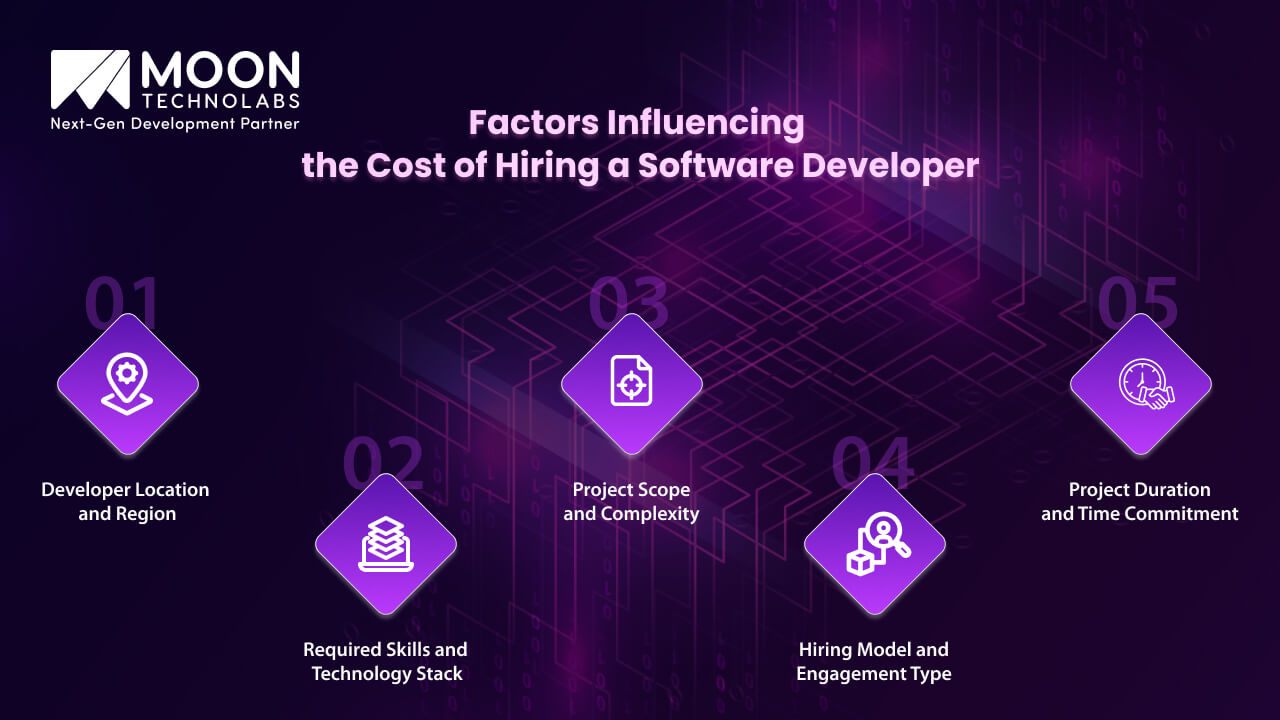
Understanding the cost factors of hiring a software developer will help you optimize your spend without sacrificing product quality. Here are the five key factors influencing the cost of hiring a software developer today:
Geography is the most significant factor in your hiring budget. Even in a remote-first world, the “local” cost of living dictates a developer’s base expectations.
The law of supply and demand heavily impacts developer rates. The “Generalist” developers are more affordable, while “Specialists” in scarce fields command significant premiums.
The more moving parts your software has, the higher the cost. This is not just about the hours worked, but about the seniority required to manage that complexity.
How you hire is just as important as who you hire. Each model has a different “all-in” cost structure:
The timeline of a software project directly impacts cost, resource allocation, and delivery quality. Shorter timelines increase expenses due to higher resource intensity, while longer commitments often allow for better cost optimization. Hence, time is literally money in software development.
Partner with Moon Technolabs to access the top 1% of global developers. We provide high-performance, cost-efficient solutions tailored to your unique goals.
Start Your Project
Choosing the right hiring model is a strategic decision that impacts your project’s budget, speed, and long-term stability.
Freelancers are independent contractors hired for specific tasks or short-term projects. They are typically the most “budget-friendly” option upfront.
It follows a pay-as-you-go cost structure and is usually billed on an hourly or per-milestone basis. No benefits, taxes, or office overhead. Freelance developers are best for small fixes, MVPs (Minimum Viable Products), or niche tasks that don’t require long-term maintenance.
| Pros and Cons |
|---|
|
These are permanent employees who work exclusively for your company. They are the most expensive but provide the highest level of alignment. This model is best for core product development and for companies where the software is the primary business.
| Pros and Cons |
|---|
|
This model is the “middle ground” where you hire a full team (Developers, QA, PM) through an external vendor. You can hire dedicated developers who work only for you. They are not your in-house employees, but they are committed to your project remotely. This model is optimal for long-term projects that require a steady pace while maintaining budget flexibility.
| Pros and Cons |
|---|
|
You Might Also Like:
This involves handing over the entire project to an agency. You pay for the result, not the hours or people. The cost structure is often fixed-price or time-and-materials-based. Usually, the highest “per-hour” cost is due to agency margins. This model is best suited to well-defined projects with a clear scope, where you don’t want to manage day-to-day work.
| Pros and Cons |
|---|
|
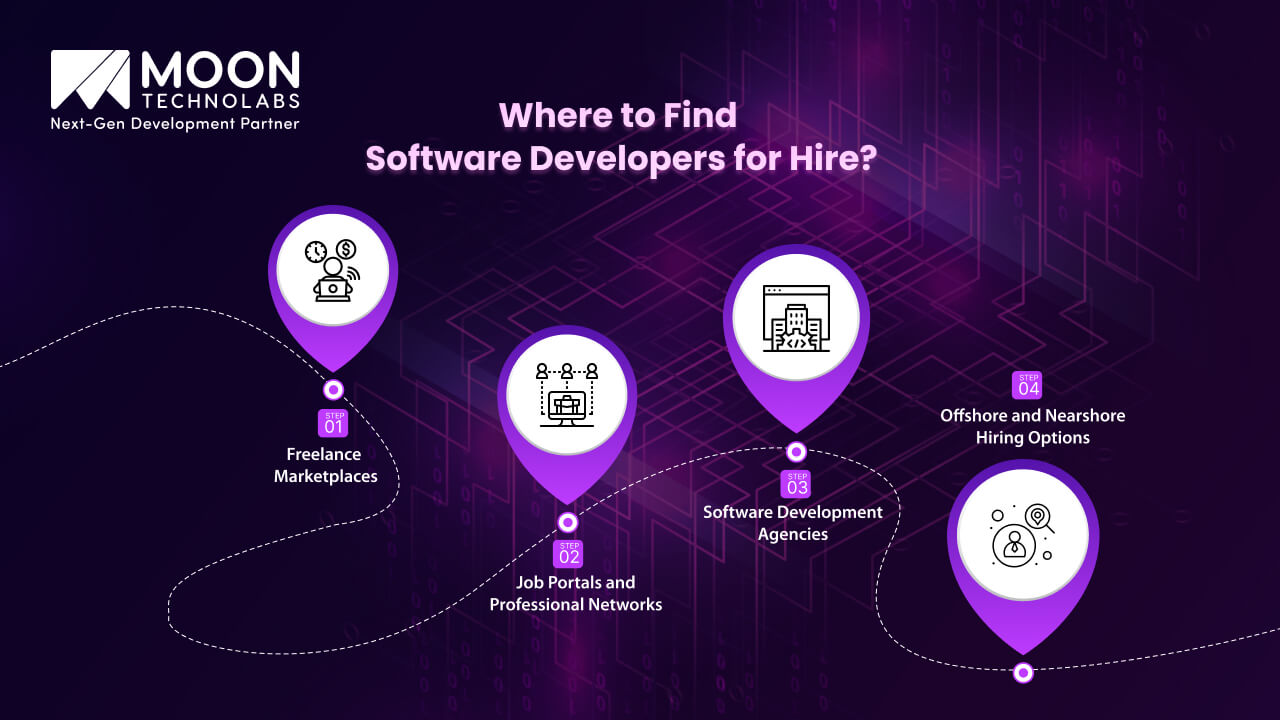
Finding the right talent requires a multi-channel approach. The “best” place to hire depends entirely on your project’s urgency, budget, and required level of oversight. Whether you need a quick fix for a landing page or a full-scale engineering team for a SaaS product, here are the options you should look for:
If you have a well-defined task or a short-term project, freelance marketplaces are the most accessible starting point.
Platforms like Upwork and Fiverr are the world’s largest hubs that have integrated AI-matching tools to help you scour millions of profiles. They are ideal for smaller tasks, MVPs, or specialized hourly work.
For high-stakes projects, platforms like Toptal or Gun.io do the heavy lifting. They pre-screen the “Top 3%” of talent, ensuring that every developer you interview has already passed rigorous technical and communication assessments.
Additionally, newer entrants such as Jobbers.io have gained traction by removing platform fees, enabling more competitive pricing between you and the developer.
When you are looking for long-term “cultural fits” or full-time employees, traditional job boards and social networks remain king.
LinkedIn Recruiter is still the most powerful tool for “passive” hiring and finding developers who aren’t actively looking but are open to the right offer. Its AI-driven filters allow you to search by specific tech stacks and years of experience.
Sites such as Dice, Stack Overflow, and GitHub Jobs are designed specifically for the developer community. Posting here ensures your job is seen by people who are deeply embedded in the tech ecosystem.
Moreover, Wellfound (formerly AngelList) is the go-to site for startups. It attracts talent specifically looking for equity-based roles and the fast-paced culture of early-stage companies.
If you don’t want to handle technical management, the best bet is to outsource the software development project to a renowned company. Agencies provide a full squad, including a project manager, lead developer, and QA tester. This is the “plug-and-play” option for companies without an internal CTO.
Moreover, an agency provides a legal contract with clear delivery milestones and a reputation to maintain. This significantly reduces the risk of project abandonment.
“Geographic arbitrage” is the standard for companies looking to maximize their ROI without sacrificing code quality.
For a US-based company, nearshore hiring means hiring from Latin America (Brazil, Mexico, Argentina). You get a 40–50% cost saving with the massive benefit of real-time communication and overlapping work hours.
Regions like Eastern Europe (Poland, Romania) and Southeast Asia (Vietnam, India) offer the deepest talent pools for offshore hiring. While the time zone gap requires more asynchronous management, the cost of a senior developer offshore can range from $40–$70/hr, compared to $150+/hr in North America.
Here are some tips for hiring cost-effective, value-optimizing software developers. The right choice balances expertise, productivity, and long-term impact on your project.
Ambiguity is the primary driver of “scope creep,” which is the fastest way to blow a budget. Hence, you must have a clear roadmap before starting.
Create a detailed product requirements document (PRD). When developers know exactly what APIs to integrate and which features are “must-haves” versus “nice-to-haves,” they can provide more accurate estimates. Also, clear instructions prevent the costly cycle of building, tearing down, and rebuilding features when the original intent is misunderstood.
A cost-effective hire is one who builds for the future. If your developer builds a system that crashes the moment you hit 1,000 users, your initial “savings” will vanish during an emergency migration.
Hire software developers who think about scalability from Day 1. Moreover, cost-effectiveness is maintained when a new developer can jump into the project without spending weeks figuring out how the previous developer built it.
One size does not fit all. Choosing the wrong engagement model can lead to unnecessary overhead:
The “cheapest” developer often ends up being the most expensive. In software development, you aren’t paying for hours but for the efficiency of those hours.
A senior developer charging $120/hr might solve a complex architectural problem in two hours that a junior developer ($40/hr) would take ten hours to solve poorly. Cost-effective hiring means finding developers who write clean, well-documented, and maintainable code.
Before committing to a long-term contract or a full-time salary, initiate a trial phase. For that, give the candidate a small, paid task, such as fixing a specific bug or building a single feature that represents your actual project.
Use this period to evaluate not just their technical skill, but also their communication style, punctuality, and how they use AI tools to assist their workflow. It’s much cheaper to part ways after a one-week trial than after three months of a failed project.
Our Vetted experts deliver high-quality web, mobile, and AI solutions at competitive prices. From flexible staff augmentation to dedicated development squads, we provide the technical excellence you need to stay ahead.
Get A Free Cost Estimate Now
The cost of hiring a software developer is less about finding the cheapest rate and more about strategically balancing quality, speed, and budget. As we’ve explored, your final investment is shaped by a complex interplay among geographic locations, specialized tech stacks such as AI and Blockchain, and the hiring model that best fits your company’s culture.
Whether you opt for the deep integration of an in-house team or the high-impact ROI of a dedicated offshore partner, the most cost-effective choice is always the one that minimizes technical debt and maximizes long-term scalability.
By clearly defining your project scope and prioritizing value over initial price tags, you can secure the elite talent necessary to turn your vision into a market-leading digital product.
Have a specific project in mind? Contact us today to discuss your requirements with our technical experts.
01
02
03
04
05

Jayanti Katariya is the CEO of Moon Technolabs, a fast-growing IT solutions provider, with 18+ years of experience in the industry. Passionate about developing creative apps from a young age, he pursued an engineering degree to further this interest. Under his leadership, Moon Technolabs has helped numerous brands establish their online presence and he has also launched an invoicing software that assists businesses to streamline their financial operations.


Submitting the form below will ensure a prompt response from us.
We refine our expertise to deliver innovative business solutions.





500 N Michigan Avenue, #600, Chicago IL 60611
13500 Long Is Dr, Pflugerville, TX 78660, USA

C/105 Ganesh Meridian, S.G. Highway, Ahmedabad, GJ 380060


Ayse D.
Co-Founder France
“ I highly recommend Moon Technolabs as the quality of service is wonderful. We have hired this company to develop the product based on some complex & technical issues. We get the best quality services as compared with others in the market. Huge Thanks to Moon Technolabs as the team is always ready to give the solution all time.”

Justin G.
Founder & CEO USA
USA“ Moon Technolabs is a pioneer in the WebRTC based project as they have fixed complicated segments of the module by fulfilling different product lines by providing 24X7 customer support. We really recommended Moon Technolabs as they are able to develop products as per the module deadline and project timeline.”

Flavio S.
Founder & Managing Director Germany
“I am happy to recommend Moon Technolabs for their app development services. They successfully developed apps for me, and I am highly satisfied with the overall outcomes. The development team has swiftly addressed the issues with responsive and effective communication to understand the requirement quickly and actively resolve the back-and-forth problems that arose...”

Jay M.
Founder & CEOUSA“Moon Technolabs is the best company that provides advanced apps and websites development services in the USA and Europe. I am a newbie to develop my app with an external team. I am really happy to work with them as I am not that much mobile apps user. Here, the team and specially the CEO of Moon Technolabs helps me to let me know about the benefits of my app to generate revenue....”


Our Offices
India
C/105 Ganesh Meridian,S.G. Highway, Ahmedabad, GJ 380060USA
500 N Michigan Avenue, #600, Chicago IL 60611Contact Information


