
 Total Views: 402
Table of Content


Blog Summary:
This blog explores the growing importance of conversational AI in healthcare by covering its rapidly expanding market size and popular use cases, ranging from appointment scheduling to claim support. The blog also highlights its benefits, future trends, and compliance considerations.
Table of Content
Communication is essential to running any healthcare organization properly, as it is in other businesses. Patients book appointments late by calling healthcare service providers directly, checking test results, asking about prescriptions, etc. And for all these, clear communication is vital. .
But, healthcare organizations often struggle to cope with the situation due to the rising patient expectations, limited staff, and strict regulations. And this is where Conversational AI in Healthcare steps in as an effective solution that addresses their most pressing issues.
As an AI-based virtual assistant and chatbot, it can handle routine tasks smoothly, such as answering common questions or sending reminders. It works 24/7, thereby reducing administrative workload while ensuring patients receive a clear, fast response.
In this blog, we will discuss conversational AI in healthcare in greater detail to help you build and implement a powerful solution for your healthcare business. Let’s explore further.
The healthcare sector is undergoing a tremendous shift driven by technological advancements, and conversational AI is at the forefront of this transformation. It ensures outstanding patient care with higher efficiency and accuracy.
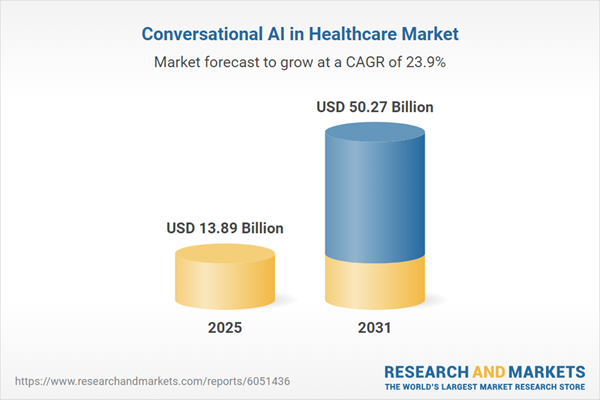
Due to these benefits, the usage of conversational AI in healthcare is growing at an unprecedented rate. According to Research and Markets, the global conversational AI market in healthcare is projected to grow from $13.89 billion in 2025 to $50.27 billion by 2031, at a CAGR of 23.91%.
Conversational AI is basically a form of Artificial Intelligence. It automatically interacts with both patients and service providers, minimizing the burden on professional healthcare providers.
A healthcare organization uses conversational AI in various ways, such as transforming administrative tasks, providing patient education, and automating customer service interactions. It works effectively for appointment scheduling, patient intake management, and providing relevant educational resources.
Conversational AI harnesses the potential advantages of natural language understanding (NLU), natural language processing (NLP), and machine learning (ML). It can analyze large volumes of data, including past patient conversations. It offers a variety of responses to patient questions, especially compared with traditional rule-based support chatbots.
Healthcare service providers are often in constant search for the right solution to boost patient outcomes while minimizing operational costs. Conversational AI emerged as a partial solution for these issues. It’s necessary for many other reasons as well:
Conversational AI is much more than just being a simple chatbot. It serves healthcare organizations in several ways, be it voice bots, smart virtual assistants, or AI-based messaging systems. The following are some of the top use cases of healthcare conversational AI:
Conversational AI enables automated appointment scheduling. It allows patients to reschedule, book, or cancel appointments using voice or chat interfaces, without having to hold or wait. With the integration of EHR platforms and hospital scheduling systems, AI assistants can do the following important things:
With the proper use of conversational AI, you can reduce front-desk workload and elevate your operational efficiency. At the same time, it provides patients with a smooth, self-service experience.
AI-driven symptom checkers provide comprehensive guidance to patients through a structured conversation to better analyze their condition. It analyzes everything properly, be it medical history, reported symptoms, or risk factors. And recommends the appropriate actions, such as teleconsultation, self-care, or emergency care.
A large number of health systems offer preliminary assessments with the following crucial benefits:
Conversational AI redefines decision support and boosts triage accuracy at scale.
A continuous and thorough engagement is highly important, especially for those patients suffering from hypertension, diabetes, heart disease, or asthma. Conversational artificial intelligence serves as a virtual care companion by providing:
AI systems can gather real-time health data and recommend timely interventions by integrating remote monitoring and wearable devices. This kind of proactive approach boosts adherence, which minimizes hospital re-admissions and thus supports value-based care models.
Healthcare providers often receive repetitive queries, including insurance acceptance, clinic hours, lab results, vaccination information, and more. So they can respond to the large volume of queries using conversational AI. It provides:
Hospitals that implemented AI virtual assistants saw significant reductions in inbound call volume while maintaining high patient satisfaction.
It can’t be denied that manual patient intake is time-consuming. Besides, it also causes many errors. Conversational AI redefines the entire process through collecting insurance details, medical history, symptoms data, and consent forms before the visit.
Using conversational AI, patients can complete pre-visit screening via voice assistants or mobile chat, reducing paperwork at the facility. We all witnessed the unprecedented use of AI tools during the COVID-19 public health crisis.
Its use cases are as follows:
Even after patients get discharged, they need constant care. Conversational AI helps patients stay engaged even during recovery with automated follow-ups. The system includes the following capabilities:
Automated follow-up is beneficial for surgical patients and those with chronic conditions. It minimizes readmission rates and improves patient-provider relationships. It also offers remote care programs that help healthcare teams analyze recovery even without frequent in-person visits.
Another popular use case of conversational AI in healthcare is mental health support. It provides stigma-free and fast support. AI chatbots offer cognitive behavioral therapy (CBT) based exercises, stress management guidance, and mood tracking.
Many platforms, including Woebot Health, demonstrate how AI-based conversational tools can supplement traditional therapy. It offers the following important benefits:
Though it can’t replace a professional therapist, AI-driven tools can help bridge accessibility gaps, especially in underserved regions.
It goes without saying that the billing process in healthcare is quite complex, which often causes issues like delayed payments and also a lot of confusion. Conversational artificial intelligence makes this process quite simple and assists patients as follows:
It helps healthcare providers automate billing support interactions to minimize administrative overhead and boost revenue cycle management. It allows patients to gain complete visibility into their overall financial responsibilities, thereby improving trust and transparency.
We have the expertise to create a HIPAA-compliant healthcare chatbot that secures patient data. Let’s get smart and secure solutions that improve the patient’s experience.
Conversational AI in healthcare offers numerous advantages, as we briefly discussed above. The following are some of the most important benefits:
It’s well known that administrative tasks in healthcare organizations take a lot of time. Your staff generally spends a lot of time on tasks like answering patients’ queries, scheduling appointments, collecting patient data, managing billing inquiries, and more.
You can free them up by automating these tasks through using conversational AI. Doing this lets your staff focus on higher-value responsibilities. AI also effectively minimizes call center load, response times, manual data-entry errors, and more. It boosts productivity while minimizing staff effort.
An improved health outcome is directly proportional to patient engagement. Conversational AI fosters patient engagement by maintaining consistent communication with patients through educational messages, reminders, and follow-ups.
An AI assistant has an enormous capability to send medication alerts. It explains treatment plans in easy-to-understand language and provides condition-specific resources. Besides, it personalizes communication based on patients’ preferences and history.
Running a healthcare organization involves huge expenses, which create difficulties for many service providers as well. Conversational AI offers the most effective way to manage increased patient volume without proportionally increasing staffing costs.
Besides, we already discussed how AI helps healthcare providers automate most of their repetitive tasks, saving time and reducing costs. AI systems can manage multiple patient interactions while ensuring consistent service quality.
Over time, it yields benefits such as reduced operational waste, increased ROI, and improved financial performance. These benefits are specifically for healthcare organizations, such as clinics, hospitals, and telehealth providers.
Clinicians can use conversational AI to gather structured patient details before final appointments and during follow-ups. With automated system assessments and pre-visit screening, doctors gather accurate data in advance, which minimizes consultation time and increases decision-making efficiency.
Integrating conversational AI systems with EHR ensures automated documentation of patient responses and minimizes manual charting. It also enables healthcare professionals to spend more time on patient care rather than on administrative documentation.
Conversational AI captures comprehensive insights from every patient interaction and enables healthcare service providers to analyze the data to identify service gaps, understand trends, and improve care delivery.
They can also use AI analytics to review treatment adherence patterns, predict patient demand, and detect potential health risks. These insights help providers focus on continuous improvement in patient care.
With the increasing adoption of conversational AI in the healthcare sector, safety and compliance are of great significance. So, it’s essential for healthcare chatbots to follow regulatory, ethical, and clinical standards to avoid any risk while increasing patient trust:
For healthcare data, privacy protection is pivotal due to its sensitive nature. Chatbots capable of gathering and processing patient information must comply with regulations such as HIPAA in the United States and other regional data protection laws.
It requires proper implementation of strong encryption, role-based access controls, secure authentication mechanisms, and secure API integrations with EHR systems.
In addition, it’s important for organizations to make clear that third-party AI vendors sign business associate agreements (BAAs) as needed. A clear consent mechanism and a transparent privacy policy are also highly important for maintaining patient trust.
Healthcare chatbots need to undergo a thorough clinical validation. In certain cases, AI tools may fall under FDA regulatory oversight. This case arises especially when the tools function as software-as-a-medical-device (SaMD).
Be it bias evaluation, regular testing, or performance benchmarking, it’s necessary to ensure reliability and accuracy. It requires continuous monitoring to detect any incorrect responses, unsafe recommendations, or any outdated medical guidelines.
It’s crucial to design healthcare chatbots with fairness and transparency. It should be unbiased while answering patients’ queries. On the other hand, patients should be aware that they are chatting with an AI system. The reason is that any kind of misrepresentation undermines trust and raises several ethical concerns.
To minimize bias, it’s important to diversify the training dataset. It should also be representative to avoid any unequal recommendations across demographic groups. It’s a good decision for organizations to define accountability frameworks and clarify who is responsible for content updates, chatbot decisions, error management, etc.
Maintaining system integrity is essential and requires robust technical safeguards. These mainly include intrusion detection systems, periodic vulnerability assessments, and multi-factor authentication.
Comprehensive audit logs should better track system changes, chatbot interactions, and data access events. It provides traceability for compliance reviews, disputes, or security incidents.
Additionally, regular third-party penetration testing and security audits further enhance resilience against cyber threats. As a healthcare provider, you need to focus on validation, compliance, and technical security when implementing conversational AI solutions to protect clinicians, patients, and the organization’s reputation.
From chatbots to smart, context-aware digital companions, conversational AI in the healthcare sector is evolving rapidly. Its prime focus now is shifting towards automation, deep personalization, and predictive care:
In the near future, conversational AI seems to be shifting beyond answering questions to predicting patients’ actual needs. AI systems will analyze wearable inputs, longitudinal health data, social determinants, and behavioral patterns to offer extremely personalized recommendations.
AI assistants can send lifestyle suggestions, medication reminders, and early risk alerts rather than waiting for patients to report symptoms. You can expect more data-driven, contextual engagement when you integrate it with advanced AI ecosystems, especially those developed by Google Health and similar platforms.
Clinical documentation is the biggest administrative stress for many physicians. Ambient conversational AI emerged as a robust solution. AI systems harness the potential of natural language understanding and voice recognition.
It listens to patient-provider conversations and automatically generates structured clinical notes in real time. It minimizes manual charting and allows doctors to focus entirely on patient interaction. Ambient documentation tools are likely to minimize burnout while enhancing the completeness and accuracy of medical records.
Voice interfaces have gained significant prominence in recent years. In the future, healthcare chatbots are expected to support voice-first and multilingual interactions, making care more accessible, especially for patients who are not tech-savvy.
As for emotional AI capabilities, they will further contribute to improving these systems. Conversational AI can indeed detect signs of anxiety, stress, or even distress through analyzing sentiment, tone, and speech patterns. This is indeed highly valuable in chronic care support and mental health monitoring.
Conversational AI will integrate with predictive analytics engines to detect health risks before they worsen. Systems can combine conversational inputs with wearable data, clinical history, and AI risk models to help detect early warning signs of health conditions. These include diabetic conditions and cardiac issues.
Conversational AI platforms function as intelligent intervention systems rather than merely communication tools. It prompts lifestyle adjustments, preventive screening, and immediate clinical escalation. Predictive conversational AI plays a leading role in boosting outcomes while minimizing overall costs.
We help you launch an AI healthcare chatbot that redefines patient interactions through smart, secure automation. Let’s transform appointment, engagement, and support.
With 16+ years of experience, we have unmatched expertise in creating high-quality healthcare chatbots that can streamline and transform your operations and improve patient care. Whether streamlining triage, automating patient engagement, or providing 24/7 support, our solution offers endless benefits for your healthcare organization.
Our AI developers have extensive expertise in leveraging cutting-edge technologies such as ML and NLP to build custom chatbot solutions tailored to your organization’s specific needs. With 300+ professionals, we provide top-rated AI systems backed by scalability and security.
In addition to delivering robust AI systems that integrate easily with your existing healthcare infrastructure, we promise fast deployment through our deep technical expertise and agile development methodology. It not only helps you maximize the patient experience but also minimizes operational costs.
By now, you understand how conversational AI has transformed the healthcare sector by streamlining clinical workflows and improving patient engagement. When you implement it properly and use it to its full potential, it will do much more than just serve as a supporting tool.
It clearly reflects that creating AI systems for healthcare is decisive. But its development and implementation require professional assistance. Partner with us to get a top-class AI solution for your organization.
01
02
03
04
05

Jayanti Katariya is the CEO of Moon Technolabs, a fast-growing IT solutions provider, with 18+ years of experience in the industry. Passionate about developing creative apps from a young age, he pursued an engineering degree to further this interest. Under his leadership, Moon Technolabs has helped numerous brands establish their online presence and he has also launched an invoicing software that assists businesses to streamline their financial operations.


Submitting the form below will ensure a prompt response from us.
We refine our expertise to deliver innovative business solutions.





500 N Michigan Avenue, #600, Chicago IL 60611
13500 Long Is Dr, Pflugerville, TX 78660, USA

C-105, Ganesh Meridian, S.G. Highway, Ahmedabad, GJ 380060


Ayse D.
Co-Founder France
“ I highly recommend Moon Technolabs as the quality of service is wonderful. We have hired this company to develop the product based on some complex & technical issues. We get the best quality services as compared with others in the market. Huge Thanks to Moon Technolabs as the team is always ready to give the solution all time.”

Justin G.
Founder & CEO USA
USA“ Moon Technolabs is a pioneer in the WebRTC based project as they have fixed complicated segments of the module by fulfilling different product lines by providing 24X7 customer support. We really recommended Moon Technolabs as they are able to develop products as per the module deadline and project timeline.”

Flavio S.
Founder & Managing Director Germany
“I am happy to recommend Moon Technolabs for their app development services. They successfully developed apps for me, and I am highly satisfied with the overall outcomes. The development team has swiftly addressed the issues with responsive and effective communication to understand the requirement quickly and actively resolve the back-and-forth problems that arose...”

Jay M.
Founder & CEOUSA“Moon Technolabs is the best company that provides advanced apps and websites development services in the USA and Europe. I am a newbie to develop my app with an external team. I am really happy to work with them as I am not that much mobile apps user. Here, the team and specially the CEO of Moon Technolabs helps me to let me know about the benefits of my app to generate revenue....”


Our Offices
India
C-105, Ganesh Meridian, S.G. Highway, Ahmedabad, GJ 380060USA
500 N Michigan Avenue, #600, Chicago IL 60611Contact Information


