
Jayanti Katariya
Last Updated: March 26, 2026 Total Views: 86

Table of Content


Blog Summary:
The guide lets you explore comprehensive information on business intelligence (BI) development, including steps, tools, and technologies. It also explains the benefits, types, challenges, and more of business intelligence, helping you create the right solution for your business.
Table of Content
Businesses from every sector generate a large volume of data every day. Meanwhile, much of this data is locked in silos and scattered across systems. As a result, decision-makers rely on incomplete information, leading to operational inefficiencies and missed growth opportunities.
To overcome these challenges, organizations need a structured system to extract valuable information from their raw data. This is where Business Intelligence Development emerges as the right solution that converts raw data into actionable insights.
BI solutions enable businesses to avail of numerous advantages, such as optimizing operations, improving predictive accuracy, understanding customer behavior, etc. The solutions let organizations focus on data-driven strategies and make decisions quickly and with confidence.
These benefits have increased demand and adoption rates of BI software, which has also had a significant impact on its market size. Grand View Research predicts that the global business intelligence software market is likely to increase at a CAGR of 9.3% from 2023 to 2033.
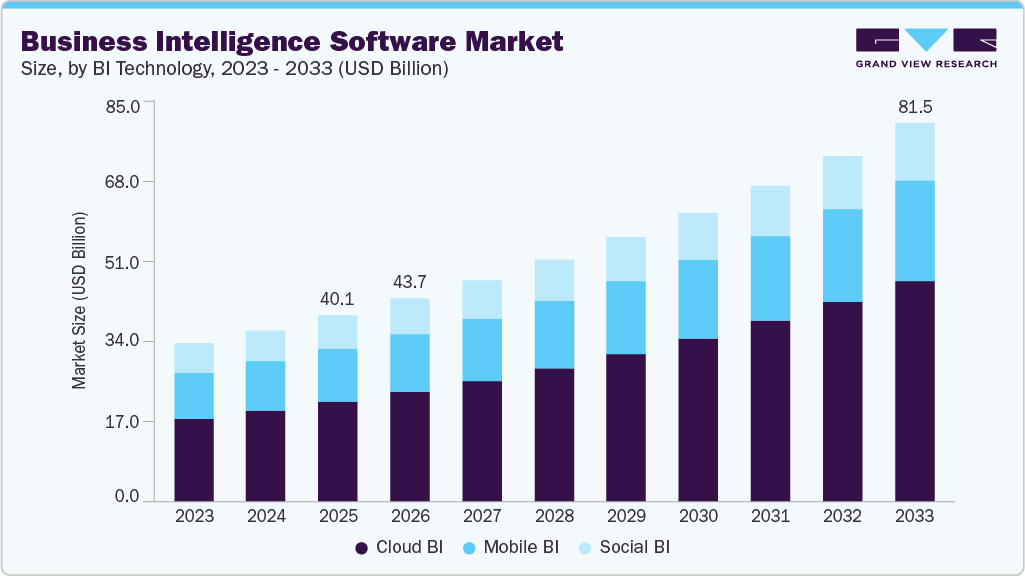
In this guide, we will discuss the complete process of developing BI software, along with related information. Take a look.
Business intelligence development is the practice of designing and building systems that transform raw data into valuable insights. In this process, data is collected from various sources.
After collection, the data is then organized and presented through reports & dashboards. BI development is pivotal for businesses to track performance and make confident decisions based on data.
BI solutions are available in various forms to meet different business needs and purposes. Let’s explore each type of solution in-depth:
Descriptive analytics primarily uses historical business data to understand what has happened in the past. It uses dashboards, reports, and data visualizations to highlight the past performance in a fully structured way.
Why It Matters:
Descriptive analytics allows businesses to measure KPIs and success, and thus gain a complete view of the entire performance.
Diagnostic analytics check the actual reasons behind the past results. It also involves drilling down into data, comparing trends, and identifying correlations to uncover root causes.
Why It Matters:
It helps companies understand past performance, identify inefficiencies, and avoid repeating mistakes.
Predictive analytics enables the prediction of future outcomes using historical data and statistical models. It enables businesses to predict customer behavior and sales performance.
Why It Matters:
Predictive analytics helps businesses anticipate trends, minimize risks, and make decisions based on future possibilities.
Prescriptive analytics uses data insights & predictive models to recommend actions. It analyzes multiple scenarios and recommends the appropriate course of action to achieve the desired outcomes.
Why It Matters:
It helps decision-makers adopt effective strategies, increase efficiency, and accelerate business performance.
With real-time BI, businesses receive up-to-date data as events occur. It processes live data streams continuously, helping organizations analyze operations and respond quickly.
Why It Matters:
Real-time BI enables fast decision-making, which plays a crucial role, especially in time-sensitive environments such as healthcare, finance, and e-commerce.
Self-service BI makes it possible to explore and use data, even for users who are technically novice. They can do it without getting assistance from the IT team. It comes with interactive dashboards and easy-to-use tools to quickly gain important insights.
Why It Matters:
It favors data democratization, which allows teams to make the right decision across departments. They can do it independently and quickly.
Selecting the right tools and technologies is important for BI development. Leveraging the right combination of tools makes data analysis simple and also boosts accessibility. The following are some of the best tools and technologies:
Microsoft Power BI integrates easily with Azure, Excel, and many other Microsoft services. It comes with real-time analytics, interactive dashboards, and robust data visualization capabilities. It boasts an intuitive interface and is good for both technical and non-technical users to explore and use data conveniently.
Best For: It’s best for businesses using the Microsoft ecosystem
Tableau has the potential to convert complex datasets into visually appealing dashboards. It enables users to make interactive reports with less coding. Businesses that focus on data storytelling and deep visual analysis rely mainly on Tableau for its performance and flexibility.
Best For: It’s perfect for storytelling and advanced data visualization.
With an associative engine, Qlik Sense lets users explore data freely, even without predefined query paths. This makes it convenient to discover hidden insights and relationships within datasets. It’s particularly beneficial for businesses that require flexible, dynamic analytics.
Best For: It’s good for flexible exploration and associate data modeling.
Looker, a part of Google Cloud, focuses on structured data modeling and controlled analytics. It uses LookML to define business logic, keeping reports aligned across teams. It’s perfect for teams that want centralized control over data definitions while enabling deep exploration.
Best For: It’s great for data exploration with powerful data modeling capabilities.
As an open-source BI tool, Apache Superset offers rich data visualization and dashboarding features. It offers complete support for a range of databases and is indeed highly customizable. Businesses seeking a cost-effective yet robust BI solution often select this tool.
Best For: It’s perfect for cost-effective analytics.
As a free tool, Google Data Studio integrates seamlessly with Google products such as Ads, Analytics, and BigQuery. It’s best for creating shareable & simple reports and dashboards, specifically for web analytics and marketing teams.
Best For: It’s perfect for Google ecosystem integration and lightweight reporting
Snowflake, a cloud-native data platform, offers capabilities for data storage and processing. It separates storage and computation while ensuring independent scaling of workloads. It serves as a backbone for BI systems to handle massive amounts of data.
Best For: It’s perfect for cloud data warehousing
Microsoft Azure Synapse combines the power of data warehousing and big data analytics into a single platform. It connects easily with various data sources and also handles complex analytics workloads. It works well for organizations managing complex data environments, thanks to its scalable architecture.
Best For: It’s perfect for enterprise-level data integration and analytics.
Build Custom BI Solutions for Your Business
We create tailored BI solutions to cater to your specific business objectives. We transform your data into valuable insights to drive measurable growth.
Building an effective business intelligence system requires a structured approach. It’s about following a series of steps that are vital to transforming raw data into actionable insights. Let’s go through each step one by one:
The BI development process starts with collecting data from various sources, such as CRM systems, APIs, databases, and third-party platforms. The data is integrated into a unified system to remove silos. It also ensures consistency across the organization.
The next step is data cleaning, as raw data is incomplete and inconsistent. During this step, various activities take place, such as data cleaning, standardization, and transformation into a fully usable format. It ensures a higher accuracy and reliability, which are necessary for meaningful analysis.
In this step, data is stored in a centralized repository, such as cloud storage or a data warehouse. It offers efficient data retrieval and secure access for reporting and analytics purposes.
Data modeling is the process of structuring data into logical formats that simplify analysis. On the other hand, visualization design emphasizes how insights can be presented through graphs, charts, dashboards, etc., to ensure usability and clarity.
The major purpose of creating interactive dashboards and reports is to offer periodic or real-time insights. With dashboards, one can monitor metrics, analyze performance, and make better decisions without diving into raw data.
After development is complete, the BI solution is deployed across the business. Your development team integrates more seamlessly with your current systems and workflows, providing smooth access and usability across departments and teams.
The fact can’t be denied that BI systems need thorough monitoring to ensure higher performance and accuracy. You need to perform regular updates, maintenance, and optimization to adapt to changing business requirements, boost efficiency, and ensure long-term success.
From prediction to decision-making, business intelligence offers many advantages to businesses. We will describe each advantage as follows:
With the use of BI tools, leaders gain an accurate insight to make decisions confidently. Organizations using business intelligence can easily determine performance metrics and trends, and make predictions to select the best course of action.
Through business intelligence tools, organizations can track performance metrics and workflows in real time, making it easier to identify delays and resource gaps. They can streamline daily operations, optimize resource allocation, and improve output across teams such as sales, operations, and marketing.
A robust BI system gives businesses immediate visibility into live data and tracks performance in real time. This allows the team to act quickly to address operational bottlenecks, shifting marketing trends, and emerging customer expectations.
BI systems analyze customer preferences, behaviors, engagement trends, and more. Businesses use these insights to improve customer satisfaction, personalize experiences, and build long-term customer relationships.
With the right BI system, businesses gain a measurable competitive advantage. They identify patterns before they are impacted, respond quickly to market shifts, and make decisions based on the data.
Even though BI development offers a range of advantages, its implementation involves certain challenges. Let’s explore the following advantages with the proper solutions:
Dealing with poor-quality data is one of the biggest challenges in BI development. Many issues, such as duplicate records, inconsistent formats, and missing values, tend to compromise data accuracy.
Solution: It’s a better option to implement validation rules and data governance practices. You can use automated data cleaning tools to maintain accuracy and consistency across a range of data sources.
A large number of companies still use their old data systems, which are not apt for modern data integration. It’s also highly complex to connect these legacy systems with the latest tools. The entire process is time-consuming.
Solution: The best option is to use APIs, middleware, and data integration platforms for minimizing the gap.
Implementing a BI solution requires proper investment in tools, skilled professionals, infrastructure, and more. These upfront costs tend to be the biggest barrier for both small and mid-sized businesses.
Solution: You should always choose cloud BI solutions that offer flexible pricing models. It’s prudent to proceed with a phased implementation approach to control costs while gradually expanding your capabilities.
Handling customer data is one of the biggest concerns for businesses from both regulatory and security perspectives. Therefore, any data breach or non-compliance can lead to serious consequences.
Solution: Always implement foolproof security practices such as data encryption, access controls, and regular audits.
It’s highly likely that even a cutting-edge BI system will struggle, especially when users are not interested in or unable to adopt it. Many factors, such as a complex interface and inadequate training, contribute to low usage across teams.
Solution: You can leverage user-friendly tools, adopt a data-based culture, and provide adequate training to staff.
Businesses use BI for a variety of functions, aiming to turn data into complete actionable insights. We will describe some popular use cases as follows:
BI tools make it convenient to analyze sales performance, monitor revenue trends, and analyze product-wise growth reasons. It allows the sales team to know what works best and where improvements are necessary, leading to better forecasting and revenue planning.
BI also enables businesses to understand customer preferences and behavior, which is vital for business growth. An organization can gather these details through checking engagement patterns, feedback, purchase history, etc. It helps them personalize their services, thereby improving customer satisfaction.
You can use BI solutions to gain complete visibility into your organization’s financial data. These include overall expenses, cash flow, profitability, etc. It also facilitates report creation, KPI checks, etc. Besides, you can also make better financial planning and control.
With BI solutions, you can get an overview of supplier performance, inventory levels, logistics operations, and more. You can review these details to minimize delays, optimize supply chain efficiency, and avoid stock shortages.
BI solutions also help marketing teams in performing tasks smoothly. They can determine a campaign’s actual performance across multiple channels. The solution helps them check important metrics such as engagement, conversion, and ROI. Using these insights, marketers can transform their overall strategies, target the right audience, and improve campaign effectiveness.
BI tools can analyze anomalies and patterns in data, which is crucial for detecting fraudulent activity or potential risks. Businesses can easily identify operational risks or unusual transactions, minimizing potential losses and improving compliance.
HR teams also use BI solutions to monitor metrics such as employee performance, retention rates, and recruitment effectiveness. On the other hand, it also enables organizations to make decisions about productivity, workforce planning, employee satisfaction, and more.
Transform Raw Data into Real Value with BI Solution
We create full-fledged BI solutions that convert raw data into meaningful insights. We help you improve efficiency, clarity, and competitive advantages.
Whether you wish to set up your own in-house team or seek to partner with BI development experts, it depends on many factors like budget, objectives, and technical capabilities. Building your in-house team gives you better control and customization.
Meanwhile, it also requires ongoing maintenance, time, and skilled resources. Partnering with an experienced business intelligence development company promises fast implementation, minimal risk, and access to specialized expertise.
Moreover, a hybrid approach also works better for many businesses. It helps them scale while ensuring that BI solutions align more closely with their operational requirements and long-term data strategy.
So, by now, you have understood the importance of BI development for businesses seeking to gain a competitive advantage. It offers numerous advantages for organizations, from improving customer understanding to optimizing operations.
To avail all these benefits, you need to develop and implement a world-class BI solution for your business. This is possible by partnering with a professional company.
01
02
03
04
05

Jayanti Katariya is the CEO of Moon Technolabs, a fast-growing IT solutions provider, with 18+ years of experience in the industry. Passionate about developing creative apps from a young age, he pursued an engineering degree to further this interest. Under his leadership, Moon Technolabs has helped numerous brands establish their online presence and he has also launched an invoicing software that assists businesses to streamline their financial operations.


Submitting the form below will ensure a prompt response from us.
We refine our expertise to deliver innovative business solutions.





205 N Michigan Avenue, #810, Chicago, 60601, Illinois, United States
13500 Long Is Dr, Pflugerville, TX 78660, USA

C/105 Ganesh Meridian, S.G. Highway, Ahmedabad, GJ 380060


Ayse D.
Co-Founder France
“ I highly recommend Moon Technolabs as the quality of service is wonderful. We have hired this company to develop the product based on some complex & technical issues. We get the best quality services as compared with others in the market. Huge Thanks to Moon Technolabs as the team is always ready to give the solution all time.”

Justin G.
Founder & CEO USA
USA“ Moon Technolabs is a pioneer in the WebRTC based project as they have fixed complicated segments of the module by fulfilling different product lines by providing 24X7 customer support. We really recommended Moon Technolabs as they are able to develop products as per the module deadline and project timeline.”

Flavio S.
Founder & Managing Director Germany
“I am happy to recommend Moon Technolabs for their app development services. They successfully developed apps for me, and I am highly satisfied with the overall outcomes. The development team has swiftly addressed the issues with responsive and effective communication to understand the requirement quickly and actively resolve the back-and-forth problems that arose...”

Jay M.
Founder & CEOUSA“Moon Technolabs is the best company that provides advanced apps and websites development services in the USA and Europe. I am a newbie to develop my app with an external team. I am really happy to work with them as I am not that much mobile apps user. Here, the team and specially the CEO of Moon Technolabs helps me to let me know about the benefits of my app to generate revenue....”


Our Offices
India
C/105 Ganesh Meridian,S.G. Highway, Ahmedabad, GJ 380060USA
205 N Michigan Avenue, #810, Chicago, 60601, Illinois, United StatesContact Information


