
 Total Views: 6870
Table of Content


Blog Summary:
This blog provides detailed insights into how AI transforms quality assurance in the software development realm. We will discuss in detail how organizations utilize AI in the QA testing process, its top benefits, and future applications. Keep reading the entire blog to explore more.
Table of Content
Artificial Intelligence (AI) has revolutionized multiple industries by restructuring their operations to improve efficiency – software development is no exception. In this industry, the unprecedented use of AI in Quality Assurance yields accuracy, efficiency, and security. It automates repetitive tasks with higher speed and accuracy, which leads to improved decision-making.
A report from Fortune Business Insights reveals that the global market size of AI-powered testing is approximately $1010.9 million in 2025 and is likely to reach up to $3824 million by 2032. It’s expected to grow at a CAGR of 20.9% during the forecast period. The stats reflect the skyrocketing popularity of AI in QA in today’s competitive digital world.
From forecasting risks and minimizing human errors to managing complex test environments, organizations leverage AI in quality assurance to address numerous challenges. It helps QA professionals achieve a higher efficiency while ensuring products are secure, high-performing, and fully compliant.
Let’s discuss in detail how AI transforms quality assurance and helps organizations deliver top-quality products.
Utilizing AI in software quality assurance helps remove complications and transform the entire software testing process. It references the use of various AI technologies, including natural language processing, machine learning, and predictive analytics. Let’s understand how AI improves the quality assurance in detail:
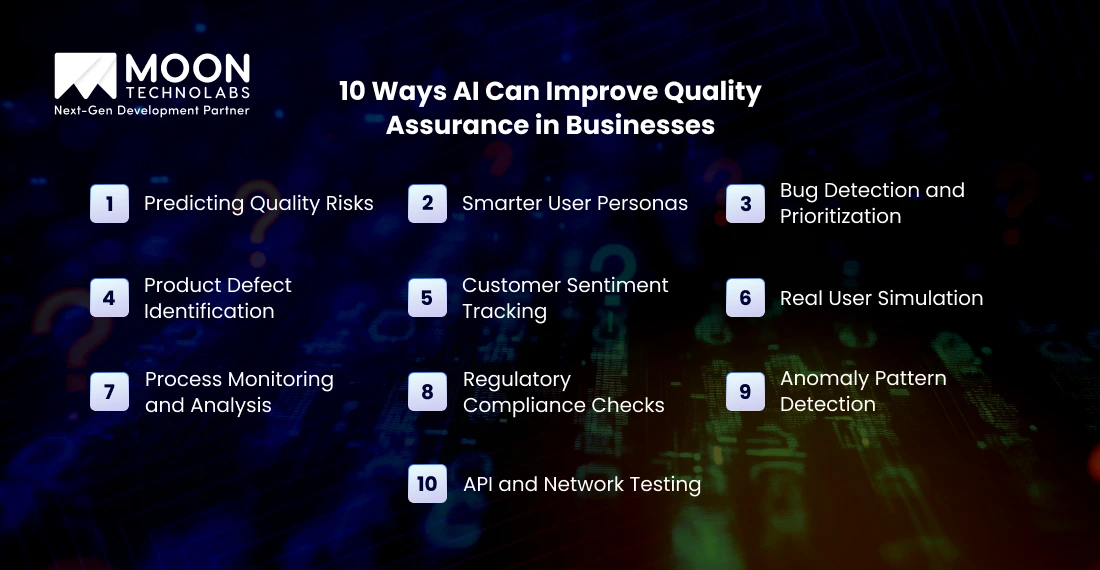
By leveraging AI for software testing, organizations can focus on data-driven, proactive, and smart quality management rather than relying on repetitive and manual testing.
Let’s explore some other ways in which the technology makes quality assurance more simplified yet effective:
With the correct implementation of AI in quality assurance, businesses can better predict potential risks even before they arise. Be it analyzing historical testing data, customer behavior patterns, or system logs, organizations can leverage AI algorithms to enhance their performance in areas prone to failure.
AI systems quite often highlight those modules as highly risky for future testing that have defects even in their previous releases. QA teams utilize this predictive ability to focus on these areas, thereby curbing downtime and addressing production-level issues that tend to be costly. Not to mention, fast decision-making brings numerous benefits for businesses.
A meaningful QA always focuses on the way users engage with a product. When discussing traditional test personas, they often focus on limited datasets, assumptions, and other limitations. These are something that indeed do not indicate the actual usage. Meanwhile, AI-driven QA takes a different approach, working based on data-driven user personas.
AI tools have the capability of analyzing even the largest volume of user interaction data, which includes mainly user preferences, behavior, demographics, device usage, and more. These insights are beneficial for developing realistic personas and providing a comprehensive customer journey.
When you test your products with their personas, it reflects that the products are tested for real-world scenarios. It delivers amazing results in terms of improved accessibility, usability, and satisfaction across different user groups.
Detecting bugs and resolving them fast is the core purpose of quality assurance. But if you rely on detecting them manually, it can be a time-consuming and costly process. Apart from this, there’s a higher possibility that you will miss any defects.
AI helps you overcome these issues by automating the detection, categorization, and prioritization of bugs. In case you discover two bugs simultaneously, AI can easily analyze which bug has a higher impact and thus helps you prioritize those bugs.
It gives you with complete assurance that the development team focuses primarily on the issues that matter most, minimizes any delays, and enhances product stability. AI bug detection not only requires less time but also boosts accuracy while minimizing false positives and preventing waste of resources.
Apart from enabling you to detect bugs quickly, AI is also effective in identifying product-level defects. The technology enables this by analyzing crash reports, performance metrics, user feedback, and other relevant data. By using spotting patterns, it also reveals even unexpected defects.
We can consider a scenario where users experience sudden slowdowns under specific situations. AI models have the capability of easily correlating data with the actual reason for the defect.
This standard of defect identification focuses on continuous product improvement and also strengthens user trust by addressing any issues before they occur in the real world.
Another popular use case of quality assurance AI is analyzing customer sentiment through support tickets, reviews, social media mentions, and other sources. Conducting all these tasks manually is a process that involves numerous hassles.
AI-powered systems possess the capability to scan a myriad of support messages and reviews to identify usability challenges, recurring complaints, performance issues, and more.
You can align your product testing with specific customer concerns by utilizing sentiment analysis throughout the entire QA process. It ensures that integration of any new features or important updates meets user pain points, which improves both loyalty and customer satisfaction.
Testing environments often fail to discover the actual complications of real-world usage. Several factors contribute to creating unique challenges, including internet speed, device type, user behavior, and others.
You can overcome these issues by using real user simulation, which minimizes the overall gap through replicating different user conditions at scale. AI models have enormous capabilities to mimic multiple users by producing realistic traffic, diverse behaviors, interaction patterns, and more.
It allows QA teams to focus on UI inconsistencies, performance issues, functionality breakdowns, and more, even under stressful scenarios. You can leverage the potential advantages of AI-based simulations to make your products scalable, resilient, and ready for real-world use.
Maintaining quality is a process that involves testing the product and also optimizing the entire QA process itself. AI-driven QA testing provides a higher level of visibility into the testing workflow through smart process monitoring and analysis.
It also provides visibility into productivity metrics and resource allocation. Apart from this, AI can easily detect inefficiencies, such as slow approval cycles or test cases. Based on these, it recommends a complete process for improvements.
Continuous monitoring is highly important as it ensures QA activities align perfectly with quality standards and project timelines. Over time, it offers numerous advantages, including minimized costs, improved workflow, and faster releases. And all these are possible even without compromising quality.
As we already discussed, manual testing is not only time-consuming but also costly and prone to errors. But AI simplifies all these with the help of automated compliance checks. It makes you stress-free by ensuring that your apps adhere to necessary frameworks, such as GDPR, HIPAA, and ISO, among others.
AI-powered tools work automatically when it comes to validating data security measures, audit trails, access controls, and other key aspects. It also minimizes the overall risk of non-compliance penalties.
They ensure full transparency and efficiency of the audit with detailed reporting. It’s crucial to integrate compliance with the QA process, which helps avoid legal issues and maintain reliability.
Human beings have limitations in detecting patterns, but AI does not. It can easily identify any irregularities in user activity, system behavior, and performance metrics, among others. For example, AI highlights any potential anomalies for the app that experience a sudden surge in unusual activity patterns or API response times.
It allows the team to investigate and resolve issues even before they impact users. Additionally, anomaly detection is crucial for security, as it can identify and flag any fraudulent attempts or suspicious activities in real-time.
Network interactions and APIs are something that the majority of advanced software relies on of late. These factors ensure the software performs smoothly. With traditional testing, which has a limited scope, QA professionals often fail to capture the details of complex dependencies.
AI simplifies that entire process through intelligent API and network testing. AI tools have outstanding potential to simulate different network conditions, highlight integration issues with third-party services, validate API responses, and more.
By analyzing historical API performance data, they can make more accurate predictions of potential failures. It ensures the sustainability and responsiveness of products even with unstable networks or overload conditions.
We help you revolutionize your QA with AI and boost your testing efficiency. Our solutions help you detect issues quickly and release products with confidence.
Talk to Our AI Experts
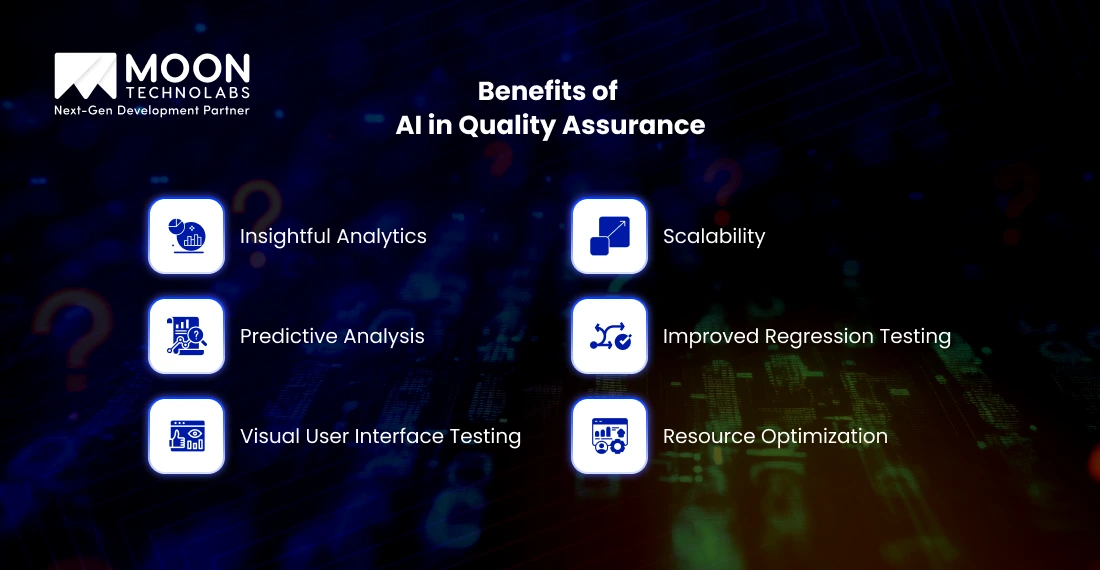
AI has taken quality assurance to the next level through automation, data-based intelligence, and predictive capabilities. These help achieve efficiency, accuracy, and customer satisfaction. Let’s explore some of the top advantages of AI quality assurance:
The major advantage of implementing AI in QA testing is its ability to generate actionable insights from vast datasets. Conventional QA methods primarily focus on binary outcomes, often without providing a comprehensive analysis of trends or addressing underlying issues.
AI algorithms have the capability of tracking patterns across different releases, identifying recurring defects, and predicting potential failures.
QA teams can transform even raw test data into fully smart analytics. It also uncovers any hidden bottlenecks in performance, focuses on high-impact areas, detects usability concerns, and more.
This level of insight enables businesses to make fully informed decisions about feature enhancements, resource allocation, release planning, and other key areas. AI-driven analytics facilitates QA professionals with continuous monitoring, which ensures product quality is maintained throughout the lifecycle.
Businesses today must manage complex ecosystems comprising numerous apps, platforms, user environments, and more. Traditional QA processes often struggle to scale, even without significant investment in resources. Artificial Intelligence resolves these challenges by enabling automated testing across multiple platforms simultaneously.
Whether you want to test web apps, mobile apps, or APIs, AI tools enable you to do so effortlessly. These tools minimize testing cycles with higher consistency. This scalability is particularly important for companies rolling out and managing high-traffic platforms, as well as handling frequent updates.
With AI-based systems, you can avoid hiring larger QA teams. It results in a fast time to the market without compromising quality, especially for many large-scale projects.
Predictive analysis is another important benefit of AI in quality assurance. You can leverage AI models to analyze user behavior, historical defect data, performance logs, and other relevant data to predict potential risks before they impact users.
This proactive approach enables QA experts to focus on areas that are likely to experience vulnerabilities or failures. For example, AI has an immense power to predict features that tend to produce more bugs even during releases.
Additionally, it also has the capability that the system may experience slowdowns in performance under higher traffic. Predictive insights are also pivotal in saving costs by preventing expensive post-release fixes and reducing production-level defects.
You Might Also Like
Being a resource-intensive process in quality assurance, regression testing requires repeated checks to ensure that any new updates don’t impact existing functionality.
When you perform it manually, it not only consumes time but also slows down the release cycle. Meanwhile, leveraging AI in regression testing helps you transform the entire process with higher speed and accuracy.
AI-based systems have the vast capability of automatically identifying any impacted areas. So, QA teams can focus only on the most impactful checks, which minimizes the testing time. AI ensures the continuity of regression testing, providing developers with fast feedback loops. It allows businesses to release updates frequently without affecting quality.
Traditional testing often faces numerous complications in validating the actual look and feel of an app. The QA team needs to verify the consistency of icons, buttons, layouts, visuals, and other elements across multiple browsers and devices. AI does it conveniently with the help of visual UI testing.
AI-driven tools highlight any issues in the user interface by using machine learning and image recognition. They make an effective comparison of design elements against any expected standards and highlight various issues, such as incorrect font sizes, misaligned buttons, and broken layouts.
It ensures apps perform mind-blowingly while delivering a fantastic user experience. Moreover, AI visual testing can adapt to dynamic UI changes. That’s the reason why it’s more reliable compared to any traditional automation scripts. It often breaks with any minor design updates.
Talking about manual QA that often demands major involvement of humans, especially for those tasks that are repetitive. These include performance checks, regression testing, and compliance monitoring, among others.
However, AI automates these repetitive tasks, allowing your QA team to focus on tasks that directly add value to your business. AI minimizes manual workload, thereby helping organizations reduce human errors, optimize costs, and boost efficiency.
The technology works effectively in test case generation, prioritization, execution, and more. It ensures resources are allocated effectively. It reflects that businesses can achieve a greater balance with limited resources.
We help you make your testing future-proof by unlocking the power of AI. Our solutions detect defects rapidly, improve efficiency, and ensure the flawless release of products.
Connect with Our Expects Now
The future of AI testing in quality assurance is more promising, driven by the increasing expectations of users. Traditional or manual QA testing often fails to meet the demands of accuracy, speed, and scalability. As a result, it also fails to meet the user’s expectations.
AI is going to dominate QA testing by bringing adaptive learning, intelligent automation, and predictive insights.
We deliver tailored AI development solutions to help businesses transform their QA strategies and address their testing challenges. Our experts ensure the proper implementation of AI in QA, driven by a powerful strategy that helps businesses automate repetitive tasks, speed up regression testing, and more.
Our solutions aim to help you with fast release cycles while maintaining the standards for software quality assurance, compliance, and accuracy. We leverage cutting-edge AI test automation tools to build intelligent testing frameworks that can predict potential risks, simulate real user environments, and provide actionable insights.
Our core focus is on resource optimization and scalability, which ensures your QA process caters to your growing business requirements.
We create QA AI solutions that deliver measurable results, whether it’s regulatory compliance, monitoring, or anomaly detection. We leave no stone unturned to help you achieve excellence in QA with efficiency, innovation, and reliability with our custom-developed AI solutions.
Use of AI in QA has transformed the way businesses deliver products that are reliable and perform well. Whether it’s compliance monitoring, predictive analysis, or bug detection, AI-based QA testing enables professionals to perform their tasks more efficiently with higher speed, accuracy, and scalability.
Organizations today utilize AI test automation tools to optimize resources, enhance customer satisfaction, and mitigate risks. As AI QA becomes more advanced over time, partnering with a company like Moon Technolabs is crucial to harness its numerous benefits.
01
02
03
04
05

Jayanti Katariya is the CEO of Moon Technolabs, a fast-growing IT solutions provider, with 18+ years of experience in the industry. Passionate about developing creative apps from a young age, he pursued an engineering degree to further this interest. Under his leadership, Moon Technolabs has helped numerous brands establish their online presence and he has also launched an invoicing software that assists businesses to streamline their financial operations.


Submitting the form below will ensure a prompt response from us.
We refine our expertise to deliver innovative business solutions.





500 N Michigan Avenue, #600, Chicago IL 60611
13500 Long Is Dr, Pflugerville, TX 78660, USA

C-105, Ganesh Meridian, S.G. Highway, Ahmedabad, GJ 380060


 France
“ I highly recommend Moon Technolabs as the quality of service is wonderful. We have hired this company to develop the product based on some complex & technical issues. We get the best quality services as compared with others in the market. Huge Thanks to Moon Technolabs as the team is always ready to give the solution all time.”

 USA
USA“ Moon Technolabs is a pioneer in the WebRTC based project as they have fixed complicated segments of the module by fulfilling different product lines by providing 24X7 customer support. We really recommended Moon Technolabs as they are able to develop products as per the module deadline and project timeline.”

 Germany
“I am happy to recommend Moon Technolabs for their app development services. They successfully developed apps for me, and I am highly satisfied with the overall outcomes. The development team has swiftly addressed the issues with responsive and effective communication to understand the requirement quickly and actively resolve the back-and-forth problems that arose...”
 USA
USA“Moon Technolabs is the best company that provides advanced apps and websites development services in the USA and Europe. I am a newbie to develop my app with an external team. I am really happy to work with them as I am not that much mobile apps user. Here, the team and specially the CEO of Moon Technolabs helps me to let me know about the benefits of my app to generate revenue....”


