
Jayanti Katariya
Last Updated: February 05, 2026 Total Views: 539
Table of Content


Blog Summary:
This comprehensive blog discusses the existing state of AI for customer success. We also explore how AI revolutionizes churn prediction and onboarding, and the core benefits of scalable personalization. Not only that, we have shared tips on best practices for integrating custom AI solutions while maintaining a vital human touch.
Table of Content
The evolution toward artificial intelligence is no longer a prediction but a reality redefining organizational ecosystems. Recent data shows that about 91% of businesses are using AI in some part of their operations in 2026, and roughly 58% of employees report regular use of AI tools at work, highlighting how deeply it’s becoming part of modern work routines.
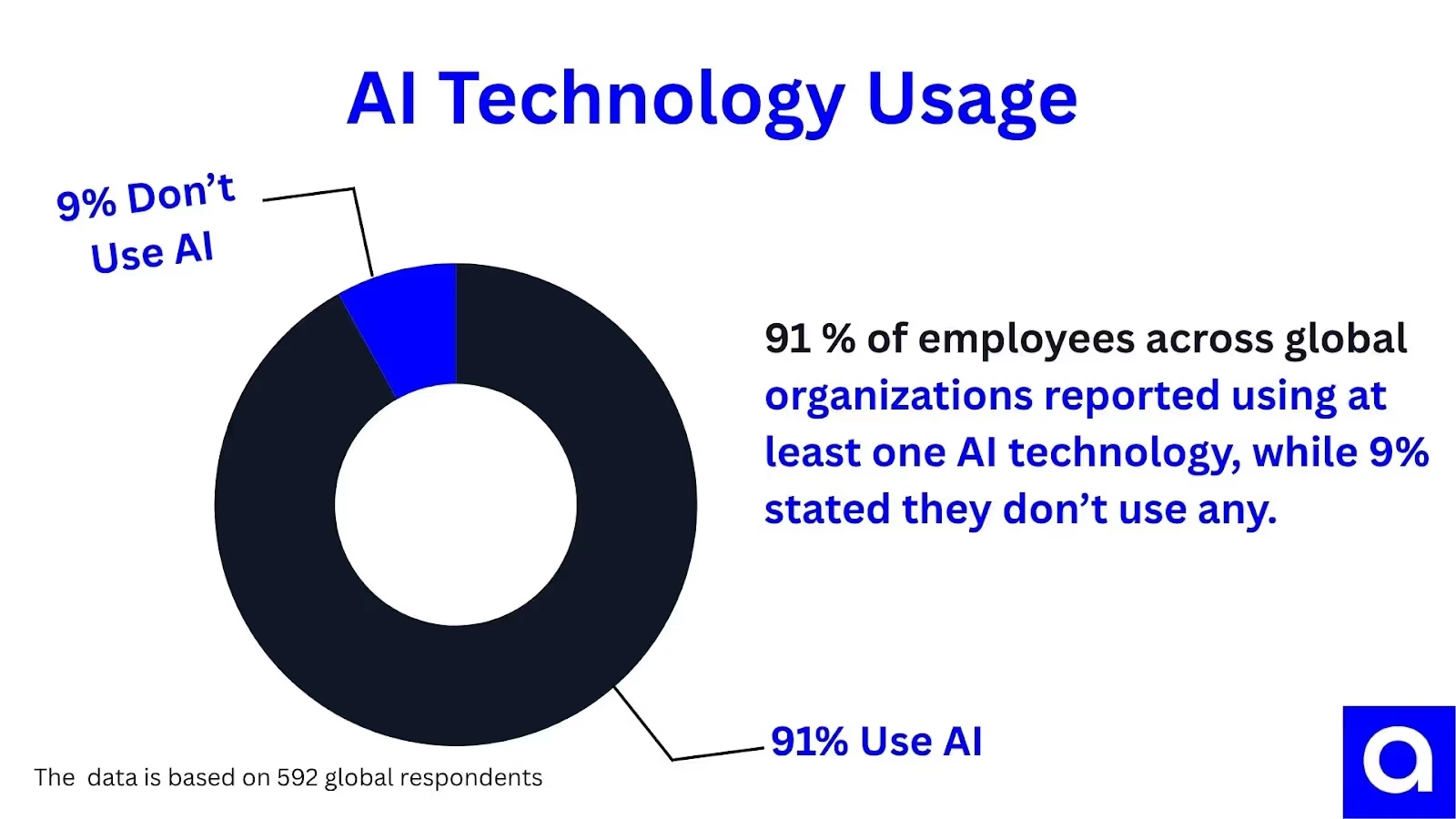
Rather than viewing this shift with hesitation, forward-thinking organizations are embracing AI as a cornerstone for achieving customer success excellence.
For customer success managers (CSMs), AI technology is a powerful catalyst for their primary objectives. It mainly involves stabilizing retention, curbing churn, and strengthening capabilities for growth potential. These advanced tools don’t merely automate; they also open a new era of proactive service.
With AI, CSMs can now deliver hyper-personalized experiences and leverage predictive analytics to resolve customer pain points before they even surface.
When systems learn from customer data, support becomes proactive instead of reactive. 🧠📊
Here is your comprehensive guide to AI in Customer Success in 2026. It features the most practical and high-impact strategies for CSMs to master these tools.
AI for customer success has shifted from an efficiency booster to a fundamental requirement for staying competitive. AI analyzes vast amounts of data in real time to provide visibility into the customer journey that was previously impossible to achieve manually.
One of the most significant shifts is the move toward predictive health scoring. Traditionally, customer success managers relied on lagging indicators, such as low usage logs or missed renewals, to identify at-risk accounts.
But now, AI has changed the game. The technology identifies subtle patterns in customer behavior that signal friction long before customers realize they are unhappy. Whether it’s a sudden drop in a specific feature’s adoption or a change in the sentiment of support tickets, AI alerts CSMs to intervene at the exact moment it matters most.
In the past, “personalization” was about simply adding a customer’s name to a template. Now, AI enables hyper-personalization across thousands of accounts.
AI tools can analyze a client’s unique business goals and automatically suggest tailored “next best actions” or training resources that align with their specific use case. This ensures that every customer feels they have a dedicated consultant, regardless of the size of the CSM’s book of business.
AI handles routine admin tasks so CSMs can focus on high-value activities, such as building deep relationships and driving strategic outcomes. It automates meeting summaries, drafts follow-up emails, and organizes CRM data.
The result is a more resilient revenue stream, higher net retention rates (NRR), and a customer base that feels truly understood and supported.
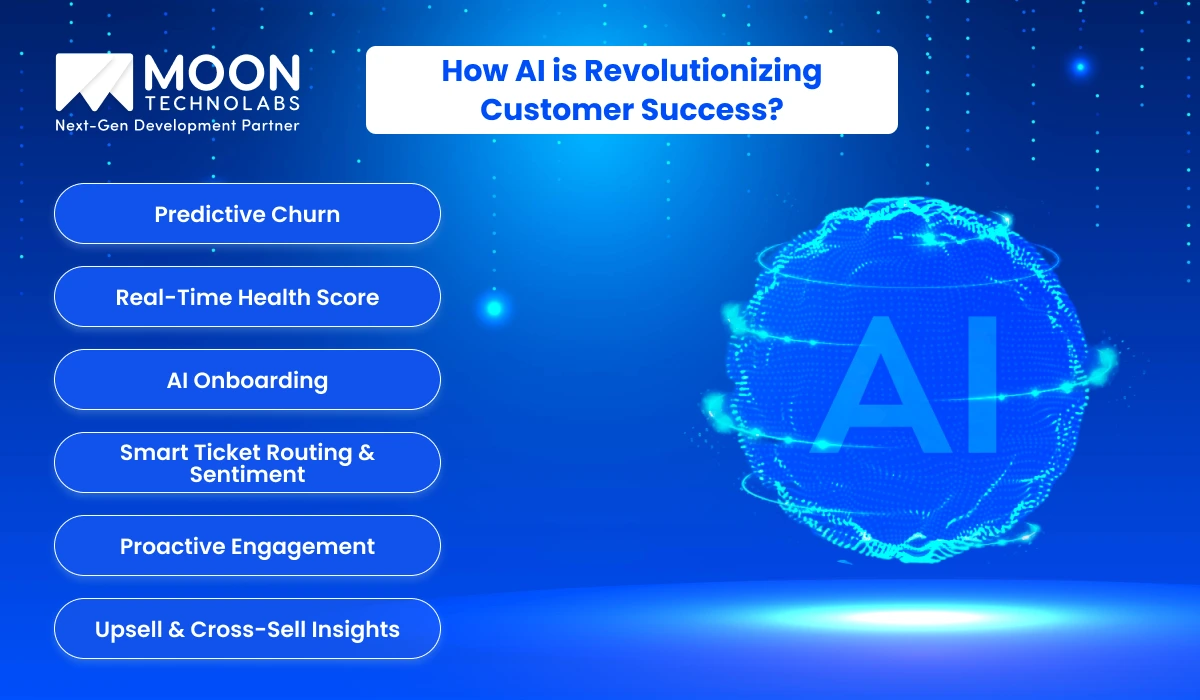
AI has transitioned from a simple chatbot tool to an intelligent engine that powers every stage of the customer lifecycle. It automates routine tasks, predicts complex tasks, and allows customer success managers to focus on high-level strategy and human relationships.
Let’s see how AI is fundamentally rewriting the playbook for customer success:
Gone are the days of lagging indicators. AI-driven churn analysis uses machine learning algorithms to identify customers who are slowly disengaging but haven’t said a word. AI analyzes login frequency, feature usage drops, and historical data patterns to eventually provide a “warning light” prior to renewal date. This way, CSMs can have ample time to save the account.
Traditional health scores were subjective or updated only once a month. As a solution, modern AI generates dynamic, real-time health scores. It pulls data from every touchpoint, like email sentiment, product engagement, and support history, to provide a 360-degree view of account health that updates by the minute.
AI-driven onboarding tools create personalized “success paths” for every user. If a new user gets stuck on a specific feature, an AI agent can provide an instant video walkthrough or a customized tooltip, ensuring they reach their “Aha! moment” faster without needing a manual call with a CSM. This matters because the first 90 days are critical for long-term retention.
AI understands the emotional weight behind support tickets, rather than just reading them. Through natural language processing (NLP), AI identifies frustrated or urgent tones and automatically routes those tickets to the concerned CSM. This ensures that high-priority issues are handled with the specific empathy and expertise they require.
AI automates proactive email outreach triggered by specific events. If a customer’s usage spikes, AI can send an automated message with advanced tips and recommendations. This makes automation feel like a high-touch and personalized concierge service.
AI is the ultimate revenue partner. By analyzing which features lead to the most success for similar clients, AI can flag “expansion opportunities.” It alerts the CSM when a customer has reached a usage threshold where moving to a higher tier or adding a complementary module would provide them with immediate ROI.
The gap between market leaders and the rest is widening. Stay ahead of the curve by integrating custom AI solutions designed for the modern customer lifecycle.
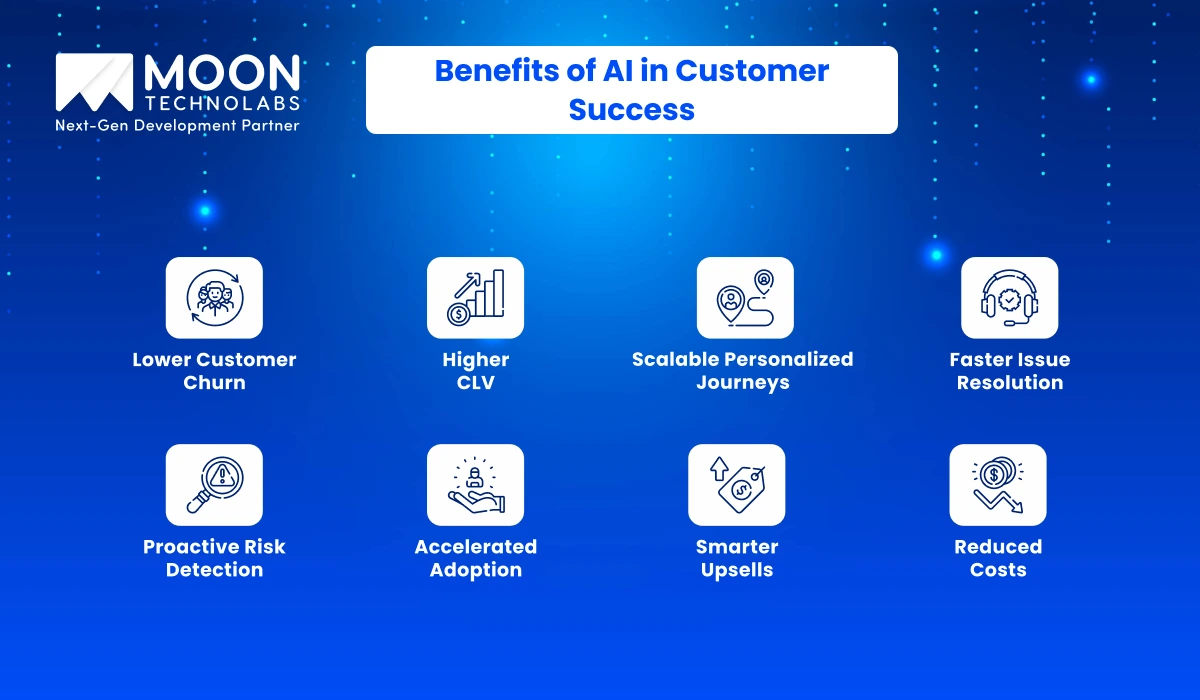
Artificial Intelligence has become the ultimate multiplier for customer success teams. It doesn’t just make things faster; however, it makes them smarter. Let’s explore the transformative benefits AI brings to modern CS organizations:
Churn silently kills SaaS growth. Traditionally, teams acted on “lagging indicators” by manually reviewing data from the past month to identify who had stopped using the platform. However, by then, knowing was usually too late.
Today, AI flips the script through predictive churn modeling. It analyzes thousands of data points, including login frequency, feature engagement, and even the “tone” of support emails.
After that, AI identifies micro-patterns that precede a cancellation. This allows CSMs to intervene with a “save” strategy weeks or even months before the customer actually considers leaving.
Customer lifetime value (CLV) is a direct reflection of how much value a client derives from your partnership over time. AI extends the customer lifecycle by ensuring they never reach a “dead end”.
AI continuously monitors and identifies when a customer is ready for the next stage of their journey. Whether it’s recommending a new integration or providing advanced training through AI integration, AI ensures the customer continually deepens their relationship with your product. A customer who consistently sees ROI is a customer who stays for years, significantly boosting their total CLV.
The biggest challenge for any growing CS team is the “ratio” problem: how do you deliver a high-touch experience to 500 customers with only 5 CSMs?
AI solves this by enabling hyper-personalization at scale. AI engines can segment customers based on their specific goals and behavior, automatically delivering tailored content, tips, and check-ins. To the customer, it feels like a 1-on-1 relationship, but to the organization, it is an automated process that requires zero manual intervention.
In the age of instant gratification, a 24-hour response time is no longer acceptable. AI agents can handle complex inquiries instantly.
Beyond simple chatbots, modern AI understands context. It can troubleshoot technical issues, guide users through a workflow, or pull data from a knowledge base to answer a niche question in seconds. When a human does need to step in, AI provides the CSM with a full summary of the issue and suggested solutions. This significantly reduces the time to resolution.
Risks aren’t always about usage. Sometimes a risk can stem from a change in a key person or a shift in customer sentiment. AI tools today can scan meeting transcripts and email threads to detect executive misalignment or a change in company strategy that might threaten the account. The automation tools flag these non-technical risks early.
A product is only valuable if it is used. AI identifies features that a specific customer would benefit from but hasn’t discovered yet. Instead of sending a generic newsletter, AI sends a targeted in-app nudge like, “We noticed you’re doing [Task X]; did you know [Feature Y] can automate this for you?”
This contextual education drives deeper product stickiness and ensures customers get the full value of their investment.
Expansion revenue is the ultimate aim for the net retention rate (NRR). However, asking for more money at the wrong time can damage customer relationships.
AI analyzes “Expansion Readiness“. It looks for signals such as hitting seat limits, high use of premium-adjacent features, or reaching a specific ROI milestone. It then alerts the customer success manager: “Customer A is 90% likely to benefit from the enterprise tier based on their current growth.”
This allows the CSM to approach the customer as a consultant offering a solution rather than a salesperson seeking a quota.
The operational burden on CSMs is a major drain on resources. Between logging notes in the CRM, drafting follow-up emails, and preparing for business reviews (QBRs), CSMs often spend 40% of their time on paperwork.
AI auto-fills CRM fields, generates QBR slide decks from raw data, and drafts personalized emails. This reduces the need to hire more staff as the customer base grows, allowing the existing team to manage a larger book of business with less stress and higher accuracy.
You Might Also Like:
It is recommended to implement AI with a strategic framework. To ensure your AI strategy drives retention rather than friction, follow these six industry best practices:
It is easy to get distracted by the new AI features. The most successful organizations start with the problem, not the tool. Before deploying a new AI model, ask:
Does this directly impact our net retention rate? Will it shorten our Time-to-Value (TTV) during onboarding? By aligning AI capabilities with specific KPIs, you ensure the technology supports the business strategy rather than adding another layer of complexity to the tech stack.
Customers are AI-savvy. They know when they are talking to a bot, and they appreciate honesty. A best practice is to be transparent about AI’s role in the relationship.
If a summary was generated by AI or a response came from an automated agent, a simple “generated by AI assistant” tag builds trust. Transparency prevents the frustration that occurs when a customer feels “tricked” into thinking they were speaking with a human.
AI should be used to augment humans, not replace them. While AI can handle data crunching and routine queries, the “human touch” is the ultimate differentiator in high-stakes B2B relationships.
The best practice is to use AI for data analysis, meeting notes, and drafting, so CSMs have more emotional energy and time for strategic consulting. When an account is in crisis or a complex negotiation is underway, the AI should step back and empower the CSM to lead with empathy and nuance.
With the surging power of AI comes increasing responsibility for data security. Customer success managers handle sensitive data—financials, usage habits, and strategic roadmaps.
Using “open” AI models that train on your data is a significant risk. Ensure your organization uses enterprise-grade AI solutions that offer “zero data retention” and comply with the latest 2026 privacy regulations (such as the evolved GDPR or CCPA frameworks). Your AI should be a vault, not a sieve.
An AI model is only as good as the data it consumes. “Garbage in, garbage out” remains the golden rule. Responsible AI training involves auditing your data for bias and ensuring the AI’s “suggestions” are accurate.
Teams should conduct regular “bias audits” to ensure the AI isn’t inadvertently prioritizing certain customer segments over others based on flawed historical data. Furthermore, CSMs must be trained to interpret AI insights critically rather than blindly following them.
The AI standard has moved beyond simple Q&A bots to autonomous AI agents. These agents can perform tasks, such as scheduling a QBR, updating a CRM entry, or triggering an onboarding sequence, without human intervention.
To scale effectively, deploy these agents for repetitive, low-value tasks. This allows your customer success team to grow its “Books of Business” without a linear increase in headcount, maintaining high service standards even as the company scales rapidly.
We specialize in building intelligent solutions that automate the routine tasks while empowering your CSMs to do what they do best, build relationships.
Off-the-shelf software is rarely enough to meet the unique complexities of enterprise-level retention. Moon Technolabs bridges this gap by delivering custom AI solutions specifically engineered to align with your organization’s unique DNA.
Rather than forcing your workflows into a rigid platform, we build intelligent layers including bespoke generative AI models and predictive analytics that integrate seamlessly with your existing CRM and tech stack.
We empower customer success teams to move beyond basic automation. Our solutions specialize in hyper-personalized onboarding, intelligent sentiment analysis, and revenue growth engines.
Moreover, we prioritize data security and scalability to ensure your AI evolution is not only fast but future-proof. It also allows your CSMs to focus on high-value strategy while the AI manages the operational heavy lifting.
It is clear that AI has evolved from a futuristic luxury into the backbone of high-performing customer success teams. By embracing predictive insights, autonomous workflows, and hyper-personalization, organizations are no longer just reacting to churn, but they are actively engineering growth.
However, the true “AI advantage” lies in the balance between machine intelligence and human empathy. Whether you are just beginning your automation journey or looking to refine your existing tech stack, the goal remains the same: using technology to build deeper, more meaningful human connections.
With the right strategy and custom AI solutions, our team can turn every customer interaction into a long-term partnership for your business. Contact us now to take your AI project further.
01
02
03
04

Jayanti Katariya is the CEO of Moon Technolabs, a fast-growing IT solutions provider, with 18+ years of experience in the industry. Passionate about developing creative apps from a young age, he pursued an engineering degree to further this interest. Under his leadership, Moon Technolabs has helped numerous brands establish their online presence and he has also launched an invoicing software that assists businesses to streamline their financial operations.


Submitting the form below will ensure a prompt response from us.
We refine our expertise to deliver innovative business solutions.





500 N Michigan Avenue, #600, Chicago IL 60611
13500 Long Is Dr, Pflugerville, TX 78660, USA

C/105 Ganesh Meridian, S.G. Highway, Ahmedabad, GJ 380060


Ayse D.
Co-Founder France
“ I highly recommend Moon Technolabs as the quality of service is wonderful. We have hired this company to develop the product based on some complex & technical issues. We get the best quality services as compared with others in the market. Huge Thanks to Moon Technolabs as the team is always ready to give the solution all time.”

Justin G.
Founder & CEO USA
USA“ Moon Technolabs is a pioneer in the WebRTC based project as they have fixed complicated segments of the module by fulfilling different product lines by providing 24X7 customer support. We really recommended Moon Technolabs as they are able to develop products as per the module deadline and project timeline.”

Flavio S.
Founder & Managing Director Germany
“I am happy to recommend Moon Technolabs for their app development services. They successfully developed apps for me, and I am highly satisfied with the overall outcomes. The development team has swiftly addressed the issues with responsive and effective communication to understand the requirement quickly and actively resolve the back-and-forth problems that arose...”

Jay M.
Founder & CEOUSA“Moon Technolabs is the best company that provides advanced apps and websites development services in the USA and Europe. I am a newbie to develop my app with an external team. I am really happy to work with them as I am not that much mobile apps user. Here, the team and specially the CEO of Moon Technolabs helps me to let me know about the benefits of my app to generate revenue....”


Our Offices
India
C/105 Ganesh Meridian,S.G. Highway, Ahmedabad, GJ 380060USA
500 N Michigan Avenue, #600, Chicago IL 60611Contact Information


