
Jayanti Katariya
Last Updated: February 24, 2026 Total Views: 269
Table of Content


Blog Summary:
Going through the blog post lets you get a detailed overview of AI as a Service (AIaaS) and its growing importance for businesses. Whether it’s types, how it works, benefits, strategies to implement, drawbacks, or the future, we explain everything about this model. Read the entire blog to select the right vendor and top strategies to implement this model successfully.
Table of Content
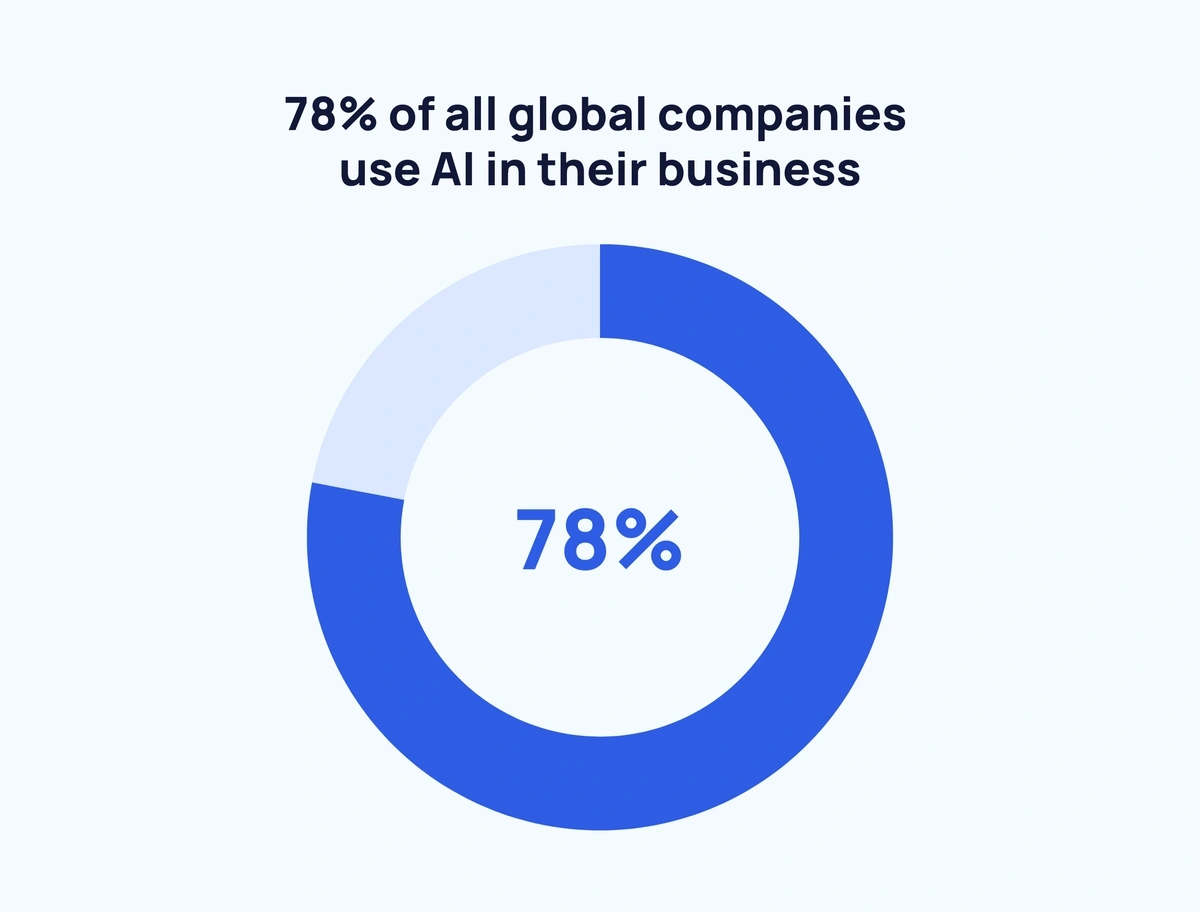
Artificial Intelligence has unmatched potential to redefine how businesses operate by improving efficiency and thus productivity. Therefore, it has transformed the business world fast. According to Exploding Topics, 78% of companies from across the world use AI in their day-to-day operations.
Organizations that have yet to adopt it often wish to leverage AI tools but think it requires additional resources or the development of additional infrastructure. AI-as-a-service is the right solution for them. It’s indeed the cost-effective way to get a competitive advantage by letting them access AI tools and data.
AIaaS service providers are responsible for developing and maintaining AI infrastructure, and allow businesses to rent according to their actual needs. Apart from being cost-effective, AIaaS offers numerous benefits to organizations as well. In this blog, we will discuss all those advantages.
Based on the cloud model, AIaaS enables any business to tap into the unmatched capabilities of Artificial Intelligence. They can implement and leverage the power of AI even without spending on creating in-house infrastructure.
With AIaaS, businesses can avail themselves of a number of AI tools and services. These include natural language processing (NLP), machine learning (ML), and data analytics, leveraging platforms or APIs.
By using AIaaS, organizations can integrate intelligent automation, make data-driven decisions, and improve the customer experience. These are the least costly options.
This model yields flexibility, scalability, and fast deployment while minimizing technical complexity. It makes even modern AI solutions fully accessible to a large number of organizations of varying sizes across industries such as finance, healthcare, manufacturing, retail, and more.
AIaaS serves its core purpose by enabling AI potential through a cloud-based platform. By using this, businesses harness the power of various AI frameworks and tools. Let’s understand everything in detail, how it works:
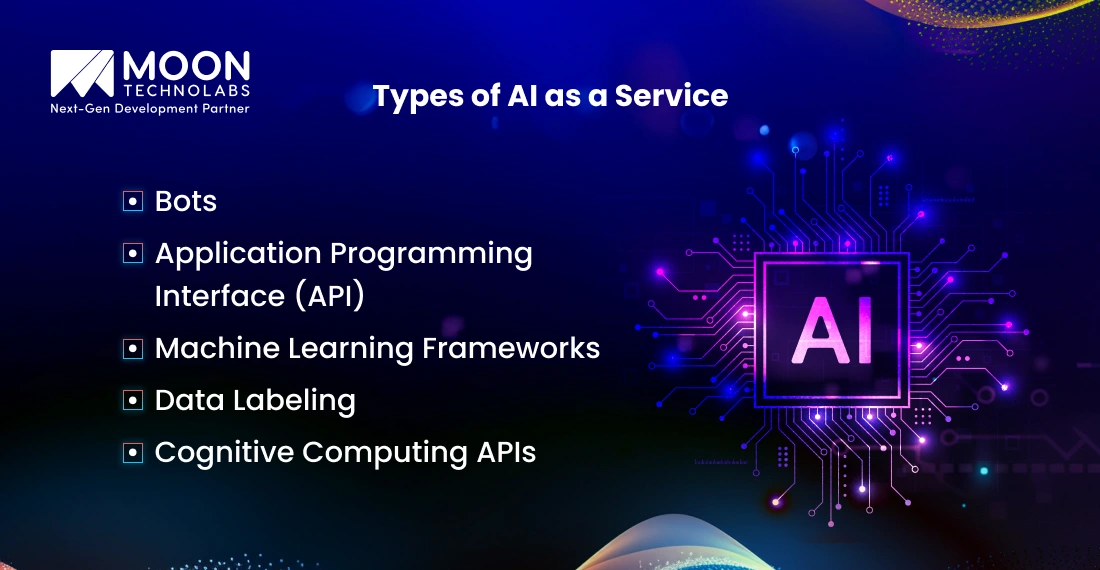
Many types of AIaaS solutions serve unique purposes. Let’s understand each type of this solution:
Whether it’s virtual assistants or chatbots, bots developed with AI are one of the top AIaaS offerings. They harness the potential benefits of ML and NLP to automate customer support, simulate human-like conversations, and offer personalized user experiences.
Businesses use bots to deliver 24/7 engagement. It minimizes both operational costs and response times. Top-rated AIaaS providers offer solutions that enable easy, fast deployment of bots across apps, websites, messaging platforms, and more.
This makes it ideal for many industries, such as banking, e-commerce, and healthcare.
With AI APIs, you get ready-to-use AI functionality that integrates smoothly with your existing software. And for this, you don’t need to create any specific algorithm from scratch. You can leverage APIs to do various important tasks such as sentiment analysis, image recognition, predictive modeling, speech-to-text conversion, and more.
For instance, you can use Google Cloud Vision API or the GPT model by OpenAI to integrate next-generation AI features into your applications hassle-free. It offers greater scalability, faster deployment, cost efficiency, and more, while maintaining flexibility across different use cases.
ML frameworks are another type of AIaaS that offers infrastructure, environments, tools, etc. These are required to properly train, implement, and manage ML models.
Whether it’s PyTorch, TensorFlow, or Amazon SageMaker, many popular frameworks enable developers to build custom models. And for this, one doesn’t need to manage their on-premises servers.
They support many important tasks such as model evaluation, data preprocessing, continuous training, and more with real-time feedback. It enables businesses to build predictive analytics and recommendation systems tailored to match their specific business objectives.
As far as data labeling services are concerned, they are indispensable for supervised learning models that require higher-accuracy datasets. With AIaaS providers, you can get human-assisted and automated labeling tools that classify images, text, video, and audio data with higher efficiency.
These services are pivotal for enhancing data quality and shortening AI project timelines. Whether it’s Labelbox or AWS Ground Truth, these platforms help organizations to manage large-scale data annotation with compliance and accuracy.
Cognitive computing APIs can understand and simulate human-like reasoning by combining AI technologies such as speech recognition, NLP, contextual analysis, and more. These APIs enable applications to interpret language nuances, emotions, intent, and more.
These improve user interaction and decision-making. For instance, Azure Cognitive Services and IBM Watson power up intelligent applications in customer service, healthcare diagnostics, business intelligence, and more.
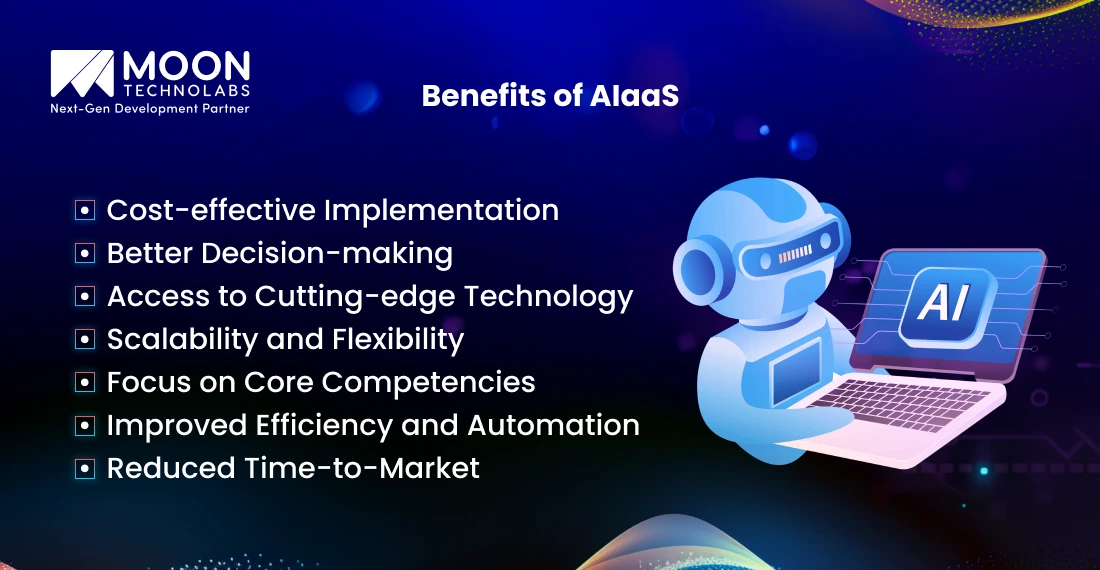
With AIaaS, businesses can avail numerous benefits, including streamlining operations, making better decisions, and staying competitive. The following are some of the top advantages of its adoption:
Affordability is one of the top benefits of AIaaS. Earlier, developing AI systems required significant investment, whether in software, hardware, or skilled personnel. By opting for AIaaS, organizations can eliminate these barriers by gaining access to ready-to-use AI models, APIs, and infrastructure.
All these can be obtained either on subscription or a pay-as-you-go basis. Businesses can test and implement their AI solutions without committing to upfront costs.
This approach is useful for both startups and medium-sized businesses – they can leverage enterprise-grade AI capabilities that were previously limited to large operations.
Cloud providers are responsible for managing maintenance, scalability, updates, and related tasks. These further help minimize overall operational costs.
As we already mentioned, AIaaS improves the entire decision-making process with predictive analytics and also ensures data-driven insights. With these solutions, you can easily process vast datasets to predict trends, identify patterns, and check anomalies in real time by using ML models and advanced algorithms.
It helps decision-makers act proactively and make the best decision. For instance, retailers can easily forecast inventory needs, healthcare providers can detect diseases early, and financial institutions can analyze credit risks.
Even if a business doesn’t have deep data science expertise, AIaaS gives them the ability to access powerful analytics tools to make better decisions faster and with higher accuracy.
Another great advantage of AIaaS is that it gives organizations complete access to AI innovations without the need for any research and development (R&D) investment.
Many leading cloud service providers, such as Microsoft Azure AI, OpenAI, Cloud AI, IBM Watson, and more, update their services with new features and models.
Soon after the update, businesses can use these technologies to automate workflows, improve customer experience, boost product offerings, etc. The emergence of AIaaS lets businesses remain at the forefront of technological progress.
When it comes to scalability, it’s one of the well-known features of AIaaS. Cloud AI services can scale resources dynamically to meet demand, whether you’re analyzing small datasets or processing large transactions.
Due to this flexibility, AIaaS is a great option for businesses of different sizes and also industries. You can start small by automating customer support, then gradually expand into complex predictive analytics or AI-based personalization.
Apart from this, AIaaS ensures a smooth integration with existing IT infrastructure, hybrid environments, multi-cloud environments, and more. This level of adaptability allows businesses to evolve their AI strategies as they grow.
When you outsource your AI infrastructure and maintenance to a reliable and well-known cloud provider, you will get more time to focus on your business objectives. You don’t need to struggle with managing any technical complexities.
Outsourcing lets you avoid spending your valuable time on data management, model training, system maintenance, and more. You can focus more on customer engagement, innovation, strategic growth, and more.
This operational efficiency is particularly beneficial for non-technical industries, including logistics, retail, finance, and more. AIaaS lets you gain greater AI benefits while focusing on your core business objectives.
By leveraging the true potential of AI-as-a-service solutions, you can automate repetitive tasks. It frees up your human resources to help you focus more on your strategic activities.
You can implement AI tools for various tasks such as fraud detection, document processing, customer service automation, workflow optimization, and more. Since ML models improve with data, they offer higher accuracy and faster results over time.
It’s clear that automation minimizes human errors and boosts productivity while maintaining consistency across operations. We can take the manufacturing sector as an example, where AIaaS is used to automate quality inspections.
The credit goes to AIaaS for minimizing the overall time required to build and implement AI-driven solutions. It gives you an excellent opportunity to incorporate AI capabilities into your apps within days, rather than waiting months.
It also makes rapid prototyping and testing easier, helping you validate your ideas quickly and bring innovations to market faster. This agility is highly important in competitive analysis, where you always need to stay ahead to grab a market advantage.
Apart from this, AIaaS has a plug-and-play nature, which also helps maximize digital transformation initiatives without the need for major overhauls to your existing systems.
We help you harness automation and scalable intelligence with customized AIaaS implementation. Foster innovation, efficiency, and growth with AI integration.
Get a Free Consultation
You need to take a strategic approach to implement AIaaS to help businesses achieve greater benefits while reducing risks. The following are some of the top strategies you can take into account to implement:
While implementing AIaaS, you first need to select the best AIaaS provider. You need to select vendors based on several factors, including service offerings, expertise, support infrastructure, scalability, and more. You need to be aware that many leading AIaaS providers offer a range of models and tools.
But each one comes with unique strengths that depend exclusively on your actual business requirements. The next important factor you need to consider is the availability of APIs, ease of integration, ongoing support, pricing models, and more.
Entering into a strategic partnership with a top AIaaS provider helps you leverage the benefits of next-generation AI capabilities. And minimizing overall implementation risks and maximizing time-to-value.
Data is pivotal for AI solutions, which necessitate accuracy in both assessment and management. You need to determine the types of data needed for your AI models, including structured and unstructured datasets, while ensuring the data quality, consistency, and completeness.
Whether it’s data preprocessing, cleaning, or labeling, these are important steps for maintaining integrity. When you implement powerful data governance practices, you reduce errors and boost model performance.
It’s essential to monitor data pipelines continuously to ensure their outputs remain accurate, reliable, and fully actionable. It’s indeed highly important for automation, predictive analytics, decision-making applications, and more.
Adhering to ethical and legal standards is essential for a successful AIaaS implementation. Organizations need to ensure compliance with data privacy regulations such as HIPAA, GDPR, CCPA, and others. You also need to adhere to legal compliance requirements for your industry.
You can avoid unintended consequences by incorporating ethical AI practices into your workflow. These practices include transparency, fairness, and bias mitigation. AIaaS providers offer built-in tools to support compliance and also responsible AI use. But businesses also need to establish internal policies.
A smooth integration of AIaaS with your existing IT infrastructure is highly significant for boosting the overall impact of AIaaS. Service providers need to plan for compatibility with databases, legacy systems, workflows, and more to avoid disruptions.
You can simplify integration while enabling gradual adoption by using standardized microservices, APIs, modular deployment strategies, and more. Using cloud-native tools with the right strategy helps you improve flexibility, scalability, and future-proofing, among other things.
To gain the maximum advantages of AIaaS, you need to select the right provider. We provide here a list of some of the most sought-after AI solution providers:
Google is one of the well-known companies offering world-class AI services. These include natural language processing, machine learning, translation APIs, computer vision, and more.
It provides you with an AutoML platform that assists organizations to create custom models with less coding, which makes it highly accessible be it for technical or non-technical teams. It provides scalable infrastructure while ensuring a highly efficient process for massive datasets.
The next leading market player is OpenAI, with robust language models that are integrated hassle-free via APIs. It offers a GPT series with a wide range of capabilities, including content generation, natural language understanding, conversational AI, and more.
It allows businesses to generate marketing content, automate customer support, improve internal productivity, and more.
By opting for IBM Watson, you will get AI solutions that can easily understand and interact with humans. As for its core services, these include speech recognition, NLP, decision support systems, visual recognition, and more.
Watson is indeed robust across healthcare, enterprise applications, customer service automation, and more. IBM Watson helps businesses implement AI responsibly.
As one of the AI as a service companies, Microsoft Azure AI provides a vast ecosystem of AI tools such as cognitive services, machine learning, Bot Services, and more. With its solutions, you can get speech recognition, predictive analytics, text analytics, image recognition, and more.
These help businesses automate their workflows while improving their decision-making. Another advantage of Azure AI is that it can be seamlessly integrated into Microsoft’s cloud ecosystem, including Power BI, Azure Data Lake, and more. These indeed facilitate vast-scale deployments and also real-time insights.
We assist you in a smooth AI integration tailored to match your actual business requirements. We help you improve workflows, boost innovation, etc.
Start AI Implementation Now
Apart from offering various advantages to businesses, implementing AI as a Service also poses certain challenges. Let’s discuss some of these challenges along with their respective solutions:
Since AIaaS platforms rely heavily on data quality to deliver results, inconsistent, inaccurate, or poor data quality leads to poor results. This can be either decision-making or predictions.
Solutions: You need to build robust data governance frameworks that include cleansing, data validation, standardization, and more. Make sure you audit datasets regularly to remove any inaccuracies.
The next challenge is that AI models tend to degrade over time as business requirements and data patterns evolve. AIaaS systems can deliver reliable results only when they are continuously updated.
Solutions: You need to continuously analyze and retrain pipelines. It’s also necessary to automate model updates with the use of MLOps practices, and also schedule periodic performance reviews.
When you process sensitive data through third-party AIaaS platforms, you may encounter privacy risks. Apart from this, unauthorized access, improper encryption, data leaks, and other issues often result in compliance violations.
Solutions: You are advised to implement security measures such as anonymization, end-to-end encryption, access controls, and more. Partner with only a reliable service provider who ensures the implementation of these security standards.
AIaaS models sometimes inadvertently reinforce societal biases when they’re not carefully designed and tested. On the other hand, biased outputs have several repercussions, such as alienating users and damaging brand reputation.
Solutions: It’s advisable to conduct fair testing and unbiased audits across the various stages of model development.
AIaaS is going to the next level as the importance of smart, faster, and highly adaptable solutions grows. Let’s explore this in more detail:
Agentic models have the potential to optimize operations, manage workflows, and support decision-making in changing environments.
With advancements, businesses can automate end-to-end processes, from supply chain to customer interactions. It boosts efficiency while minimizing the need for manual oversight.
Hyper-customization is another future trend for AIaaS solutions. It offers APIs and models tailored to match the specific business and industry requirements.
Rather than offering one-size-fits tools, service providers let you customize AI models for unique preferences, datasets, operational contexts, etc.
When you integrate AIaaS with edge computing, you can deploy AI models on local networks, sensors, and other devices, enhancing reliability and response time.
This is particularly important across industries such as manufacturing, autonomous vehicles, IoT-enabled healthcare, and more.
With the rapid adoption of AI, demand for transparent, explainable AI is also increasing. In the future, AIaaS will provide tools that can analyze, audit, and interpret model decisions.
Improved transparency is necessary to foster trust and reliability among stakeholders. It allows you to find out and reduce errors or biases in AI outputs.
From strategy formulation to integration and deployment, we provide end-to-end support to help you implement AIaaS solutions more efficiently.
With our immense expertise in this domain, we ensure a smooth adoption of AI solutions, such as predictive analytics, chatbots, and automation tools, tailored to meet industry requirements.
We have mastered the art of blending an in-depth understanding of business goals with technical proficiency to perform AI implementation while maintaining data security, integrity, and compliance. We endeavor to let organizations leverage advanced AI capabilities fast, improve smart decision-making, optimize operations, and more.
So, you now understand the true significance of AIaaS and its need for your organization, right? This solution is indeed quite necessary to help you innovate without hefty infrastructure investments.
Meanwhile, the actual success relies mainly on regulatory compliance, data handling, strategic vendor selection, and more. Partner with us to implement the AIaaS solutions smoothly and make your business prosper.
01
02
03
04
05

Jayanti Katariya is the CEO of Moon Technolabs, a fast-growing IT solutions provider, with 18+ years of experience in the industry. Passionate about developing creative apps from a young age, he pursued an engineering degree to further this interest. Under his leadership, Moon Technolabs has helped numerous brands establish their online presence and he has also launched an invoicing software that assists businesses to streamline their financial operations.


Submitting the form below will ensure a prompt response from us.
We refine our expertise to deliver innovative business solutions.




500 N Michigan Avenue, #600, Chicago IL 60611
13500 Long Is Dr, Pflugerville, TX 78660, USA

C-105, Ganesh Meridian, S.G. Highway, Ahmedabad, GJ 380060


Ayse D.
Co-Founder France
“ I highly recommend Moon Technolabs as the quality of service is wonderful. We have hired this company to develop the product based on some complex & technical issues. We get the best quality services as compared with others in the market. Huge Thanks to Moon Technolabs as the team is always ready to give the solution all time.”

Justin G.
Founder & CEO USA
USA“ Moon Technolabs is a pioneer in the WebRTC based project as they have fixed complicated segments of the module by fulfilling different product lines by providing 24X7 customer support. We really recommended Moon Technolabs as they are able to develop products as per the module deadline and project timeline.”

Flavio S.
Founder & Managing Director Germany
“I am happy to recommend Moon Technolabs for their app development services. They successfully developed apps for me, and I am highly satisfied with the overall outcomes. The development team has swiftly addressed the issues with responsive and effective communication to understand the requirement quickly and actively resolve the back-and-forth problems that arose...”

Jay M.
Founder & CEOUSA“Moon Technolabs is the best company that provides advanced apps and websites development services in the USA and Europe. I am a newbie to develop my app with an external team. I am really happy to work with them as I am not that much mobile apps user. Here, the team and specially the CEO of Moon Technolabs helps me to let me know about the benefits of my app to generate revenue....”


Our Offices
India
C-105, Ganesh Meridian, S.G. Highway, Ahmedabad, GJ 380060USA
500 N Michigan Avenue, #600, Chicago IL 60611Contact Information


