
marketingteam
Last Updated: February 27, 2026 Total Views: 90
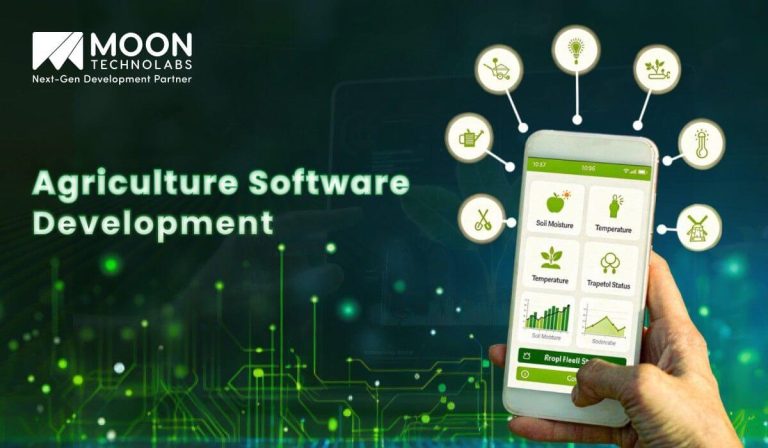
Table of Content


Blog Summary:
This blog guides you through the complete landscape of Agriculture Software Development and its role in modern farming. It explains how smart digital solutions help improve productivity, optimize resources, and support data-driven decisions. You’ll learn about key applications, benefits, development processes, costs, and industry trends. By the end, you’ll understand how agriculture software can transform and scale agribusiness operations effectively.
Table of Content
Are you one of those who believe they need superhuman insight, yet rely on notes and spreadsheets to fix their problems? You may not be alone.
Even today, most growers invest in generic apps and gadgets to fix issues such as labour gaps, resource wastage, or weather/soil impacts. Owing to manual errors and data silos, they may not offer real results or unified insights.
That’s where agriculture software development is a game-changer. These tailored solutions connect sensors, satellite data, weather forecasts, and operational workflows to deliver a single smart system.
Blending AI with IoT and Cloudtech, these platforms help you manage all facets of agriculture, like irrigation, equipment, and crop health, with confidence. As per recent innovations, precise predictions can outperform guesswork to boost yields and sustainability.
In this article, we will help you understand how agricultural software can transform modern farming capabilities.
Agricultural software development involves building digital solutions that help farmers and agricultural businesses manage their operations more efficiently. So, instead of walking through the fields and guessing when to irrigate, you have a farm management system. This will collect the soil moisture data using sensors and let you know when and how much water is needed.
The agriculture software solutions include farm management systems, livestock trading platforms, supply chain solutions, crop-monitoring applications, and AI-backed analytics dashboards. Unlike traditional generic tools, these systems are designed for farming workflows, field conditions, and seasonal cycles.
The goal of agricultural software development isn’t limited to automating the process; it should enable confident decision-making. This allows you to turn raw farm data into clear actionable insights, helping you reduce waste, improve yields, and control costs.
Agricultural software development is no longer an emerging market; it is rapidly evolving. As concerns about climate pressures, cost optimization, and labour shortages rise, farms across the globe are turning to digital solutions.
The global smart agriculture market is currently valued at $15 Bn in 2022 and is expected to surpass $40 Bn by 2032.
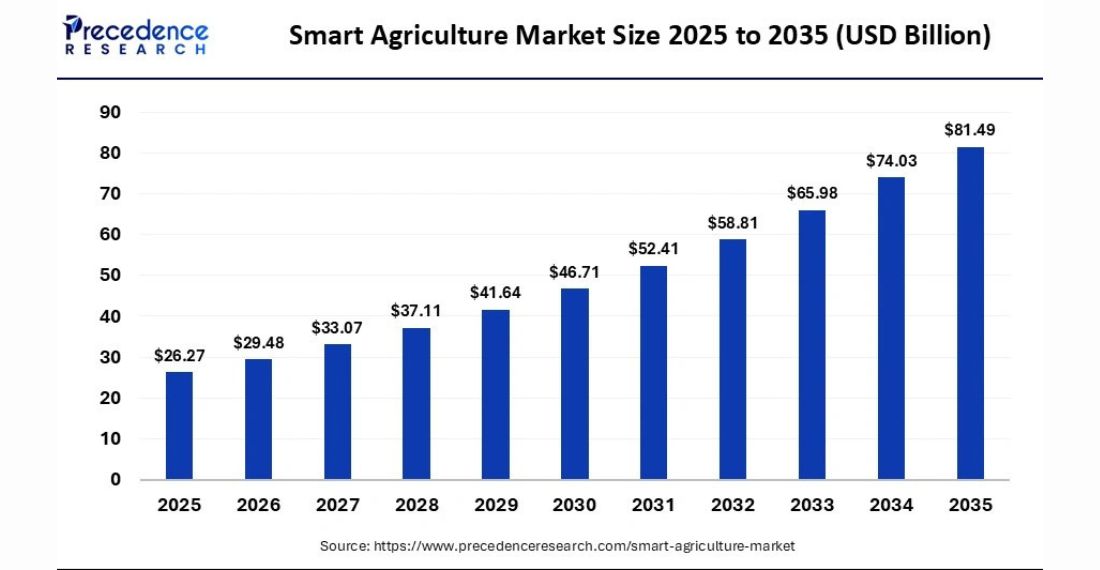
Together, they are sending a clear message that agriculture software is a growing opportunity, and embracing it now can steer you ahead of the competition.
Agriculture is gradually becoming a complex, data-driven, and competitive market. Your business should adopt a smarter system to stay profitable and resilient.
With agriculture software development, you can automate operations, like irrigation scheduling, crop monitoring, and inventory management. It will reduce dependency on manual processes and minimize expensive errors.
Real-time visibility into field conditions and resource utilization can optimize water, seeds, fertilizer, and labour use, resulting in higher yields and better operational efficiency across the farm cycle.
As your farms expand across multiple logistics, managing workforce coordination, inventory storage, compliance, and logistics can become complex. The custom software will centralize operational data into a single dashboard, allowing you to track performance, standardize processes, and ensure consistency. Whether you need supply chain coordination or multi-field planning, these systems can simplify management.
Modern agriculture generates massive amounts of data, such as soil health and weather patterns. With the software development tools, you can transform raw data into actionable insights using analytics and forecasting. Instead of relying on intuition, your business can make faster data-backed decisions while reducing risks.
In the wake of unpredictable data and environmental pressures, adaptability is important. Agriculture software can use predictive analytics with environmental monitoring to help farms conserve resources, reduce waste, and prepare for climate change, enabling long-term sustainability.
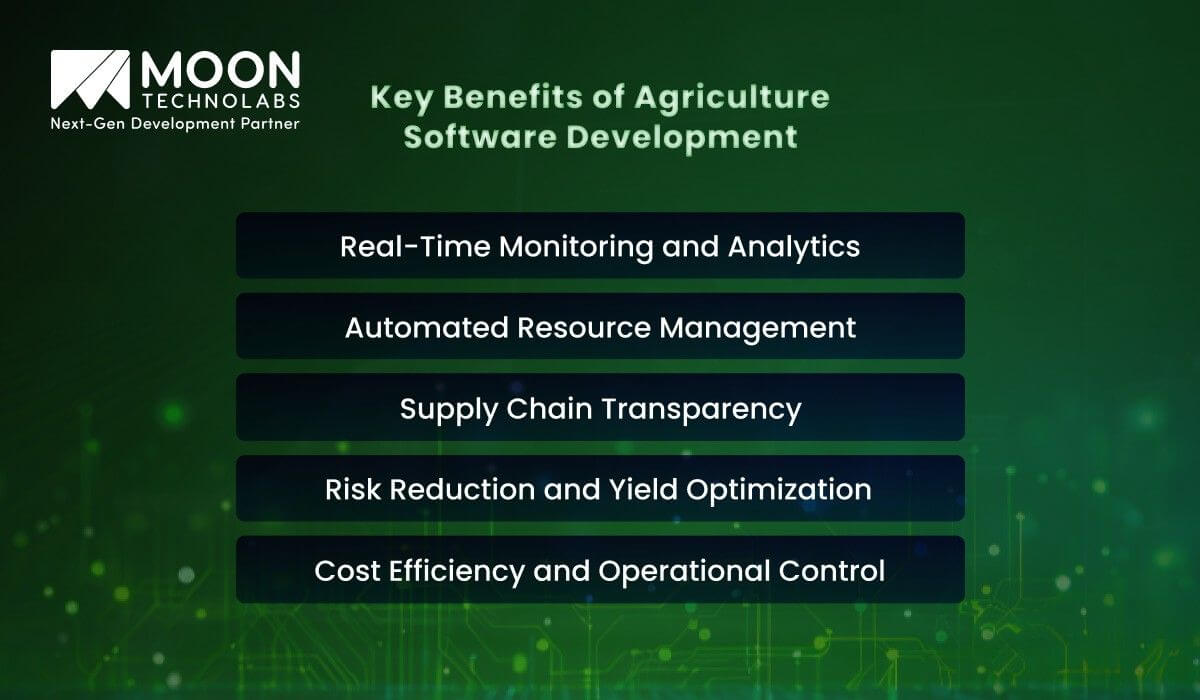
Investing in agriculture software isn’t just about upgrading technology; it is also about transforming your farm operations for ease and efficiency. Here is what you will gain by building or adopting the software.
What if you could know what is happening across your fields at any given moment? With real-time monitoring and analytics, you get instant insights into soil conditions, equipment status, crop health, and the impact of weather. This helps enhance performance with proactive solutions.
Using the software’s automated irrigation, inventory tracking, and fertilizer scheduling features, you can ensure resources are properly allocated and used. This eliminates waste, saves money, and removes guesswork from operations.
Software solutions give you complete traceability across the lifecycle, from harvest to distribution. Using it, you can track shipments and manage storage to build trust with buyers and partners.
Predictive analytics helps you determine disease risks, performance gaps, and even weather threats. With these forecasts, you can reduce uncertainty and improve crop outputs.
The centralized software dashboards give you complete insight into the financial and operational health, allowing you to control expenses, enhance margins, and scale confidently.
Transform your agricultural operations with smart, scalable software designed to maximize productivity and enable long-term growth.
Get Started
Agriculture software doesn’t help with a single function; it supports multiple facets of your agribusiness to offer smarter, connected, and faster operations. Here are the core areas where it delivers maximum impact.
This is your farm’s digital command centre. Using the software, you can plan crops for the particular climate or soil, track the field activities, manage labour, and monitor inputs from a single place.
This tool combines GPS, sensors, and data analytics to optimize irrigation, fertilization, and planting. By applying the right input at the right time and place, you can improve yields while reducing waste.
Using this software, you can monitor your livestock’s productivity and welfare. It will track the health, breeding cycle,s and even feed management, ensuring fewer losses and better outcomes.
You manage procurement, storage, distribution, and marketplace connections seamlessly with this platform. It can even improve traceability, transparency, pricing, and coordination among farmers, suppliers, and buyers.
Connected devices and sensors monitor temperature, equipment performance, and soil moisture in real time. The system will offer actionable insights with predictive analytics to help improve yields.
Streamline loan management with subsidy tracking and insurance claims to make farm finances accessible and structured.
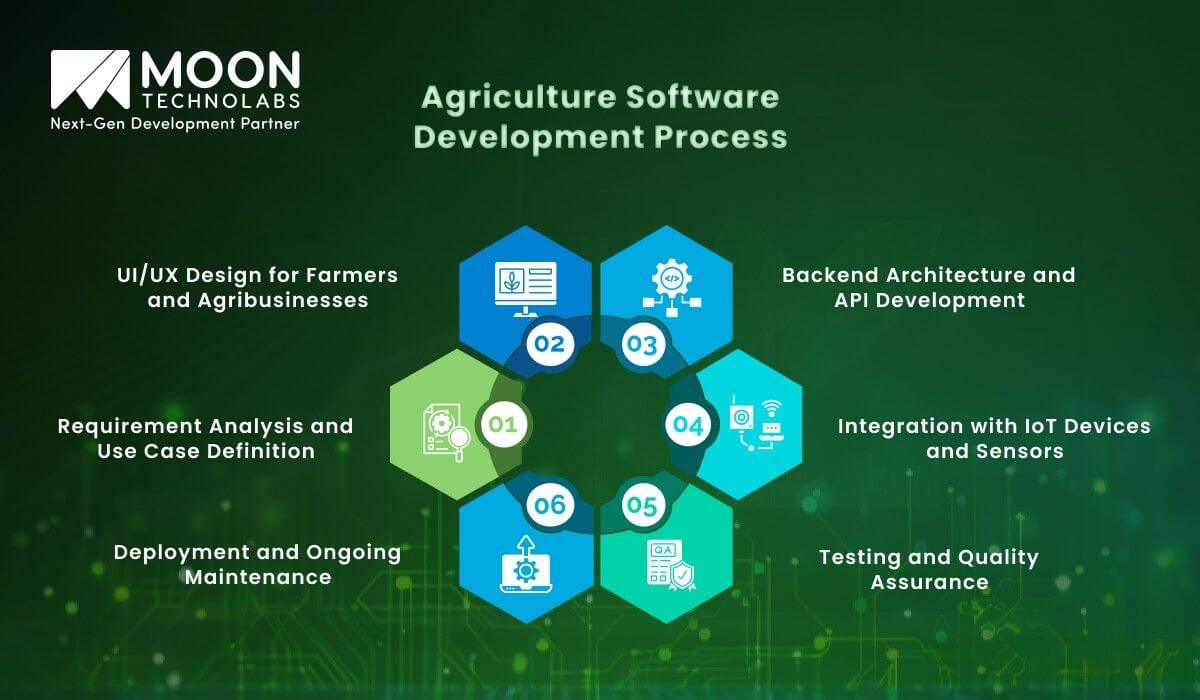
Building an agriculture software isn’t just about writing the code. It involves understanding the farm’s ecosystem and simplifying operational complexities with the right systems. We use a structured and collaborative process to create an impactful system.
We begin the process with an in-depth discovery session with your team. This helps understand workflows, seasonal dependencies, and compliance needs. Using these points, we can define use cases and success metrics to deliver a solution that aligns with real-world farming challenges and long-term vision.
You need practical, intuitive farm software. That’s why we design mobile-first and easy-to-navigate dashboards that connect seamlessly with fields, offices, and warehouses. Each feature we introduce is defined with clarity, minimizing training time and improving adoption.
We deliver secure and scalable backend systems, built to manage large datasets, multi-location operations, and real-time analytics. With an API-backed approach, we ensure smooth integration with third-party platforms and a future-proof solution.
By connecting soil sensors, weather stations, drone and equipment trackers to your agricultural software, we provide accurate data capture to automate decision-making.
Before proceeding with the launch, we rigorously test the app for usability, security, performance, and integrations. This helps us ensure that everything works against real-world farm conditions.
After deploying the solution, we continuously optimize, monitor performance, and incorporate updates. Consequently, your software evolves as your business grows.
By choosing the right tech stack, you can build a solution that handles real-time data, large data sets and even integrations without slowing the operations. Here’s the stack that works best for smart farming needs.
React, Angular, and Vue.js are commonly used to build fast, responsive, and usable interfaces. These technologies enable real-time updates and seamless access, which is essential for farmers and field workers operating in dynamic environments.
Using technologies like Node.js, Python, and Java, you can introduce scalability and strong performance, needed to handle analytics and automation. PostgreSQL and MongoDB help manage structured and unstructured data efficiently.
Platforms like AWS, Microsoft Azure, and Google Cloud can provide secure storage, automated backups, scalability, and high availability. These are important to you during peak farming sessions.
IoT frameworks with edge devices can process sensor data locally, reducing latency and offering real-time alerts. This is crucial for monitoring equipment and soil health.
TensorFlow and PyTorch are popular tools that implement predictive analytics, disease detection, and yield forecasting. They turn your regular farm data into a strategic advantage for your business.
While agriculture software solutions extend several benefits, you should understand the challenges involved and plan for them strategically.
Most farms are located in areas with unstable Internet access. Without proper planning, it can impact real-time data sync. You should build offline capabilities and edge processing systems to
Weak security can expose all your sensitive data, such as financial records, land details, and operational insights. You must implement strong encryption with a secure cloud infrastructure to protect your business.
Integrating sensors, drones, machinery, and GPS devices with your software can be technically complex. You should choose compatible devices and use standard APIs to improve integration.
Software that suits small farms may struggle at scale. Using a flexible and cloud-based architecture can ensure your platform evolves seamlessly as operations expand.
By understanding these challenges early, you can design smarter, more resilient agricultural software solutions.
Build secure, future-ready agriculture software solutions that scale with your evolving operations and market needs.
Connect With Us
As agriculture continues to digitize, some developments are moving from advanced to essential. These software development trends will shape the next phase of smart farming software solutions.
The cost of agriculture software development ranges from $10,000 to $150,000+.
The actual cost will depend on the scope, features, and integrations you plan to include in the solution.
A basic farm management system with essential tracking and reporting features can cost you between $10,000 and $30,000. A mid-tier application with data analytics, GPS tracking, and IoT can cost between $60,000 and $150,000. However, as you incorporate advanced features such as AI, the price will exceed $150,000.
The team location and their per-hour rates will also impact the cost of developing a software solution. The US and European markets have higher per-hour rates than Indian and South Asian markets.
Other factors that influence the pricing include feature complexity, the number of user roles, and real-time data processing needs expressed by your system. For example, a software built for a large agribusiness with predictive analytics and automation features needs a stronger backend. The cost would be higher in this case than for simple backend requirements.
The developer timelines will also depend on the type of software solution you are building. It will take about 3-4 months to develop a mid-level solution and 9+ months for an advanced platform.
You should also account for ongoing costs like software development security, system updates, maintenance, infrastructure scaling, and cloud hosting. Custom software solutions deliver long-term operational savings and efficiency gains despite a high upfront investment.
Agriculture is no longer about land, labour, or machinery alone; it is also about data, precision, and smart decision-making.
From improving productivity to enabling real-time monitoring and management of large-scale operations, agriculture software solutions transform how farms grow in an evolving landscape. With the emergence of technologies like AI, IoT, automation, and predictive analytics, investing in the right digital solution is a strategic business move.
But the right technology or idea isn’t enough; you need a good development partner who understands agricultural workflows and the scalability challenges they pose. That’s where Moon Technolabs can help.
With deep technical expertise and a solution-driven approach, we build reliable and future-ready solutions tailored to your business goals. If you want to modernize farming operations to unlock measurable growth, connect with our team now.
01
02
03
04
05

Jayanti Katariya is the CEO of Moon Technolabs, a fast-growing IT solutions provider, with 18+ years of experience in the industry. Passionate about developing creative apps from a young age, he pursued an engineering degree to further this interest. Under his leadership, Moon Technolabs has helped numerous brands establish their online presence and he has also launched an invoicing software that assists businesses to streamline their financial operations.


Submitting the form below will ensure a prompt response from us.
We refine our expertise to deliver innovative business solutions.





500 N Michigan Avenue, #600, Chicago IL 60611
13500 Long Is Dr, Pflugerville, TX 78660, USA

C-105, Ganesh Meridian, S.G. Highway, Ahmedabad, GJ 380060


Ayse D.
Co-Founder France
“ I highly recommend Moon Technolabs as the quality of service is wonderful. We have hired this company to develop the product based on some complex & technical issues. We get the best quality services as compared with others in the market. Huge Thanks to Moon Technolabs as the team is always ready to give the solution all time.”

Justin G.
Founder & CEO USA
USA“ Moon Technolabs is a pioneer in the WebRTC based project as they have fixed complicated segments of the module by fulfilling different product lines by providing 24X7 customer support. We really recommended Moon Technolabs as they are able to develop products as per the module deadline and project timeline.”

Flavio S.
Founder & Managing Director Germany
“I am happy to recommend Moon Technolabs for their app development services. They successfully developed apps for me, and I am highly satisfied with the overall outcomes. The development team has swiftly addressed the issues with responsive and effective communication to understand the requirement quickly and actively resolve the back-and-forth problems that arose...”

Jay M.
Founder & CEOUSA“Moon Technolabs is the best company that provides advanced apps and websites development services in the USA and Europe. I am a newbie to develop my app with an external team. I am really happy to work with them as I am not that much mobile apps user. Here, the team and specially the CEO of Moon Technolabs helps me to let me know about the benefits of my app to generate revenue....”


Our Offices
India
C-105, Ganesh Meridian, S.G. Highway, Ahmedabad, GJ 380060USA
500 N Michigan Avenue, #600, Chicago IL 60611Contact Information


