Total View: 106
Submitting the form below will ensure a prompt response from us.
Moon Technolabs helps businesses build high-quality, scalable software by embedding quality assurance into every stage of the development lifecycle. From requirement analysis to final deployment, our QA specialists work closely with developers to identify risks early, validate functionality, and ensure the software aligns with business goals. This proactive approach reduces defects, shortens release cycles, and improves overall product reliability.
We leverage a balanced mix of manual and automated testing to ensure comprehensive coverage across platforms, devices, and use cases. By integrating QA with Agile and DevOps practices, we enable continuous testing, faster feedback loops, and seamless CI/CD workflows. This ensures that applications remain stable, performant, and secure as they scale to meet growing user demand and complex functionality.
Lets go with the quick guide on why is a quality assurance tester needed on a software development team?
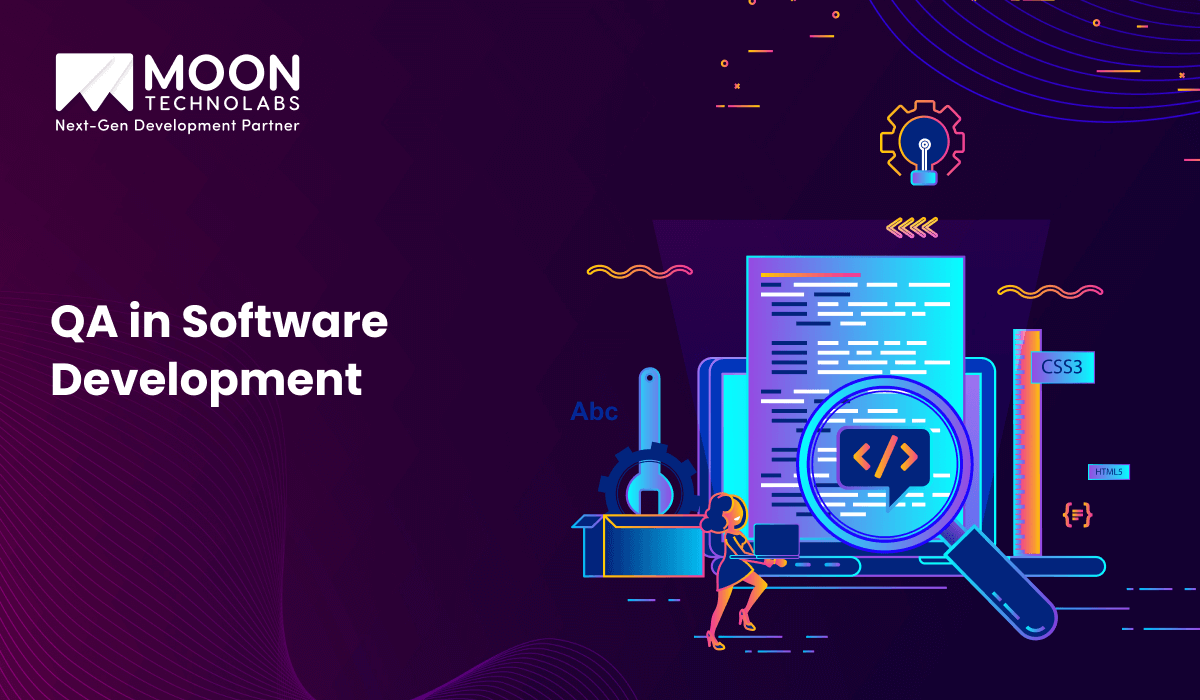
QA in software development is the process of ensuring that a product meets defined quality standards throughout the development lifecycle. It focuses on preventing defects, improving processes, and validating that the software behaves as expected under real-world conditions.
Unlike testing alone, QA is a proactive approach that starts from requirement analysis and continues through design, development, testing, deployment, and maintenance.
QA is essential because it:
Without QA, software teams often face costly rework, negative user feedback, and system failures.
Although often used interchangeably, QA and testing are not the same.
QA is process-oriented, while testing is product-oriented. Testing is a subset of QA.
QA starts at the very beginning of the Software Development Lifecycle (SDLC). It begins during requirement gathering and continues through:
Early QA involvement helps detect ambiguities, missing requirements, and design flaws before development begins.
Common QA activities include:
Each activity ensures a specific quality aspect of the software.
QA covers multiple types of testing, including:
In Agile, QA works closely with developers in short sprints, ensuring continuous testing and quick feedback.
In DevOps, QA is integrated into CI/CD pipelines, enabling:
This approach is often referred to as Shift-Left Testing, where quality is addressed early and continuously.
A good QA engineer needs:
Modern QA roles often combine testing, automation, and quality strategy.
QA ensures that:
By validating real-world scenarios, QA directly impacts user satisfaction and retention.
You Might Also Like:
No. QA is an ongoing process. Even after release, QA supports:
Continuous QA helps software evolve without compromising stability.
Moon Technolabs helps businesses build high-quality, scalable software testing by embedding quality assurance into every stage of the development lifecycle. From requirement analysis to final deployment, our QA specialists work closely with developers to identify risks early, validate functionality, and ensure the software aligns with business goals. This proactive approach reduces defects, shortens release cycles, and improves overall product reliability.
We leverage a balanced mix of manual and automated testing to ensure comprehensive coverage across platforms, devices, and use cases. By integrating QA with Agile and DevOps practices, we enable continuous testing, faster feedback loops, and seamless CI/CD workflows. This ensures that applications remain stable, performant, and secure as they scale to meet growing user demand and complex functionality.
Looking to improve reliability, performance, and user experience? Moon Technolabs provides end-to-end QA services to ensure scalable, defect-free software.
QA in software development is not just about finding bugs—it’s about building confidence in the product. By focusing on prevention, validation, and continuous improvement, QA ensures that software is reliable, secure, and ready for real users.
Organizations that invest in strong QA practices benefit from faster releases, lower costs, happier users, and long-term success. In today’s competitive digital landscape, QA is no longer optional—it’s a strategic necessity.

Jayanti Katariya is the CEO of Moon Technolabs, a fast-growing IT solutions provider, with 18+ years of experience in the industry. Passionate about developing creative apps from a young age, he pursued an engineering degree to further this interest. Under his leadership, Moon Technolabs has helped numerous brands establish their online presence and he has also launched an invoicing software that assists businesses to streamline their financial operations.


Submitting the form below will ensure a prompt response from us.
We refine our expertise to deliver innovative business solutions.





500 N Michigan Avenue, #600, Chicago IL 60611
13500 Long Is Dr, Pflugerville, TX 78660, USA

C-105, Ganesh Meridian, S.G. Highway, Ahmedabad, GJ 380060


 France
“ I highly recommend Moon Technolabs as the quality of service is wonderful. We have hired this company to develop the product based on some complex & technical issues. We get the best quality services as compared with others in the market. Huge Thanks to Moon Technolabs as the team is always ready to give the solution all time.”

 USA
USA“ Moon Technolabs is a pioneer in the WebRTC based project as they have fixed complicated segments of the module by fulfilling different product lines by providing 24X7 customer support. We really recommended Moon Technolabs as they are able to develop products as per the module deadline and project timeline.”

 Germany
“I am happy to recommend Moon Technolabs for their app development services. They successfully developed apps for me, and I am highly satisfied with the overall outcomes. The development team has swiftly addressed the issues with responsive and effective communication to understand the requirement quickly and actively resolve the back-and-forth problems that arose...”
 USA
USA“Moon Technolabs is the best company that provides advanced apps and websites development services in the USA and Europe. I am a newbie to develop my app with an external team. I am really happy to work with them as I am not that much mobile apps user. Here, the team and specially the CEO of Moon Technolabs helps me to let me know about the benefits of my app to generate revenue....”