Total View: 82
Submitting the form below will ensure a prompt response from us.
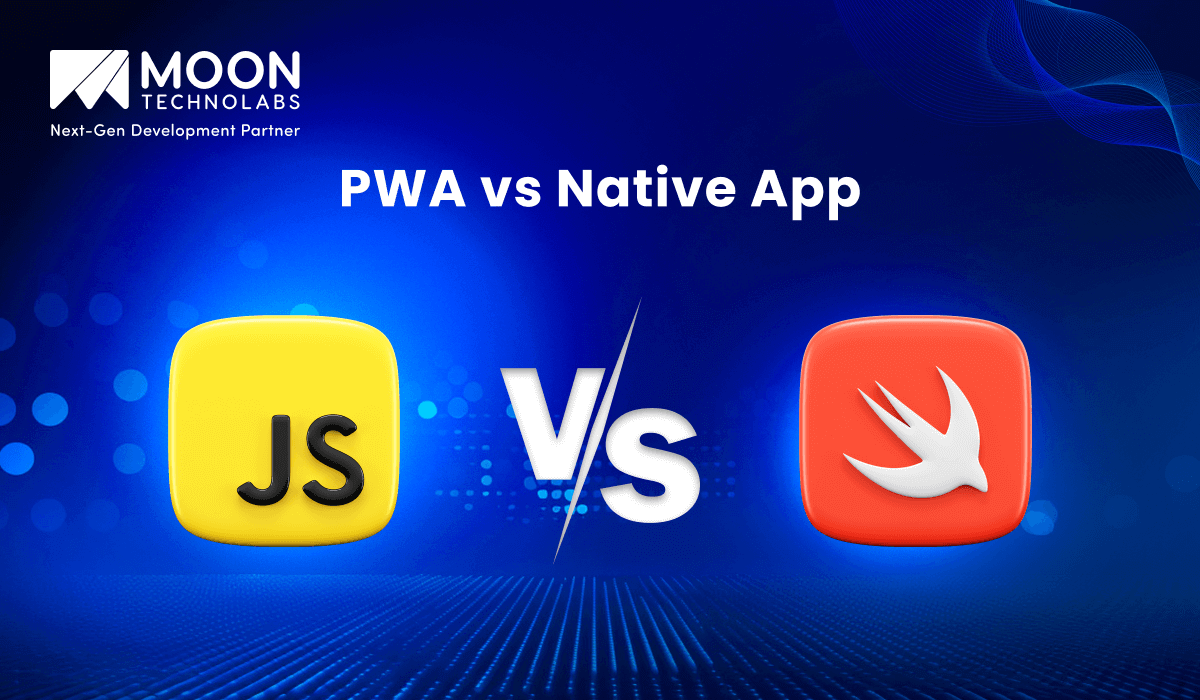
Choosing between a Progressive Web App (PWA) and a Native App is a critical decision for businesses planning a digital product. Both approaches aim to deliver seamless user experiences, but they differ significantly in their development processes, performance, costs, and long-term scalability. Understanding these differences helps you make an informed choice aligned with your business goals, target audience, and budget.
This article breaks down PWA vs Native App in a clear, practical way—covering definitions, key differences, pros and cons, use cases, and how Moon Technolabs helps businesses choose and build the right solution.
A Progressive Web App is a web application that uses modern web technologies to deliver an app-like experience directly through a browser. PWAs work on any device with a compatible browser and do not require installation from an app store.
Key characteristics of PWAs include:
PWAs bridge the gap between websites and mobile apps, making them a popular choice for businesses seeking speed and reach.
You Might Also Like:
A Native App is built specifically for a particular operating system, such as iOS (Swift/Objective-C) or Android (Kotlin/Java). These apps are installed directly from app stores like Google Play or Apple App Store.
Native apps:
They are often preferred for complex, high-performance applications.
PWAs offer several business-friendly benefits:
For startups and content-driven platforms, PWAs provide an efficient path to market.
Native apps excel in areas requiring deep device integration:
They are ideal for feature-rich, performance-critical applications.
Despite their flexibility, PWAs have some constraints:
These limitations may affect applications requiring advanced functionality.
Native apps also come with trade-offs:
This can be challenging for businesses with limited resources or tight deadlines.
The right choice depends on your business needs:
Choose a PWA if:
Choose a Native App if:
In many cases, businesses start with a PWA and later move to native apps as they scale.
Both approaches can be secure when implemented correctly:
Security depends more on implementation quality than on the platform itself.
You Might Also Like:
Moon Technolabs helps businesses evaluate their goals, user expectations, and technical requirements before choosing between a PWA and a Native App. Our experts analyze performance needs, scalability plans, budget constraints, and time-to-market expectations to recommend the most suitable approach.
Whether it’s building a high-performance native app or an SEO-friendly PWA, we deliver scalable, secure, and user-focused solutions tailored to your business strategy.
Not sure whether a PWA or Native App fits your goals? Moon Technolabs helps you evaluate, design, and build the right solution.
The PWA vs Native App debate doesn’t have a one-size-fits-all answer. PWAs offer flexibility, cost-efficiency, and broad reach, while native apps deliver unmatched performance and deep platform integration. The best choice depends on what your business values most—speed, reach, performance, or advanced functionality.
With expert guidance and the right development partner, you can confidently choose a solution that supports your growth today and scales for tomorrow.

Jayanti Katariya is the CEO of Moon Technolabs, a fast-growing IT solutions provider, with 18+ years of experience in the industry. Passionate about developing creative apps from a young age, he pursued an engineering degree to further this interest. Under his leadership, Moon Technolabs has helped numerous brands establish their online presence and he has also launched an invoicing software that assists businesses to streamline their financial operations.


Submitting the form below will ensure a prompt response from us.
We refine our expertise to deliver innovative business solutions.




500 N Michigan Avenue, #600, Chicago IL 60611
13500 Long Is Dr, Pflugerville, TX 78660, USA

C-105, Ganesh Meridian, S.G. Highway, Ahmedabad, GJ 380060


 France
“ I highly recommend Moon Technolabs as the quality of service is wonderful. We have hired this company to develop the product based on some complex & technical issues. We get the best quality services as compared with others in the market. Huge Thanks to Moon Technolabs as the team is always ready to give the solution all time.”

 USA
USA“ Moon Technolabs is a pioneer in the WebRTC based project as they have fixed complicated segments of the module by fulfilling different product lines by providing 24X7 customer support. We really recommended Moon Technolabs as they are able to develop products as per the module deadline and project timeline.”

 Germany
“I am happy to recommend Moon Technolabs for their app development services. They successfully developed apps for me, and I am highly satisfied with the overall outcomes. The development team has swiftly addressed the issues with responsive and effective communication to understand the requirement quickly and actively resolve the back-and-forth problems that arose...”
 USA
USA“Moon Technolabs is the best company that provides advanced apps and websites development services in the USA and Europe. I am a newbie to develop my app with an external team. I am really happy to work with them as I am not that much mobile apps user. Here, the team and specially the CEO of Moon Technolabs helps me to let me know about the benefits of my app to generate revenue....”